
SEO Title: Which Crops Grow in the Tierra Fría? A Complete Guide by Elevation and Region Meta Description: Discover which crops thrive in the tierra fría zone, from Andean potatoes and quinoa to barley and fava beans, with elevation ranges, growing tips, and historical context.
Which Crops Grow in the Tierra Fría: Guide by Elevation

Samuel Rourke
16 Jul 2026
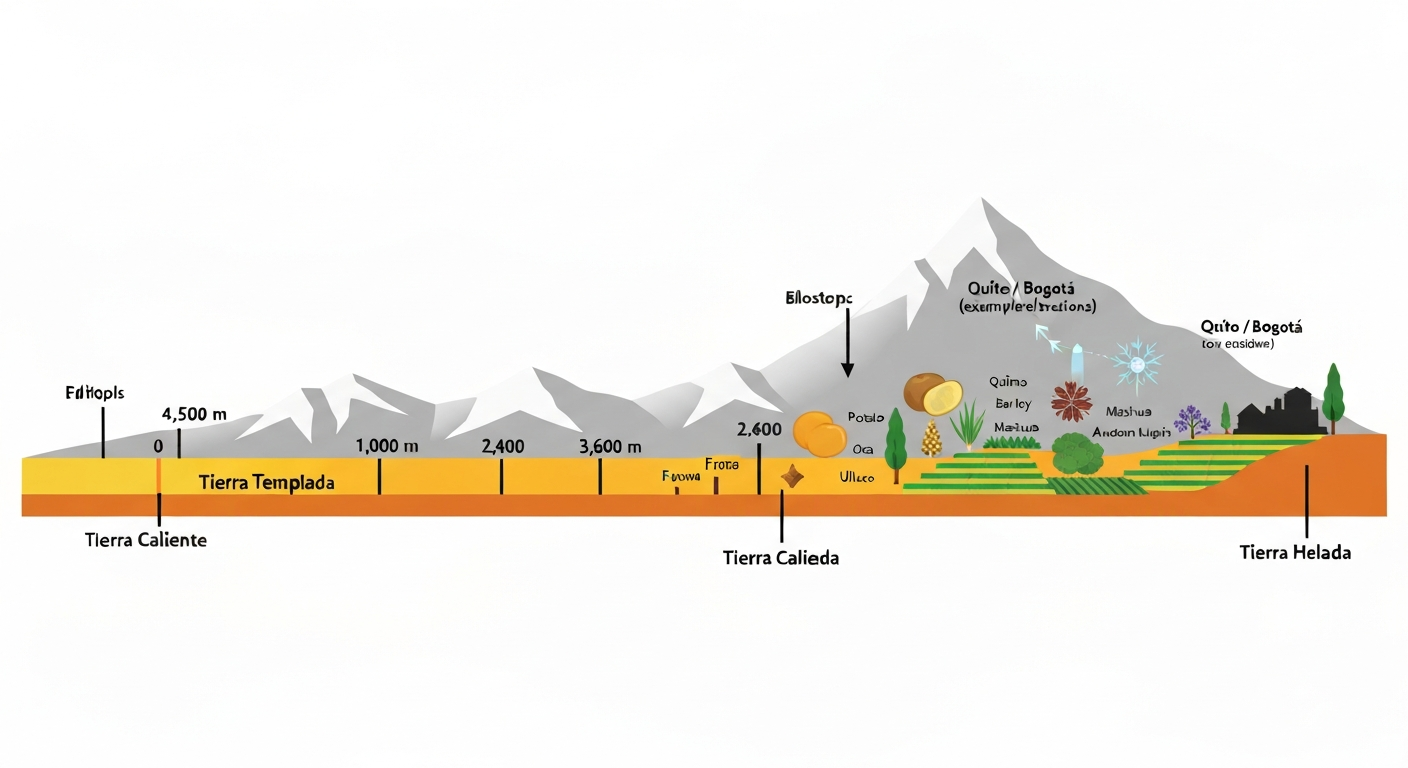
The tierra fría grows potatoes, quinoa, barley, fava beans, oca, mashua, ulluco, Andean lupin, oats, peas, and a wide range of cool-tolerant vegetables. These crops succeed because the zone sits roughly between 1,800 and 3,600 meters above sea level across tropical Latin America, keeping temperatures cool enough to exclude many lowland crops but warm enough, most of the time, to support a productive, diverse agricultural system.
What Exactly Is the Tierra Fría?
Tierra fría simply means 'cold land' in Spanish, and it refers to the highland thermal belt that stretches across the mountainous interior of tropical Latin America. The classic definition places it between roughly 1,800 and 3,600 meters above sea level (about 6,000 to 12,000 feet), though exact cutoffs shift depending on the country and the author you read. See Living in a vertical world | Mountains: A Very Short Introduction (Oxford Academic) for discussion of altitude zonation and thermal belts See Living in a vertical world | Mountains: A Very Short Introduction (Oxford Academic) for discussion of altitude zonation and thermal belts.. Colombian ecological sources commonly map the tierra fría montane zone to around 2,200 to 3,000 meters, while Peruvian geographic traditions, following the framework developed by Javier Pulgar Vidal, associate the equivalent 'Quechua' cultivable band with about 2,300 to 3,500 meters. Mexican highland classifications use slightly different language, referring to a 'piso frío' or 'semifrío' zone at roughly 2,400 to 3,300 meters, and the cutoffs vary by state and author.
Temperatures across the tierra fría average around 10 to 16 degrees Celsius annually in most inhabited and farmed parts of the zone. Cities like Bogotá at about 2,630 meters and Quito at about 2,850 meters are textbook examples: both sit in the tierra fría, both average around 13 to 15 degrees Celsius year-round, and both have virtually no seasonal temperature swing, which is characteristic of equatorial highlands. Frost risk is real and location-dependent. In the Andean altiplano and at the upper margins of the zone, frost can occur on 140 to 220 days per year in some sub-regions. At lower tierra fría elevations and in sheltered inter-Andean valleys, frost is far less frequent. That difference matters enormously for crop selection.
Growing seasons in the tierra fría are not defined by hot and cold as they are in temperate North America or Europe. Instead, they follow wet and dry cycles. Most areas have one or two rainy seasons per year, and planting is timed to those windows. The combination of cool temperatures, high UV radiation at altitude, and seasonal rainfall produces a growing environment unlike anything in the California lowlands or the midwestern plains, which is worth keeping in mind when comparing this zone to other agricultural regions.
Climate Bands and Microclimates Within the Tierra Fría
The tierra fría is not one uniform climate. Within those 1,800 or so vertical meters, conditions change dramatically. Slope aspect, whether a hillside faces toward or away from the equator, can shift effective temperatures by several degrees, push frost frequencies up or down, and determine how long the growing season lasts. East-facing slopes in the Andes often receive morning sun and dry afternoon winds, which affects soil moisture and evapotranspiration differently than west-facing slopes that catch afternoon sun and evening clouds.
Valley floors tend to be frost traps, since cold air drains downhill at night and pools in low areas. Farmers who have worked these landscapes for generations understand this intuitively, and traditional terrace systems (andenes in the Andes) were often sited deliberately on mid-slope positions that avoid both frost-prone valley floors and the harshest wind exposure at ridge tops. The La Paz and El Alto area in Bolivia illustrates how quickly conditions change with elevation: El Alto at around 4,100 meters averages about 8 degrees Celsius annually, while lower La Paz neighborhoods at around 3,600 meters are noticeably warmer at 12 to 13 degrees, a difference of just a few hundred meters that completely changes what you can grow reliably.
Rainfall distribution also varies across the zone. The outer (windward) slopes of mountain ranges typically receive more precipitation than interior valleys, which creates a patchwork of humid and semi-arid microclimates. This is why inter-Andean valley systems in Peru, Ecuador, and Colombia support irrigated cropping of wheat, potatoes, and vegetables even during dry seasons, while open altiplano areas rely almost entirely on seasonal rains and are far more vulnerable to drought and frost in the same period.
How Elevation and Microclimate Drive Crop Choices
When you are deciding what to plant in the tierra fría, elevation is the first variable to nail down, not just because it controls temperature, but because it controls frost probability, season length, soil organic matter accumulation, and UV intensity. In practical terms, most farmers and gardeners working in this zone think in two rough sub-bands: the lower tierra fría (roughly 1,800 to 2,800 meters) where the widest range of cool-season crops is viable, and the upper tierra fría and transition to tierra helada (2,800 to 3,600+ meters) where the crop roster narrows to the most cold-tolerant species.
Soil type matters too. Many highland Andean soils are volcanic in origin, Andosols, with high organic matter, good water retention, and slightly acidic pH. These suit potatoes, quinoa, and fava beans well. Where soils are heavier and less well-drained, root crops like oca and ulluco still perform reasonably, but drainage management becomes critical. Irrigation in the upper tierra fría is often needed during dry seasons, and pre-Columbian canal and terrace systems were engineered precisely to extend the productive season and buffer against drought and frost at the same time.
A useful mental model: the lower you sit in the tierra fría, the more your crop list resembles a cool temperate garden. The higher you go, the more your list converges on the handful of species that originated in or adapted to Andean high-altitude conditions over millennia, primarily the Andean tubers, quinoa, barley, and fava beans.
Staple Tubers: The Backbone of Tierra Fría Agriculture
Potatoes are the defining crop of the tierra fría and arguably of the entire Andes. The International Potato Center (CIP) in Lima manages one of the world's largest potato genebanks precisely because the Andean highlands are the center of potato diversity. Different Solanum species and thousands of landraces span an altitudinal range from about 1,000 to over 4,000 meters depending on the ecotype, with the core tierra fría band being productive potato-growing territory. In practical cultivation, potatoes in this zone need well-drained, friable soils, adequate phosphorus, protection from late frost at flowering, and enough water during tuber bulking. Traditional Andean farmers rotate potatoes with fallow periods and with legumes to manage soil fertility and pest pressure, a system that has worked for thousands of years.
Oca (Oxalis tuberosa) is the second most important Andean tuber after the potato and is commonly cultivated between about 2,800 and 4,000 meters. It tolerates frost better than potato, has a pleasant slightly tangy flavor when sun-dried (a process called 'oca-drying' that reduces oxalic acid content), and is maintained in CIP and national genebanks across Peru, Bolivia, and Ecuador. If you are farming or gardening above 3,000 meters where potatoes are marginal, oca is a reliable alternative.
Mashua (Tropaeolum tuberosum) and ulluco (Ullucus tuberosus) round out the traditional Andean tuber complex. Both are adapted above roughly 2,500 meters, both are maintained in national research institute collections in Peru and Bolivia, and both have cultural and nutritional importance that goes well beyond their current commercial footprint. Mashua in particular is exceptionally frost-hardy and is sometimes grown at the upper margins of the tierra fría where almost nothing else will produce a harvestable yield. Ulluco produces small, colorful tubers with a waxy texture and is valued both as food and in traditional medicine. These four, potato, oca, mashua, ulluco, form an interlocking system that gave Andean highland communities food security across a wide range of elevation and climate variability.
Grains and Pseudocereals in the Tierra Fría
Quinoa (Chenopodium quinoa) is the pseudocereal most associated with Andean highlands, and its altitudinal range is impressively wide. FAO documentation and Andean agronomic research both note that valley ecotypes are common between about 2,000 and 3,500 meters, while altiplano ecotypes push up to around 4,000 meters. The tierra fría sits comfortably within quinoa's productive range for most ecotypes. Quinoa tolerates frost (especially at seed and rosette stages), saline soils, and periodic drought better than most cereals, which is part of why it became a staple in regions where those stresses occur regularly. For growers in the tierra fría today, variety selection matters: valley ecotypes perform better at lower elevations and have shorter growing cycles; altiplano ecotypes are slower-maturing but hardier at the upper end of the zone.
Barley may be the single most globally useful cereal for cold highlands. Ethnobotanical and agronomic studies across multiple highland systems, Andean, Ethiopian, Tibetan, consistently show barley outperforming other cereals above 3,000 meters because of its relatively short growing season and cold tolerance. In the Andes, barley was introduced by the Spanish but was adopted rapidly by highland communities because it fit the tierra fría environment well. It is commonly grown today across inter-Andean valleys and upper basin areas in Peru, Bolivia, Ecuador, and Colombia, both for human consumption (toasted barley flour, known as 'máchica' or 'cañihua' preparations, though cañihua is a separate species) and for animal feed.
Wheat can be grown in the tierra fría, but it is more sensitive to frost than barley and has a longer growing season requirement. Favorable inter-Andean valley microclimates at 2,500 to 3,500 meters can support wheat with adapted cultivars, but the upper altitudinal ceiling for reliable wheat production is around 3,000 to 3,900 meters in the best-case conditions. Above that, barley or quinoa is the safer bet. Oats are similarly useful as a cool-season cereal and forage crop in the lower and mid tierra fría, widely grown in Colombian and Ecuadorian highland farms for both grain and green fodder.
Legumes That Perform Well in Cool Highland Conditions
Fava beans (Vicia faba, also called broad beans) are arguably the most important legume in the tierra fría and have been since colonial times. They tolerate frost reasonably well, fix atmospheric nitrogen (improving soils for subsequent potato crops), and produce reliably across the 2,000 to 3,500 meter range in Andean highland systems. In the Andes, fava beans were introduced by the Spanish and integrated quickly into highland rotations, a pattern worth noting when comparing this zone to mission-era California, where the crop list and climate were quite different.
Andean lupin, known locally as 'tarwi' in Peru and 'chocho' in Ecuador (Lupinus mutabilis), is a native high-altitude legume with documented cultivation across roughly 2,000 to 3,850 meters depending on ecotype. It is high in protein and fat, serves as a soil-improving crop in rotation, and is used in both human food and animal feed. Raw tarwi contains bitter alkaloids that need to be removed by soaking in water before consumption, a processing step that highland communities have practiced for centuries. Modern interest in plant-based protein has renewed research attention on this crop.
Peas (Pisum sativum) grow well across the lower and mid tierra fría, typically below 3,000 meters, where they are a common smallholder and market garden crop. Highland common bean landraces, including 'nuña' (popping) beans, extend production up to about 3,000 meters. Peruvian nuña/popping beans and Andean bean diversity (IntechOpen chapter) documents Phaseolus vulgaris highland landraces traditionally cultivated between ≈1,500–3,000 m. These are Phaseolus vulgaris types that have been selected over generations for adaptation to cool temperatures and short seasons, and they represent a genetically distinct pool from lowland common beans grown at warmer elevations.
Vegetables, Fruits, and Other Crops at Tierra Fría Elevations
The tierra fría supports a broader vegetable list than many people expect, especially in the lower portions of the zone. Brassicas, cabbage, broccoli, cauliflower, kale, do well in the cool, moist conditions of inter-Andean valleys and are major commercial crops around highland cities like Bogotá, Quito, and Cusco. Carrots, beets, turnips, and radishes are reliable root vegetables across the zone. Lettuce, cilantro, and other leafy greens grow year-round at lower tierra fría elevations where frost is rare. Corn (maize) is generally at its altitudinal upper limit at the boundary between tierra templada and tierra fría, roughly 2,400 to 2,800 meters depending on the latitude and local conditions, and production drops off sharply above that.
Tree fruits adapted to cool temperatures include apple, pear, plum, and cherry, which were introduced by Spanish colonizers and found the tierra fría climate surprisingly suitable. These are grown commercially and in home gardens across highland Colombia, Ecuador, and Peru. Blackberries (Rubus species, including the native Andean mora) are well-adapted to the upper tier of the zone and are an important commercial fruit crop in highland Colombia and Ecuador today. The native tree tomato (tamarillo, Cyphomandra betacea) is also a tierra fría specialist, thriving at elevations where tomatoes and peppers cannot.
Traditional and Historical Context: Pre-Columbian to Colonial
Understanding tierra fría agriculture is impossible without the historical layer. Pre-Columbian Andean civilizations, including the Inca and their predecessors, managed the highland zone with extraordinary sophistication. Terrace systems (andenes) built across steep Andean slopes functioned as thermal regulators, retaining heat in the soil, improving drainage, and creating frost-buffered growing environments. Raised field systems (waru-waru) in the altiplano used water channels to moderate night temperatures through the thermal mass of standing water. Crop storage in freeze-dried form (chuño for potatoes, tunta for white freeze-dried potato) allowed surplus production to be preserved for years, providing insurance against crop failure.
After Spanish colonization, the tierra fría crop roster changed significantly. Barley, wheat, fava beans, peas, turnips, and fruit trees were introduced and integrated into highland farming systems. Some of these, particularly barley and fava beans, filled ecological niches so well that they became permanent fixtures of highland agriculture and remain staples today. Others, like wheat, competed with quinoa and in many areas displaced it temporarily, though quinoa has since rebounded as both a subsistence and export crop.
The contrast with California mission agriculture is instructive. Spanish missions in California, including Mission San Fernando Rey de España, Mission San Francisco Solano, Mission San José, and Mission Santa Bárbara, operated in Mediterranean lowland or foothill climates, mostly below 500 meters elevation, with warm dry summers and mild wet winters. For more on the specific crops grown at Mission San Francisco Solano, see the page on what crops did Mission San Francisco Solano grow. Their crop lists centered on wheat, barley, maize, beans, and Mediterranean fruits and vegetables adapted to that climate. For a specific example of mission-era crop lists and practices, see what crops did Mission Santa Barbara grow. Mission San Fernando Rey de España grew wheat, barley, maize, beans, and Mediterranean fruits and vegetables such as grapes and olives, reflecting the missions' focus on staples and orchard crops suited to California's Mediterranean climate. The tierra fría zone is climatically and agronomically a completely different world: cooler year-round, higher in elevation, frost-prone, and dominated by crops like potatoes, quinoa, and Andean tubers that would have been marginal or impossible at the mission sites. The missions and the tierra fría both operated under Spanish colonial agricultural frameworks, but the crops they grew reflect just how powerfully local climate shapes what can actually be farmed.
Crops at a Glance: Elevation Ranges and Key Notes
| Crop | Typical Elevation Range (m) | Cold/Frost Tolerance | Key Notes |
|---|---|---|---|
| Potato (Solanum tuberosum & Andean spp.) | 1,000–4,000+ | Moderate (frost damages foliage) | Core tierra fría staple; thousands of Andean landraces; needs well-drained soil |
| Oca (Oxalis tuberosa) | 2,800–4,000 | Good | Second most important Andean tuber; sun-drying reduces bitterness |
| Mashua (Tropaeolum tuberosum) | 2,500–4,000+ | Very good | Frost-hardy; useful at upper tierra fría margins |
| Ulluco (Ullucus tuberosus) | 2,500–3,800 | Good | Waxy, colorful tubers; requires good drainage |
| Quinoa (Chenopodium quinoa) | 2,000–4,000 | Good (ecotype-dependent) | Valley ecotypes for mid-zone; altiplano ecotypes for upper zone |
| Barley (Hordeum vulgare) | 1,800–3,800+ | Very good | Most reliable cereal above 3,000 m; used for food and forage |
| Wheat (Triticum aestivum) | 1,800–3,900 | Moderate | Upper limit frost-dependent; barley preferred above ~3,200 m |
| Oats (Avena sativa) | 1,800–3,500 | Good | Dual-use grain and forage crop; widely grown in Colombian/Ecuadorian highlands |
| Fava bean (Vicia faba) | 2,000–3,500 | Good | Key nitrogen-fixer; important in potato rotations |
| Andean lupin / Tarwi (Lupinus mutabilis) | 2,000–3,850 | Good | High protein; alkaloids require water-soaking before consumption |
| Common bean highland types / Nuña (Phaseolus vulgaris) | 1,500–3,000 | Moderate | Adapted landraces; nuña types pop when cooked |
| Peas (Pisum sativum) | 1,800–3,000 | Good | Common smallholder and market garden crop |
| Brassicas (cabbage, broccoli, etc.) | 2,000–3,200 | Good | Major commercial crops near highland cities |
| Carrots, beets, turnips | 1,800–3,200 | Good | Reliable root vegetables across the zone |
| Andean blackberry / Mora (Rubus spp.) | 2,200–3,200 | Good | Important commercial fruit in highland Colombia and Ecuador |
| Tree tomato / Tamarillo (Cyphomandra betacea) | 1,800–3,000 | Moderate | Native tierra fría fruit; outperforms common tomato at altitude |
Practical Decision Steps for Farmers and Gardeners
If you are planning what to grow in a tierra fría location, a simple sequence of questions will get you to a workable crop list faster than any general recommendation.
- Establish your exact elevation and frost frequency. A difference of 200 to 300 meters can move you from a viable wheat zone to a barley-and-tuber-only zone. If you don't have a formal frost record, ask neighboring farmers how often they have seen frost damage in the past five years, and at what months.
- Identify your rainy season windows. Planting is timed to rainfall in most tierra fría locations. Know whether you have one or two rainy seasons and how long each lasts, because that determines how many crops per year are feasible and whether long-season crops like some potato varieties are viable.
- Assess your slope and aspect. South-facing slopes in the southern hemisphere (and north-facing in the northern hemisphere) are warmer and frost-drained mid-slopes are safer than valley floors. If you have a frost-prone site, favor frost-tolerant crops like mashua, oca, barley, fava beans, and quinoa.
- Match crop to market and use. In the lower tierra fría near highland cities, high-value vegetables (brassicas, carrots, peas) and fruits (mora, tamarillo) can be profitable because urban markets are close. In more remote upper-zone areas, staple production (potato, barley, quinoa, fava beans) is more practical and provides food security.
- Choose adapted varieties, not general commercial seed. Andean highland crops have enormous landrace diversity precisely because different altitudes and microclimates require different genotypes. CIP, INIA, and national agricultural extension services in Peru, Bolivia, Ecuador, and Colombia maintain and distribute altitude-specific varieties. Using locally adapted seed is one of the highest-return decisions you can make.
- Plan rotations to protect soil fertility and break pest cycles. The classic Andean rotation — potato, then fava bean or lupin, then fallow or cereals — is effective because it combines a heavy nitrogen user (potato) with a nitrogen fixer (legume) and a period of soil restoration. Adapting this to your specific crops and conditions is more productive than monoculture.
Cash Crops and Commercial Potential in the Tierra Fría Today
Beyond subsistence staples, the tierra fría supports several commercially significant crops in the modern era. Quinoa has become a high-value export crop from Peru and Bolivia, with significant production in inter-Andean valleys and altiplano areas in the tierra fría and above. Certified organic and heritage-variety potatoes command premium prices in urban Andean markets and increasingly in export markets. Andean blackberry (mora) is a major commercial fruit in highland Colombia, where it is processed into juices, jams, and pulps for both domestic and international sale. Cut flowers, particularly roses and carnations, are a massive industry in the Colombian and Ecuadorian tierra fría, where the combination of cool temperatures, high light intensity, and proximity to Bogotá and Quito airports supports year-round export production. Broccoli and other brassicas are grown at scale in highland Ecuador specifically for the frozen vegetable export market.
Forage crops, particularly improved pasture grasses and oats, support the dairy industry that has become economically important across highland Colombia, Ecuador, and Peru. The tierra fría is too cold for tropical grasses but well-suited to temperate ryegrasses and clovers, which underpin highland milk production. This dairy economy is itself a colonial-era introduction, cattle were not native to the Americas, but it has become deeply embedded in the economic and culinary culture of Andean highland communities.
A Note on Tierra Fría vs. Mission-Era California Agriculture
Readers exploring regional and historical crop patterns sometimes encounter tierra fría alongside California mission agriculture, and the contrast is worth making explicit. California's Spanish missions operated in a Mediterranean climate zone well below the tierra fría's elevation threshold. Their agricultural output centered on wheat, barley, maize, grapes, olives, and garden vegetables suited to warm, dry summers and mild winters, a completely different ecological context from the cool, high-altitude Andean zone. The missions introduced European crop systems to a California environment that was already warm and relatively productive. The tierra fría, by contrast, was already host to one of the world's most sophisticated highland agricultural traditions before European contact, built around crops, potato, quinoa, oca, mashua, ulluco, tarwi, that the Spanish colonizers had never encountered before. Both represent important chapters in the history of agriculture in the Americas, but they belong to different worlds climatically, ecologically, and historically.
FAQ
SEO title and meta description for the article
SEO title: Which crops grow in the tierra fría (altitude, crops & cultivation tips) Meta description: Crops for tierra fría (≈1,800–3,600 m): tubers, grains, legumes, fruits and practical cultivation, market and historical notes (≤160 chars).
What is 'tierra fría'? Definition, altitude, temperature, frost risk and growing season
Heading: What is tierra fría? Definition: 'Tierra fría' (literally “cold land”) is the highland thermal belt in tropical Latin America where cooler, temperate conditions dominate agriculture. Typical altitude range used in literature is roughly 1,800–3,600 m above sea level (local cutoffs vary: e.g., Pulgar Vidal and Peruvian sources often place the Quechua/tierra fría band near 2,300–3,500 m; Colombian sources commonly map montane/tierra fría ~2,200–3,000 m). Climate: mean annual temperatures commonly ≈8–16 °C depending on elevation and location (examples: Quito ~13–14 °C at ~2,850 m; Bogotá ~13–15 °C at ~2,600 m; higher sites around La Paz/El Alto can be ~8–12 °C at ~3,600 m). Frost risk and growing season: frost frequency increases rapidly with elevation; many tierra fría sites experience regular nocturnal frosts and short frost‑free windows. High‑altitude Andean meteorological reports (SENAMHI summaries) show some production zones can have dozens to hundreds of frost days per year, so growers must plan for frost risk and short growing seasons. Evidence: altitude and climate ranges summarized from Andean altitudinal zonation studies, city climate data, and national meteorological syntheses (Pulgar Vidal, Quito/Bogotá/La Paz station data, SENAMHI frost tables).
Which crops reliably grow in the tierra fría — categorized list
Heading: Crops that thrive in tierra fría (categories) Staple tubers - Potato (Solanum tuberosum and related Andean tubers): extremely versatile across ~1,000–4,000+ m; many landraces adapted to high altitude (International Potato Center/CIP). - Oca (Oxalis tuberosa): widely cultivated at ~2,800–4,000 m. - Ullucu (Ullucus tuberosus) and mashua (Tropaeolum tuberosum): traditional highland tubers common above ~2,500 m. Grains / pseudocereals - Quinoa (Chenopodium quinoa): ecotypes adapted from lowlands to ~4,000 m; common in tierra fría valleys ~2,000–3,500 m (FAO). - Barley: frost‑tolerant cereal used above 3,000 m in many highland systems. - Wheat and oats: possible in favourable microclimates up to ~3,000–3,900 m with adapted varieties. Legumes - Common bean (highland landraces, e.g., nuña types): grown ~1,500–3,000 m. - Andean lupin (Lupinus mutabilis, tarwi/chocho): adapted across ~2,000–3,850 m; used for protein and soil improvement. Vegetables - Cool‑season greens: cabbage, kale, spinach, chard (with variety and frost management). - Root vegetables: carrot, beet, turnip (short‑season cultivars). Fruits - Temperate fruits: apple, pear, some plum and peach varieties in cooler, higher valleys and where chilling requirements are met. - Berries: blackberry and some raspberry cultivars can succeed in sheltered sites. Forage and fodder - Improved grasses and clover mixes adapted to cool climates; lupin and vetch for green manure. Cash/industrial crops - Quinoa and highland barley as commercial grains. - Potatoes for table and processing (chip/fry cultivars bred for high altitude). Note: altitude and microclimate matter — many of these crops succeed only in particular micro‑elevations, sheltered valleys, terrace sites, or with frost protection. Sources include CIP, FAO, national research institutes and highland agronomy literature.
Practical cultivation notes (planting windows, soil, irrigation, frost protection, terraces, seed/variety choices)
Heading: Practical cultivation notes for tierra fría Decision first steps (see Decision Steps entry): choose market, check elevation/microclimate, assess inputs and risk tolerance. Planting windows and season length - Use local frost calendars (SENAMHI or extension data) to determine last and first frost dates. Many tierra fría sites need short‑season or early/late planting to avoid frost on sensitive stages. Soil and fertility - Highland soils often are shallow, stony or volcanic in origin; add organic matter and use phosphate and potassium inputs where soil tests show deficiencies. Legumes (lupin, beans) improve soil N when rotated. Irrigation and water - Cool sites may have lower evaporative demand but need reliable water during critical growth stages; furrow/bed irrigation and small‑scale sprinklers are common. Drainage is essential to avoid root rot in cold wet soils. Frost protection - Short‑term: low tunnels, plastic row covers, localized windbreaks, and mulches for shallow tubers. - Landscape: site crop rows on slopes/terraces with cold‑air drainage and avoid frost pockets. Use windbreaks and stone walls to moderate night cooling. Terracing and erosion control - Terraces are historically and practically important in the Andes to create flat beds, conserve soil, and reduce frost pooling. Contour hedgerows and grass strips reduce slope erosion. Seed and variety choices - Prefer locally adapted landraces or high‑altitude‑bred cultivars (potato landraces, quinoa ecotypes, barley/wheat adapted lines). International centers (CIP, CIAT, national institutes) provide germplasm and adapted varieties. Integrated pest and disease notes - Cool climates slow some pests but favor fungal diseases in wet periods; good rotation, drainage and seed selection help. Evidence base: agronomy bulletins from CIP, national research institutes (INIA, SENAMHI), and peer‑reviewed highland cropping studies.
Table: Representative crops × approximate elevation band / brief notes
Heading: Crop × elevation / notes table Crop | Approx. elevation band (m) | Brief notes Potato (Solanum spp.) | 1,000–4,000+ | Very altitude‑plastic; many landraces for tuber diversity and frost tolerance. Oca (Oxalis tuberosa) | 2,800–4,000 | Traditional Andean tuber; fits cold, high terraces. Ullucu / Mashua | 2,500–4,000 | Cultivated historically in highlands; used fresh and for local markets. Quinoa | 2,000–4,000 | Wide ecotype range; choose valley vs altiplano ecotypes for your elevation. Barley | 2,500–3,800+ | Frost‑tolerant cereal; good in cool, short seasons. Wheat / Oats | 2,000–3,900 | Possible in sheltered microclimates with adapted cultivars. Common bean (highland types) | 1,500–3,000 | Use highland landraces ('nuña') for cooler sites. Lupin (L. mutabilis) | 2,000–3,850 | Protein crop and green manure; suited to cold uplands. Cool vegetables (cabbage, kale, carrot) | 1,800–3,200 | Use short‑season, frost‑resistant varieties; protect seedlings. Temperate fruits (apple, pear) | 1,800–3,200+ | Require chilling; success depends on microclimate and variety. Forage grasses & clovers | 1,800–3,600 | Select cool‑season species; manage for seasonal feed shortages. Notes: these bands are approximate—local microclimate (slope aspect, valley shelter, radiation, frost frequency) changes outcomes. See extension and seed suppliers for cultivar recommendations (CIP, national institutes).
Modern commercial examples and market considerations
Heading: Modern commercial examples & market notes - Potatoes: commercial seed and table potato production for local and export markets is well developed in Andean tierra fría zones; CIP supports improved varieties targeted at tuber quality and disease resistance. - Quinoa: since global demand rose in the 2000s, valley and altiplano quinoa producers have commercialized ecotypes; market success depends on quality, certification and logistics. - Barley: used for feed and malting in some highland regions; choose malting‑quality or feed cultivars depending on market. Market decision cues - Assess local demand and transport access; high‑value niche crops (heirloom potato varieties, specialty quinoa lines, berries) can justify higher labour and protection costs. - Certification and postharvest: for export (quinoa, specialty potatoes) attention to grading, drying, and certification is critical. Evidence: production trends and cultivar programs documented by CIP, FAO, and national agricultural services.
Next Articles
What Did the Delaware Colony Grow: Crops, Uses & Legacy
Colonial Delaware’s main crops, grains, hay, flax, fruits, vegetables, livestock, why they thrived and how they were sold.
What Did Jamestown Grow and How They Farmed It
Learn what Jamestown colonists grew and the methods they used to plant, harvest, and adapt crops to Virginia conditions.
What Did the New England Colonies Grow? Major Crops
Major New England colonial crops explained by climate and soil, from corn and wheat to beans and hay, plus today’s paral