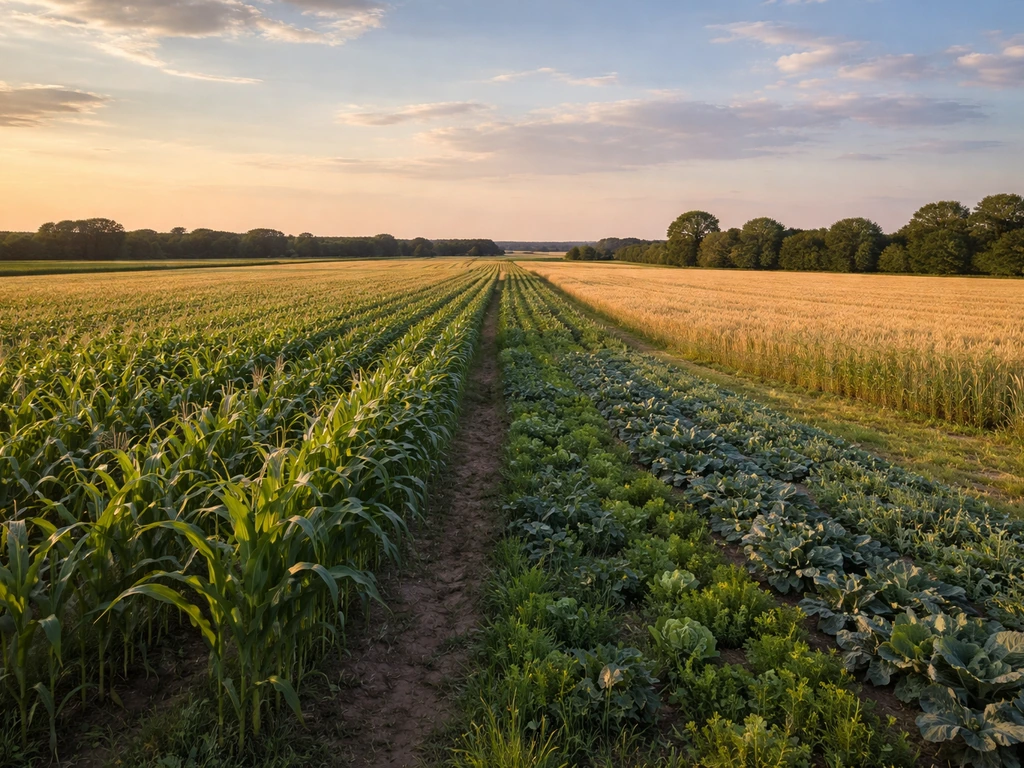
Farmers grow whatever their climate, soil, and market will support. In the U.S. Corn Belt (Illinois, Iowa, Indiana, and neighboring states), that means mostly corn and soybeans, which together cover about 75% of the region's farmland. In the Pacific Northwest, it shifts to apples, wheat, hops, pears, cherries, and hazelnuts. Globally, rice dominates lowland Asia, wheat covers the Great Plains and Central Asian steppes, and cassava feeds much of sub-Saharan Africa. The short version: location dictates the crop list more than almost any other factor.
What Crops Do Farmers Grow By Region, Climate, and Time

Samuel Rourke
2 May 2026
Quick answer by region and climate
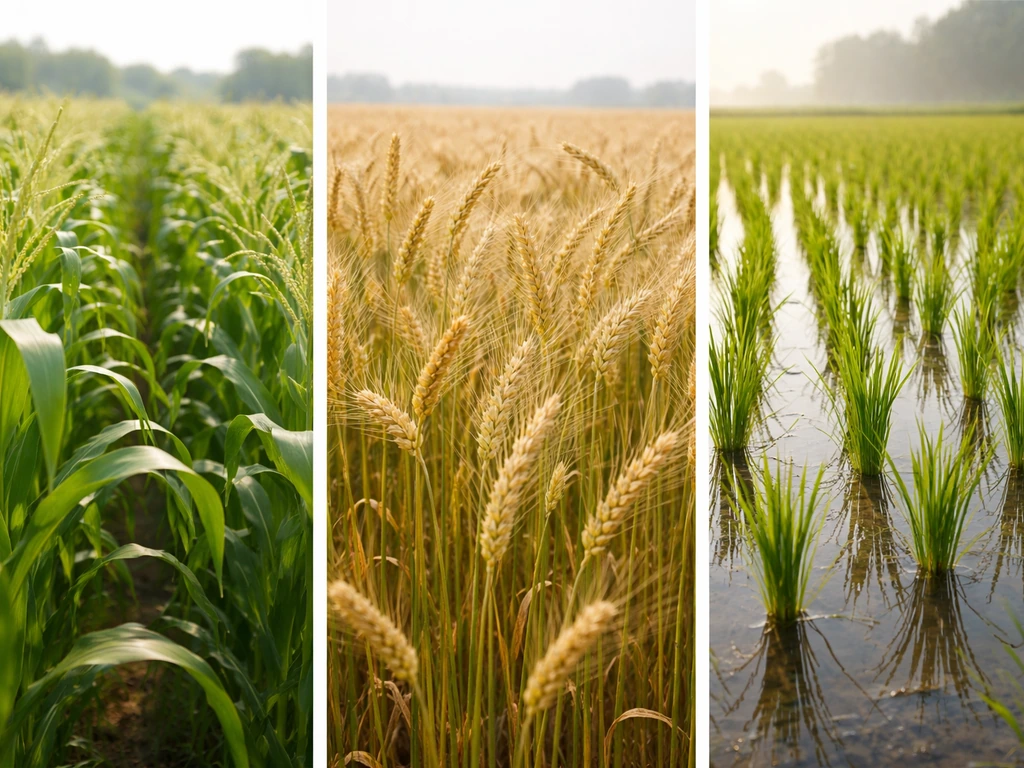
Here's a fast reference for what farmers actually grow across major regions and climate types. These aren't exhaustive lists, but they reflect the dominant crops you'd find if you visited these places today.
| Region / Climate | Primary Crops Grown | Key Driver |
|---|---|---|
| U.S. Corn Belt (Midwest) | Corn, soybeans, hay | Deep fertile soil, warm summers, 140-180 frost-free days |
| U.S. Great Plains | Winter wheat, sorghum, sunflowers, cattle forage | Semi-arid, flat terrain, cold winters |
| U.S. Pacific Northwest | Apples, wheat, hops, pears, cherries, blueberries, hazelnuts | Mild wet winters, dry summers, irrigation-fed valleys |
| U.S. Southeast (Alabama, Georgia) | Cotton, peanuts, soybeans, corn, timber | Long growing season, warm humid climate |
| U.S. California Central Valley | Almonds, grapes, tomatoes, lettuce, pistachios, citrus | Mediterranean climate, intensive irrigation |
| South and Southeast Asia | Rice, sugarcane, bananas, tea, rubber | Monsoon rains, tropical heat, flooded lowlands |
| Sub-Saharan Africa | Cassava, maize, sorghum, millet, groundnuts | Variable rainfall, tropical savanna |
| European Plains (France, Germany, Poland) | Wheat, barley, rapeseed (canola), sugar beets, potatoes | Temperate oceanic and continental climates |
| South America (Brazil, Argentina) | Soybeans, corn, sugarcane, coffee, beef cattle | Tropical to subtropical, fertile pampas |
| Middle East / North Africa | Wheat, dates, olives, barley, cotton (irrigated) | Arid, irrigation-dependent, ancient river valleys |
Within any one country or state, crop lists shift significantly by county or province. The USDA's National Agricultural Statistics Service publishes state-level overviews that rank crops by planted acreage and value of production, which is the fastest way to confirm the dominant crops for any U.S. state right now.
The major crop groups, explained simply
When you look at any regional crop list, you'll see the same handful of categories come up over and over. Knowing what each group means helps you read any list, anywhere in the world.
Grains (cereals)
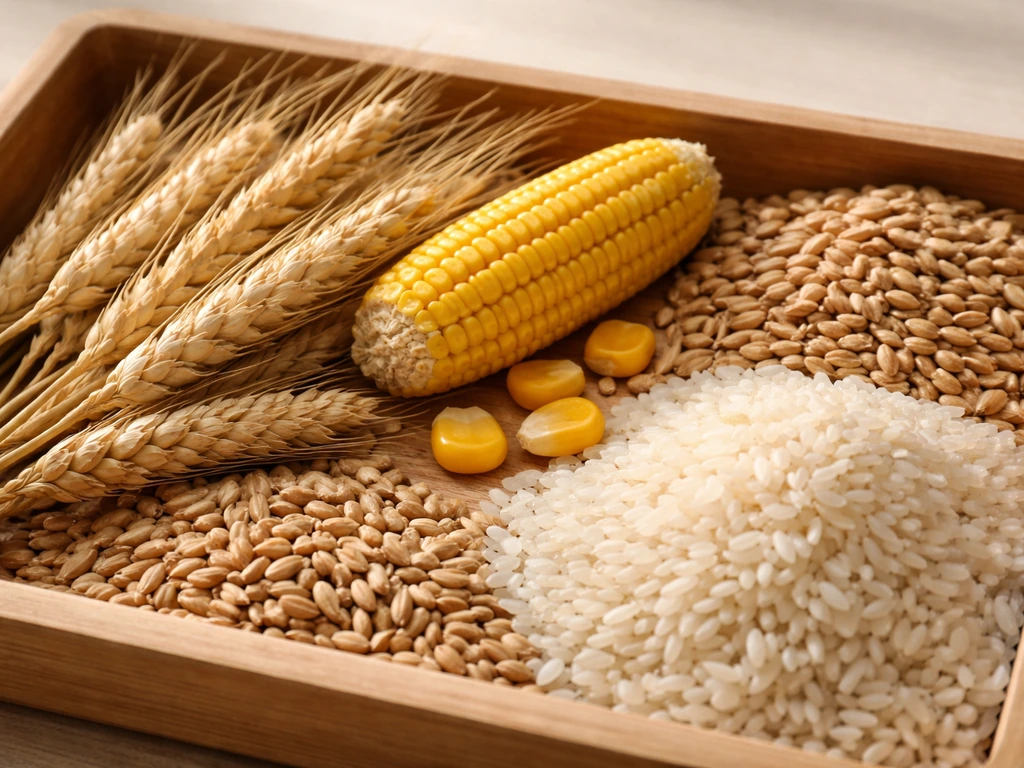
Grains are the most widely grown crop type on earth. Wheat, corn (maize), rice, barley, oats, sorghum, and millet all fall here. They're calorie-dense, storable, and tradeable, which is why they dominate large-scale farming on every continent. Corn and wheat alone account for a massive share of total U.S. harvested cropland each year.
Oilseeds
Oilseeds are grown for the oil extracted from their seeds, and in some cases for high-protein meal left behind after crushing. Soybeans, sunflowers, canola (rapeseed), cottonseed, and peanuts are the major examples. Soybeans are particularly important in the U.S. Midwest, where they're often rotated with corn in a two-year cycle that benefits both crops.
Vegetables and roots
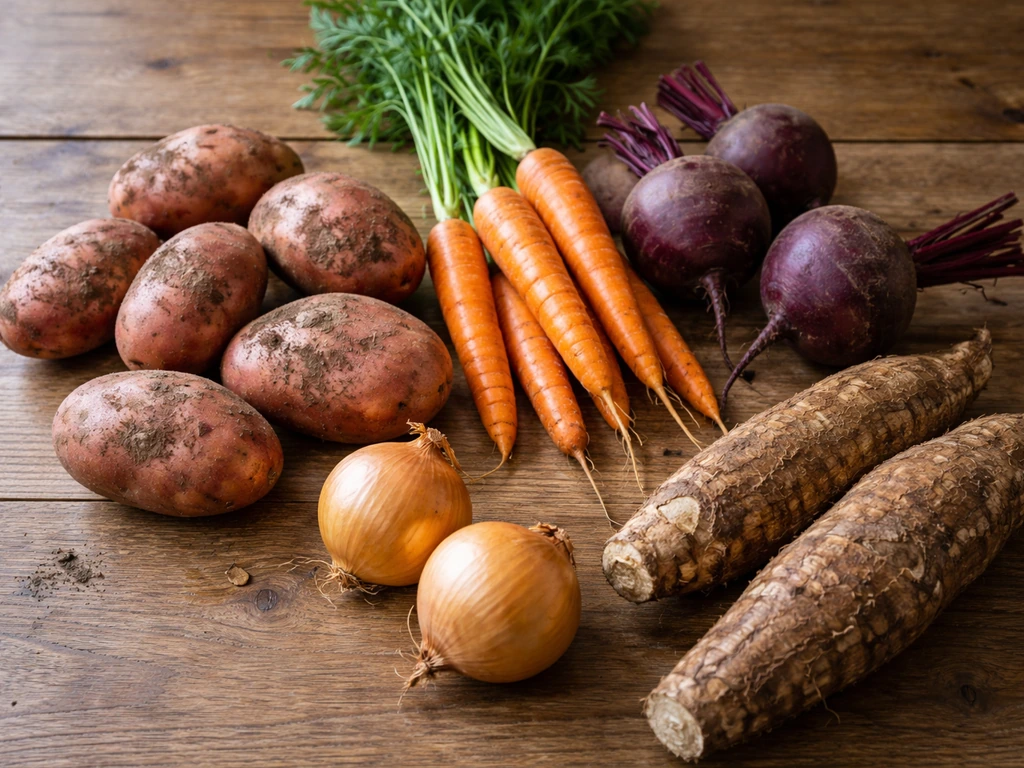
Vegetables cover a huge range, from potatoes and sweet corn to lettuce, tomatoes, and onions. Root crops like cassava, yams, and sugar beets also fall into this broad group. These crops tend to need more intensive management and closer attention to soil moisture than grain crops, which is why they cluster in regions with reliable irrigation or consistent rainfall.
Fruits (and nuts)
Tree fruits and vine crops require long-term investment because orchards and vineyards take years to mature. That's why you see apples concentrated in Washington State (where the climate and soil suit them and the infrastructure for packing and shipping is already built), almonds in California's Central Valley, and citrus in Florida and the Rio Grande Valley of Texas. Nuts like hazelnuts, walnuts, and pistachios follow similar logic.
Fiber and cash crops
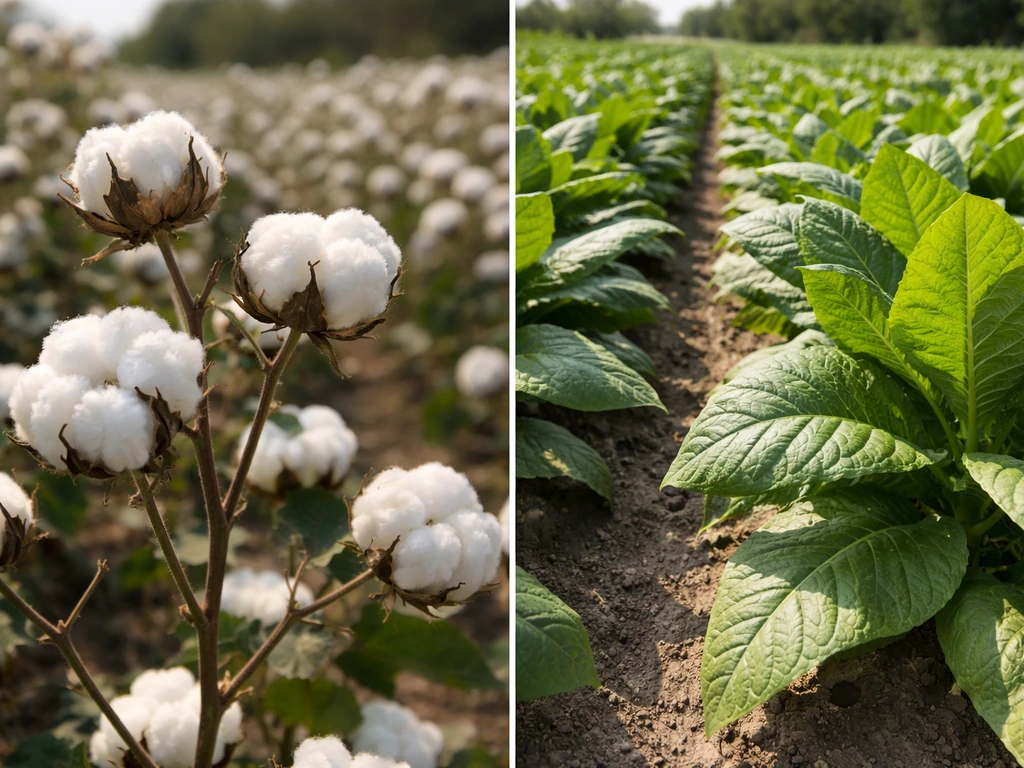
Cotton is the classic fiber crop in the U.S. South and Southwest, grown for its lint. Tobacco, once dominant in the Carolinas and Virginia, has declined sharply but is still grown in parts of Kentucky and Tennessee. Sugar crops (sugarcane in Louisiana and Florida, sugar beets in the Red River Valley and Rocky Mountain states) also fall into the cash crop category. These crops tend to be highly location-specific because they need particular temperature ranges and, in the case of sugarcane, a frost-free climate.
Legumes and cover crops
Beyond soybeans, legumes include dry beans, lentils, chickpeas, and field peas. These crops fix nitrogen from the air into the soil, making them valuable rotation partners for grains. Cover crops like phacelia, clover, and winter rye are increasingly common, grown not primarily for harvest but to protect and improve soil between main cash crop seasons. USDA notes that cover crops can conserve soil moisture and reduce crop loss during drought blank" rel="noopener noreferrer">cover crops can conserve soil moisture during drought. Farmers grow phacelia as a cover crop because it helps protect soil and support healthier farmland between main growing seasons.
Why soil, rainfall, temperature, and season length matter so much
Climate and soil are the real gatekeepers of what any farmer can grow. A farmer doesn't get to pick their weather, and changing soil type is expensive and slow. So the crop list for any region is essentially a response to what the land and sky allow. In other words, the right question is what farmers grow based on local conditions what any farmer can grow.
- Soil type: Heavy clay soils retain water well but can waterlog easily, favoring rice paddies or grasses rather than root vegetables that need drainage. Sandy loam soils drain freely and warm up faster in spring, making them excellent for potatoes and many vegetables. The deep, organic-rich mollisols of the Corn Belt are among the most productive grain-growing soils in the world.
- Rainfall and irrigation: Crops like corn need 20-30 inches of moisture during the growing season. Where rainfall doesn't supply that, farmers irrigate, which is why cotton, alfalfa, and vegetables thrive in otherwise dry regions of Arizona and California. In dryland farming areas like the northern Great Plains, drought-tolerant crops like winter wheat, lentils, and millet dominate.
- Temperature and frost dates: Every crop has a minimum germination temperature and a tolerance threshold for frost. Corn needs soil above 50°F to germinate and can't handle a hard freeze at any growth stage. Cotton needs a long, hot frost-free period of at least 180 days. Short-season crops like barley, oats, and cool-weather vegetables can thrive where summer is brief.
- Growing season length: The number of frost-free days defines what's possible. Southern states like Alabama and Georgia have 200-plus frost-free days, supporting cotton, peanuts, and year-round vegetables. Northern Minnesota or Montana may have 90-120 days, shifting farmers toward spring wheat, canola, and short-season corn hybrids.
- Market access and infrastructure: Even when the climate suits a crop, farmers also need roads, storage, processing facilities, and buyers. This is why crop patterns can cluster around processing plants, like soybean crushing facilities or cotton gins, even within a region where the climate would technically support multiple options.
What farmers grew historically, and how things have changed
The crop map of any country looks very different depending on which century you're looking at. Understanding that shift helps explain why certain regions are so strongly associated with certain crops today, and why those associations sometimes no longer apply.
Ancient civilizations
The earliest large-scale agriculture concentrated around river valleys where annual flooding deposited rich sediment. Ancient Egypt grew emmer wheat and barley along the Nile, along with flax for linen and papyrus for writing. Mesopotamia (modern Iraq) farmed wheat, barley, lentils, onions, garlic, and dates in the fertile floodplains between the Tigris and Euphrates. In Mesoamerica, the "Three Sisters" system combined corn, beans, and squash in a mutually beneficial polyculture. Ancient China concentrated on millet and rice, depending on whether farmers were in the dry north or the wet south. These ancient crop choices weren't random. They were the result of centuries of selecting whatever plants could be reliably cultivated, stored, and traded in each region's particular conditions.
Colonial and early modern periods
European colonization dramatically reshuffled global crop geography. Tobacco became the first major cash crop of the American South in the 1600s, followed by indigo and then cotton after the invention of the cotton gin in 1793. Sugar dominated the Caribbean and parts of South America wherever colonial powers could force labor-intensive cultivation. Meanwhile, the Columbian Exchange sent potatoes, tomatoes, corn, and cacao from the Americas to Europe and Asia, fundamentally changing what farmers there could grow. Potatoes alone transformed northern European agriculture and demographics within two centuries.
19th and 20th century shifts
Mechanization in the 1800s pushed farming toward large-scale monocultures of wheat, corn, and cotton. The introduction of synthetic nitrogen fertilizers in the 20th century (the Haber-Bosch process, commercialized by the 1920s) allowed corn yields to climb dramatically and made it possible to grow grain year after year without rotating in legumes. The "Green Revolution" of the 1960s-70s brought high-yield wheat and rice varieties to South Asia and Latin America, massively increasing production in countries like India, Pakistan, and Mexico. Tobacco, which once dominated the upper South and mid-Atlantic, declined steeply after the 1990s due to falling domestic demand and the end of federal price supports. Today, those same fields in Kentucky and Virginia often grow corn, soybeans, or hemp.
Recent decades
Since around 2000, a few major trends have continued to reshape what farmers grow. Soybean acreage expanded dramatically across South America, particularly in Brazil and Argentina, as global demand for animal feed and vegetable oil grew. In the U.S., the Renewable Fuel Standard created a sustained market for corn ethanol, incentivizing Corn Belt farmers to push corn acreage higher and reducing crop diversity in some areas. Cover cropping and multi-species rotations have become more common as farmers try to manage soil health, weed pressure, and input costs, which is part of why crops like phacelia, cereal rye, and sunn hemp are showing up in more rotation plans today.
How crop lists differ across the U.S., other countries, and ancient civilizations
The same basic factors (climate, soil, market, and history) create very different crop mixes depending on where and when you're looking. A few comparisons help illustrate how big those differences can be.
| Location / Period | Top Crops | Driving Factor |
|---|---|---|
| U.S. Midwest today | Corn, soybeans | Fertile glacial soils, ethanol/feed markets, mechanization |
| U.S. Pacific Northwest today | Apples, wheat, hops, cherries, blueberries | Mild climate, irrigation, proximity to Asian export markets |
| U.S. Southeast today | Cotton, peanuts, broiler chickens, soybeans | Long frost-free season, historical cash crop culture |
| Ancient Egypt (3000-30 BCE) | Emmer wheat, barley, flax, dates | Nile flooding, desert climate, irrigation canals |
| Ancient Mesoamerica | Corn, beans, squash (Three Sisters), cacao | Tropical climate, polyculture tradition, no draft animals |
| Medieval Europe (900-1400 CE) | Rye, wheat, oats, barley, turnips | Short growing seasons, low-input farming, subsistence focus |
| Colonial American South (1700s) | Tobacco, indigo, rice (coastal SC/GA) | Export markets, colonial land grants, enslaved labor |
| India today | Rice, wheat, sugarcane, cotton, lentils | Monsoon system, Green Revolution legacy, large population |
| Brazil today | Soybeans, sugarcane, coffee, corn, cattle | Cerrado expansion, biofuel mandate, global export demand |
It's worth noting that subsistence farmers, who grow primarily to feed their own households rather than sell to markets, follow a different logic entirely. If you're wondering what subsistence farmers grow, focus on the crops that reliably produce calories in their local climate and soil. They prioritize caloric reliability, crop diversity, and pest or drought resilience over maximizing yield of a single commodity. That means subsistence farming landscapes in places like rural Kenya, Bangladesh, or highland Peru often look far more diverse than the large monoculture fields common in commercial agriculture.
The Great Plains offer a useful contrast within the U.S. itself. Where the Corn Belt is dominated by corn and soybeans in a tight rotation, Great Plains farmers deal with less rainfall, flatter terrain, and colder winters, pushing them toward winter wheat, grain sorghum, sunflowers, and dry-land cattle operations. The crop mix on the Great Plains has also changed significantly over the past 150 years, shifting from native grassland to dryland wheat, then to irrigated corn and soybeans in some areas as center-pivot irrigation expanded.
How to find out what's grown locally today
If you want to know what farmers are actually growing right now in a specific place, here's how to get there quickly and accurately. FAO's statistical materials also compile harvested-area information and use FAO crop classification references that can help validate harvested-area sourcing and crop-area composition by crop FAO statistical PDF.
- Start with USDA NASS State Agriculture Overviews. The NASS Quick Stats tool publishes an annual state-by-state overview that lists crops ranked by planted acreage, harvested acreage, yield, and value of production. This is the most authoritative single source for current U.S. crop data and is updated each spring with the latest estimates. Search for '[your state] USDA NASS state agriculture overview' to find it directly.
- Check NASS Charts and Maps for field crops. USDA NASS maintains an A-to-Z field crops portal with acreage and yield maps by state and year for all major field crops, including corn, cotton, wheat, and soybeans. This lets you see spatial patterns, not just statewide totals.
- Use this site's geography-first crop pages. For state-by-state, country-by-country, or historical period breakdowns, this site organizes crop information by geography so you can find what's grown in a specific region without having to piece it together from multiple sources.
- Cross-check with local Extension Service resources. Every U.S. state has a land-grant university Extension Service that publishes crop budgets, planting guides, and county-level crop data. These are written for farmers in your specific region and climate, making them highly practical.
- Factor in your local climate variables. Once you have a candidate crop list for your region, check it against your average first and last frost dates, annual rainfall or irrigation access, and soil type. Your county's USDA Natural Resources Conservation Service (NRCS) office can pull Web Soil Survey data for your specific parcel.
- For historical crop data, consult census records and state agricultural histories. The USDA Census of Agriculture has been conducted every five years since 1840 and is searchable by state and county. State land-grant university libraries often hold detailed agricultural histories that describe what was grown in each county during earlier periods.
- If you're researching ancient or pre-colonial agriculture, look for archaeobotanical studies, which analyze plant remains from excavation sites, alongside historical records from the period. University archaeology departments and national museum databases often publish this data online.
One practical tip: when looking at any crop list, pay attention to whether it's sorted by acreage or by value. A state might have more wheat acres than any other crop, but a much smaller almond or specialty vegetable sector that contributes more to total farm revenue. Both pieces of information matter depending on whether you're trying to understand land use patterns or economic importance.
The number of crops a farmer grows in a year also varies a lot. In regions with two or three planting windows, a single field might produce multiple crops annually, a common practice in parts of Asia and the warmer U.S. states. In the northern U.S. and Canada, a single main crop per season is the norm, sometimes followed by a fall cover crop. How many crops per year is feasible in a given place is itself shaped by the same climate variables that determine which crops are grown in the first place. A common question is what do farmers grow under plastic in places that need season extension or protection from cold, wind, and heavy rain.
FAQ
Why might two neighboring counties grow different crops even if they have similar weather?
Soil drainage and frost risk can differ over short distances, and local water access (irrigation availability, water rights, aquifer depth) can change what is practical. Farm-level constraints like field size, equipment, and contract buyers also push crop choices away from what you would expect from climate alone.
How can I tell whether a crop list is based on acreage or profit?
Check whether the source reports planted acreage, harvested acreage, or “value of production.” Bulk crops often lead by acres, while specialty fruits, nuts, and vegetables can rank higher by revenue even with fewer acres. If you only compare one metric, you can misread what farmers “grow most.”
Do farmers always plant the same crop every year in the same field?
Not usually. Crop rotation is common to manage pests, reduce disease carryover, and improve soil fertility. In regions where fertilizer is costly or where certain weeds build up, farmers may shift crops year to year even if the climate supports the same crop indefinitely.
What does “crop types” mean in practice, and are the categories mutually exclusive?
Categories like grains, oilseeds, vegetables, and legumes are broad and can overlap in real farm operations. For example, peanuts might be treated like an oilseed in some statistics, while farmers may still evaluate it for rotation benefits. Also, some farms blend cash cropping with cover crops that do not show up as harvested commodity crops.
How do farmers decide between rainfed farming and irrigation when both are possible?
They compare expected yield stability, input and water costs, and risk management. Irrigation can expand options, but it depends on reliable water supply, infrastructure costs, and constraints like groundwater depletion or water allocation rules that may limit how much irrigation a farm can use.
What crops are common in very dry or drought-prone areas besides the “headline” grain?
Farmers often choose drought-tolerant grains and oilseeds, and many pair them with livestock or grazing systems if crop yields are too variable. In some regions, they also plant shorter-season varieties to fit within rainfall patterns and reduce exposure to late-season dry spells.
How does season extension change what farmers grow under plastic?
Plastic tunnels and row covers often speed up early growth, protect from cold snaps, and reduce wind and heavy rain damage. That typically enables higher-value vegetables and greens in colder climates, and it can allow an extra planting window compared with open-field production.
Why do some regions look monoculture-heavy even though the article mentions rotations?
Commercial systems often optimize around strong commodity markets, standardized equipment, and economies of scale, which can narrow crop diversity at the field level. Rotations may still happen, but the rotation partners can be closely related commodities (like corn and soybeans) rather than a wide variety of different crops.
How many crops can a farmer grow in a year, and what determines the limit?
The practical limit is driven by the number of planting windows, length of growing season, and the time needed to prepare fields between crops. Weather extremes matter too, including heat stress, rainfall timing, and frost dates. In short-season climates, adding a second cash crop may be less feasible than planting a cover crop for soil protection.
Do subsistence farmers grow the same crops as commercial farms?
They often prioritize different traits: dependable calorie production, resilience to local pests and drought, and the ability to store food. That can lead to more diverse plots (multiple staples and minor crops) and different emphasis on varieties compared with regions where commercial farms chase market demand.
If a crop is “possible” in a region, why might farmers still not plant it?
Feasibility includes more than climate and soil. Market access (processors, buyers, transport), seed availability, risk of price swings, and required equipment can make a crop unattractive. Policies and subsidies can also shift decisions, especially for crops tied to specific commodity programs.
Next Articles
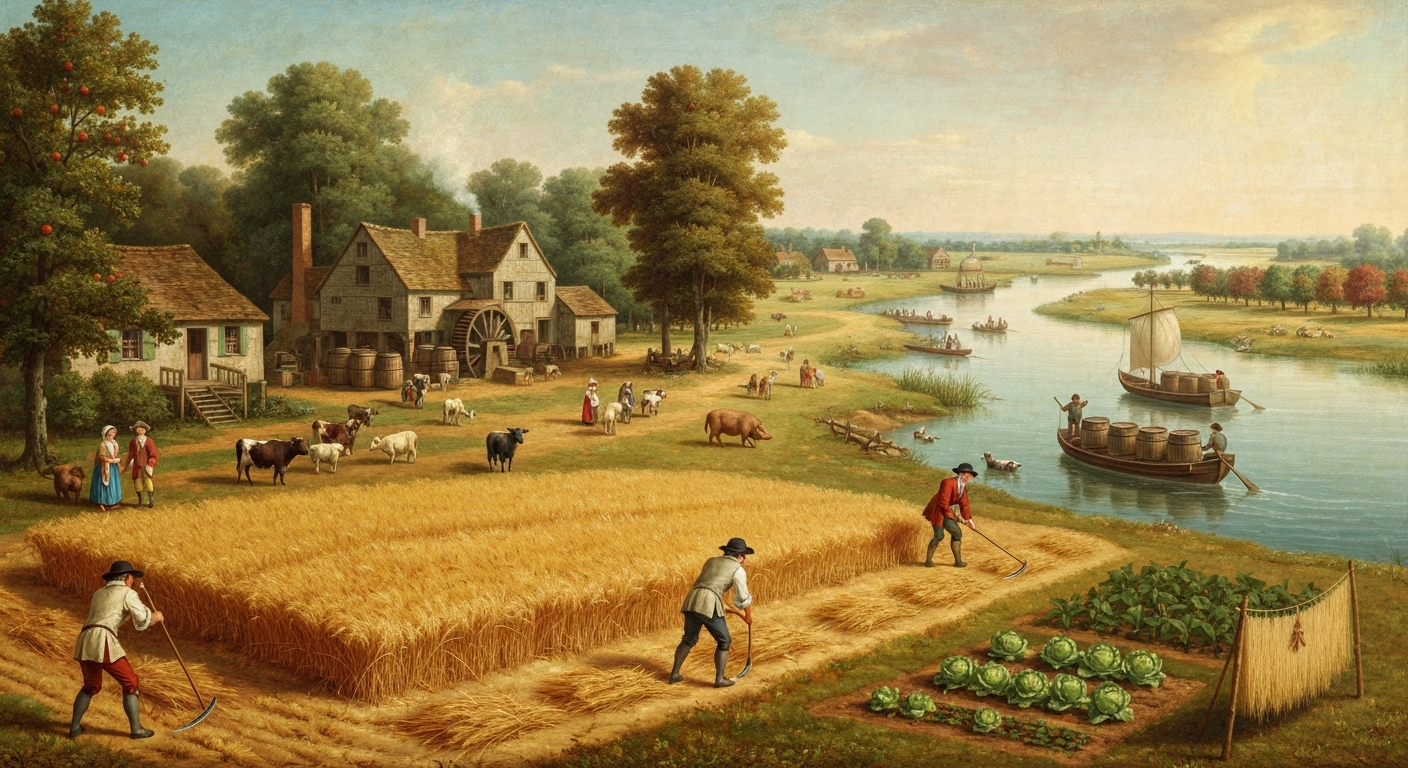
What Did the Delaware Colony Grow: Crops, Uses & Legacy
Colonial Delaware’s main crops, grains, hay, flax, fruits, vegetables, livestock, why they thrived and how they were sold.
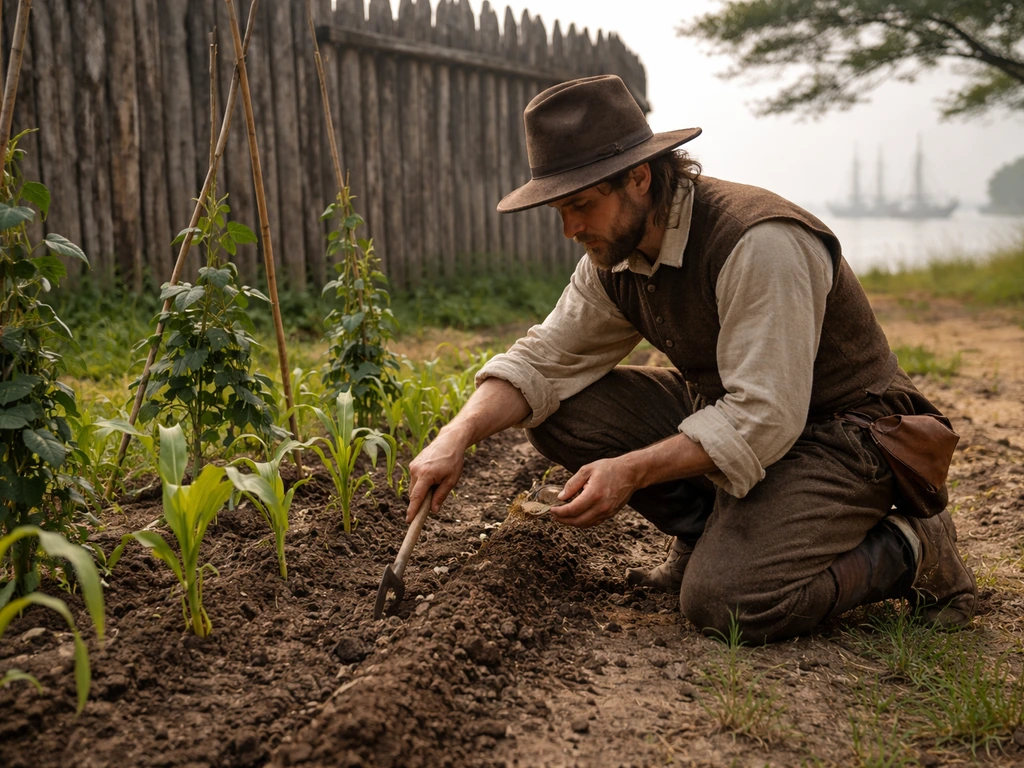
What Did Jamestown Grow and How They Farmed It
Learn what Jamestown colonists grew and the methods they used to plant, harvest, and adapt crops to Virginia conditions.
What Did the New England Colonies Grow? Major Crops
Major New England colonial crops explained by climate and soil, from corn and wheat to beans and hay, plus today’s paral