
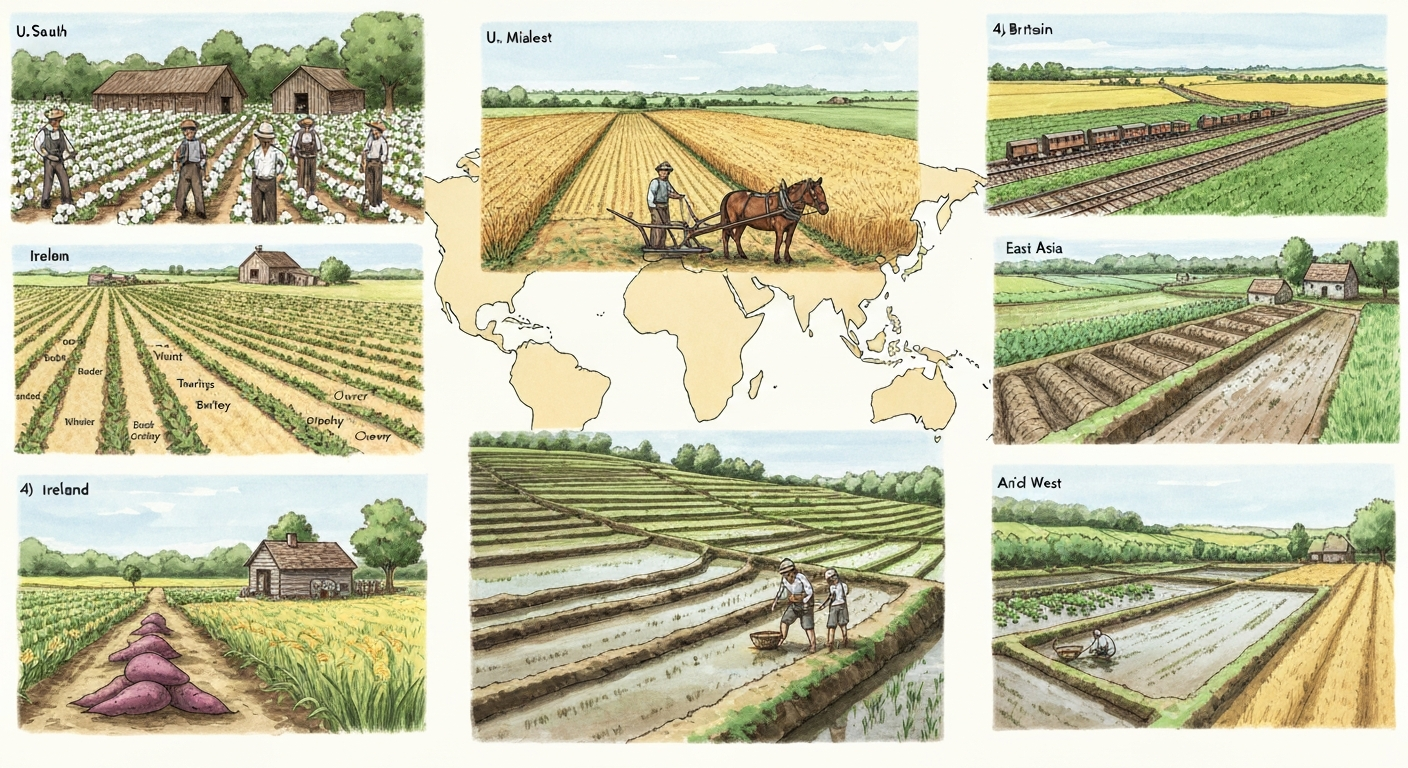
Tenant farmers grew whatever their land, climate, and landlord allowed. In the U.S. South that meant cotton, tobacco, corn, and sweet potatoes. In the Midwest it meant wheat, corn, oats, and hay. In Britain and Ireland it meant wheat, barley, oats, turnips, and (for Irish smallholders) potatoes. In South Asia it meant paddy rice, wheat, pulses, oilseeds, cotton, and jute. In East Asia it meant irrigated rice in the wet lowlands and wheat, millet, sorghum, and soybeans farther north. The short pattern across all of these regions is the same: the most profitable or rent-payable crop the land could support was the one tenants were expected or contractually required to grow.
What Did Tenant Farmers Grow: Crops by Region and Era, Why?

Samuel Rourke
4 Aug 2026
What tenant farming actually means
The USDA defines a tenant farmer as an operator who farms land owned by someone else. That breaks into two main types: cash tenants, who pay a fixed rent in money regardless of how the harvest goes, and share tenants (including sharecroppers), who pay rent as a fraction of what they produce. The distinction matters enormously for crop choice. A cash tenant has an incentive to grow whatever is most profitable because they keep everything above the fixed payment. A share tenant's crop choice is often controlled or constrained by the landowner, who has a direct stake in what gets planted and how much of it gets harvested.
Sharecropping is a specific form of share tenancy in which the landlord typically provided land, housing, and sometimes seed, tools, or credit, while the tenant supplied labor. The tenant then remitted a pre-agreed share of the crop as rent. In practice this gave landlords enormous leverage over what was planted, since they often extended credit through a crop-lien system that tied repayment to a particular cash crop. Tenant farming and sharecropping are related but not identical, and neither should be conflated with enslaved labor, though all three systems sometimes operated in the same landscapes at the same time and in some cases followed one another historically.
U.S. South before the Civil War: cotton, tobacco, rice, and the subsistence layer beneath
Antebellum Southern agriculture was dominated by four commercial crops: cotton, tobacco, rice, and sugar. Cotton was the engine of the Cotton Belt, stretching from South Carolina through Georgia, Alabama, Mississippi, Louisiana, and into Texas. Tobacco held sway in Virginia, North Carolina, and Kentucky. Rice occupied the tidal lowlands of South Carolina and Georgia, where the intricate dike-and-floodgate systems required enormous organized labor. Sugar was confined largely to Louisiana's alluvial soils and long frost-free season.
Underneath the cash crop layer sat a subsistence tier that smallholders and tenant farmers depended on for food. Corn (maize) was grown almost universally across the South, serving as feed for hogs and cattle and as the primary starch in most diets. Sweet potatoes were a critical calorie source on small holdings, and many tenant plots included a kitchen garden with cowpeas, greens, and squash. The plantation system relied heavily on enslaved labor, but white smallholders and tenant farmers occupied the same landscape, often renting marginal land from larger planters and growing similar crop combinations at a smaller scale. For more on specific groups who owned enslaved people and the crops they cultivated, see what crops did the Quakers grow using slaves. See the article on how slaves helped to grow the colonial economies for more on enslaved labor's role in driving plantation production, credit systems, and market integration. Understanding how the colonial and plantation labor economies shaped this landscape is useful context here.
The agroecological logic was clear. The deep, well-drained loamy soils of the Black Belt in Alabama and Mississippi produced cotton that graded high in the Liverpool markets. The long growing season (200-plus frost-free days across the Deep South) suited cotton's slow maturation. Tobacco preferred the lighter, sandier soils of the Piedmont. Rice required flat, tidal or flood-irrigated lowlands with heavy clay soils that held water. Each crop was planted where the land gave it the best chance, and tenants had little say in that geography.
Typical antebellum crop rotation on tenant and smallholder plots
- Cotton (primary cash crop) — planted April through May, harvested September through November
- Corn (subsistence and feed) — often grown in alternating rows with cotton on smaller plots
- Sweet potatoes — planted in mounds from slips in late spring, harvested before first frost
- Cowpeas (black-eyed peas) — frequently relay-planted into corn after first cultivation, fixing nitrogen
- Small grains (oats, wheat) — winter crops grown on plots rested from cotton, providing early-spring feed
Reconstruction and the sharecropping era: when cotton locked in an entire region
After emancipation in 1865, the plantation labor system had to be rebuilt. The Freedmen's Bureau (operating 1865 to 1872) supervised labor agreements between freedpeople and former planters. Its field-office contracts, many preserved at the National Archives, document the transition from gang labor and enslaved work to a patchwork of wage labor, cash tenancy, and sharecropping. One primary 1867 sharecropping contract from Marshall County, Mississippi (involving planter Isham G. Bailey) shows freedmen contracting to cultivate cotton and corn and to remit more than half the cotton crop and a specified fraction of corn to the landowner. That contract is a useful artifact of how crop choice was not negotiated by the tenant, it was dictated by the landowner and embedded in the contract terms.
Mississippi's cotton output fell from roughly 1.2 million bales in 1860 to about 565,000 bales in 1870, a near-halving that reflects the disruption to the old labor system. But by the 1880s and 1890s, sharecropping had re-anchored cotton production across the South. The crop-lien system reinforced this: country merchants and landlords extended credit to sharecroppers against a lien on the next cotton crop, which meant tenants were often legally bound to plant cotton whether they wanted to or not. Growing food crops instead of cotton could mean defaulting on debt.
Corn remained essential alongside cotton for most sharecropping families. A typical arrangement involved planting the bulk of the rented acreage in cotton (the rent-producing crop) with a smaller plot in corn for household and animal subsistence. Sweet potatoes, sorghum for molasses, and a kitchen garden rounded out the food supply. The degree to which tenants could plant food crops depended heavily on their specific contract terms and the landlord's willingness to allow it. Many Freedmen's Bureau case files show that landlords pushed hard for maximum cotton acreage.
Sharecropping versus cash tenancy versus enslaved labor: a comparison
| System | Who controlled crop choice | Typical crops grown | Labor source | Rent form |
|---|---|---|---|---|
| Enslaved plantation labor (pre-1865) | Planter entirely | Cotton, tobacco, rice, sugar, corn | Enslaved people (no tenancy relationship) | Not applicable — unpaid forced labor |
| Sharecropping (post-1865) | Landlord or jointly by contract | Cotton, corn; food crops secondary | Freedpeople and poor white families | Share of crop (often 50% or more to landlord) |
| Cash tenancy (post-1865 South) | Tenant, within credit constraints | Cotton, corn, some diversification | Tenant family and hired help | Fixed cash payment regardless of yield |
| Midwestern cash tenancy (late 19th c.) | Tenant, market-driven | Wheat, corn, oats, hay | Tenant family, seasonal hired labor | Fixed cash or crop-share, varied by state |
U.S. Midwest: grain, hay, and the market tenant
Midwestern tenant farming had a very different character from Southern sharecropping. By the late 19th century, Illinois, Iowa, Kansas, Nebraska, and neighboring states had developed a grain economy built around corn and wheat, with oats and hay filling out livestock-based rotations. Tenants here were more likely to be cash tenants or crop-share tenants rather than sharecroppers in the Southern sense, and many rented from absentee landowners who had acquired prairie land as an investment.
Corn dominated the central Midwest because the deep, fertile mollisols of the prairie combined with warm summers and adequate summer rainfall made it one of the highest-yielding environments for corn on earth. Wheat was more common in Kansas, Nebraska, and the Dakotas, where drier conditions and cooler temperatures suited the winter or spring wheat types. Oats were a staple feed crop grown in rotation with corn, and clover and timothy hay were cut for livestock feed and also served as a soil-improving rotation break. A common Midwestern tenant rotation was corn, corn, oats, clover hay, a four-year sequence that built organic matter and controlled weeds without fertilizer inputs.
Market integration via rail was the key driver. Once the transcontinental and regional rail networks were built through the 1870s and 1880s, Midwestern tenants could get grain to Chicago, St. Louis, and ultimately export markets. This made specialization in wheat or corn economically rational in a way it had not been when transport was limited to river systems. Tenants who could only farm with draft animals and hand tools still had strong market incentives to plant the same grains as their owner-operator neighbors.
Dry farming and the expansion westward
In the 1890s through the early 1900s, dry-farming techniques were widely promoted by land-grant colleges and USDA extension services to push rainfed wheat production into the semi-arid Great Plains and inland Pacific Northwest. Summer fallow (leaving land unplanted for a season to accumulate soil moisture) was the central technique. Tenants and homesteaders under the Homestead Act and Carey Act adopted these practices and extended wheat into regions that had previously been considered too dry for reliable grain farming. The Inland Pacific Northwest, particularly the Palouse region of Washington and Idaho, became one of the most productive dryland wheat zones in the world through exactly this combination of good volcanic ash soils and summer-fallow management.
U.S. West in the 19th century: tenant crops, ranching, and commercial staples
Western tenant farming in the 19th century was shaped by aridity, land grants, and the availability of irrigation. In California, large land grants from the Mexican period and early American statehood created a landscape where small tenants farmed portions of huge estates. Chinese and later Japanese immigrant tenant farmers were responsible for much of California's early commercial vegetable production, wheat farming in the Sacramento and San Joaquin Valleys, and later fruit and hop growing. Wheat was California's dominant cash crop through the 1870s and 1880s, grown on dry-farmed flatlands by tenant operators who sold into the international grain trade.
Where irrigation water was available, through the Carey Act and later federal reclamation projects, tenant and smallholder cropping diversified rapidly into fruits, vegetables, sugar beets, and alfalfa. Alfalfa was particularly important in the arid West because it supported livestock, fixed nitrogen, and could be cut multiple times per season under irrigation. In Colorado, Utah, and the Pacific Northwest, irrigated tenant plots grew potatoes, onions, and stone fruits alongside cereals. Ranching and open-range cattle operations also coexisted with tenant grain farming, and many tenants combined cropping with small livestock enterprises.
Texas deserves specific mention here. See the discussion on why did planters in Texas grow wealthy in the 1850s for more on cotton profits, fertile alluvial soils, and concentrated land ownership that produced planter wealth. By the 1850s, planters in east Texas had moved heavily into cotton cultivation using enslaved labor on rich alluvial bottomlands, and cotton profits were a primary source of antebellum planter wealth in the state. After the Civil War, sharecropping and tenant farming replaced enslaved labor on many of these same lands, with cotton remaining the dominant crop. The reasons Texas planters grew wealthy in the 1850s are closely tied to the same forces that shaped tenant cropping choices after the war: fertile soils, cotton market demand, and concentrated land ownership.
Britain and Ireland: wheat, roots, and the potato before the famine
British tenant farming operated under a landlord-tenant system that was among the most formalized in the world by the 18th and 19th centuries. Board of Agriculture parish returns recorded tenant holdings, acres in arable versus pasture, livestock counts, and typical arable crops. In the lowland arable regions of England (East Anglia, the Midlands, and the south), the Norfolk four-course rotation became a standard tenant-farming template from the mid-18th century onward: wheat, turnips, barley, and clover or grass. This system was explicitly designed to maintain soil fertility without purchased fertilizer, and landlords often required tenants to follow it as a lease condition.
The Norfolk four-course rotation
- Wheat — the primary cash grain, sold to millers and markets
- Turnips — grown for sheep and cattle fodder; sheep folded on the field added manure
- Barley — a second cash grain sold to maltsters for brewing
- Clover or rye-grass — cut for hay or grazed; legume fixes nitrogen, improving the following wheat crop
In upland Britain (the Scottish Highlands, Wales, northern England, and the western hill districts) tenant farming shifted away from arable cropping toward sheep and cattle grazing on rough pasture. Holdings here emphasized oats rather than wheat because oats tolerated cool, wet conditions and shorter growing seasons better than wheat or barley. Oats were a subsistence staple, a horse feed, and a limited market crop in these regions. The agroecological divide between lowland arable England and upland pastoral Britain is one of the clearest examples on the site of how climate and soil directly determine what tenants could and did grow.
Ireland's tenant-farming landscape before the 1845 to 1852 famine was characterized by extreme subdivision of holdings and heavy reliance on the potato. Tithe Applotment Books from the early 19th century and estate records show that smallholders in many Irish districts occupied plots measured in fractions of an acre, and the potato, yielding more calories per acre than any other available crop, was essential to subsistence. Oats and barley were also grown, but often as a rent crop (sold to pay cash rent) while the family ate potatoes. This created a catastrophic vulnerability: when Phytophthora infestans destroyed the potato harvest repeatedly from 1845 onward, the tenant class had almost no fallback crop. The famine represents one of history's starkest illustrations of how tenancy arrangements and monoculture dependence interact with crop failure.
South Asia: paddy, dry cereals, pulses, and the colonial tenure systems
South Asian tenant farming operated under several distinct tenure systems during the colonial period: zamindari (where zamindars collected rent from tenants and paid a portion to the colonial government), ryotwari (where the government dealt directly with individual cultivators), and mahalwari (village-level collective arrangements common in north India). Each system shaped what tenants grew and how much of it they could keep, but agroecology was still the dominant determinant of crop choice.
The Imperial Gazetteer of India, compiled under British rule, documents regional cropping in considerable detail. Paddy rice dominated the irrigated deltas: the Bengal and Orissa coasts, the Krishna and Godavari deltas of Andhra, the Cauvery delta of Tamil Nadu, and the coastal lowlands of Kerala and the Konkan. These are environments with heavy monsoon rainfall, flat alluvial soils, and perennial or seasonal irrigation, and wet-rice cultivation was the only system that could fully exploit them. Tenant farmers in these regions typically grew one or two rice crops per year (kharif and sometimes rabi, depending on irrigation availability), supplemented by pulses and vegetables on the bunds and margins.
Away from the deltas, in the drier Deccan plateau, the Punjab plains, and the Gangetic heartland, dry cereals dominated. Wheat was the primary rabi (winter/spring) crop across much of north India, particularly where canal irrigation made it reliable. Millets (jowar/sorghum, bajra/pearl millet) were the staple kharif crops on drier, lighter soils across Maharashtra, Rajasthan, and Karnataka. Pulses (lentils, chickpeas, pigeon peas) were grown in rotation with cereals and provided both food protein and a nitrogen-cycling benefit. Cotton was a major commercial crop in Maharashtra and Gujarat, grown by tenants who were often deeply indebted to merchants or moneylenders and effectively locked into cash-crop production by their debt obligations, a dynamic with obvious parallels to the U.S. South's crop-lien system. Jute dominated wet eastern Bengal as a fiber cash crop.
South Asian seasonal cropping calendar for tenant farmers
| Season | Crops grown | Region | Water source |
|---|---|---|---|
| Kharif (June–November, monsoon) | Paddy rice, jowar, bajra, cotton, jute, groundnuts | Bengal delta, Deccan, Gujarat, Punjab | Monsoon rainfall and tank/canal irrigation |
| Rabi (November–April, dry season) | Wheat, barley, chickpea, lentil, mustard | Punjab, Gangetic Plain, Deccan | Canal irrigation, well irrigation, residual soil moisture |
| Zaid (April–June, hot-weather short season) | Vegetables, melons, green gram, fodder crops | Irrigated areas near rivers and canals | River floodwater recession or canal |
East Asia: wet-rice systems, relay cropping, and northern dryland cereals
East Asian tenant farming followed ecological zones with remarkable consistency across China, Japan, and Korea. In the irrigated lowlands of southern China, Japan's Pacific coast, and Korea's western plains, wet-rice cultivation was the foundation of the tenant economy. Tenants typically grew one or two rice crops per year depending on latitude and water availability, and rent was paid in rice, a fixed volume in many cash-rent arrangements or a share of the harvest in share-tenancy systems. The rice rent system meant that rice cultivation was non-negotiable for most lowland tenants; it was both the food staple and the currency of rent.
In the Yangtze River delta region of central China, one of the most intensively farmed landscapes in agricultural history, tenant farmers developed complex relay-cropping and multi-cropping systems. A typical year might include winter wheat or rapeseed grown on drained paddy fields, followed by a transplanted rice crop in early summer, then a second rice crop or a fall vegetable crop. Cotton was also a major tenant crop in the Yangtze delta from the Song dynasty onward, and the combination of paddy rice and cotton on the same holdings, switching by field and season, was a defining feature of the regional tenant economy.
In northern China, Manchuria, and the Korean interior, where winters were too cold and summers too short for reliable wet rice, tenant farmers grew a dry-cereal complex: wheat in winter, millet and sorghum (kaoliang) in summer, soybeans as a nitrogen-fixing rotation crop, and vegetables for household use. Japanese tenant farmers in Hokkaido, the northernmost main island, grew spring wheat, potatoes, and fodder crops rather than rice. Soy was particularly important across northeastern China as both food and a market crop, and by the early 20th century Manchurian soybean exports were significant in world commodity markets.
Tenancy arrangements in East Asia ranged from formal written contracts to informal hereditary occupancy rights that were recognized by custom if not law. In Japan, the Meiji-era land tax reform of 1873 formalized land ownership and set the stage for a highly commercialized tenant-landlord system in which rice rents were converted at prevailing market prices and tenant disputes over rent rates became a recurring source of rural unrest through the early 20th century. In China, tenancy arrangements varied enormously by region, from the relatively secure permanent tenancy rights of the Yangtze delta to the precarious short-term leases more common in the north.
A regional summary: what tenant farmers grew and why
| Region / Period | Primary cash crops | Subsistence / food crops | Key agroecological driver | Tenancy form |
|---|---|---|---|---|
| U.S. South, antebellum | Cotton, tobacco, rice, sugar | Corn, sweet potatoes, cowpeas | Long frost-free season, alluvial soils, slave-labor infrastructure | Small tenancy alongside slave plantations |
| U.S. South, Reconstruction–1900s | Cotton (dominant), tobacco | Corn, sweet potatoes, sorghum | Crop-lien credit system locked in cotton | Sharecropping, cash tenancy |
| U.S. Midwest, late 19th c. | Wheat, corn | Oats, hay, clover | Deep prairie mollisols, rail access to markets | Cash tenancy, crop-share tenancy |
| U.S. West, 19th c. | Wheat, fruits, vegetables (irrigated) | Alfalfa, potatoes, onions | Aridity, irrigation availability, land grant structure | Cash tenancy, homestead smallholding |
| Britain (lowland), 18th–19th c. | Wheat, barley | Turnips, clover, oats | Temperate maritime climate, Norfolk rotation requirements | Formal leasehold tenancy |
| Ireland, early 19th c. | Oats, barley (as rent crops) | Potato (primary diet) | Potato calorie yield on small plots; oats for rent payment | Subdivision tenancy under absentee landlords |
| South Asia (irrigated delta) | Rice, jute, cotton | Pulses, vegetables | Monsoon and canal irrigation, alluvial delta soils | Zamindari, ryotwari |
| South Asia (dry interior) | Cotton, groundnuts, wheat | Millet, sorghum, chickpea, lentil | Semi-arid climate, limited irrigation | Ryotwari, mahalwari |
| East Asia (southern wet rice) | Rice, cotton, rapeseed | Vegetables, legumes | Subtropical monsoon, flat irrigated paddies | Share rent and cash rent in rice |
| East Asia (northern dryland) | Wheat, soy, sorghum | Millet, vegetables, potatoes | Cold winters, rainfed loess and alluvial soils | Informal hereditary and short-term lease |
Why tenant farmers so often ended up growing commercial crops
Across almost every region and period, tenant farmers were pulled toward commercial cash crops by the same basic logic: rent had to be paid in cash or as a share of a marketable commodity. See an explanation of why was it more profitable to grow commercial crops for a concise account of the economic incentives that pushed tenants toward cash-crop production. A tenant growing only subsistence food could feed their family but had nothing to give the landlord. This is why cotton dominated the U.S. South, why rice rent defined Japanese tenancy, why Deccan tenants grew cotton despite the debt risk, and why Irish smallholders sold their oats to pay rent while living on potatoes. The commercial crop was the rent crop, and everything else was survival.
The profitability of commercial crops for the landowner (and sometimes the tenant) reinforced this pattern. When cotton prices were high, landlords had every incentive to push tenants into maximizing cotton acreage. When they fell, as during the agricultural depressions of the 1880s and 1890s, tenants were often trapped by debt into continuing to plant cotton even at a loss. This is the underlying tension in the history of tenant farming worldwide: the crop choices visible in census records and gazetteers were not always chosen freely by the people who did the actual planting.
Modern tenant farming and crop continuity
Modern tenant farming in the United States still follows many of the same geographic patterns. USDA Agricultural Census data continue to separate owner-operators, part-owners, and tenants, and the crop choices of cash tenants in Iowa or Kansas today (corn, soybeans, wheat) reflect the same agroecological logic that shaped 19th-century Midwestern cropping. Soybeans have largely replaced oats in Midwestern rotations since the mid-20th century, but the corn-soybean rotation on rented land is now the most common agricultural system in the U.S. by total acres. In the South, cotton and tobacco acreage has fallen substantially, replaced by soybeans, peanuts, and poultry integration on former sharecropping lands.
In South Asia, land reform legislation after independence in India and Pakistan attempted to break up zamindari holdings and give tenants ownership rights, with mixed results. Tenancy persists in many forms, and the crop choices of tenant cultivators in Punjab, Andhra Pradesh, or Bangladesh today still reflect the same seasonal rice-wheat or rice-pulse rotations documented in 19th-century gazetteers. In East Asia, collectivization in China and post-war land reform in Japan and South Korea transformed formal tenancy, but the underlying cropping systems, wet rice in the south, wheat and soy in the north, continue because the agroecology that drove them has not changed.
The through-line across all of this is straightforward: tenant farmers grew what the land could support, what the market would buy, and what the landlord or credit system required. Understanding those three forces, agroecology, market access, and tenancy terms, explains the crop geography of tenant farming better than any other framework.
FAQ
What is a tenant farmer and what's the quick answer to 'What did tenant farmers grow?'
A tenant farmer is someone who operates and cultivates land owned by another person, paying rent either in cash (cash tenant) or as a portion of the crop (share tenant). Quick answer: tenant farmers grew whatever crops the land, climate, market, and tenancy terms made most economical — commonly cash crops (cotton, tobacco, rice, sugar, coffee, cocoa, groundnuts) where markets and landlords pushed them, and staples/cereals (corn/maize, wheat, oats, millet, sorghum, potatoes, cassava) where subsistence needs, climate or soil limited commercial cropping.
Which crops did tenant farmers grow in the antebellum U.S. South?
Antebellum tenant-operated and plantation lands focused on commercial crops: primarily cotton in the Cotton Belt, plus tobacco, rice (coastal lowlands), and sugar (Gulf Coast). Smallholders and tenants also grew subsistence staples such as corn (maize), sweet potatoes and garden vegetables to feed households.
What crops did tenant farmers grow in the U.S. South after the Civil War (Reconstruction/sharecropping era)?
During Reconstruction and the late 19th century many freedpeople and poor whites became sharecroppers or tenants and were often required — by contracts, landlord credit or provision of inputs — to grow cotton as the dominant cash crop, with corn/maize planted for household food. Contracts and credit often constrained crop choice toward marketables (cotton) rather than diversified food production.
What crops were typical for tenant farmers in the U.S. Midwest and Western Plains?
Midwestern and Plains tenants typically grew cereals and forages: corn (maize), wheat, oats, barley, and hay. In semi‑arid western areas dry‑farming wheat, summer fallow and later irrigated cereals where water was available were common. Livestock forage and mixed grain‑livestock rotations were also frequent.
What did tenant farmers grow in Britain and Ireland historically?
In Britain tenants on arable holdings commonly grew wheat, barley, oats and turnips (root crops used in rotations and fodder). In upland/highland zones tenant holdings emphasized grazing (sheep, rough pasture). In Ireland before the 1845–52 famine many small tenants relied heavily on the potato as the staple, supplemented by oats and small grain where possible.
What crops did tenant farmers grow in South Asia under colonial tenure systems?
Tenant and peasant cultivators in South Asia produced rice (paddy) in irrigated deltas and riverine plains, and dryland cereals (millets, sorghum), pulses, oilseeds, cotton and jute in other zones. The prevailing tenancy framework (zamindari, ryotwari, mahalwari) influenced rent demands and sometimes steered tenants toward cash crops demanded by markets or landlords.
Next Articles
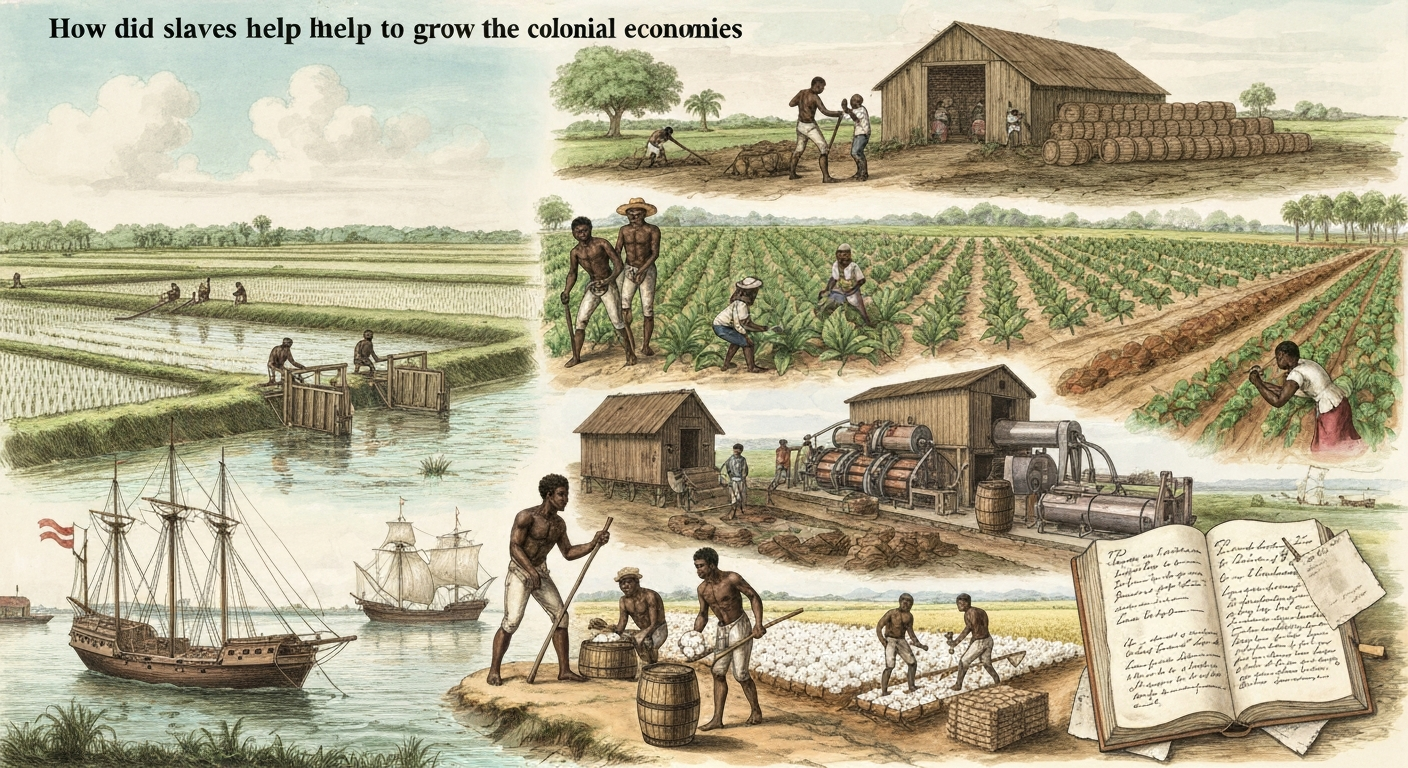
How Enslaved Labor Grew Colonial Economies: Crops & Regions
Enslaved labor's role in growing colonial economies via tobacco, rice, indigo, sugar, cotton.
Why Commercial Crops Were More Profitable Than Subsistence Farming
Commercial crops often paid more due to market demand, better yields, scale, lower unit costs, storage and infrastructur
Why Texas Planters Grew Wealthy in the 1850s
Why Texas planters got rich in the 1850s: cotton boom, land and labor systems, financing, markets, and evidence sources.