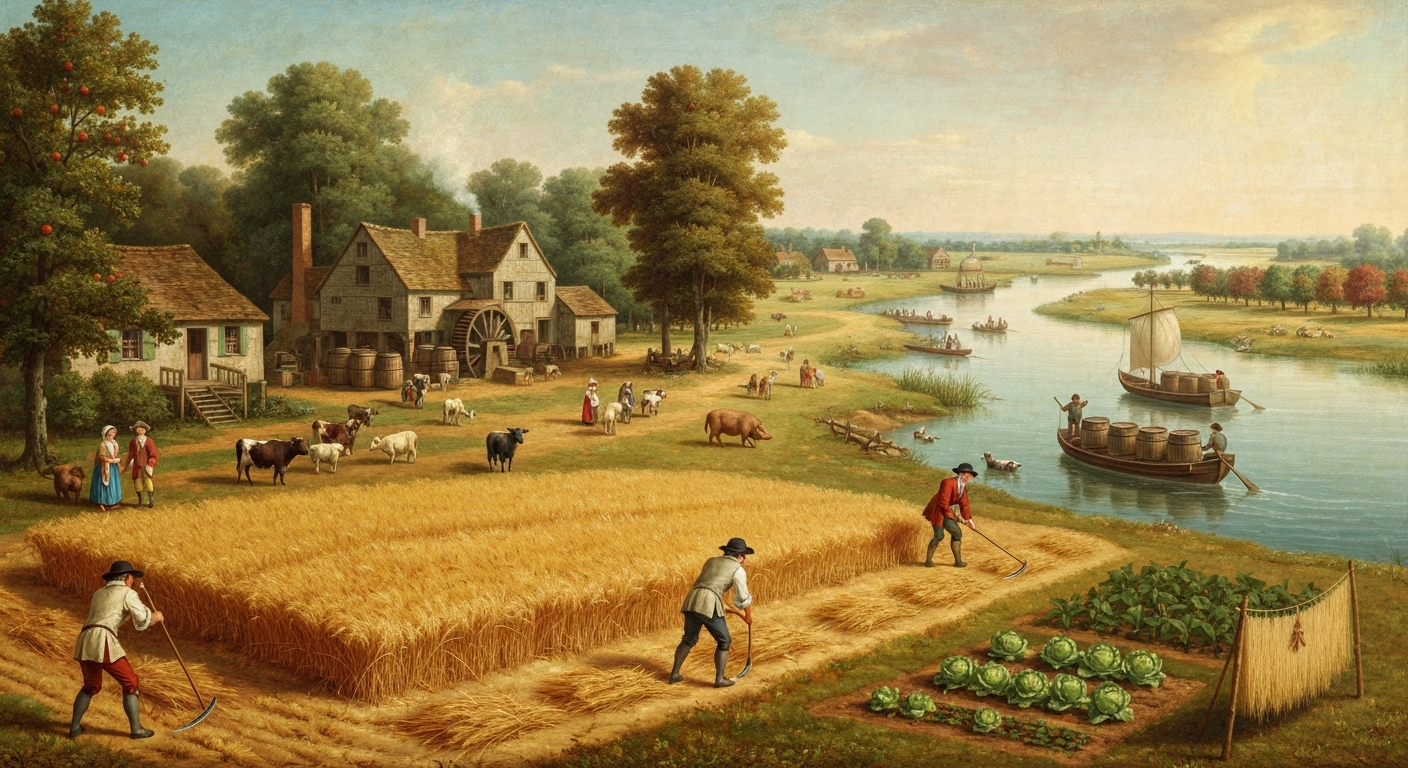
The Delaware Colony grew wheat as its dominant cash crop, along with rye, barley, oats, and corn for subsistence and feed. Farmers also raised flax and hemp for fiber, kept kitchen gardens, cultivated apple and peach orchards, and ran mixed livestock operations producing butter, cheese, pork, and beef. Wheat milled at the Brandywine and Christina complexes near Wilmington was barreled as flour and shipped to Philadelphia, the West Indies, and other Atlantic markets, making grain the economic engine of colonial Delaware agriculture from the late 17th century through the 18th century.
What Did the Delaware Colony Grow: Crops, Uses & Legacy

Samuel Rourke
25 Jul 2026
Quick Answer: Delaware Colony's Principal Crops and Livestock
If you need a fast reference, here are the main crops and livestock raised in the Delaware Colony during the colonial period.
- Wheat (soft red winter) — the primary cash and export grain
- Corn (Indian corn/maize) — subsistence staple and hog feed
- Rye — subsistence grain, livestock feed, and local barter
- Barley — livestock feed, local brewing, and small-scale market sale
- Oats — feed grain for horses and cattle
- Hay — essential winter fodder for all livestock
- Flax and hemp — fiber crops processed on-farm into linen and cordage
- Vegetables (kitchen gardens) — beans, peas, cabbages, turnips, and root crops for household use
- Apples and peaches (orchards) — household consumption, cider, and local sale
- Cattle — dairy (butter, cheese) and beef
- Swine — primary household meat source
- Sheep — wool and mutton
What Delaware Colony Farmers Actually Grew: A Full Breakdown
Colonial Delaware agriculture was built on a combination of subsistence crops that fed the farm household and cash crops that generated income through regional and Atlantic trade. The distinction matters because it explains how farmers made decisions about land use and what they prioritized in good and bad years.
Grains
Wheat was king. Soft red winter wheat planted in the fall and harvested in summer suited the Delaware climate well, and by the 18th century it dominated the commercial side of farming across New Castle and Kent counties. Estate inventories and mill records make this clear: by 1786, Wilmington merchants were processing approximately 20,783 barrels of superfine flour annually at the Brandywine mills, with the broader Brandywine mill cluster grinding tens of thousands of barrels per year. Rye, barley, and oats rounded out the grain picture. Rye grew on lighter, sandier soils where wheat performed poorly and was used for household bread, as animal feed, and occasionally traded locally. Barley fed livestock and supplied local maltsters and brewers. Oats were primarily a feed grain, essential for the horses and oxen that powered farm work.
Corn, or Indian corn as colonists called it, was the backbone of household subsistence. Farmers grew it to feed themselves, their families, and their hogs. Some corn was kiln-dried for longer storage and coastal shipment, but most stayed on the farm or moved to local markets as cornmeal. Corn is one of the few crops with clear continuity from Indigenous agricultural practice into colonial farming in the region.
Hay
Hay rarely gets the attention it deserves in colonial agricultural histories, but it was as critical as any grain crop. Without sufficient hay, livestock did not survive mid-Atlantic winters, and without livestock, farms could not plow, haul, or fertilize. Probate inventories from Kent and New Castle counties consistently list hay in barns alongside grain stores, confirming that farmers allocated real land and labor to hay production every season.
Flax and Hemp
Flax was a standard crop on Delaware farms throughout the colonial period. Estate inventories regularly list flaxseed (sometimes in quantities like five pecks), along with the processing equipment: spinning wheels, looms, hatchels (the combing tools used to separate fiber), and finished linen cloth. Most flax was processed and woven at home, producing the linen fabric that clothed farm families and furnished households. Some farms also grew hemp, which provided coarser fiber for rope and cordage. Both crops reflect how self-sufficient these households tried to be, producing not just food but the raw materials for clothing and household textiles.
Vegetables and Kitchen Gardens
Every colonial Delaware farm kept a kitchen garden. Beans, peas, cabbages, turnips, onions, and root vegetables like parsnips and carrots were standard. These provided fresh food in season and preserved food (dried, salted, or root-cellared) through winter. Archaeological surveys of colonial farmsteads in Kent County and elsewhere have turned up evidence of food-processing areas consistent with preservation activities. Kitchen gardens were primarily subsistence operations and rarely entered formal trade, but they were indispensable to the household economy.
Orchard Fruits
Apples and peaches thrived in Delaware's climate, and both were widespread on colonial farms. Apples were pressed into cider, which served as a safe everyday drink in an era when water quality was uncertain, and were also dried or stored for winter eating. Peaches were particularly well-suited to Delaware's sandy soils, especially in lower Kent and Sussex counties. Both fruits were consumed on the farm, traded locally, and in some cases distilled. Orchards represented a long-term investment: planting trees took years to pay off, so their presence in estate inventories signals stable, established farm operations.
Livestock and Dairy
Mixed livestock operations were universal. Probate inventories across all three Delaware counties (New Castle, Kent, and Sussex) list cows, calves, sheep, and swine alongside churns, milk pans, and cooperage. This means farms were actively producing butter and cheese for household use and local sale, not just keeping animals for occasional slaughter. Swine were the primary meat animal: pigs were cheap to raise (they foraged and ate farm scraps and surplus corn), reproduced quickly, and preserved well as salt pork and bacon. Cattle provided dairy, beef, and draft power. Sheep contributed wool for home spinning and mutton. Hides from cattle and hogs also appear in merchant records as goods traded to Wilmington and Philadelphia buyers.
| Crop / Product | Type | Primary Use | Subsistence or Cash/Export |
|---|---|---|---|
| Wheat | Grain | Flour, bread, Atlantic trade | Cash/Export |
| Corn (maize) | Grain | Household food, hog feed, cornmeal | Subsistence (some coastal trade) |
| Rye | Grain | Bread, feed, local barter | Subsistence |
| Barley | Grain | Feed, local brewing | Subsistence / Local market |
| Oats | Grain | Horse and cattle feed | Subsistence |
| Hay | Fodder | Winter livestock feed | Subsistence |
| Flax | Fiber crop | On-farm linen production | Subsistence (some local sale) |
| Hemp | Fiber crop | Rope and cordage | Subsistence / Local market |
| Vegetables | Kitchen garden | Household food | Subsistence |
| Apples | Orchard fruit | Cider, eating, drying | Subsistence / Local market |
| Peaches | Orchard fruit | Eating, distilling, local trade | Subsistence / Local market |
| Butter and cheese | Dairy | Household use, local sale | Subsistence / Local market |
| Pork and beef | Livestock | Household meat, local sale | Subsistence / Local market |
| Hides and wool | Livestock byproduct | Local merchant trade | Local market / Export |
Why Delaware Was Good Farmland: Climate, Soils, and Water
Delaware sits at a sweet spot for mid-Atlantic agriculture. The colony's climate falls in a humid temperate zone with warm summers and cool but not brutal winters, giving farmers a growing season of roughly 180 to 200 days in the north and somewhat longer toward the southern coast. That is plenty of time for winter wheat to mature, for corn to fill out, and for orchards to produce well. Frosts come late enough in fall and early enough in spring to match the rhythms of the crops colonists most wanted to grow.
Soils vary significantly across the colony's short north-to-south span. The northern third, around New Castle County, sits on the Piedmont, where heavier, loamier soils supported productive wheat and rye cultivation. The middle and southern portions of the colony (Kent and Sussex counties) transition to the Coastal Plain, where lighter, sandier soils were better suited to corn, peaches, and sweet potatoes than to heavy grain production. This soil gradient directly explains the crop variation between counties, which I'll cover in more detail when I get to regional differences.
Access to water was transformative. The Delaware River, Delaware Bay, the Christina River, and the Brandywine Creek were not just geographic features but the logistical infrastructure of colonial agriculture. Farmers could move bulky grain by water far more cheaply than by road. The Brandywine's fall line (where the water drops elevation sharply) powered the merchant mills that turned raw wheat into exportable flour. Without that water-powered milling and the river access to ship product downstream, Delaware wheat farming would have been a much more local, subsistence-oriented enterprise.
Trade Routes and Market Demand: Who Bought Delaware's Crops
Philadelphia was the commercial hub that made Delaware's grain surplus worth producing. Wilmington merchants connected Delaware farmers to Philadelphia's export network by receiving wheat from farmers in all three counties, milling it at the Brandywine and Christina complexes, coopering it into barrels, and loading it onto sloops and schooners bound for Philadelphia or directly to the West Indies. A letter from Wilmington dated April 22, 1808, recorded in the Founders Online archive, documents schooners carrying hundreds of barrels of flour suspected for Barbados, which confirms the Caribbean as a real and sustained end market for Delaware flour well into the early national period.
The internal geography of trade was equally important. Farmers in Kent and Sussex counties, farther from the mills, used Christiana Bridge (the head of tide on the Christina River) as a collection point. They moved wheat and corn by wagon to the bridge, then by barge downstream to the Christina and Brandywine mills. Merchants recorded these transactions in daybooks and account books that are now held in the Hagley Museum and Library collections, and they confirm that the trade network extended deep into the lower counties. Hides, barley, and secondary produce also traveled these same routes, though in smaller volumes.
It is worth comparing this to the Southern Colonies' export structure. For more on what the Southern Colonies grew, tobacco, rice, and indigo, see the related article what did the Southern Colonies grow. Virginia and the Carolinas organized their agriculture around tobacco, rice, and indigo destined directly for British markets, and the European Caribbean colonies were almost entirely devoted to sugar. Delaware, by contrast, fed an Atlantic food trade rather than a luxury or manufactured-goods trade. Its flour went to feed populations in the Caribbean and along the Atlantic seaboard, making Delaware's agriculture more aligned with the other Middle Colonies (Pennsylvania, New York, New Jersey) than with its southern neighbors.
How Delaware Farms Operated: Size, Tools, Rotations, and Mills
Regional studies of the 18th-century mid-Atlantic farm give us a reasonable sense of typical scale. A working family farm ran around 125 acres, with perhaps 26 acres planted to wheat in a given year. At period yields, that might produce roughly 345 bushels, leaving a marketable surplus of somewhere around 50 to 60 bushels after the household and livestock took their share. It was enough to participate in the market, but not enough to make any one farmer wealthy. Wealth accumulated at the mill and merchant level, not in the fields.
Crop rotations were practiced, though not always with the formal systematic rigor that agricultural improvers would later advocate. A common pattern involved rotating wheat with corn, then fallowing or putting ground to hay and pasture. This preserved some soil fertility in the absence of commercial fertilizers and reduced pest and disease pressure from continuous grain monoculture. Manure from livestock, especially cattle and swine, was the primary soil amendment and was spread on fields closest to the farmstead.
Tools were basic but effective: iron-shod wooden plows pulled by oxen or horses, harrows for seedbed preparation, scythes and cradles for grain harvest, flails for threshing on barn floors, and winnowing fans or baskets for cleaning grain. Oxen were common on smaller farms because they were cheaper to keep than horses (they ate hay and could be slaughtered for beef when their draft days were over). Wealthier farms ran horses. Mills were essential infrastructure: gristmills for corn and grain, and the large merchant flour mills at the Brandywine that sorted, ground, and bolted wheat into grades of flour for export. Flour Milling (Encyclopedia of Greater Philadelphia) notes the Brandywine and Christina complexes were merchant‑oriented mills with cooperages and wharf access, and that local cooperage, shipping, and kiln‑drying practices supported the export of flour and meal. Cooperages attached to the mills produced the barrels that made shipping possible.
Who Did the Work: Labor on Colonial Delaware Farms
The most common labor arrangement in colonial Delaware was the family farm, where the household itself provided most of the labor. Husbands, wives, and older children all worked. Men handled field work, livestock management, and heavy construction. Women managed the dairy, kitchen garden, food preservation, and textile production (including spinning flax into thread and weaving linen on the household loom). This domestic manufacturing work is often invisible in histories focused on grain and trade, but probate inventories make it tangible: spinning wheels, looms, hatchels, and finished cloth appear regularly in estate records alongside the grain barrels. Probate inventories and regional archaeological studies documenting spinning wheels, looms, hatchels, barrels of grain, cows, sheep, churns, and cooperage are detailed in Historical Archaeology of the Delaware Valley, 1600–1850 (University of Tennessee Press).
Tenant farming was also widespread, particularly on larger landholdings. Landowners rented parcels to tenant families in exchange for a share of the crop or a fixed cash payment. This allowed land to be worked productively without the owner needing to manage it directly, and gave tenant families a path to building capital toward their own land purchase.
Indentured servants played a significant role in the 17th century and into the early 18th century, particularly in New Castle County. Servants arrived under contract to work for a set term (typically four to seven years) in exchange for passage, housing, and freedom dues at the end of the contract. Their labor filled gaps on farms that were too small to justify enslaved workers but too demanding for family labor alone.
Enslaved labor was present in colonial Delaware but on a smaller scale than in the Chesapeake or Carolina colonies. Enslaved people appear in estate inventories and probate records for wealthier households, particularly in New Castle County. The scale never approached the plantation system of the Southern Colonies, where tobacco, rice, and indigo production drove massive demand for coerced labor. Delaware's grain-and-livestock economy, organized around family and tenant farms, did not generate the same economic incentive for large-scale enslavement, though the practice was real and the people involved bore very real costs. Wage labor, hired by the day or season for harvest work especially, also supplemented family labor as the century progressed.
How Agriculture Differed Across New Castle, Kent, and Sussex
Delaware's three counties are a short distance apart, but they represent meaningfully different agricultural environments, and colonial farmers responded accordingly.
New Castle County: The Wheat Belt
New Castle County, in the north, had the best soils for wheat: heavier Piedmont loams that held moisture and nutrients better than the sandy coastal plain to the south. It also had direct proximity to the Brandywine and Christina mill complexes and the port of Wilmington, meaning farmers could move grain to market with relatively low transport costs. New Castle farms were more commercially oriented, more likely to produce meaningful wheat surpluses, and more integrated into the Philadelphia merchant network. Indentured servants and, to a lesser extent, enslaved labor were more common here than in the lower counties, reflecting the greater commercial intensity.
Kent County: The Middle Ground
Kent County was the transition zone. Its soils were lighter than New Castle's but still productive for wheat and corn, and Christiana Bridge provided river access to the mills. Kent farms ran a genuine mix of wheat for cash and corn for subsistence, with robust livestock operations. Archaeological and documentary evidence from Kent County farmsteads shows the full range of mixed husbandry: grain storage, dairy implements, butchery evidence, and textile-processing tools all appear together. Distance from the main mills added transport cost and dampened commercial intensity compared to New Castle, but Kent farmers were active participants in the regional grain trade.
Sussex County: Corn, Peaches, and Coastal Trade
Sussex County, in the south, was the most rural and subsistence-oriented of the three. Sandy, lighter soils were less hospitable to wheat but suited corn and peaches well. The county was more isolated from the Brandywine mills, which raised transport costs and reduced the profitability of wheat as a cash crop. Coastal access via the Delaware Bay gave some Sussex farmers an outlet for kiln-dried corn and other produce through small-scale coastal shipping, but the agricultural economy here was more oriented toward feeding the household and local community than toward Atlantic export. Sussex also had the closest cultural ties to the Eastern Shore of Maryland, reflecting a similar landscape and economy across that regional border.
Delaware vs. Other Colonial Regions: How It Compares
Understanding Delaware's agriculture is easier when you place it next to its neighbors and contrast it with more distant colonial regions. Delaware fit squarely within the Middle Colonies grain belt, sharing wheat-focused export agriculture with Pennsylvania and parts of New York and New Jersey. For a detailed overview of crops across Pennsylvania, New York, New Jersey, and Delaware, see what did the Middle Colonies grow. If you look at what the Middle Colonies grew as a whole, Delaware is essentially the southern end of that same system, differentiated mainly by its smaller size and the dominance of the Brandywine mill complex as its processing hub.
The contrast with the Southern Colonies is sharp. Virginia's colonial agriculture, including the early Jamestown settlement, was built around tobacco as a cash crop, with corn playing a supporting subsistence role rather than a market one. The Carolinas added rice and indigo to that export portfolio. None of these crops appeared as meaningful commercial products in Delaware. The climatic and soil differences are part of the reason, but so is the different labor system and the different market orientation. Southern plantation agriculture required large workforces of enslaved people to be profitable; Delaware's grain-and-livestock system worked on family and tenant scales.
The comparison with the European Caribbean colonies is even more stark. Those islands, producing sugar, cotton, and tropical commodities for European markets, were monoculture export economies dependent almost entirely on enslaved labor at massive scale. Delaware's mixed-grain farms could not be more different in structure, crop selection, or social organization. Delaware was actually a supplier to those Caribbean islands, sending flour and corn to feed the plantation labor force that grew sugar. That relationship puts the two agricultural systems in direct economic contact even while they were agronomically worlds apart.
New England, by contrast, shared Delaware's grain-and-livestock mixed farming model, but with shorter growing seasons, rockier soils, and less navigable river infrastructure. For more on regional crops, see what did the New England colonies grow for details on New England's typical crops and farming practices. New England farmers produced for local consumption and coastal trade rather than for the Atlantic flour export market that Delaware accessed through Philadelphia. The relative advantage Delaware and Pennsylvania held in grain milling and river transport explains why the Middle Colonies became 'the breadbasket of the colonies,' a label that never quite applied to New England.
From Colonial Fields to Modern Delaware Agriculture
The crops that defined colonial Delaware agriculture still show up in the state today, though the scale and context have changed dramatically. Corn remains one of Delaware's most widely grown crops, now predominantly field corn used in animal feed, ethanol, and processed food rather than household subsistence. Soybeans, which arrived later, now dominate the same Coastal Plain soils in Kent and Sussex that once grew subsistence corn and peaches. Wheat is still grown in Delaware, particularly in the north, though the state is a minor player compared to the great Plains wheat belt. The peach orchards that once made Sussex County a regional fruit producer have largely disappeared, victims of disease and competition, though small orchards persist.
What has truly persisted is the agricultural logic: Delaware's flat, fertile coastal plain soils, relatively mild climate, and access to mid-Atlantic markets still make it productive farmland. The crops have changed, the scale has changed, and the labor system has been transformed, but the underlying geographic reasons that made colonial Delaware a productive agricultural colony still hold.
FAQ
Quick answer: What were the main crops of the Delaware Colony in the 17th–18th centuries?
Main crops and products: grains (soft red winter wheat as the principal market grain, plus rye, barley, oats, and maize/corn), hay, flax and hemp (for fiber), vegetables (garden produce for household use and local sale), orchard fruits (notably apples and peaches), and livestock/dairy (cattle, hogs, sheep for meat, hides, butter and cheese). Wheat was the leading cash/export crop, often milled at Brandywine/Christina mills and shipped from Wilmington to Philadelphia, the Caribbean and other markets.
Can you provide a categorized list of crops and their typical uses (subsistence vs. cash/export)?
Categorized crop list and uses: - Market/export cash crops: soft red winter wheat (barreled flour shipped via Brandywine/Wilmington), some kiln‑dried maize for coastal trade. - Local market and cash: barley and oats (brewing, feed), hides and tallow. - Subsistence and farm feed: maize/corn (meal, livestock feed), hay. - Household manufacture and local sale: flax and hemp (linen, rope, cordage), orchard fruits (apples/peaches for cider, drying, local sale), vegetables (beans, peas, root crops). - Livestock/dairy: cattle, hogs, sheep for meat, milk, cheese, butter, and hides; hogs in particular were raised for household provisioning and local markets.
Why did these crops thrive in colonial Delaware? (environmental and market factors)
Environmental and market reasons: - Climate and soils: temperate mid‑Atlantic climate with a long growing season and fertile glacial and alluvial soils (especially along river and tidewater flats) suited to mixed grains, hay and orchards. - Waterways and ports: Christina and Brandywine creeks, the Delaware River, and Wilmington provided milling sites, cooperage and transshipment points to Philadelphia, coastal routes and Caribbean markets. - Market access and infrastructure: merchant mills (Brandywine cluster), cooperages, local sloops and coastal shipping enabled efficient conversion of wheat to barreled flour and export. - Labor and technology fit: family and tenant farms using available draft animals, simple mill technology and household textile tools (spinning wheels, looms) matched the region’s diversified agricultural economy.
How were crops produced, processed and marketed in colonial Delaware?
Production, processing and marketing: - Production: mix of small family farms and some larger holdings growing a rotation of grains, flax/hemp, and maintaining livestock. Typical farms might reserve a portion of acreage for wheat (marketable surplus) with corn and vegetables for household use and feed. - Processing: wheat often taken to merchant mills (Brandywine/Christina) for grinding into flour; on‑farm processing included threshing, kilns for drying corn, flax retting and spinning/loom work for linen, and cooperage for barrel production. - Marketing: farmers sold wheat/barley/hides to Wilmington merchants; barrelled flour was loaded at Wilmington and shipped by coastal vessels to Philadelphia and the West Indies. Probate inventories, daybooks and merchant papers document these commercial links and volumes (e.g., tens of thousands of barrels at Brandywine mills by the 1780s).
What were common farming systems and labor arrangements in Delaware during this period?
Farming systems and labor: - Farm scale and organization: predominantly family farms with draft animals; some tenant farms and a minority of larger merchant‑oriented holdings. - Labor arrangements: household family labor (men, women and children) performed most tasks; tenant and hired labor supplemented families on larger farms. Indentured servants were still present in the 17th century; enslaved labor existed in Delaware too, though at lower intensities than in the Chesapeake and Deep South. - Division of labor: men typically handled field work and draft animals; women spun, wove and processed flax, maintained gardens, dairied and preserved food; cooperage and mill work were artisan/merchant activities in towns.
How did Delaware agriculture compare directly with other colonial regions (Middle Colonies, New England, Southern colonies, Caribbean)?
Regional comparisons: - Middle Colonies (broadly): Delaware shared many traits—mixed grain–livestock farming, substantial wheat production, and household textile production. It was often integrated into the larger Middle‑Colony grain economy centered on Philadelphia. - New England: New England farms were smaller, rockier and more oriented to subsistence, livestock and small‑scale orchards; less emphasis on large wheat surpluses for export. - Southern colonies (e.g., Virginia/Jamestown): Southern planters emphasized tobacco as a dominant cash crop in Virginia; plantations were larger and relied more heavily on enslaved labor, with export patterns and labor intensity differing from Delaware’s mixed farms. - Caribbean/European colonies: Caribbean colonies focused on sugar (and in some islands indigo) for export, with extremely plantation‑scale monoculture and heavy reliance on enslaved African labor—contrasting sharply with Delaware’s mixed, smaller‑scale grain/livestock system.
Next Articles
What Did Jamestown Grow and How They Farmed It
Learn what Jamestown colonists grew and the methods they used to plant, harvest, and adapt crops to Virginia conditions.
What Did the New England Colonies Grow? Major Crops
Major New England colonial crops explained by climate and soil, from corn and wheat to beans and hay, plus today’s paral
What Europeans Mostly Grew in Caribbean Colonies
Learn which crops Europeans dominated in Caribbean colonies, especially sugarcane, plus key supporting estate plants by