
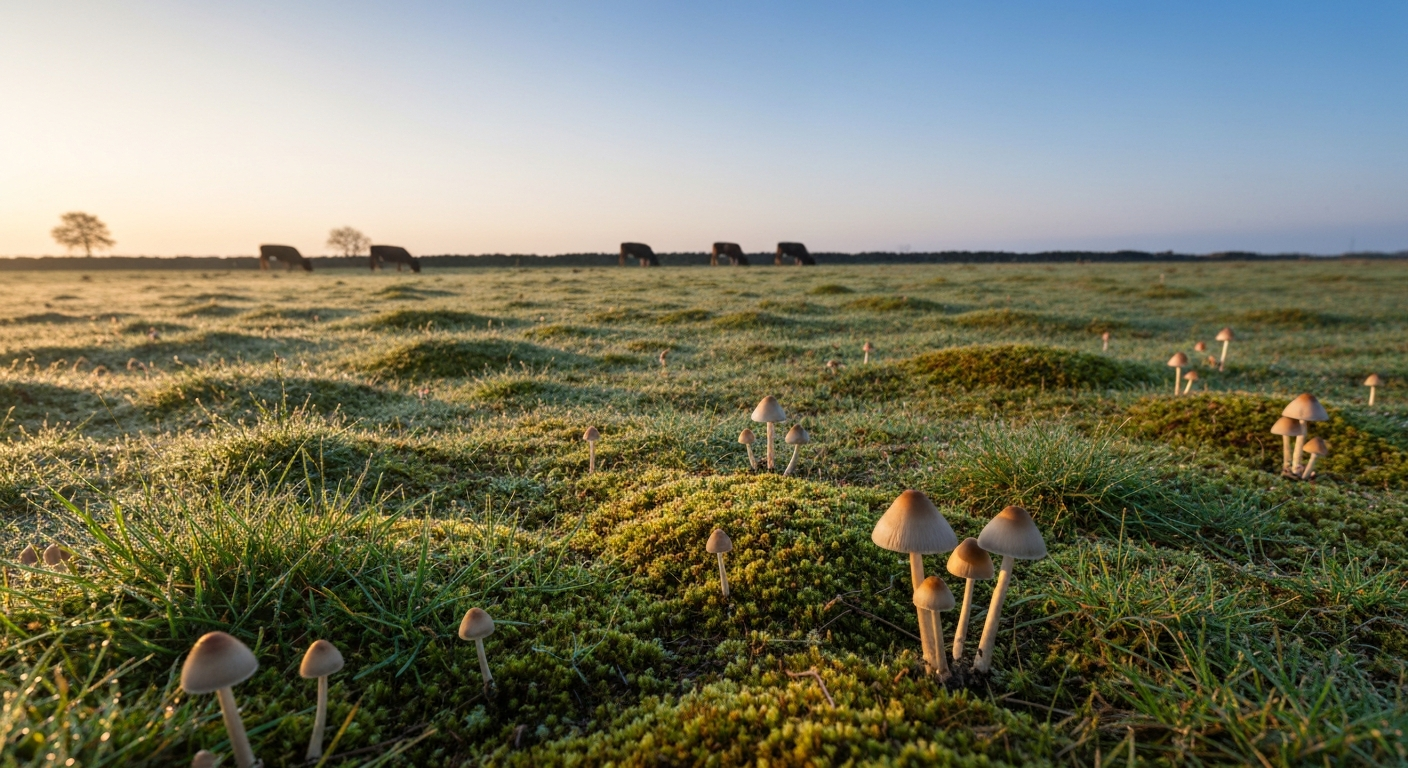
Yes, liberty caps (Psilocybe semilanceata) do grow in cow and horse fields, along with sheep pastures and other grazed grasslands. They are not growing because of the animals' dung, though. Liberty caps are saprotrophic fungi that fruit from the soil and decomposing grass root-mat of long-established, unimproved pastures. Grazing animals help create the right conditions: a short, patchy sward, minimal fertiliser input, and intact soil structure. Find that kind of traditional, low-intensity pasture in a temperate climate and you have a reasonable chance of finding liberty caps in autumn.
Do Liberty Caps Grow in Cow Fields and Horse Pastures?

Samuel Rourke
5 Aug 2026
Who this article is for
This piece is written for a wide audience, each with a different reason for asking the question. Students researching grassland ecology or fungal distribution will find the habitat, geographic, and seasonal data useful for assignments and field projects. Farmers and land managers with cattle, horses, or sheep need to know whether their pastures are likely to harbour liberty caps and what, if anything, they can or should do about it. Gardeners who manage old meadow turf or paddocks may encounter these mushrooms and want to identify them responsibly. Historians and agricultural researchers tracing land-use patterns will find the link between traditional low-input farming and grassland fungal diversity worth noting. Public health workers and extension agents dealing with accidental ingestion cases will find the identification, look-alike, and safety sections directly applicable.
What are liberty caps exactly
Psilocybe semilanceata is the species most people mean when they say 'liberty cap.' It is a small, slender grassland mushroom belonging to the family Hymenogastraceae. The name 'liberty cap' comes from the cap shape: a sharply pointed, conical to bell-shaped pileus that looks like the Phrygian cap worn as a symbol of freedom in ancient Rome and later in revolutionary France. The species contains the psychoactive compounds psilocybin and psilocin, which places it in a legally restricted category in most countries.
The broader Psilocybe genus contains over 100 species globally, but semilanceata stands out as the temperate grassland specialist. It is sometimes grouped informally with a handful of similar small grassland Psilocybes: P. strictipes (which lacks the pronounced nipple-like papilla), P. pelliculosa (a North American woodland and edge species), and the dung-growing P. fimetaria and P. coprophila. Modern molecular work confirms that the 'semilanceata-like' complex includes several look-alike taxa, so morphological identification alone has real limits, especially when confirming records in new geographic areas.
The pasture conditions where liberty caps are most likely to appear
Not every cow field is equal from a liberty cap perspective. The species has a strong preference for long-established, unimproved pastures: fields that have not been ploughed and reseeded in living memory, have never been treated with synthetic nitrogen fertiliser, and carry a diverse sward of fine grasses and mosses. These are often called 'old permanent pasture' in the UK or 'unimproved grassland' in conservation surveys. Think hill farms, traditional hay meadows grazed in late summer, old parkland, and low-input upland cattle farms.
Soil type matters. Liberty caps favour slightly acidic to neutral, free-draining soils with a well-developed root-mat and organic horizon. Heavy clay soils that waterlog badly or highly alkaline chalk soils are less productive habitat. The grass surface itself should be short to medium height, kept open by grazing pressure rather than left rank. Grazing by cattle, horses, or sheep all produce acceptable sward conditions, though the specific animals matter less than the management style: low stocking density, no fertiliser application, and continuity of grassland going back decades.
Importantly, liberty caps do not grow directly from dung. This surprises many people. The confusion arises because pastures obviously have animal waste present, and some closely related Psilocybe species (P. fimetaria, P. coprophila) genuinely are coprophilous and will fruit from fresh herbivore dung. P. semilanceata, by contrast, fruits from the soil and decomposing grass roots, typically emerging through the turf a little distance from any dung pat. Moss-covered areas within pastures, especially where the sward is slightly depressed or damp, often produce the densest clusters.
| Condition | Favourable | Unfavourable |
|---|---|---|
| Pasture history | Long-established (decades+), never ploughed | Recently reseeded or cultivated |
| Fertiliser use | None or minimal (unfertilised) | Regular NPK or slurry application |
| Sward height | Short to medium, grazed or cut low | Rank, ungrazed, or very heavily poached |
| Soil type | Slightly acidic to neutral, free-draining loam | Heavy waterlogged clay or highly alkaline chalk |
| Moisture | Consistently moist surface, especially in autumn | Dry or drought-stressed turf |
| Moss/root-mat | Well-developed moss and grass root-mat present | Bare soil, compacted, or recently disturbed |
| Direct dung | Not required; species is NOT coprophilous | Dung patches alone do not produce P. semilanceata |
| Grazing animals | Cattle, horses, sheep all compatible if low-input | None (ungrazed rank meadow) or over-stocked |
Why liberty caps turn up in grazed pastures: the ecology behind it
Liberty caps occupy a saprotrophic niche: they break down organic matter in the soil rather than forming mycorrhizal partnerships with plant roots or parasitising living tissue. Their mycelium lives within the decomposing grass root-mat, processing plant debris in the upper soil horizon. This makes them heavily dependent on the quality and continuity of that root-mat. Long-established pastures build up a rich, layered organic horizon over decades, and it is exactly this structure that supports the species.
Grazing animals contribute indirectly in several ways. Research on sward management and grassland basidiomycete fungi (Griffith et al. A review chapter, Saprotrophic basidiomycetes in grasslands: distribution and function, review chapter (Griffith et al. / BMS symposia), places Psilocybe and related small brown grassland agarics within saprotrophic grassland fungal assemblages dependent on soil/root organic matter and long continuity of grassland, and highlights their sensitivity to nutrient enrichment and management blank" rel="noopener noreferrer">Saprotrophic basidiomycetes in grasslands: distribution and function — review chapter (Griffith et al. / BMS symposia). , 2012, Biological Conservation) shows that grazing height, timing, and stocking density all influence fruiting patterns in grassland fungi. Cattle and horses create a heterogeneous sward: patches of very short turf alongside slightly taller areas, open spots where hooves have compressed the surface, and localized nutrient variation from urine and dung. This patchiness actually benefits grassland fungi by creating a mosaic of microhabitats. A uniformly managed, heavily fertilised silage field, by contrast, produces a dense monoculture of ryegrass and suppresses most grassland fungal diversity.
Nutrient enrichment is the biggest enemy. Nitrogen fertiliser, slurry application, and even concentrated dung patches from very high stocking densities all raise soil nitrogen levels, which favours fast-growing grasses over the low-nutrient-adapted grassland fungi. Veterinary anthelmintics (wormers) have also been flagged in the conservation literature as a potential concern, since ivermectin and similar compounds pass through animal guts in active form and can affect dung-decomposing invertebrates and fungi alike. The exact threshold effects on P. semilanceata populations are not yet fully resolved, but the direction of the effect is clear: intensive management reduces grassland fungal diversity.
Where in the world they grow: geographic and climate distribution
Liberty caps are primarily a temperate grassland species. Their core distribution covers the cool, moist grasslands of western and northern Europe: the United Kingdom and Ireland (where records are particularly dense and well-documented), Scandinavia, the Low Countries, France, Germany, and into central Europe. GBIF occurrence data aggregates thousands of georeferenced records globally, with the heaviest clustering in the UK, Ireland, the Netherlands, and Scandinavia. These are exactly the regions where low-input pastoral farming has persisted longest and where the cool, moist climate favours late-season fungal fruiting.
In North America, P. semilanceata records exist but are more scattered. The Pacific Northwest (Oregon, Washington, northern California) is the most frequently reported area, where the climate is suitably cool and wet in autumn. Some records exist from the northeastern US and eastern Canada, though verified, sequence-confirmed records are rarer than the many citizen-science observations would suggest. The semilanceata-like complex includes look-alikes such as P. pelliculosa in Pacific Northwest woodlands, so geographic range claims should be treated cautiously without molecular confirmation.
Australasia also has verified records. New Zealand and parts of southern Australia (where European settlers introduced European grass species) have produced confirmed P. semilanceata collections, and the species is listed in national biodiversity databases including the Biota of New Zealand and the Atlas of Living Australia. South America has some reports as well, particularly from Chile and Argentina, again in areas of cool temperate grassland. The genomics literature (Microbiology Resource Announcements, 2024) lists the species as 'widely distributed in temperate grasslands across Europe, Australasia and the Americas,' a characterisation that is well-supported by vouchered material. High‑quality draft genomes of ecologically and geographically diverse Psilocybe species, Microbiology Resource Announcements (2024) lists Psilocybe semilanceata as the type species and reports it as widely distributed in temperate grasslands across Europe, Australasia and the Americas, based on vouchered wild collections High‑quality draft genomes of ecologically and geographically diverse Psilocybe species — Microbiology Resource Announcements (2024).
| Region | Occurrence status | Typical habitat | Climate zone |
|---|---|---|---|
| UK and Ireland | Very well documented, thousands of records | Unimproved upland and lowland pasture, old lawns | Cfb (oceanic, cool and moist) |
| Scandinavia and Low Countries | Well documented, many verified records | Old meadows, lightly grazed pasture | Cfb to Dfb (cool temperate) |
| Central and southern Europe | Present but less frequent | Montane pastures, older meadows | Cfb to Dfb at elevation |
| Pacific Northwest USA/Canada | Reported, some verified records | Cool moist grasslands, parks, old pasture | Cfb (oceanic) |
| Northeastern USA/eastern Canada | Occasional, verification quality varies | Old pastures, lawns, golf courses reported | Dfb (humid continental) |
| New Zealand and SE Australia | Confirmed, in national databases | Introduced grass pastures, parks | Cfb / temperate oceanic |
| Chile and Argentina | Some reports, fewer verified sequences | Cool temperate Patagonian grasslands | Cfb to Csb (temperate) |
When they fruit: seasonality and the triggers that bring them up
In the UK and Ireland, the main fruiting season runs from late August through November, with September and October being the peak months. In Scandinavia the window is slightly earlier, tracking the shorter growing season. In the Pacific Northwest of North America, October and November are the most productive months. The pattern is consistent: liberty caps fruit in cool, moist conditions after the heat of summer has broken. They need the soil to be adequately moist but not waterlogged, and air temperatures generally between about 5 and 15 degrees Celsius.
The most reliable trigger is a period of sustained rainfall following a dry spell, particularly when night temperatures drop noticeably. A classic 'liberty cap autumn' in the UK involves a dry September followed by steady October rain with cool nights. Fruiting bodies are ephemeral: they appear over a few days, release spores, and collapse quickly, especially after frost. This means the productive window at any single site can be as short as one to three weeks in a given year, though the mycelium persists in the root-mat through the rest of the year.
Year-to-year variability is significant. A wet, mild autumn can produce dense flushes across wide areas. A dry October or an early hard frost can result in almost no surface fruiting bodies. This variability makes both citizen-science records and farmer observations inconsistent from year to year, which is worth knowing if you are trying to document historical or regional occurrences: absence in a single year does not mean the species is absent from the site.
Identifying liberty caps in the field
Liberty caps are small, distinctive mushrooms once you know the key features, but they sit in a group of small brown grassland agarics that includes some genuinely dangerous look-alikes. Here are the reliable visual and diagnostic features to work through.
Cap
The cap (pileus) is conical to bell-shaped, 5 to 25 mm across, with a distinctively sharp central nipple (umbo or papilla) that persists even as the cap expands with age. The colour is variable and hygrophanous: in wet conditions it is a dark olive-brown to caramel-tan with a slightly translucent, striated margin; as it dries it fades to a pale straw-yellow from the centre outward. The skin (pellicle) is separable: you can peel a thin gelatinous layer off the cap surface, which is a useful field character.
Gills and stipe
The gills are narrow, adnate to slightly adnexed, pale grey at first and darkening to purple-brown or near-black as the spores mature. The stipe (stem) is long and slender relative to the cap: typically 40 to 100 mm long by 1 to 2 mm thick, often wavy or sinuous, pale cream to light brown, and fibrous rather than brittle. A key field character is that the stipe often has a bluish-green tinge at the base when handled or bruised.
Bruising reaction and spore print
Bruising is an important test. When the flesh or stipe base is damaged or pressed, P. semilanceata typically shows a blue or blue-green colour change within a few minutes. This bluing reaction is caused by the oxidation of psilocin and is characteristic of psilocybin-containing species, though it is not exclusive to them and may be subtle or absent in older or dry specimens. A spore print taken on white paper produces a dark purple-brown to near-black deposit. Spores under a microscope are ellipsoid with a germ-pore and measure approximately 10 to 14 by 6 to 8 micrometres with dark violet-brown walls. Flask-shaped cheilocystidia with elongated necks are the key microscopic character used in formal identification keys.
Look-alikes and why misidentification is genuinely dangerous
The most dangerous look-alike in grassland and pasture habitats is Galerina marginata and related Galerina species. Galerina contains deadly amatoxins, the same compounds responsible for the majority of fatal mushroom poisonings worldwide. A small brown agaric with a dark spore print growing in turf could be Galerina. Inocybe species, also found in grassland and field margins, contain muscarine and cause a characteristic cholinergic syndrome (sweating, salivation, small pupils, slow heart rate). Poison centre reviews consistently highlight these two genera as the most common sources of serious harm from small brown pasture mushroom misidentifications.
- Galerina spp.: small brown, grows in turf and on wood; rusty-brown spore print (not purple-black); no bluing; contains deadly amatoxins
- Inocybe spp.: brown, often with fibrous or splitting cap; brown spore print; no bluing; contains muscarine; common in grassland and hedge edges
- Psilocybe strictipes: similar to P. semilanceata but lacks the pointed papilla; North American and northern European pastures
- Psilocybe fimetaria: grows directly from herbivore dung (not from grass root-mat); similar appearance but dung substrate is distinctive
- Conocybe and Pholiotina spp.: small, pale brown, fragile; some contain amatoxins; common in lawns and disturbed turf
The practical limit for non-specialists is real and worth stating plainly: visual field identification of small brown grassland mushrooms is not sufficient to guarantee accurate species identification. Modern taxonomic reviews and molecular studies emphasize that even experienced mycologists use DNA (ITS sequencing) or vouchered herbarium material to confirm tricky records, especially for geographic range extensions. If you are not a trained mycologist, the combination of small, brown, pasture habitat, and dark spore print is not enough to confidently distinguish P. semilanceata from a potentially lethal Galerina.
Legal status and safety considerations
Psilocybe semilanceata is a controlled substance in most countries where it naturally occurs. In the United States, psilocybin and psilocin are Schedule I controlled substances under federal law, making possession, collection, or distribution of liberty caps illegal regardless of intent. In the UK, P. semilanceata is a Class A drug under the Misuse of Drugs Act 1971 (amended 2005). Similar restrictions apply across most of the EU, Canada, and Australia, though a small number of jurisdictions have moved toward decriminalisation or medical-use exemptions in recent years. Farmers and landowners should be aware that the presence of liberty caps on their land does not itself create legal liability, but knowingly facilitating collection could in some jurisdictions. If you suspect someone is collecting controlled fungi from your land, the appropriate response is to consult local legal guidance or contact authorities.
For livestock, there is no well-documented evidence that grazing animals are harmed by incidentally consuming liberty caps. Cattle and horses foraging in pasture may consume fruiting bodies along with grass, but reported toxicity cases in livestock are rare and the literature does not identify P. semilanceata as a significant agricultural veterinary hazard. The greater practical concern is human health: accidental ingestion by children (who may pick and eat small mushrooms in pastures) and deliberate but poorly informed foraging by adults who misidentify look-alikes.
What farmers and land managers can actually do
If you manage pasture and want to reduce the likelihood of liberty caps fruiting, the conservation literature points clearly in the direction of more intensive management: regular fertiliser application, sward reseeding, and increased stocking densities all reduce grassland fungal diversity, including Psilocybe. But this is a significant trade-off: the same management changes that suppress liberty caps also degrade the broader grassland ecology, reduce wildflower diversity, and may compromise agri-environment scheme eligibility. Most land managers in practice accept that a few weeks of autumn fruiting is a manageable situation rather than a reason to restructure their whole farming system.
Practical steps that are more targeted include temporarily restricting public access to affected areas during peak fruiting season (September to November), posting advisory signage, and informing any staff, contractors, or agri-tourism visitors who work the land. Families with young children using the fields should be informed. If you are dealing with a specific public-health concern or repeated incidents of collection on your land, county extension services, the local poison control center, and regional mycological societies are the right points of contact for evidence-based advice tailored to your region.
For students and historians: documenting regional and historical occurrences
If you are researching the historical or geographic distribution of liberty caps, there are several well-established routes. National herbaria hold voucher specimens with collection dates, localities, and habitat notes going back well over a century in some cases: the Royal Botanic Gardens Kew herbarium, the Natural History Museum London, and equivalents in Stockholm, Helsinki, and Edinburgh all hold relevant material. The Finnish Biodiversity Information Facility (laji.fi) and similar national portals provide georeferenced occurrence records with habitat annotations that you can query and download.
GBIF (the Global Biodiversity Information Facility) aggregates records from herbaria, national databases, and citizen-science platforms into a single searchable database. You can filter P. semilanceata occurrences by country, date range, and dataset to build a regional and temporal picture. For North American records especially, prioritising sequence-verified or herbarium-vouchered records over unverified iNaturalist observations will give you a more accurate distributional baseline. Older agricultural records (tithe maps, grazing commons surveys, estate management records) occasionally note 'toadstools' in pasture without species-level identification but can serve as circumstantial land-use context for why certain fields historically supported grassland fungi.
Regional and national mycological societies (the British Mycological Society, the North American Mycological Association, and their regional affiliates) run organised forays and maintain species recording schemes that produce the most reliable distributional data. Contacting your regional society is the best way to access curated local records and to contribute well-documented new observations to the scientific record.
How this connects to broader pasture and crop geography
The story of liberty caps in cow and horse fields is ultimately a story about land use. The species is an indicator of traditional, low-input pastoral farming that has persisted in the same fields for generations. The same management practices that produce the unimproved grassland habitat for liberty caps also shape what other crops and plants thrive in a region: the relationship between livestock, soil structure, and biological diversity runs through all of them. Understanding why certain fungi, wildflowers, or even specific grasses occupy particular fields in particular regions is essentially the same question as understanding why farmers in different regions grow different crops, whether that is driven by soil type, climate, management tradition, or economic pressure. That interplay of geography, climate, and farming practice is the thread connecting grassland ecology to the broader crop geography that this site maps across regions and time periods. For a focused look at a common legume choice in crop rotations, see why do farmers grow field beans. For a related example of how soil type and water management shape crop choices, see what do farmers grow in paddy fields. See the site's page on what do farmers grow in California for a crop-by-crop look at how climate, soil, and management determine regional farming choices.
FAQ
Do liberty caps (Psilocybe semilanceata) grow in cow and horse fields?
Yes. Psilocybe semilanceata—commonly called the liberty cap—is a grassland species that commonly fruits in unimproved or long‑established pastures and grazed turf. It is frequently reported from fields grazed by cattle, horses and sheep, but it normally fruits from the grass/soil/root‑mat rather than directly from fresh dung. Presence depends on local climate, management history and sward condition, so local verification (vouchered specimens or sequence data) is recommended.
Why are liberty caps associated with grazed pastures rather than dung?
Ecologically, liberty caps are saprotrophic members of grassland fungal assemblages that feed on organic matter in the root‑mat and soil. Grazing creates a short, patchy sward and continuity of old turf (root‑mat) that favours fruiting by these fungi. Animal grazing influences microhabitats (compacted patches, urine/dung nutrient hotspots, sward heterogeneity) that alter moisture and organic inputs, increasing the chance of fruiting without the mushrooms growing directly on dung. Some related Psilocybe species are truly coprophilous, but P. semilanceata is typically non‑coprophilous.
What specific pasture conditions favour liberty cap fruiting?
Key pasture habitat features: long‑established, unimproved or low‑input pastures and meadows; short, grazed or mown swards with an intact root‑mat; well‑drained acidic to neutral soils with moderate moisture (often after rainy periods); low fertilizer and minimal reseeding. Heavy agricultural intensification, fertiliser addition, ploughing or loss of long continuity of turf reduces occurrence.
How does grazing regime (cattle vs. horses vs. sheep) affect occurrence?
All three livestock types can create sward conditions that favour liberty caps. Differences matter: stocking density and grazing height influence sward patchiness and root‑mat continuity; horses often create pronounced patchiness; cattle produce different trampling and dung/urine patterns than sheep. The mechanism is via sward structure and microhabitat heterogeneity rather than a strict dependence on a particular animal’s dung.
Where are liberty caps found geographically and in what climate zones?
Distribution is primarily temperate. Regionally: temperate Europe (widespread, best‑documented), parts of temperate North America (scattered reports and some established populations), and records from Australasia and other temperate regions. They favour temperate, oceanic to cool continental climates where autumn/wet season cues trigger fruiting. Exact regional presence should be checked against local records (national atlases, GBIF, regional mycological societies).
When (seasonality) do liberty caps fruit and what lifecycle cues trigger fruiting?
Typical seasonality in temperate regions: autumn fruiting peaks (often September–November in the Northern Hemisphere) following cooling temperatures and increased moisture. Fruit bodies can appear after sustained rain and mild temperatures; fruiting timing varies with latitude, local microclimate and grazing/mowing schedule. In milder oceanic climates they can appear earlier or persist later.
Next Articles
What Do Farmers Grow in Paddy Fields: Crops & Systems
What do farmers grow in paddy fields: rice varieties, non-rice crops, and integrated systems by region and season.
Why Farmers Grow Different Crops in a Field: Rotation & Regions
Why farmers grow different crops in a field: soil, pests, markets, rotations, examples, maps & decision framework.
What Do Farmers Grow in California Most Common Crops
Main California crops by region, climate and season, plus how to verify what farmers grow in your county