
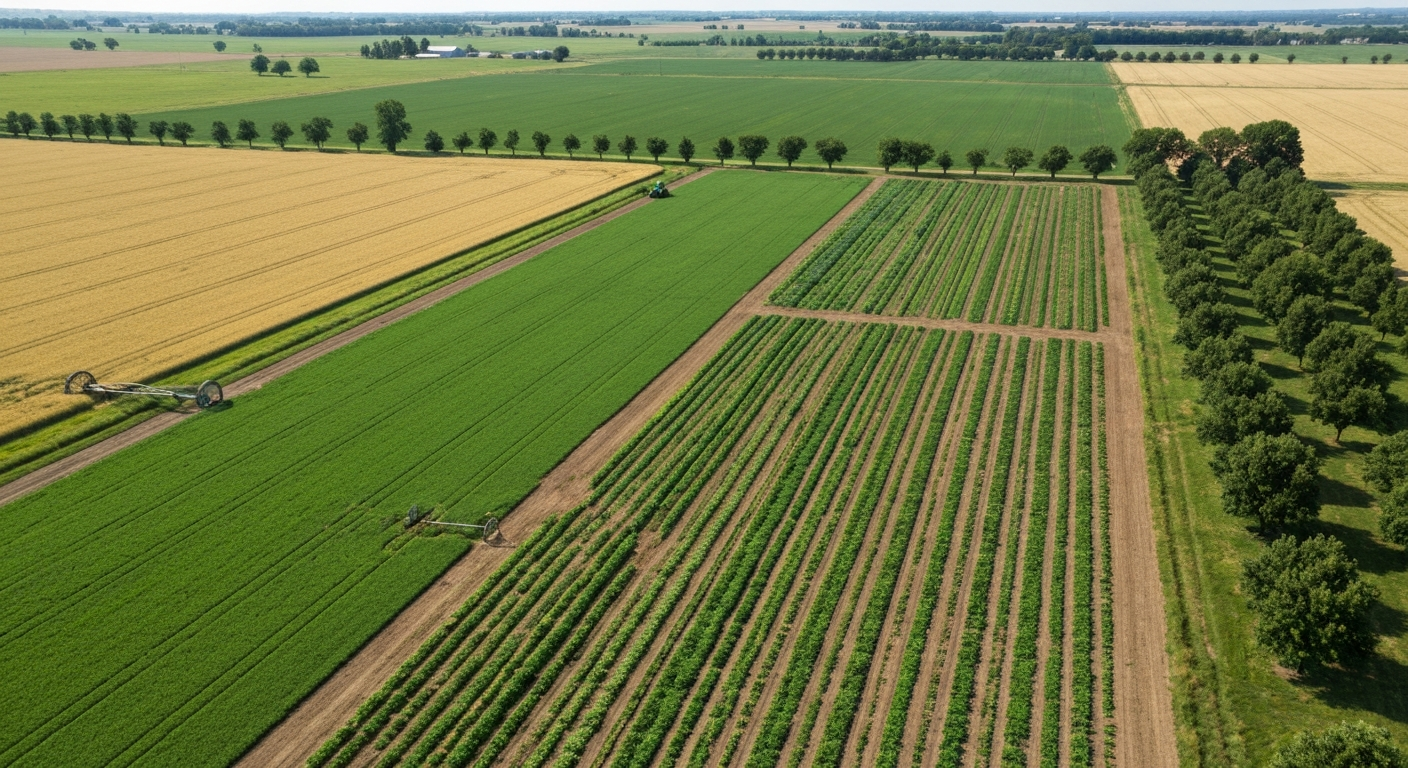
Farmers grow different crops in the same field and across their farm because no single crop can do everything a farm needs. One crop fixes nitrogen while its neighbor uses it. A cereal breaks a disease cycle that would devastate a continuous legume stand. A second vegetable fills a seasonal labor gap while the first is being harvested. A legume cover crop rebuilds soil between cash crops. Put simply, crop diversity is a management tool, not a happy accident, and the evidence behind it is substantial: a meta-analysis of 3,663 paired field trials found that crop rotations consistently deliver yield gains, improved nutritional output, and higher revenue compared with continuous monoculture.
Why Farmers Grow Different Crops in a Field: Rotation & Regions

Samuel Rourke
21 Jul 2026
Key takeaways before you read on
- Crop rotation, intercropping, and cover cropping are the main field-scale methods farmers use to introduce crop diversity.
- Legumes fix an average of roughly 87 kg of nitrogen per hectare per year, reducing synthetic fertilizer costs for following crops.
- Rotating crops breaks pest and disease cycles that accumulate under monoculture, reducing soil-borne pathogen pressure.
- Diversified farms show lower income volatility and higher long-term profitability than monoculture operations, particularly when market access is good.
- Regional context matters: California irrigated polyculture, tropical paddy systems, and Mediterranean dry-land rotations each apply the same core principles in different ways.
- Ancient civilizations from Mesopotamia to Mesoamerica developed proto-rotation practices thousands of years before the science was formalized.
- FAO's Global Agro-Ecological Zones (GAEZ v4) database is the standard reference for mapping which crops suit which regions and climates.
Why growing a single crop everywhere is a problem
If you plant the same crop in the same field year after year, the soil gradually loses the nutrients that crop removes most heavily. Pests and pathogens that specialize on that crop build up in the soil and canopy. Weeds that match the crop's growth window colonize and are hard to control without escalating chemical inputs. Labor peaks and troughs become extreme. And if that one crop fails or prices drop, the whole farm suffers. Diversifying crops, whether across space within a field or across time through rotation, is how farmers manage all of these pressures at once. The USDA Natural Resources Conservation Service lists rotation and cover cropping as foundational practices for soil health, not as optional extras.
This article walks through the reasons in detail, the field-scale techniques used to deliver them, the agronomic science underneath, and how the principles play out in specific regions and farming systems. Whether you are a student trying to understand agricultural geography, a gardener planning beds, or a farmer reviewing your rotation, the framework here should give you something concrete to work with.
The core reasons farmers mix crops
Soil fertility and what legumes contribute
Different crops extract and return different nutrients. Cereals are heavy nitrogen users; legumes produce their own via biological nitrogen fixation (BNF) through symbiosis with Rhizobium bacteria in root nodules. Across legume species, meta-analyses report mean above-ground nitrogen fixed at around 87 kg N per hectare per year, with fodder legumes like alfalfa averaging closer to 131 kg N/ha/yr and grain pulses averaging roughly 76 kg N/ha/yr. Hairy vetch, a popular cover crop, can fix 50 to 190 kg N/ha in a single season under good conditions, with some studies reporting maxima near 300 kg/ha. When a legume precrop is incorporated or its residues are left on a field, the following cereal or vegetable can draw on that nitrogen bank, reducing synthetic fertilizer applications. This is the primary reason field beans, peas, and clovers appear so consistently in rotations worldwide, a topic worth exploring in more depth when you look at why farmers grow field beans specifically.
Pest and disease management
Soil-borne pathogens and specialist insect pests accumulate when their host is grown repeatedly in the same place. Breaking that cycle by introducing a non-host crop is one of the oldest and most effective pest management tools available. Meta-analyses show that crop rotations and diversified systems substantially reduce soil-borne disease incidence and nematode damage. Intercropping studies consistently show reduced foliar pathogen incidence and lower insect pest pressure compared with monocultures, partly because mixed canopies are harder for pests to colonize and partly because they support higher populations of natural enemies.
Risk diversification
Growing several crops spreads weather risk, price risk, and pest risk across the farm. If a late frost damages the vegetable crop, the cereal is unaffected. If commodity prices collapse for one crop, others buffer the income hit. Economic studies and meta-analyses consistently find that crop diversification lowers income volatility over time, though the size of the benefit depends heavily on market access, farm size, and the crops chosen. A 2026 global meta-analysis of mixed crop-livestock systems across 700 studies found that integrated systems often reduce production costs and income variability while increasing net income, even if real-farm adoption barriers remain significant. A 2026 global meta-analysis, 'Are mixed crop‑livestock systems economically and environmentally performant? A global meta-analysis (2026)', reviewed 700 studies and found integrated mixed systems often reduced production costs and income variability while increasing net income and biodiversity, though on‑farm results were heterogeneous and adoption barriers persist.
Market signals and contract availability
Farmers respond to price signals, processor contracts, and proximity to markets when they decide what to plant where. Farm-level choice studies from regions as different as Central India and the U.S. Midwest show that contract availability and processing infrastructure are primary drivers of crop allocation across fields. A farmer near a cannery will allocate a field to processing tomatoes even if it would agronomically suit a cereal, because the economic return outweighs the rotation benefit. In practice, crop choice is always a negotiation between what the soil and climate allow and what the market will pay.
Labor and water optimization
On any farm where labor is a binding constraint, planting crops with staggered sowing and harvest windows spreads the work more evenly across the season. The same logic applies to irrigation: crops with complementary water demands let a farmer use the same water source without creating simultaneous peak demand. In California, for instance, tree nuts requiring sustained summer irrigation can sit alongside early-season vegetable crops that are finished and out of the ground before peak nut water demand arrives. Matching crop water schedules to irrigation system capacity is a core planning step, especially in water-limited systems.
Microclimate and land use
Fields are rarely uniform. A low-lying wet corner suits rice or watercress; a stony, free-draining ridge suits lavender or winter wheat. Using different crops on different parts of a field capitalizes on natural variation rather than fighting it. Agroforestry takes this further: trees create shade gradients, windbreaks, and leaf-litter zones that support an entirely different range of understory crops, from shade-tolerant vegetables to coffee and cacao. FAO's GAEZ v4 modeling platform formalizes this at global scale by layering climate, soil, terrain, and crop response data to generate suitability maps for hundreds of crops across every agricultural zone on earth.
Field-scale methods: how farmers actually do it
Crop rotation
Rotation is the sequential growing of different crops on the same land across years. A classic temperate rotation cycles a cereal (wheat or corn), a legume (soybeans, peas, or field beans), and often a root crop or oilseed (canola, turnips) across a three- to four-year period. Each crop improves or at least maintains the conditions for the next. Rotation is classified as a climate-smart practice by USDA-NRCS because it conserves soil structure, reduces erosion, supports nutrient cycling, and controls pests without requiring additional inputs. Conservation Crop Rotation – Climate‑Smart Plant Cover (USDA‑NRCS fact sheet) describes rotation as a climate‑smart practice that conserves soil, reduces erosion, and supports nutrient management and pest control. Field trials and satellite-combined experimental analyses both confirm that rotation benefits on corn and soybean yields are real, measurable, and climate-dependent, with larger gains in drier years when rotation crops improve water retention.
Intercropping
Intercropping grows two or more crops simultaneously in the same field, either in alternating rows, in mixed stands, or in spatial patterns designed to maximize resource capture. Cereal-legume mixtures are the most studied and most widely practiced form. The advantage comes from temporal and spatial differentiation: the crops access different light levels, different soil layers, and different seasonal moisture windows. Field experiments documented in Scientific Reports show that temporal differentiation of crop growth is one of the principal drivers of intercropping yield advantage, because crops that peak at different times do not compete as directly for the same resources.
Strip cropping and relay cropping
Strip cropping arranges different crops in alternating bands wide enough for machinery but close enough to share microclimatic benefits and reduce erosion on slopes. Relay cropping plants the second crop into the standing first crop before it is harvested, overlapping their growing periods. Both methods reduce the period of bare soil on the field, which is critical for erosion control and moisture retention.
Agroforestry
Integrating trees with crops or livestock in the same space is one of the oldest diversification strategies known. Tropical agroforestry systems, such as coffee grown under shade trees or cacao under emergent canopy, layer multiple crop species vertically to capture more total solar radiation, reduce soil temperature, and improve water infiltration. In temperate systems, alley cropping places rows of trees between strips of annual crops, while silvopasture combines timber or fruit trees with grazed pasture. All of these reduce the monoculture risk profile while potentially adding high-value perennial products.
Cover crops
Cover crops are grown primarily to benefit the soil rather than for harvest. Common cover crops include cereal rye, hairy vetch, crimson clover, radishes, and mustard. Rye produces allelopathic benzoxazinoid compounds (BX compounds) that suppress weed germination when terminated and left as surface mulch, with effectiveness depending on cultivar, biomass produced, and termination timing. Mustard and other brassicas release glucosinolate hydrolysis products (isothiocyanates) during decomposition that suppress soil-borne nematodes, fungi, and some weeds, a practice called biofumigation. Legume cover crops fix nitrogen as described above. The combination of a legume and a cereal cover crop in a mix covers multiple benefits simultaneously.
The agronomic science that makes it work
Nitrogen fixation
BNF is the cornerstone mechanism behind legume-based rotations and intercrops. The Rhizobium-legume symbiosis converts atmospheric N2 into ammonium in root nodules, which the plant uses and eventually releases to the soil through residue decomposition. The amount fixed depends on species, inoculation with effective Rhizobium strains, soil pH (legumes prefer 6.0 to 7.0), available soil nitrogen (high background nitrate suppresses nodulation), and biomass produced. Organic systems that cannot use synthetic nitrogen rely on this mechanism almost entirely, which is why legumes appear in virtually every organic rotation worldwide.
Allelopathy
Some crops release chemicals that inhibit germination or growth of neighboring plants. Cereal rye's BX compounds and brassica isothiocyanates are the best-documented examples in Western agriculture. Allelopathy can be both a tool (weed suppression by cover crops) and a hazard (residue from allelopathic crops can inhibit the following cash crop if not properly managed). Timing decomposition through termination date and tillage depth matters more than farmers often realize.
Pest break
Most soil-borne pathogens and specialist pests have limited survival periods in the absence of a host. A one- to three-year break from a susceptible host is enough to collapse populations to below economically damaging thresholds for many diseases (clubroot in brassicas, Sclerotinia in canola, cyst nematodes in cereals). The soil microbiome also shifts under rotated systems toward communities more suppressive to pathogens, a phenomenon reviewed extensively in the context of plant disease suppression and microbiome research. This is a durable, input-free form of pest management that accumulates value over multiple rotation cycles.
Root architecture and resource partitioning
Deep-rooted crops (alfalfa, sunflower, carrot) access water and nutrients from subsoil layers that shallow-rooted crops (lettuce, onion, radish) cannot reach. Growing these together or in sequence means total resource extraction from the soil profile is higher than any single crop could achieve. Nitrogen-fixing legumes with tap roots and fibrous-rooted cereals partition both above-ground light interception and below-ground nutrient zones, which is why their intercrop combinations consistently outperform their monoculture equivalents in land equivalent ratio calculations.
How to decide what to grow where: six practical criteria
| Decision criterion | What to assess | Key questions to ask |
|---|---|---|
| Climate | Temperature range, frost dates, rainfall seasonality | Does this crop's growing window fit the frost-free period? Can it handle seasonal dry spells without irrigation? |
| Soil type | Texture, pH, drainage, organic matter, compaction | Does this crop need well-drained sandy loam or does it tolerate clay? What pH does it prefer? |
| Water and irrigation | Rainfall reliability, irrigation access, crop water demand | What is peak crop water demand and does my system deliver it? Are water costs proportional to the crop's gross margin? |
| Market and policy | Local prices, contracts, subsidies, distance to processor | Is there a buyer within economic hauling distance? Are there crop insurance or subsidy programs that affect the risk profile? |
| Labor | Availability and cost at sowing, management, and harvest | Does this crop's labor peak overlap with another crop's peak? Can I handle both with available workforce? |
| Equipment | Owned or accessible machinery, compatibility across crops | Do I have the right planter, harvester, or sprayer for this crop or can I rent it cost-effectively? |
A simple decision framework for choosing crop combinations
The following flowchart logic walks through the key decision points in sequence. It works for a large commercial farm, a smallholder, or a backyard gardener, with scale adjustments noted. Work through each step before committing to a rotation or intercrop plan.
- Identify your climate zone and frost window. Use USDA hardiness zones or FAO GAEZ v4 climate classifications to narrow crop candidates to those that will actually complete their growing cycle.
- Assess your soil. Test pH, texture, and drainage. Eliminate crops that fundamentally conflict with your soil type (for example, root crops in heavy clay, acid-sensitive legumes in pH below 5.5).
- List what was grown last year (or last two years). Remove any crops that share disease families with recent crops (for example, do not follow canola with another brassica if clubroot is present).
- Check market access. For each remaining candidate, confirm there is a viable buyer, a realistic price, and manageable transport cost. Eliminate crops with no local market unless they are consumed on-farm.
- Map labor and equipment peaks. Plot planting and harvest windows for your shortlisted crops on a calendar. Eliminate combinations that create unmanageable simultaneous peaks.
- Select for complementarity. From remaining options, prioritize combinations where one crop fixes nitrogen for the next, where pest families differ, and where water demand does not peak simultaneously.
- Confirm with local extension data. County extension offices, NRCS field offices, and Crops By Region regional pages provide region-specific rotation recommendations and yield benchmarks to validate your plan.
Ready-to-use rotation and intercrop templates
Temperate four-year arable rotation
- Year 1: Winter wheat (nitrogen draw-down, cash crop, allelopathic cereal rye cover crop option post-harvest)
- Year 2: Field beans or soybeans (nitrogen fixation, pest break from cereal diseases, ~76 to 131 kg N/ha credit to following crop)
- Year 3: Oilseed rape or canola (broadleaf break, cash crop — avoid if clubroot present without at least 3-year break)
- Year 4: Spring barley with clover undersow (lower input cereal, clover establishes for Year 1 nitrogen credit if rotation is extended)
Mediterranean dry-land rotation
- Year 1: Durum wheat or bread wheat (main cash crop, autumn sowing to capture winter rains)
- Year 2: Chickpea or lentil (legume nitrogen credit, drought-tolerant, pest break for cereal diseases)
- Year 3: Fallow or vetch cover crop (soil moisture recharge, additional nitrogen if vetch terminated and incorporated)
Tropical smallholder intercrop
- Main season: Maize intercropped with climbing beans in alternating rows (beans fix nitrogen, maize provides structural support, land equivalent ratio typically greater than 1.2)
- Short season: Cowpea or groundnut on the same land (short-cycle legume, nitrogen top-up, drought bridge)
- Dry season (if irrigation available): Leafy vegetables or sweet potato on residual soil moisture and legume nitrogen
Garden-scale three-bed rotation (no heavy equipment needed)
- Bed A (Year 1): Brassicas (cabbage, broccoli, kale) on bed last used for legumes to use residual nitrogen
- Bed B (Year 1): Legumes (peas, beans, broad beans) with root crop companion (carrot, parsnip) for root-zone differentiation
- Bed C (Year 1): Potatoes or root crops on bed last used for brassicas, away from solanaceous history if possible
- Rotate each bed forward one position the following year
Comparative table: common crops mapped to regional constraints
| Crop | Primary region | Water need | Labor intensity | Key soil requirement | Main market driver |
|---|---|---|---|---|---|
| Winter wheat | Temperate (US Great Plains, N. Europe, N. China) | Low-moderate, rain-fed | Low (mechanized) | pH 6.0–7.5, well-drained loam | Commodity grain markets, export |
| Soybeans | Temperate/subtropical (US Midwest, Brazil, Argentina) | Moderate, rain-fed or supplemental | Low (mechanized) | pH 6.0–7.0, good drainage | Global protein/oil commodity price |
| Field beans (faba) | Cool temperate (UK, N. Europe, N. Africa) | Low-moderate, rain-fed | Low-moderate | pH 6.5–8.0, tolerates clay | Animal feed, niche human food market |
| Rice (paddy) | Tropical/subtropical (S. Asia, SE Asia, E. Asia) | Very high, flooded systems | High (transplanting, harvesting) | Flat terrain, impermeable subsoil | Staple food, government price support |
| Almonds | Mediterranean (California, Spain, Australia) | High, irrigated summer | Moderate (harvest mechanized) | Well-drained, pH 6.0–7.5 | Export, commodity nut price |
| Maize/corn | Temperate to tropical (US, sub-Saharan Africa, China) | Moderate-high | Low (mechanized) to high (smallholder) | pH 5.8–7.0, fertile loam | Feed grain, starch, ethanol |
| Chickpea | Semi-arid (S. Asia, Mediterranean, Australia) | Low, post-rainy season dry | Moderate | Well-drained, pH 6.0–8.0 | Pulse export, domestic food markets |
| Processing tomato | Mediterranean, irrigated (California, Italy) | High, irrigated | High at harvest (mechanized in CA) | Deep fertile loam, pH 6.0–6.8 | Cannery contracts, proximity to processor |
| Hairy vetch (cover) | Temperate (eastern US, S. Europe) | Low-moderate | Low | Tolerant of low fertility and pH 5.5–7.0 | Nitrogen credit to following crop, no direct sale |
| Azolla (aquatic fern) | Tropical paddy (S. Asia, SE Asia) | Permanent shallow water | Low once established | Flooded paddy conditions | On-farm green manure and fish feed, not traded |
California: where geography forces crop diversity
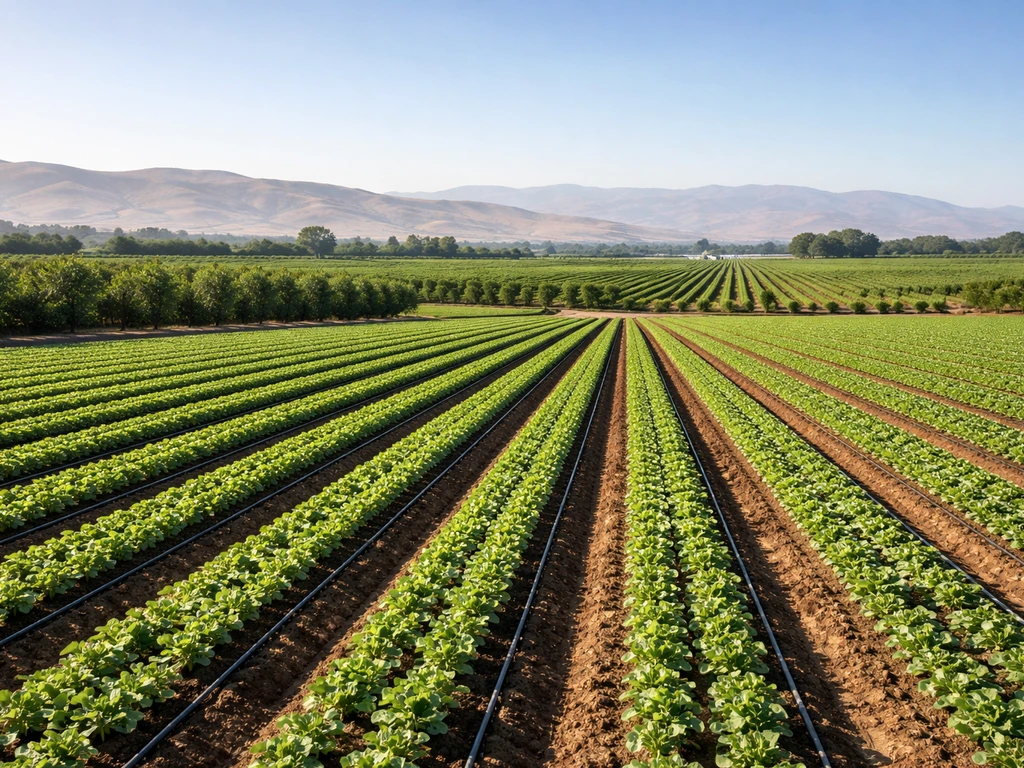
California is one of the most instructive cases of geographic crop diversification anywhere in the world. For a detailed list of crops and regional explanations, see the regional guide titled what do farmers grow in California. The state's Central Valley is essentially a vast irrigated desert that produces roughly half of U.S. fruits, nuts, and vegetables because of imported water, fertile alluvial soils, and a long frost-free season. The San Joaquin Valley dominates global almond, pistachio, and walnut production. The Sacramento Valley produces rice (much of it exported to Asia), processing tomatoes, and sunflowers. Coastal valleys from Salinas to Santa Barbara supply leafy vegetables and strawberries year-round to national markets thanks to mild marine-influenced temperatures.
What is particularly instructive about California is that crop choice is driven by a three-way interaction of water cost and availability, market contract infrastructure, and microclimate. Almonds need around 1,200 mm of water equivalent per year and are economically viable only because the commodity export price supports the irrigation cost. Processing tomatoes rotate with wheat or safflower to manage soil-borne diseases, particularly Fusarium and nematodes. Leafy vegetable growers in the Salinas Valley rotate lettuce with broccoli, strawberries, and grain crops on short cycles to break soilborne disease cycles, particularly the lettuce drop pathogen Sclerotinia minor. The state's cropping geography is a real-world demonstration of every principle discussed in this article, compressed into one extraordinarily productive region.
Paddy field systems: rice, double-cropping, azolla, and fish
Flooded paddy fields are perhaps the world's most sophisticated traditional multi-species system. In South and Southeast Asia, the basic rice-rice double-crop rotation uses two successive rice crops per year, enabled by the tropical day length and temperature. In between or alongside those crops, farmers integrate azolla (a floating aquatic fern that hosts nitrogen-fixing cyanobacteria), fish, and ducks to add protein, manage weeds and pests, and cycle nutrients within the paddy ecosystem. Azolla can fix significant nitrogen and also provides biomass for incorporation as green manure before the next rice crop, reducing fertilizer requirements. Duck-rice systems, still practiced across southern China and Vietnam, use ducks to eat insects and weeds between rice rows without damaging established plants.
In higher-elevation or more temperate paddy regions (parts of Japan, Korea, northern China), a rice-wheat or rice-rapeseed rotation replaces the double-rice system. The wheat or rapeseed occupies the drained field through winter, providing a cash crop and a soil structure benefit from the drying and aerating cycle before the field is reflooded for rice. Understanding what farmers grow in paddy fields reveals how completely a single crop system can be transformed by layering spatial and temporal diversity into what looks from the outside like a monoculture.
Why farmers grow field beans: nitrogen, feed, and markets
Faba beans (Vicia faba), commonly called field beans in the UK and Europe, are grown for a combination of agronomic and economic reasons that illustrate the core logic of this article perfectly. Agronomically, they fix nitrogen (typically 100 to 180 kg N/ha under good conditions), break cereal disease cycles, and improve soil structure with their deep tap roots. They tolerate clay soils and cool temperatures that many other legumes cannot manage. Economically, they supply the livestock feed market as a high-protein alternative to imported soy meal, and a smaller but growing market for human consumption in plant-based food products. UK and European policy incentives for home-grown protein crops have reinforced their adoption in recent years.
The agronomic case for field beans is strong enough that they appear in rotations even when the gross margin is modest, because their nitrogen contribution and disease-break value show up as real cost savings in the following cereal crop. That is a useful model for thinking about any rotation crop: the value is not always on the sales ledger for that crop alone; it is distributed across the whole rotation sequence.
Pastures, dung, and fungi: why managed fields support more than crops
Not everything that grows in a field is planted there. Managed pastures and mown grasslands support complex fungal communities that respond to grazing pressure, soil moisture, grass species composition, and dung availability. Psilocybe semilanceata (liberty caps) are a well-known example of fungi associated with heavily grazed, unfertilized, moist grassland in temperate regions. They are dung-adjacent rather than strictly dung-dependent, fruiting in short grass that has been fertilized by livestock over extended periods, typically from late summer through autumn when soil temperatures drop after warm, wet conditions. Their presence is as much an indicator of long-term grazing management and soil history as of any single agronomic decision.
This is a useful reminder that what farmers choose to grow (or not grow) in a field shapes the entire ecology of that field, including the fungi, invertebrates, and microbiome below ground. Decisions about grazing intensity, mowing frequency, and fertilization history all determine what other organisms find the field habitable. For anyone mapping what grows in specific fields by region and management type, fungal communities are part of that picture, not separate from it.
Ancient civilizations and the deep history of crop diversity
The practice of growing multiple crops in sequence or combination is not a modern invention. Mesopotamian farmers in the Tigris-Euphrates valley rotated barley with legumes (lentils, chickpeas) at least 5,000 years ago, and Sumerian agricultural texts reference fallow and legume years as part of soil management. In ancient Egypt, the Nile flood cycle enforced a natural rotation: floodwater deposited silt and nutrients, and farmers planted different crops on the receding flood plain depending on soil moisture depth. The Roman agronomist Columella documented rotation principles in the first century CE, recommending legumes before grain to restore field fertility.
In East Asia, Chinese agricultural texts from the Han dynasty (around 200 BCE to 220 CE) describe green manure practices and mixed cropping that closely anticipate modern intercropping science. In Mesoamerica, the milpa system of maize, beans, and squash grown together is perhaps the most famous traditional intercrop in the world. The three crops collectively called the Three Sisters work together precisely because they partition resources: maize provides structure for climbing beans, beans fix nitrogen for the maize, and squash sprawls at ground level suppressing weeds and reducing soil moisture evaporation. This system was feeding millions of people centuries before European contact and remains in use today.
What is striking about these ancient systems is that their designers arrived at the same agronomic principles that modern science has since quantified, through observation and accumulated practice rather than controlled experiments. The mechanisms were not understood in biochemical detail, but the outcomes were real and replicable.
How to identify what is growing in a field by region and season
Whether you are a student researching agricultural geography, a farmer assessing neighboring land use, or a historian trying to interpret historical land records, identifying crops in the field requires combining multiple cues. Ground-level signs, seasonal timing, and remote sensing data each contribute different information.
Ground-level identification cues
- Leaf shape and color: cereals show parallel-veined narrow leaves; legumes show compound or trifoliate leaves; brassicas show lobed blue-green leaves with waxy cuticle.
- Plant height and structure: corn and sorghum tower above soybeans at the same growth stage; determinate legumes stop growing at a fixed height while cereals continue elongating.
- Flower color and timing: yellow flowers in a field in early spring often indicate canola or mustard; blue-purple flowers in summer suggest borage or phacelia cover crops.
- Row spacing and pattern: wide rows (75 to 90 cm) suggest row crops like corn, sunflower, or cotton; narrow rows (15 to 25 cm) suggest small grains or dense-sown legumes.
- Seed pods and fruit: visible pods hanging below leaf canopy indicate soybeans, peas, or field beans; heads above the canopy indicate grain cereals.
- Soil surface: flooded or puddled fields in low-lying areas in spring or summer strongly suggest paddy rice or watercress in appropriate climates.
Seasonal and satellite cues
Satellite-based vegetation indices (NDVI from Landsat, Sentinel-2, or MODIS) show crop canopy green-up and senescence timing with enough resolution to distinguish winter and spring crops and to identify fallow periods. Winter cereals show green-up in autumn and early spring while summer crops (maize, soybean, cotton) show late spring emergence. Rice paddy fields show very distinctive flood-drain cycles visible in synthetic aperture radar (SAR) imagery, which penetrates cloud cover common in monsoon regions. USDA Cropland Data Layer (CDL) products classify crop types across the contiguous U.S. at 30-meter resolution using satellite imagery combined with ground truth data, and are publicly available for any year from 2008 onward. FAO GAEZ v4 provides the global equivalent for crop suitability mapping.
Benefits and trade-offs: a clear-eyed comparison
| Factor | Diverse/rotated system | Monoculture system | Net verdict |
|---|---|---|---|
| Yield (individual crop) | Often slightly lower per crop per season | Potentially higher peak yield per crop per season | Monoculture wins short-term, rotation wins over time |
| Total land productivity | Higher land equivalent ratio (typically >1.0 in intercrops) | Lower total system productivity | Diverse system advantage |
| Soil health | Improves with legumes, cover crops, and root diversity | Declines with continuous monoculture, compaction risk increases | Strong diverse system advantage |
| Pest and disease risk | Lower, reduced host density and soil-borne pressure | Higher, accumulation of specialist pests and pathogens | Strong diverse system advantage |
| Input costs (fertilizer) | Lower if legumes supply nitrogen | Higher synthetic N requirement for continuous cereal/vegetable | Diverse system advantage (context-dependent) |
| Input costs (pesticide) | Lower in well-managed rotations | Often higher to manage accumulated pest pressure | Diverse system advantage (variable) |
| Management complexity | Higher, more decisions, more equipment needs | Simpler, single crop knowledge and machinery | Monoculture advantage for simplicity |
| Income volatility | Lower across diversified crops | Higher if market or weather event hits the sole crop | Strong diverse system advantage |
| Market scalability | Limited for each crop individually | Easier to scale single commodity for large buyers | Monoculture advantage for commodity markets |
| Carbon sequestration | Higher with cover crops, reduced tillage, agroforestry | Lower under continuous tillage monoculture | Diverse system advantage |
Making it work on a small farm or garden
The principles above apply at any scale, but the practical execution looks different on a 0.1-hectare garden versus a 1,000-hectare arable farm. Smallholders and gardeners generally have more flexibility (shorter supply chains, more crop choices, easier hand labor) but less access to market infrastructure and machinery. The most accessible entry points are: a three- to four-bed rotation using the brassica/legume/root structure described above, a cereal-legume intercrop in any available open space, and a legume or brassica cover crop after main crop harvest to fill the winter gap. None of these require specialized equipment. A hand fork, a hoe, and saved or purchased seed are sufficient.
For smallholders in lower-income contexts, the milpa-style maize-bean-squash intercrop is proven, low-input, and nutritionally comprehensive. For temperate smallholders, a field beans and winter wheat rotation on even a small field can reduce bought-in fertilizer by the equivalent of 100 kg N per hectare across the rotation, which translates to real cash savings. The key is choosing combinations that genuinely complement each other rather than simply adding complexity for its own sake.
Low-equipment intercrop options for smallholders
- Maize and climbing beans: plant beans at the base of maize plants at or just after maize emergence; no additional equipment needed.
- Tomato and basil: plant basil between tomato rows; basil is reported to repel aphids and whitefly, and is a valuable cash or kitchen crop.
- Wheat or barley undersown with clover: broadcast clover seed into the standing cereal canopy at tillering; clover establishes as the cereal matures and provides a nitrogen-fixing cover after harvest.
- Garlic and brassicas: plant garlic between brassica transplants; allicin compounds may deter some brassica pests.
- Winter rye cover crop followed by vegetables: terminate rye at flowering for maximum biomass and allelopathic weed suppression; allow three to four weeks before transplanting into residue.
Suggested images, maps, and figures for illustrating these patterns
The following image types would substantially improve reader comprehension of the concepts in this article. These are descriptions for editorial and design teams to source, commission, or create.
- Rotation diagram (illustrated): A circular or linear diagram showing a four-year temperate rotation (wheat, field beans, oilseed rape, spring barley) with arrows showing nitrogen flow, disease break points, and cover crop placement. Placement: immediately after the rotation templates section.
- NDVI satellite time series (raster map): A Sentinel-2 or Landsat composite showing a mixed-crop agricultural landscape (ideally California Central Valley or a Midwest corn-soy region) across four seasonal frames (winter, spring, summer, autumn) to illustrate how different crops green up and senesce at different times. Placement: alongside the satellite identification section.
- Nitrogen cycle illustration: A simplified diagram showing legume root nodule fixation, residue incorporation, mineralization, and uptake by following crop. Caption: 'Biological nitrogen fixation in a legume precrop can supply 76 to 180 kg N/ha to the following crop through residue decomposition.' Placement: after the BNF section.
- Milpa/Three Sisters field photo: A ground-level photograph of maize-bean-squash intercrop showing the physical structure of the system. Placement: in the historical patterns section.
- California crop map: A county-level choropleth or crop-area map of California's Central Valley showing almond, processing tomato, rice, and vegetable zones. Placement: in the California regional section.
- Paddy field aerial photo: An aerial or satellite view of paddy terrace systems (Vietnam, Philippines, or southern China) showing the patchwork of flooded and drained fields at different crop stages. Placement: in the paddy systems section.
- Root depth comparison diagram: A side-by-side cross-section illustration showing shallow-rooted lettuce versus deep-rooted alfalfa or carrot, labeling the different soil horizons each accesses. Placement: after the root architecture section.
- Cover crop field photo: A photograph of a hairy vetch and cereal rye cover crop mix in a temperate field, with caption noting the dual nitrogen fixation and allelopathic weed suppression benefits. Placement: after the cover crops section.
On-farm planning worksheet and checklist
Work through the following questions before finalizing your crop plan. They are designed for a single field or bed, but apply across a whole farm by repeating the process for each management unit.
- What crop was grown here last year, and the year before? (List both.)
- Are any of the following present or historically problematic: Sclerotinia, club root, cyst nematode, Fusarium wilt, white rot? If yes, which crop families must be avoided this year?
- What is the soil pH? (Test or estimate.) Is it below 6.0? If yes, legumes will likely nodulate poorly without lime amendment.
- What is the frost-free window? (Last spring frost to first autumn frost.) Does your intended crop fit within it?
- Is irrigation available? What is the peak daily delivery capacity (liters or mm per day)? Does your intended crop's peak demand fall within that capacity?
- What is the nearest buyer, processor, or market for each candidate crop? What is the current indicative price per tonne or unit?
- What are your labor availability peaks? Mark weeks when labor is unavailable. Do any candidate crops require harvest exactly during those weeks?
- Do you own or have access to the required planting and harvesting equipment for each candidate crop?
- Which candidate crops fix nitrogen or leave a positive soil nitrogen balance? Prioritize at least one of these in each three- to four-year rotation cycle.
- What is the estimated gross margin per hectare for each candidate crop, less variable costs? Compare at least three candidates before deciding.
Quick nitrogen credit calculation
To estimate the nitrogen credit from a legume precrop: multiply the expected above-ground dry matter yield (in tonnes per hectare) by the crop's typical nitrogen content (for field beans, approximately 3.5 to 4.5 percent N in grain; for hairy vetch biomass, approximately 3.0 to 4.0 percent N). Multiply the result by the estimated proportion of that nitrogen derived from fixation (typically 0.65 to 0.90 for well-nodulated legumes in low-N soils). Apply an availability factor of 0.30 to 0.50 to account for immobilization, leaching, and mineralization timing. The result is the approximate plant-available N credit to your following crop. For a well-grown field bean crop yielding 3.5 t/ha at 4 percent N with 75 percent Ndfa and 40 percent availability, the calculation gives roughly 42 kg N/ha as a practical fertilizer credit, which at current urea prices represents a meaningful cost saving.
Where to go next for regional crop planning
The principles in this article are universal, but the application is always local. The same rotation logic produces different crop lists in California, the UK, the Mekong Delta, and the Ethiopian highlands because the climate, soil, and markets are different. Crops By Region organizes exactly that local specificity, mapping what crops grow where and why across U.S. states, global countries, and historical periods. If you want to dig into the specifics of what California farmers grow and why, or to understand the full range of crops and organisms that develop in paddy fields across Asia, or to explore the historical crop systems of ancient Mesopotamia or Mesoamerica, the regional and topical pages on this site are built around the same geographic and ecological framework used throughout this article.
The core answer has not changed across five millennia of agricultural history: farmers grow different crops because diversity is the most reliable way to maintain soil fertility, manage risk, optimize labor and water, and sustain productivity across years and across an entire farm. The specific crops change. The principle does not.
FAQ
Why do farmers grow different crops within the same field or across a farm?
Farmers diversify crops for agronomic, economic and risk reasons: to maintain or restore soil fertility (especially using legumes for biological N fixation), to break pest and disease cycles (pest‑break effects), to spread market and price risk, to optimize labor and water use across seasons, and to exploit microclimates or soil variability on the farm. Empirical meta‑analyses show crop rotations and increased species diversity raise average yields, improve nutrition and revenue versus continuous monoculture, though effects depend on sequence and region (see PMC meta‑analysis).
What field‑scale methods do farmers use to grow different crops in the same area?
Principal methods: crop rotation (sequential crops on the same land), intercropping (simultaneous species mixtures), strip and relay cropping (adjacent strips or staggered planting), agroforestry (trees with field crops or livestock), and cover crops (off‑season species for soil protection and N capture/release). NRCS/USDA practice standards treat many of these as proven soil‑health and climate‑smart practices.
What are the main agronomic mechanisms behind these practices?
Key mechanisms: biological nitrogen fixation by legumes (BNF) supplies N to following crops; allelopathy/biofumigation from Brassicaceae or rye residues suppresses weeds and certain pathogens; pest‑break effects and increased plant diversity reduce host continuity and pathogen build‑up; complementary root architectures and phenology improve resource capture (water, light, nutrients); and altered soil microbiomes can enhance disease suppression and nutrient cycling.
How much nitrogen can legumes contribute and how does that affect cropping decisions?
BNF ranges widely by species and management. Meta‑analyses report mean above‑ground N fixed around tens to over 100 kg N·ha⁻¹·yr⁻¹ depending on the legume: fodder legumes (e.g., alfalfa) average higher (~131 kg N·ha⁻¹·yr⁻¹), grain pulses lower (~76 kg N·ha⁻¹·yr⁻¹). Cover legumes like hairy vetch often supply 50–190 kg N·ha⁻¹ under favorable conditions. Farmers use these credits to reduce synthetic fertilizer rates based on crop, biomass and residue management.
What evidence shows rotations and intercropping improve yields and pest control?
Global meta‑analyses of thousands of paired field trials indicate rotations (including legume precrops) increase yields, nutritional output and revenue compared with continuous monoculture. Intercropping experiments and reviews show cereal–legume mixtures often reduce foliar disease and insect pests, boost natural enemies and increase land‑level productivity through temporal and spatial complementarity (see npj Sustainable Agriculture and Scientific Reports studies).
What practical decision criteria should farmers use when choosing crop mixes or rotations?
Key criteria: climate and season length, soil type and fertility, water availability/irrigation, local pest and disease history, market demand/prices and contract access, labor availability and timing, equipment constraints, and policy/incentive programs. Use these to rank objectives (e.g., maximize short‑term profit vs. build soil) and select rotations/intercrops accordingly.
Next Articles
What Do Farmers Grow in California Most Common Crops
Main California crops by region, climate and season, plus how to verify what farmers grow in your county
What Did the Delaware Colony Grow: Crops, Uses & Legacy
Colonial Delaware’s main crops, grains, hay, flax, fruits, vegetables, livestock, why they thrived and how they were sold.
What Did Jamestown Grow and How They Farmed It
Learn what Jamestown colonists grew and the methods they used to plant, harvest, and adapt crops to Virginia conditions.