
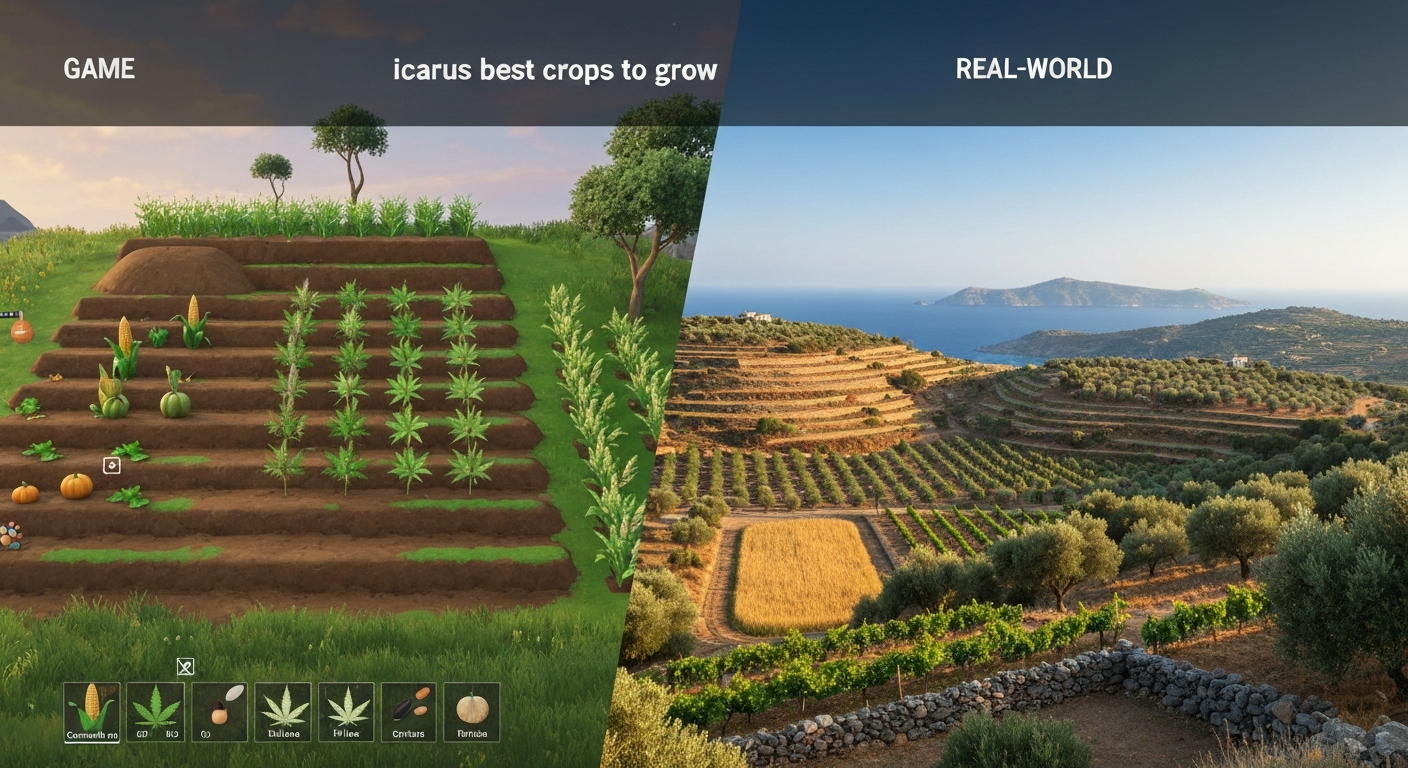
If you searched 'Icarus best crops to grow,' you are almost certainly looking for one of two very different things: a ranked farming guide for the survival game ICARUS (developed by RocketWerkz), or practical crop advice for a real-world Mediterranean-style island environment. Both are covered here, clearly labeled, so you can jump straight to what you need. In the game, Corn, Pumpkin, and Rye stand out as the most efficient all-purpose crops; in a real-world Mediterranean or temperate island setting, Wheat, Olives, and Grapes are your anchor crops, backed by millennia of regional practice and solid FAO agronomy data.
Icarus Best Crops to Grow: Top Picks for Game & Garden

Samuel Rourke
11 Aug 2026
How to use this article
This page splits cleanly into two tracks. Use the guide below to find your entry point, then skip ahead as needed. Each major section is labeled either 'GAME' or 'REAL-WORLD' so there is no confusion about which context applies.
| You are a... | Jump to section | What you will find |
|---|---|---|
| Gamer (ICARUS survival sim) | ICARUS Game: Ranked Crops + Seasonal Mechanics | Best crops by food/cash/feed/crafting purpose, growth tips, patch context |
| Gardener or small farmer | Real-World Mediterranean: Ranked Crops + Seasonal Calendar | Ranked crops, planting windows, soil/pH, yields |
| Student or historian | Real-World Seasonal Guidance + Historical Context | Mediterranean agricultural tradition, climate rationale, ancient patterns |
| Farmer planning rotation | Crop Rotation and Succession Planting | What to grow after canola, green manures, compatible sequences |
| Anyone wanting practical detail | Practical Planting, Soil and Harvest Tips | Spacing, pH, fertiliser, pests, expected returns |
ICARUS game: the best crops to grow, ranked by purpose
ICARUS is a session-based survival game where farming is a genuine mid-to-late-game investment. You plant on Dirt Mounds early on, then upgrade to tiered Crop Plots (Wood, Iron, and higher), and eventually Hydroponic or Aeroponic plots that dramatically cut growth time. See Dirt Mound, ICARUS Wiki (wiki.gg) for details on Dirt Mounds, tiered Crop Plots, Hydroponic/Aeroponic plots, the Seed Extractor, beehives, fertilisers and talent-tree modifiers that affect growth and spoilage blank" rel="noopener noreferrer">Dirt Mound — ICARUS Wiki (wiki.gg). Seeds come from harvesting wild flora, from crafting, or from running harvested crops through a Seed Extractor. Players can obtain and reproduce seeds in ICARUS: many flora drop seeds or seeds are produced via a Seed Extractor, and planted crops can yield seeds on harvest (Seeds, Icarus Wiki (Fandom)) blank" rel="noopener noreferrer">Seeds — Icarus Wiki (Fandom). Talent tree choices and fertiliser application modify growth speed and spoilage rates, so the 'best' crop shifts depending on where you are in a session. What follows is my recommended ranking for each core farming purpose, based on consistent community feedback and wiki data. Always cross-check current growth times against the live ICARUS Wiki or official patch notes because RocketWerkz updates farming mechanics regularly. For Palia-specific recommendations, see the guide on the best crops to grow Palia.
Best crops for food and health regeneration (GAME)
- Corn: High calorie output per plot, widely available seeds, and versatile as both direct food and an ingredient in cooked recipes. Strong early-to-mid-game staple.
- Pumpkin: Excellent food value and one of the best crops for cooking complex meals that grant stamina and health buffs. Pumpkin seeds are reliably obtained and the crop performs well on basic Dirt Mounds.
- Potato: Fast-ish growth and a reliable calorie source. Potatoes are particularly good when you need consistent food production without upgrading your plot tier yet.
- Rye: Produces grain used in bread recipes; bread restores both food and health efficiently. Becomes more valuable once you unlock milling mechanics.
- Berries (various): Low-effort calorie top-ups. Not as calorie-dense as Corn or Pumpkin but useful in the early session when plot space is limited.
Best crops for crafting and high-value processing (GAME)
- Hemp: The single most important crafting crop in ICARUS. Hemp fibre is used in rope, cloth, and numerous workshop recipes. Prioritise this as soon as crafting stations unlock.
- Flax: Similar to Hemp in crafting utility; Flax produces fibre for clothing and advanced textile recipes. Running both Hemp and Flax gives crafting redundancy.
- Tobacco: A high-value crop primarily for trade and mission-specific uses. Less critical for basic survival but valuable if you are optimising a cash/points economy within a session.
- Wheat: Grain for advanced food crafting. Pairs with Rye for a reliable milling operation once mid-game workshops are established.
Best crops for animal feed (GAME)
If you are running an animal husbandry setup in ICARUS, your animal feed priorities shift the crop list. Corn and assorted root vegetables are the workhorses here. Dedicate at least two Crop Plots to Corn purely for animal feed once you have domesticated animals, because the feed-to-output ratio (meat, hides, other resources) makes the plot investment worthwhile. Community guides on r/ICARUS consistently flag Corn as the top pick for this role.
Quick ICARUS crop comparison (GAME)
| Crop | Primary purpose | Plot tier needed | Key benefit | Notes |
|---|---|---|---|---|
| Corn | Food + Animal feed | Dirt Mound / Crop Plot | High calorie density, multipurpose | Top all-rounder; prioritise early |
| Pumpkin | Food / Cooking | Dirt Mound / Crop Plot | Strong cooking buffs | Good on basic plots |
| Hemp | Crafting (fibre/rope) | Crop Plot | Essential for workshop progression | Plant as soon as crafting unlocks |
| Rye | Food / Milling | Crop Plot | Bread = efficient food+health restore | Best value in mid-game |
| Flax | Crafting (textiles) | Crop Plot | Clothing and advanced recipes | Pair with Hemp |
| Potato | Food | Dirt Mound / Crop Plot | Reliable calorie source, fast-ish growth | Early session fallback |
| Tobacco | Trade / Cash value | Crop Plot | High session value | Non-essential for survival |
| Wheat | Food / Milling | Crop Plot | Advanced bread and food recipes | Mid-to-late game focus |
ICARUS game: seasonal mechanics and planting timing
ICARUS uses an in-game day/night cycle and, depending on the biome and session type, weather events that affect crop growth. The game does not replicate real calendar months directly, but the community commonly maps game progression to real-world session length. A single ICARUS session can run anywhere from a few hours to multi-day efforts. Here is how to think about planting timing within a session rather than by calendar month.
Early session (equivalent to 'June' pacing: high energy, limited resources)
In the opening phase of a session you have limited materials and need fast food returns. This maps well to the real-world June dynamic where you work with what is already established and make quick decisions. In ICARUS early-session farming, focus on Dirt Mounds planted with Corn, Pumpkin, or Potatoes. Do not spend resources building tiered Crop Plots until you have secured a workshop. If you are curious how June timing translates to real planting decisions, the site's guide on best crops to grow in June covers that ground for real-world contexts.
Mid-session (equivalent to 'October' pacing: consolidation and stockpiling)
Mid-session is the ICARUS equivalent of an autumn consolidation phase. This is when you build Iron or higher-tier Crop Plots, set up a Seed Extractor to bank seeds for the next run, and diversify into Hemp, Flax, and Wheat. Fertiliser becomes worth the crafting cost here because growth-speed bonuses compound across multiple plot upgrades. Just as real October is prime time for sowing winter cereals and establishing vine cuttings in Mediterranean climates, your mid-session ICARUS farm should be 'sowing' the crafting and animal-feed infrastructure that pays off in the final session phase. For real-world October crop decisions, the site's page on what crops grow in October goes deeper on that timing.
Late session (end-game farm optimisation)
Hydroponic and Aeroponic plots sharply reduce growth time. By late session, swap your basic plots to these tiers if the session allows it. Run Tobacco and high-value processing crops alongside food staples. Place beehives near flowering crops for passive production bonuses where applicable. Keep Seed Extractor running throughout so you exit the session with a stocked seed bank for future runs.
Real-world 'Icarus': best crops to grow on a Mediterranean or temperate island
The island of Icarus (Ikaria) in the Aegean, along with the broader Mediterranean island category, sits in a Köppen Csa or Csb climate zone: hot, dry summers and mild, wet winters. This climate pattern has driven the same core cropping system for thousands of years. The Mediterranean triad of wheat, olives, and grapes is not just historical sentiment, it is a direct response to a climate where winter rain supports grain and tree establishment, summer drought demands drought-tolerant perennials, and thin rocky soils reward deep-rooted crops over shallow annuals.
Ranked best crops by purpose (REAL-WORLD)
Food crops
- Wheat (Triticum aestivum / durum): The anchor food crop. Autumn-sown (September–October) in Mediterranean rainfed systems; harvested June–July. FAO data confirms that early October sowing is optimal — delayed sowing can cost approximately 1% yield per day in some Mediterranean dryland trials. Suitable for thin calcareous soils common on Aegean and Western Mediterranean islands.
- Fava bean / Broad bean (Vicia faba): A traditional winter legume sown October–November. Fixes atmospheric nitrogen, improving soil for the following wheat or vegetable crop. High in protein; a dietary staple across Mediterranean history from ancient Egypt through classical Greece.
- Tomato (Solanum lycopersicum): Spring–summer vegetable; transplant April–June, harvest July–September. Needs irrigation in dry Mediterranean summers but produces very high yields under drip irrigation (commercial Mediterranean systems commonly report 60–100 t/ha under intensive management).
- Potato: Can be grown as a spring crop (plant February–March, harvest May–June) or an autumn crop (plant September, harvest November–December) on irrigated island plots. Versatile and calorie-dense.
- Leafy brassicas and salad crops (cabbage, lettuce, spinach): Autumn–winter crops in Mediterranean climates; plant September–December, harvest November–April. Too heat-stressed for summer production without cooling infrastructure.
Cash and commercial crops
- Grape (Vitis vinifera): Planted as rooted cuttings in September–October in Mediterranean regions; productive vines from year 3–4 onward. FAO data shows commercial yields vary widely — roughly 5–20 t/ha depending on variety and management system (table grapes, wine, raisins). Grapes are the highest-value perennial cash crop on most Mediterranean islands and have been since at least the Bronze Age.
- Olive (Olea europaea): Sapling establishment in late autumn to early spring (dormant season). Approximately 98% of global olive production has historically been concentrated in the Mediterranean basin. Yields vary considerably by system — a mechanised orchard example from southern Italy recorded around 1.5 t/ha of olives and 243 L/ha of oil in a single harvest year. Long-lived and drought-tolerant once established; the definitive Mediterranean cash tree.
- Citrus (lemon, orange, mandarin): Spring-planted or transplanted in mild Mediterranean coastal zones; suited to irrigated valley floors and lower slopes. High market value for fresh and processed product.
Animal feed crops
- Barley (Hordeum vulgare): Autumn-sown alongside or instead of wheat; barley is more drought-tolerant than wheat and commonly grown for animal feed on drier Mediterranean islands. Sow October–November, harvest May–June.
- Oats (Avena sativa): Autumn-sown winter cereal; used historically and currently for fodder on Mediterranean islands. Tolerates poorer soils than wheat.
- Sulla / Hedysarum coronarium: A traditional Mediterranean forage legume used for grazing and hay. Nitrogen-fixing, improves soil structure. Sow October–November.
Processing and crafting-equivalent crops (REAL-WORLD)
- Cotton: Grown in warmer Mediterranean coastal areas; spring-planted (April–May), harvested September–October. Historically important in eastern Mediterranean textile production.
- Flax (Linum usitatissimum): One of the oldest cultivated fibre crops in the Mediterranean; autumn or early spring sown. Both fibre and linseed (oil) uses. Ancient Egypt and Levant were the dominant producers in antiquity.
- Herbs (thyme, rosemary, lavender, sage): Perennial Mediterranean aromatics; easy to establish on thin rocky soils. Significant value in culinary, medicinal and essential-oil markets. Plant autumn or early spring.
Real-world Mediterranean crop comparison
| Crop | Purpose | Sow / Plant | Harvest | Soil preference | Water needs | Notes |
|---|---|---|---|---|---|---|
| Wheat (durum/bread) | Food / staple grain | Sep–Oct | Jun–Jul | Calcareous loam, pH 6.0–7.5 | Rainfed in winter | Sow early Oct for best yield |
| Olive | Cash / oil | Late autumn – early spring (saplings) | Oct–Dec | Rocky calcareous, pH 5.5–8.5 | Drought-tolerant once established | 3–5 year establishment before production |
| Grape | Cash / wine / table | Sep–Oct (cuttings) | Aug–Oct | Well-drained, pH 5.5–7.0 | Low–moderate; no summer rain needed | Full yield from year 3–4 |
| Fava bean | Food / nitrogen-fixing | Oct–Nov | Mar–Apr | Clay loam, pH 6.0–7.5 | Winter rain sufficient | Excellent rotation crop before cereals |
| Barley | Animal feed / grain | Oct–Nov | May–Jun | Tolerates poor/sandy soils, pH 6.0–7.5 | Rainfed | More drought-tolerant than wheat |
| Tomato | Food / cash vegetable | Transplant Apr–Jun | Jul–Sep | Fertile loam, pH 6.0–6.8 | Regular irrigation required | High yield under drip irrigation |
| Potato | Food | Feb–Mar or Sep | May–Jun or Nov–Dec | Sandy loam, pH 5.5–6.5 | Moderate; irrigation helpful in summer | Two season windows available |
| Cotton | Processing / fibre | Apr–May | Sep–Oct | Deep loam, pH 5.8–8.0 | Moderate summer irrigation | Warmer coastal sites only |
| Flax | Processing / fibre / oil | Oct–Nov or Feb–Mar | May–Jun | Well-drained loam, pH 5.5–7.0 | Moderate | Ancient Mediterranean fibre staple |
Real-world seasonal planting guidance: June, October and a month-by-month calendar
The Mediterranean climate creates a somewhat counterintuitive seasonal rhythm for farmers used to temperate northern European or North American schedules. Summer is largely dormant for new field sowing, June heat and dryness make it a harvest and fallow month, not a planting month. Autumn is your most important planting season. Here is what that looks like month by month.
What to do in June on a Mediterranean island
June marks the dry-hot start of a Mediterranean summer. The correct activity for most field crops in June is harvesting, not sowing. Winter cereals (wheat, barley) sown the previous October are reaching grain maturity and should be harvested before heat and moisture stress cause quality loss. Tomatoes, peppers, and cucumbers transplanted in April–May are in active growth and need irrigation management. This is not the month to sow wheat or establish new vines. June is, however, a reasonable time to transplant heat-tolerant vegetable seedlings (aubergine, sweet corn, melons) into irrigated plots. For a broader look at what is happening in gardens and fields in June, the guide to best crops to grow in June covers the full picture across different climate contexts.
What to do in October on a Mediterranean island
October is arguably the single most important month on a Mediterranean island farm. The first autumn rains typically arrive, temperatures drop to productive ranges, and the ground is workable again after summer hardening. Sow winter wheat and barley as soon as soil moisture allows, ideally early October for best yield outcomes, based on FAO dryland wheat guidance. Plant fava beans and other cool-season legumes. This is also prime time for planting vine cuttings and establishing olive saplings in prepared ground. Brassica transplants (cabbage, broccoli, cauliflower) go in through October and November for winter harvest. For a deeper dive into the full range of autumn options, the page on what crops grow in October is a useful companion.
Month-by-month mini planting calendar (Mediterranean / temperate island)
| Month | Sow / Plant | Harvest / Maintain |
|---|---|---|
| January | Hardy brassicas (indoors/protected), broad beans in mild areas | Olives (late harvest), winter greens |
| February | Spring potatoes, early onion sets, broad beans | Winter greens, brassicas |
| March | Early tomato/pepper seedlings indoors, spring barley (cool sites) | Broad beans, winter lettuce |
| April | Tomatoes, peppers, aubergine transplants; spring potatoes (late) | Spring barley, early potatoes, winter greens |
| May | Melons, cucumbers, courgette, sweet corn | Spring potatoes, broad beans (late), spring barley |
| June | Heat-tolerant vegetables (aubergine, melon) into irrigated plots only; prep fallow ground | Wheat, barley (winter-sown), garlic |
| July | Minimal field sowing; irrigate and maintain summer crops | Wheat (late), grapes (early varieties), summer vegetables |
| August | Sow early autumn brassica seedlings in nursery beds | Grapes, tomatoes, peppers, melons |
| September | Vine cuttings, garlic, early autumn onions, warm-site winter wheat | Grapes (main), tomatoes, cotton |
| October | Winter wheat, barley, fava beans, brassica transplants, vine cuttings, olive saplings | Grapes (late), cotton, autumn potatoes (plant Sep → harvest Nov) |
| November | Garlic, broad beans, autumn onions, cover crops | Autumn potatoes, olives (early), brassicas (young) |
| December | Cover crops, garlic top-up | Olives (main harvest), winter greens |
Crop rotation and succession planting: what to grow after canola and beyond
Whether you are farming in the game ICARUS or on a real Mediterranean island, the principle of crop rotation applies: avoid planting the same crop family in the same ground year after year, and use deliberate sequences to manage soil health, pests, and nutrient loads. The question of the best crop to grow after canola is one of the most common rotation questions on this site, and the answer applies both to real farming and to thinking about your ICARUS plot succession within a longer server.
Best crops to follow canola (real-world)
Canola (oilseed rape) belongs to the Brassica family. It leaves behind a residue that, when decomposed, releases sulphur compounds and can suppress some soilborne pathogens, but it also depletes nitrogen and can harbour clubroot, sclerotinia, and blackleg if you return too soon. The standard agronomic advice is a minimum 3-to-4-year break before canola returns to the same field. In the rotation slot immediately after canola, the best choices are cereals and nitrogen-fixing legumes.
- Winter wheat: The most common follow-on after canola in temperate and Mediterranean systems. Canola is harvested in early summer, giving time to prepare a seedbed for October wheat sowing. The cereal root system differs from Brassica roots, breaking pest and disease cycles.
- Winter barley: Similar logic to wheat; slightly earlier sowing option in Mediterranean systems, useful if soil preparation time is tight.
- Fava bean / Field bean: An excellent nitrogen-fixing follow-on that rebuilds soil nitrogen depleted by canola. In Mediterranean rotations: canola → fava bean → wheat is a productive three-year sequence.
- Oats: Tolerates lower soil fertility than wheat; a sensible choice if canola has left the soil in a depleted state and fertility rebuilding is a priority.
- Sunflower: Works well in warmer Mediterranean rotations as a non-Brassica break crop; different root depth and nutrient profile from canola.
Canola rotation sequences with green manures and cover crops
| Year | Crop | Rotation role | Benefit |
|---|---|---|---|
| Year 1 | Canola / Oilseed rape | Cash crop | High-value oil crop; leave minimum 3 years before return |
| Year 2 | Winter wheat | Cereal break | Disease break; utilises residual sulphur; high-value grain |
| Year 3 | Fava bean / Field pea | Legume / nitrogen-fixer | Fixes 80–150 kg N/ha; breaks cereal disease cycles |
| Year 4 | Barley or oats | Second cereal | Cleans up legume volunteers; lower input costs |
| Cover (between years) | Phacelia, clover, or mustard (non-Brassica cover) | Green manure / cover crop | Suppresses weeds, adds organic matter; mustard only if clubroot-free |
For ICARUS players thinking in game-rotation terms: if you run Hemp or Flax in a plot for multiple harvests, treat the next planting cycle as an opportunity for a food crop like Corn or Pumpkin. The game does not model soil chemistry, but plot-switching keeps your farm productive across the different in-game resource demands of a long session. The site's dedicated guide to the best crop to grow after canola covers the real-world rotation options in more detail.
Practical planting, soil and harvest tips for each top crop
The following tips cover both real-world Mediterranean growing and, where relevant, ICARUS in-game mechanics. Each entry is labeled so you know which context applies.
Wheat (REAL-WORLD)
- Sowing depth: 3–5 cm; row spacing 15–20 cm for drilled sowings, 12 cm for narrow-row irrigated systems.
- Soil pH: 6.0–7.5 ideal. Mediterranean calcareous soils are often naturally in this range.
- Fertiliser: Apply a split nitrogen programme: a basal application at sowing (30–40 kg N/ha for rainfed), followed by a top-dress at tillering if moisture is adequate.
- Key pests and diseases: Aphids (vectors of barley yellow dwarf virus), rust (stripe/yellow rust most common in cool-wet springs), and septoria leaf blotch. Use certified disease-resistant varieties where possible.
- Expected yield: Rainfed Mediterranean dryland wheat commonly yields 1.5–3.5 t/ha depending on season rainfall; irrigated spring wheat can reach 5–7 t/ha.
- Harvest: Combine harvest when grain moisture drops below approximately 14%. On small island plots, traditional scythe or small-plot reaper-binder methods remain in use.
Olive (REAL-WORLD)
- Spacing: Traditional extensive groves at 8–12 m between trees; modern intensive systems at 5–7 m; super-high-density systems (machine-harvested) at 1.5 × 4 m.
- Soil pH: 5.5–8.5; tolerates thin, rocky, calcareous soils — actually produces better-quality oil under mild stress.
- Fertiliser: Modest nitrogen needs (30–80 kg N/ha/year for mature groves); over-fertilisation reduces oil quality. Foliar boron application addresses common Mediterranean micronutrient deficiency.
- Pests and diseases: Olive fruit fly (Bactrocera oleae) is the main pest — monitor with pheromone traps; treat before egg-laying threshold. Verticillium wilt is the major soil-borne disease; avoid planting on previously tomato- or potato-cropped ground.
- Expected yield: Extensively managed traditional groves: 1–3 t/ha olives. Modern intensive systems: 4–8 t/ha. A mechanised southern Italy site recorded approximately 1.5 t/ha and 243 L/ha oil.
- Harvest: Pick or mechanically shake when drupes reach 50–75% colour change from green to purple-black for highest polyphenol content in oil. Hand-rake or mechanical harvester options both widely used on island farms.
Grape (REAL-WORLD)
- Planting: Dormant hardwood cuttings or certified rooted cuttings; plant in October–November or February–March depending on island frost risk. Space at 1–2 m in-row, 2.5–3.5 m between rows for mechanised access.
- Soil pH: 5.5–7.0; well-drained soils essential — grapes are highly susceptible to root rot in waterlogged conditions.
- Fertiliser: Annual potassium application is a priority for fruit quality; nitrogen moderate (30–50 kg N/ha); magnesium deficiency common on light sandy soils.
- Pests and diseases: Powdery mildew (Erysiphe necator) and downy mildew (Plasmopara viticola) are the primary foliar diseases in Mediterranean conditions; copper and sulphur sprays are the traditional and organic-approved management tools. Grape berry moth is a key insect pest.
- Expected yield: FAO data indicates 5–20 t/ha for commercial vineyards depending on variety, training system, and end use (wine grapes typically lower, table grapes higher).
- Harvest: Timing determined by sugar-to-acid balance (Brix measurement); typically August–October depending on variety and site altitude.
Corn / Hemp / Pumpkin (GAME: ICARUS)
- In ICARUS, all crops require a planting platform (Dirt Mound minimum); upgrading to Iron Crop Plot or higher reduces growth time significantly.
- Fertiliser in-game: Apply fertiliser to plots to reduce spoilage rate and boost growth speed. Crafting fertiliser requires organic material; plan your production chain before you need it.
- Seed management: Use a Seed Extractor on harvested crops to bank seeds before the session ends. Do not consume your entire harvest; keep a seed buffer of at least 5–10 seeds per crop type.
- Placement: Position crop plots near your base structure for easy monitoring. Some community guides note that proximity to water sources or within biome-appropriate zones (check biome tags in the wiki) can affect availability and growth conditions.
- Talent trees: Farming-related talents reduce growth time and spoilage; invest in these early if you plan a dedicated farming session, as the compounding effect over multiple harvests is significant.
- Harvest timing: Harvest crops as soon as they are ready to prevent in-game spoilage from degrading food value. High-tier plots with fertiliser applied have slower spoilage, giving you a window if you are away from base.
- Beehives: Place beehives near flowering crops where applicable for passive honey production and minor yield bonuses; a low-cost addition to any established mid-game farm.
Fava bean (REAL-WORLD)
- Sowing depth: 5–8 cm; spacing 25–30 cm in-row, 45–60 cm between rows.
- Soil pH: 6.0–7.5; fava beans are sensitive to acidic soils (below 5.5) and waterlogging.
- Fertiliser: No nitrogen needed at sowing; inoculate seed with Rhizobium leguminosarum for reliable nitrogen fixation if fields have not grown legumes recently. A well-nodulated crop fixes 80–150 kg N/ha over the season.
- Pests and diseases: Black bean aphid (Aphis fabae) is the dominant pest in Mediterranean winters; Botrytis grey mould in wet springs; chocolate spot (Botrytis fabae) on foliage.
- Expected yield: 1.5–4 t/ha dry seed depending on season and variety.
- Harvest: Harvest for fresh shelling (early May in mild Mediterranean sites) or leave to dry-pod for dry seed (June). If used as a green manure / plough-in crop, terminate at peak flowering for maximum nitrogen benefit.
Historical context: why these crops define Mediterranean agriculture
The Greek island of Ikaria (ancient Icarus) sits within an agricultural tradition that stretches back at least 10,000 years. The 'Mediterranean triad', wheat, olive, and grape, was not simply a cultural preference. It was a rational agricultural response to thin soils, summer drought, and seasonal rainfall. Wheat provided calories through the winter and spring. Olives and grapes, being deep-rooted perennials, could survive dry summers that killed annual crops. Legumes (fava beans, lentils, chickpeas) have been documented in Aegean Bronze Age contexts at sites like Akrotiri on Thera, confirming that nitrogen-fixing rotations were in practice long before modern agronomy codified them. Flax cultivation for linen fibre was documented in Minoan and Mycenaean contexts. These patterns are not accidents of history; they are the agricultural logic of a specific climate, still directly relevant to anyone farming in the Mediterranean today.
Game vs. real-world: a side-by-side comparison
If you want to compare your ICARUS game priorities against real-world Mediterranean equivalents at a glance, this table is the quickest reference.
| Purpose | ICARUS (game) top crop | Real-world Mediterranean top crop | Why the parallel works |
|---|---|---|---|
| Primary food staple | Corn | Wheat | Both are high-calorie, versatile and early-priority crops |
| Cooking / processed food | Pumpkin / Rye | Grape / Tomato | Both require processing (cooking or fermentation/preservation) for peak value |
| Crafting / fibre | Hemp | Flax / Cotton | Both are fibre crops central to mid-game/season craft and textile production |
| Cash / high-value trade | Tobacco | Olive / Grape | Both are speciality crops with high output value relative to land/effort |
| Animal feed | Corn (secondary use) | Barley / Sulla | Both serve dual food-and-feed roles in their respective systems |
| Soil improvement / rotation | Plot-switching (Hemp → Corn) | Fava bean → Wheat | Both use variety diversity to maintain productivity over time |
Final recommendations at a glance
For ICARUS the game, lead with Corn and Pumpkin on your first Dirt Mounds, add Hemp as soon as you have a Crop Plot and a crafting station, then round out your farm with Rye and Flax for mid-game processing. Keep your Seed Extractor running and upgrade your plots to Iron tier before investing in fertiliser crafting. For real-world Mediterranean island farming, Wheat sown in early October is your non-negotiable anchor, paired with Fava beans for rotation and soil health. Olives and Grapes are your long-term cash crop investments, plant them in your first autumn on any new land and they will pay back for decades. Summer is for irrigation, maintenance, and harvesting what is already in the ground, not for new field sowing. October is when the real work begins.
FAQ
SEO title and meta description for “Icarus best crops to grow”
SEO title: Icarus — Best Crops to Grow (Game & Mediterranean Island Guide) Meta description (≤160 chars): Ranked crop picks for ICARUS (game) and a Mediterranean-style island: planting months, June/October windows, rotation (after canola) and tips.
How do you resolve the ambiguity in the query “Icarus best crops to grow”?
This guide covers two distinct contexts, stated up front: (A) ICARUS the survival video game (developer: RocketWerkz) — mechanics-based crop choices for in-game food, crafting and animal feed; and (B) a real-world Mediterranean/temperate island (interpreted as “Icarus”) — climate- and evidence-based crop recommendations for food, cash, feed and craft/processing. Each section below is labeled with its context so readers can skip to the relevant part.
What are the top-ranked crops to grow in ICARUS (game) and why?
Ranked lists (mechanics-based — check current wiki/patch notes for exact growth time changes): - Food / Early survival 1. Berry bushes (fast, easy seed/harvest, minimal soil) — quick food and healing. 2. Corn (fast-ish, good bulk food) — reliable calories and seed reproduction. 3. Potatoes (sturdy yield, cooks into better food). - High-value / Crafting / Animal feed 1. Cotton — used in clothing/crafting; grows in warmer biomes and yields crafting fiber. 2. Tobacco / Coffee (if present in current meta) — high-value crafting components. 3. Ginseng / Exotic herbs (biome-limited) — used in advanced recipes and trading. - Utility / Quality-of-life 1. Beehives (pollination & honey) — increases food variety and preserves resources. Why these suit ICARUS: crops are ranked on growth speed, seed return rates, biome accessibility, and crafting uses. In-game mechanics (plot tier, fertilizer, light/water and talent bonuses) affect growth — label: these are game-mechanics recommendations; consult the ICARUS Wiki for live numbers.
What are the top-ranked crops for a Mediterranean/temperate island (real-world)?
Ranked by purpose in Mediterranean/Csa–Csb climates (evidence-based, FAO/extension sources): - Food staples 1. Winter wheat (autumn sowing Sept–Oct) — efficient use of winter rains; high calorie per hectare. 2. Barley (flexible, drought-tolerant) — good rotation break and feed. 3. Legumes (fava/broad beans, chickpea) — fix nitrogen, protein and complementary sowing windows. - Cash crops 1. Grapes (Vitis vinifera) — long-term vineyard investment; yields and returns depend on variety and system (5–20 t/ha typical range). 2. Olives — classic Mediterranean cash crop; planted dormant season; oil yields highly variable by system. 3. Citrus (where frost risk is low) — high market value in protected microclimates. - Vegetables & summer crops 1. Tomatoes, peppers, eggplant, cucumber — warm-season transplanted April–June; high return per area with irrigation. - Animal feed / cover crops 1. Alfalfa (lucerne) — perennial high-protein forage under irrigation. 2. Canola/rapeseed (as cover/rotation oilseed) — fits autumn sowing or spring windows depending on local rainfall. Why these suit the region: recommendations follow Mediterranean seasonality (wet cool winters, hot dry summers) and FAO/university extension findings on planting windows, water requirements and yields.
What crops are best to plant in June and in October for the Mediterranean island interpretation?
June (Mediterranean): - Key actions: harvest spring-sown vegetables, transplant heat-loving crops, start irrigation schedule, plant short-season summer vegetables in containers. - Crops to be planted or transplanted: tomatoes (late transplant), peppers, eggplant, cucurbits (squash, cucumber) if using drip irrigation; fallow/soil-building cover crops in irrigated systems. October (Mediterranean): - Primary autumn planting window: sow winter cereals (wheat, barley) Sept–Oct for best yields; plant fava beans (broad beans) and many cool-season vegetables (leafy greens, brassicas) for winter harvest; plant vine cuttings and olive saplings in dormant season. - Recommended October sowings: wheat, barley, fava bean, garlic (in many areas), early brassicas transplants (kale, cabbage).
Can you provide a month-by-month mini planting calendar for a Mediterranean/temperate island?
Month-by-month (generalized Csa/Csb pattern — adjust to local frost dates and microclimate): - January: Dormant-season tree planting (olive cuttings in mild areas), sow lettuce/leafy greens in protected beds, prune vines. - February: Continue dormant-root planting, sow early broad beans in mild areas. - March: Transplant early brassicas, sow fast spring vegetables (radish, carrots), prepare beds for tomatoes. - April: Transplant tomatoes/peppers under protection; sow cucurbits indoors/early outdoors in warm microclimates. - May: Harden off transplants; plant main-season tomatoes/peppers; start drip irrigation scheduling. - June: Harvest spring vegetables, transplant late warm-season crops, sow quick cover crops in irrigated plots. - July: Peak summer maintenance — irrigation, pest control, harvest heat-loving crops. - August: Continue irrigation; plan autumn sowing; start soil amendments. - September: Begin sowing winter cereals where autumn rains occur (Sept–Oct ideal); transplant autumn brassicas. - October: Primary cereal/legume sowing window; plant vine cuttings and many tree saplings; sow garlic in suitable zones. - November: Finish autumn sowings; mulch and protect young plants. - December: Winter maintenance, cover cropping, pruning, planning next season.
Next Articles
Best Crops to Grow Palia: Game & Palia Kalan Farming Guide
Best crops to grow Palia: game yields, Palia Kalan planting calendars, rotations, soil & seed tips.
What Crops Grow in October: Regional Harvests & Plantings
What crops grow in October: harvests vs plantings, regional calendars, climate cues, storage & quick tips.
Best Crops to Grow in June: What to Plant Now by Region
Region-by-region June planting guide with best crops, what to sow now, and care tips for frost, heat, pests, and harvest