October is one of the busiest months on the agricultural calendar in the Northern Hemisphere. Depending on where you are and what you grow, you might be pulling the last pumpkins and apples off the vine and tree, or pressing garlic cloves into cooling soil for a summer harvest the following year. The short version: in temperate North America and Europe, October is primarily a harvest month for warm-season crops and a planting month for cool-season and overwintering crops. In the Southern Hemisphere, it flips entirely, October falls in spring, making it a primary planting window for summer crops in places like Argentina, South Africa, and Australia.
What Crops Grow in October: Regional Harvests & Plantings

Samuel Rourke
19 Jul 2026
Who this guide is for and how to use it
This reference is built for anyone who needs a clear, geography-aware answer to what is actually happening in October fields, gardens, and farms. That includes backyard gardeners figuring out what to plant or harvest right now, farmers planning production calendars, students studying agricultural geography or history, and researchers mapping crop patterns across time and place. The guide is organized so you can read straight through for a complete picture, or jump to the regional tables and checklists if you need quick reference answers. It covers the Northern and Southern Hemispheres, major U.S. regions, global climate zones, and even traces October-period agriculture back to ancient Egypt, Mesopotamia, Rome, and Mesoamerica.
October as an agricultural month: Northern vs Southern Hemisphere
The single most important thing to understand about October agriculture is that the month means completely opposite things depending on which hemisphere you are in. In the Northern Hemisphere, October marks the transition from growing season to dormancy. Day length is shrinking, night temperatures are dropping, and most warm-season crops have either been harvested or are approaching their final window. In the Southern Hemisphere, October is the equivalent of late April to early May in the north: days are lengthening, soils are warming, and farmers are planting summer staples like maize, sorghum, cotton, soybeans, and sunflowers.
The FAO Crop Calendar, which maps planting and harvesting windows for over 100 crops across countries worldwide, makes this split visible instantly. A tomato harvest in October in northern Italy is happening at the same time as tomato transplanting in South Africa's Limpopo Province. This guide focuses primarily on temperate Northern Hemisphere conditions because that is where the majority of search traffic for this question originates, but regional notes for Southern Hemisphere and tropical zones are included throughout.
| Region | Hemisphere | October Role | Key Activities |
|---|---|---|---|
| U.S. Midwest / Northeast | Northern | Late harvest, early winter prep | Harvest corn, apples, pumpkins; plant garlic |
| U.S. Pacific Northwest | Northern | Harvest and fall planting | Harvest late vegetables; sow winter greens |
| U.S. Southeast / Gulf Coast | Northern | Fall planting season begins | Plant cool-season vegetables, winter annuals |
| Mediterranean Europe | Northern | Grape/olive harvest, sowing begins | Harvest grapes and olives; sow winter wheat |
| Eastern Australia | Southern | Spring planting | Plant summer crops: maize, sorghum, cotton |
| Southern Brazil / Argentina | Southern | Spring planting | Plant soybeans, maize, sunflowers |
| South Africa | Southern | Spring planting | Plant maize, sorghum, summer vegetables |
| Tropical regions (year-round) | Both | Varies by monsoon cycle | Depends on wet/dry season timing |
Harvested in October vs planted in October: knowing the difference
The phrase 'crops that grow in October' actually describes two very different things, and mixing them up leads to real planning mistakes. Crops harvested in October were planted earlier in the season, usually in spring or summer, and have now completed their growth cycle. Crops planted in October are going into the ground now to produce a harvest weeks or months later, sometimes not until the following summer. A third category exists too: crops that are actively growing through October as part of a continuous or multi-season cycle, like established perennial orchards or overwintering cover crops.
A practical rule: if a crop is frost-sensitive and you see it at its mature size in October, it was planted in spring and is being harvested now. If you are putting something in the ground in October, it is almost certainly a cool-season crop, a bulb, a root, or a cover crop that needs cold stratification or a slow winter establishment period to perform well the following season. The decision cue is simple: check the crop's days-to-maturity against your average first frost date. If days-to-maturity exceeds the time left before frost, you are planting for next season.
Why crops succeed or fail in October
Temperature and frost thresholds
Temperature is the primary driver of October crop performance. Most warm-season crops (corn, squash, tomatoes, peppers, beans) stop productive growth once nighttime temperatures consistently fall below 50°F (10°C), and they die outright at hard freezes of 28°F (-2°C) or below. Cool-season crops like spinach, kale, garlic, and many brassicas actually perform better as temperatures drop into the 40–55°F range and can tolerate light frosts without damage. The USDA Plant Hardiness Zone Map is the standard reference for understanding what minimum temperatures to expect in a given location and whether a crop or cultivar can survive them.
Photoperiod: day length as a trigger
Many crops use day length as a biological cue to start or stop key growth stages. Onions are a clear example: short-day varieties begin bulbing when day length drops below about 12 hours, which happens in October at latitudes above roughly 35°N. Planting the wrong onion type for your latitude in fall can mean you get lush tops but no bulb formation. Garlic is less day-length sensitive at planting but will only initiate scape and bulb formation in spring in response to lengthening days following its winter cold period. Understanding photoperiod matters most when selecting cultivars for fall planting.
Soil temperature cues
Soil temperature at a 4-inch (10 cm) depth is more useful than air temperature for many October planting decisions. The widely used guideline for fall garlic planting, for example, is to plant when morning soil temperature is near 50°F (10°C). This allows roots to establish before the soil freezes without triggering excessive top growth that would be vulnerable to winter kill. For direct-seeded winter greens, soil temperatures above 40°F are needed for reliable germination. Once soil temperatures consistently drop below 35°F, most new plantings will not establish roots until spring.
Growing Degree Days and crop maturity
Growing Degree Days (GDD) are the standard thermal-time model used in extension practice to predict when crops reach harvest maturity. For corn, the base temperature is 50°F, and most common commercial hybrids require 2,300 to 2,800 GDD to reach physiological maturity. Whether a corn crop finishes before the first hard October freeze depends on the accumulated heat from planting date to fall. University of Minnesota Extension and other land-grant tools allow farmers to track GDD accumulation and estimate whether their hybrid will mature before frost arrives, a critical October planning tool in the Corn Belt.
Cool-season vs warm-season crops: timing and the October switchover
The distinction between cool-season and warm-season crops is the single most useful framework for understanding October agriculture. Warm-season crops need warm nights, warm soil, and long days to grow. They were planted after last frost in spring, have grown all summer, and are either being harvested now or are losing quality as October temperatures fall. For guidance on warm-season varieties commonly planted as soils warm, see our guide to the best crops to grow in June. Cool-season crops prefer air temperatures in the 45–75°F range, tolerate light frost, and either stall or fail in summer heat. October is the window where the transition happens: warm-season crops come out, cool-season crops go in.
| Crop Type | Optimal Growing Temp | Frost Tolerance | October Role | Examples |
|---|---|---|---|---|
| Warm-season | 65–95°F (18–35°C) | None — killed by frost | Final harvest window | Corn, pumpkins, tomatoes, peppers, squash |
| Cool-season (harvest) | 45–75°F (7–24°C) | Light frost tolerant | Active harvest or extending season | Broccoli, cabbage, kale, spinach, root crops |
| Cool-season (planting) | Soil 40–55°F at planting | Establish before freeze | Prime planting window | Garlic, onion sets, winter wheat, cover crops |
| Perennial / tree crops | Varies by species | Dormancy onset | Harvest (apples, grapes) or dormancy prep | Apples, pears, grapes, hazelnuts |
In the U.S. Southeast and Gulf Coast states, the warm-season/cool-season switch happens in October in a way that feels counterintuitive to Northern gardeners. Summer in Georgia or Louisiana is too hot for many vegetables. October is when temperatures finally drop into the productive range for broccoli, lettuce, spinach, and carrots, making it the primary planting season for those crops rather than a closing window. That regional difference matters enormously when building any kind of national or regional planting calendar.
Common October harvests
Apples
Apple harvest is one of the defining activities of October in temperate North America and Europe. Washington State, the largest U.S. apple-producing state, concentrates most of its commercial harvest between late August and October, with mid- to late-season varieties like Honeycrisp, Fuji, and Granny Smith coming off during October. Timing depends on cultivar, accumulated heat, and sugar development. For storage, apples keep best at 30–32°F (-1 to 0°C) and 90–95% relative humidity. Extension guidance (How long can I store fresh apples?, National Extension) notes most dessert apple cultivars store best at 30–32°F (–1 to 0°C) and 90–95% relative humidity How long can I store fresh apples? — National Extension (apples.extension.org). At those conditions, many varieties hold marketable quality for several months, which is why fresh apples appear in grocery stores well into winter even though harvest ended in October. Chill hour requirements also matter for apple orchards: most commercial temperate cultivars need 400 to 1,000+ chill hours during winter dormancy to set a good spring bloom and subsequent crop, a detail that constrains where specific varieties can grow successfully.
Pumpkins and winter squash
Pumpkins and winter squash are frost-sensitive crops that reach maturity in late summer through October in most temperate U.S. production zones. Penn State Extension and other resources note that growers typically aim to complete harvest before the first hard frost, which often falls in late October in northern states. Heavy fall rains during the maturation window are a real production risk: wet conditions accelerate fruit rot and reduce storage quality. Properly cured winter squash (held at 80–85°F and 80–85% RH for 10 days after harvest) develops a toughened rind that extends storage life significantly, with most varieties holding 3 to 6 months in cool dry conditions.
Root crops: carrots, beets, parsnips, and turnips
Root crops planted in late spring or midsummer are a major October harvest category. Carrots, beets, parsnips, turnips, and celeriac can all be left in the ground through light frosts, in fact, a frost or two actually improves the sweetness of parsnips and carrots by converting starches to sugars. Harvest before the ground freezes hard. FAO postharvest guidance recommends storing most root crops at near-freezing temperatures (32–40°F / 0–4°C) with high humidity (90–95% RH) to prevent desiccation, either in commercial cold storage or in traditional root cellars. Some growers leave a portion of the carrot and beet crop in the ground under heavy mulch as a living root cellar, harvesting as needed through early winter.
Brassicas: broccoli, cabbage, Brussels sprouts, and kale
Brassicas are the workhorses of the October harvest in cool temperate zones. Crops transplanted in midsummer come to harvest maturity in September and October. Brussels sprouts actually improve in flavor after a light frost, and experienced growers in the Northeast often deliberately leave them to sweeten up in October. Broccoli and cabbage hold well in the field through light frosts and can be harvested over several weeks. In high tunnels and under row covers, brassica harvest windows extend well into November and December, which is a major reason protected culture has expanded so rapidly among market farmers and CSA operations looking to extend their fall season.
Late corn
Corn harvest in October is routine across much of the U.S. Corn Belt. Whether a given field is ready comes down to hybrid maturity (measured in GDD) and how much heat accumulated from planting through fall. A late-planted or long-maturity hybrid in a cool-summer year may be in the field in October with a race against frost underway. Harvest should occur when grain moisture is at or below about 25%, with further drying (natural field drying or mechanical dryer) bringing moisture down to the 13–15% range needed for safe storage. October weather, especially early freezes or wet conditions, is one of the primary yield and quality risks in corn production.
Grapes
Wine grape harvest in Mediterranean-climate regions of the Northern Hemisphere typically runs September through October, with later-ripening varieties like Cabernet Sauvignon and Riesling often coming in during October. In Washington State, Oregon's Willamette Valley, and California's Napa and Sonoma valleys, October is an active harvest month with harvest timing driven by sugar accumulation (Brix), pH, and flavor development. In Mediterranean Europe (France, Italy, Spain), October marks the tail end of vendange (harvest) for most regions. Rain and early cold snaps in October are significant quality risks for all wine grape production.
Other notable October harvests
- Sweet potatoes: Harvested before first frost in warm temperate and southern U.S. states; must be cured at 85–90°F and 85–90% RH for 4–8 days to heal skin damage and develop sugars
- Pears: Late varieties (Bosc, Anjou, Comice) mature in October in the Pacific Northwest and Northeast
- Potatoes: Main-crop potato harvest is typically September into October in northern states; storage at 38–40°F and high humidity (95% RH) extends shelf life to several months
- Hazelnuts: October is the primary harvest month across the Willamette Valley in Oregon, the largest U.S. production region
- Dried beans: Field beans and dried bean varieties are harvested in October after vines dry down in late summer
- Sunflowers: Commercial sunflower harvest runs September through October across the Northern Plains as seed moisture drops to around 10%
Common October plantings
Garlic
Fall-planted garlic is one of the most rewarding October tasks for any grower, from backyard gardeners to commercial market farmers. The standard recommendation is to plant garlic 4 to 6 weeks before the soil freezes, which puts the ideal window in mid- to late October for USDA Zones 4 through 6 (covering much of the northern U.S.). The practical soil temperature cue is to plant when morning soil temperature at 4 inches (10 cm) depth is near 50°F (10°C). This gives cloves time to push roots before freeze-up without producing excessive top growth that would be killed over winter. Hardneck varieties (Rocambole, Porcelain, Purple Stripe) are generally better adapted to cold-winter regions; softneck types dominate in milder climates. Cloves planted in October in Zone 5 typically emerge in spring and are harvested the following July.
Onion sets and shallots
In many U.S. regions, particularly the Southeast, Southwest, and mild Pacific Coast areas, growers plant short-day or intermediate-day onion sets and shallots in fall (October through November) for larger spring and early-summer bulbs. Cultivar selection here is critical and latitude-dependent: short-day onion varieties initiate bulbing when day length reaches about 12 hours, which occurs in spring at southern latitudes. An OSU Extension planting guide recommends matching cultivar type (short-day, intermediate, or long-day) precisely to local latitude for fall-planted onions. In northern climates, spring planting is more common, but overwintering onion sets can work in protected sites with mild winters.
Cover crops
October is a prime cover crop planting window across the northern two-thirds of the U. For region-specific recommendations, see our guide to the best crops to grow in Palia for crop choices adapted to similar cool-season planting windows. S. The goal is to establish ground cover quickly enough to provide erosion protection through winter, suppress weeds, fix nitrogen (for legume species), and improve soil organic matter. Winter rye is the most frost-tolerant and fastest-establishing option and can be seeded as late as early November in northern states. Winter wheat, cereal oats, hairy vetch, crimson clover, and Austrian winter peas are also commonly used. Hairy vetch and winter rye mixes are popular among vegetable growers for heavy biomass production and easy termination in spring. Seeding should happen at least 4 weeks before hard freeze for adequate establishment. For regional recommendations on which crops perform best in October planting windows, see Icarus's guide to the best crops to grow (bfcd2c62-1b2f-48f5-8403-f15508995cd8). For guidance on selecting the best crop to grow after canola in rotation, see recommendations on the best crop to grow after canola.
Winter vegetables and fall brassica transplants
In the Pacific Northwest, particularly west of the Cascades, OSU Extension guidance lists October sowings of spinach, mâche, claytonia, Asian greens, and arugula as a standard window for winter production. These crops germinate slowly in cooling soils but establish enough root mass before freeze-up to survive and produce harvest through winter and early spring. Under row covers or in unheated high tunnels, October transplants of kale, spinach, and overwintering lettuce varieties can produce through December and into spring. In the Southeast, October is the start of the primary cool-season vegetable growing season: direct-sow carrots, beets, turnips, mustard greens, and lettuce for harvests from November through February.
Winter wheat and small grains
Winter wheat planting across the Great Plains and Midwest is centered on October, with the Cooperative Extension 'Hessian fly-free date' calendar providing region-specific guidance on planting windows. Seeding too early invites pest pressure and excess fall growth; seeding too late risks poor establishment before freeze. The goal is to have 4 to 5 tillers established before the ground freezes hard. Winter rye, triticale, and barley are planted on similar schedules depending on region and intended use.
October planting and harvest checklist by U.S. region
| U.S. Region | Harvest in October | Plant in October |
|---|---|---|
| Northeast (Zones 4–6) | Apples, pears, pumpkins, winter squash, root crops, Brussels sprouts, late corn, potatoes | Garlic, winter rye, hairy vetch, spinach (protected), overwintering kale |
| Midwest / Corn Belt (Zones 4–6) | Field corn, soybeans, pumpkins, winter squash, root crops, apples | Garlic, winter wheat, winter rye, cover crop mixes |
| Pacific Northwest (Zones 7–9) | Pears, hazelnuts, late apples, brassicas, root crops, wine grapes | Garlic, spinach, Asian greens, mâche, claytonia, onion sets, cover crops |
| Southeast / Gulf Coast (Zones 7–9) | Sweet potatoes, late summer vegetables winding down | Broccoli, cabbage, kale, carrots, beets, lettuce, spinach, onion sets, garlic |
| Southwest / Intermountain (Zones 5–8) | Apples, pumpkins, winter squash, late corn, chile peppers | Garlic, winter wheat, cover crops, cool-season vegetables |
| California (Zones 8–10) | Wine grapes, almonds, walnuts, late tomatoes, pumpkins, peppers | Cover crops, broccoli, cauliflower, lettuce, spinach, garlic, onion sets |
October crop calendars across major global climate zones
The Köppen-Geiger climate classification system is useful here because it groups regions by shared temperature and precipitation patterns that directly determine what is happening in October fields. A humid continental climate in Minnesota, Poland, or Hokkaido, Japan looks broadly similar in October terms: warm-season crops wrapping up, cool-season crops going in. A Mediterranean climate in California, Chile, or the Western Cape of South Africa has its own distinct October rhythm.
| Climate Zone (Köppen) | Example Regions | October Hemisphere | Key October Crops |
|---|---|---|---|
| Humid continental (Dfb/Dfa) | U.S. Midwest, Central Europe, Northern China | Northern — late season | Harvest corn, wheat, apples; plant garlic, winter wheat |
| Mediterranean (Csa/Csb) | California, Southern Europe, Central Chile (spring) | North: harvest; South: planting | North: grapes, olives; South: plant summer vegetables |
| Humid subtropical (Cfa) | U.S. Southeast, Eastern China, NE Argentina | North: cool-season planting; South: spring planting | North: plant broccoli, carrots; South: plant soybeans, maize |
| Oceanic (Cfb) | Pacific Northwest, UK, Southern Chile (spring) | North: harvest/planting; South: spring planting | North: brassicas, root crops, garlic; South: plant summer crops |
| Semi-arid (BSk/BSh) | Great Plains, Northern Mexico, North Africa | North: winter wheat planting | Winter wheat, garlic, cover crops |
| Tropical savanna (Aw) | Sub-Saharan Africa, Northern Brazil | Both hemispheres — dry/wet season dependent | Sorghum, millet, cassava depending on rainfall timing |
Season extension: keeping October crops going longer
Row covers, high tunnels, and low tunnels are the three main tools market farmers and serious gardeners use to extend the October growing season. A single layer of floating row cover (1.5 oz weight) provides 4–6°F of frost protection and is enough to keep tomatoes and peppers productive through October frosts in northern climates. Double-layer row cover or a low tunnel adds another 8–10°F of protection and can keep fall brassicas and greens producing into December. High tunnels (unheated gothic-frame structures covered with single-layer greenhouse poly) extend the effective growing season by 4 to 6 weeks on either end of the season. Cornell Vegetable Program trials document commercial brassica and leafy green harvests in high tunnels through November and into December in Zone 5 conditions. Greenhouse production obviously extends this indefinitely, but the economics shift toward higher-value crops at that point.
Storing and processing October harvests
Getting the harvest in is only half the job. Proper handling in October determines whether crops are marketable for weeks or months. The FAO Small-Scale Postharvest Handling manual is one of the most practical references for storage temperature and humidity by commodity. FAO’s Small‑Scale Postharvest Handling Practices, FAO (manual) documents standard curing practices (warm, dry air for bulbs and tubers), optimal storage temperature and humidity ranges by commodity, and processing/storage recommendations commonly used for October‑harvested root and bulb crops Small‑Scale Postharvest Handling Practices — FAO (manual). Here are the key numbers you need to know.
| Crop | Curing (if needed) | Storage Temp | Humidity | Expected Storage Life |
|---|---|---|---|---|
| Apples | None | 30–32°F (-1–0°C) | 90–95% RH | 1–6 months depending on variety |
| Pumpkins / Winter squash | 80–85°F for 10 days | 50–55°F (10–13°C) | 50–70% RH | 3–6 months |
| Sweet potatoes | 85–90°F for 4–8 days | 55–60°F (13–16°C) | 85–90% RH | 4–6 months |
| Potatoes | 50–60°F for 1–2 weeks | 38–40°F (3–4°C) | 90–95% RH | 4–8 months |
| Carrots / Root crops | None | 32–40°F (0–4°C) | 90–95% RH | 2–6 months |
| Garlic (spring harvest) | Cure in warm dry air 2–4 weeks | 32–40°F (0–4°C) or room temp | 60–70% RH | 6–8 months softneck |
| Onions | Cure in warm dry air 2–4 weeks | 32–40°F (0–4°C) | 60–70% RH | 4–8 months |
| Corn (grain) | Dry to 13–15% moisture | Cool and dry | Below 13% RH at grain surface | 12+ months |
Pests, diseases, and weather risks in October
October brings its own set of production hazards. Late-season fungal diseases, particularly Botrytis (gray mold), become more aggressive as temperatures drop and humidity rises. Stored pumpkins and squash are especially vulnerable to Botrytis and Phytophthora rots if field conditions were wet near harvest. For apple orchards, fire blight canker management and bitter pit calcium deficiency (an issue in fruit rather than a pathogen) are October concerns. In corn, early October freezes before black layer formation (physiological maturity) lock in whatever yield exists with high moisture content, forcing expensive drying and reducing grain quality.
For newly planted crops, slugs are a significant pest in wet October conditions and attack garlic, cover crop seedlings, and winter greens transplants. Rodents (voles, field mice) begin moving into field and garden areas as temperatures drop and are a real threat to garlic beds, stored root crops, and orchard roots. Row covers placed for frost protection also create warm, humid conditions that can favor aphid and whitefly buildup on fall brassicas, inspect regularly and remove covers on warm days when possible.
October crops in ancient agricultural civilizations
Agricultural calendars from ancient civilizations reveal that October-period farming was just as active and organized as it is today, though the crops and methods differed by region. What is striking is how clearly climate drove the calendar then just as it does now.
Ancient Egypt
In ancient Egypt, October corresponded to the beginning of the agricultural year, not the end. The annual Nile flood (inundation, or Akhet) receded in September and October, leaving behind a layer of silt-rich alluvial soil across the floodplain. Egyptian farmers used October to begin planting emmer wheat, barley, lentils, and flax into the wet, fertile soil, a direct parallel to what we now call a fall planting season, though driven by flood recession rather than cooling temperatures. The growing season ran through winter and into spring, with harvest in March through May.
Mesopotamia
In the river valleys of ancient Mesopotamia (modern Iraq), October likewise marked the beginning of the agricultural planting season. The hot, dry summer fallow ended as temperatures moderated, and farmers in the Tigris-Euphrates floodplain began sowing barley, emmer wheat, and various legumes. Irrigation from the river system allowed cropping in areas that would otherwise have been too dry for reliable rain-fed agriculture. Barley was the dominant staple crop and the basis of the grain-ration economy documented in Sumerian administrative tablets.
Roman Mediterranean
Roman agricultural writers including Columella and Varro described October as a busy month for the Roman farmer. The grape harvest (vindemia) was underway or completing in most of Italy, olive harvesting was beginning in southern regions, and winter grain sowing (wheat and spelt) was in progress. Columella's 'De Re Rustica' explicitly addresses October sowing of turnips, radishes, and garlic, essentially the same crops gardeners plant in October today. The Roman agricultural calendar aligned closely with the Mediterranean climate pattern of dry summers and wet, mild winters, making autumn sowing of winter crops both practical and necessary.
Mesoamerica
In Mesoamerican civilizations, October fell within or just after the main rainy season in most of the region (roughly May through October), making it a harvest rather than planting period for the primary maize crop. The milpa system, intercropping maize, beans, and squash together, was the agricultural foundation of Maya, Aztec, and other Mesoamerican societies. Maize harvested in October would be dried and stored in cribs or granaries for year-round use. In some higher-elevation regions with a longer dry season, a secondary planting might begin in October as rains diminished. Cacao harvesting also occurred in October in lowland tropical areas, overlapping with the main pod maturation period.
Quick-reference: suggested image and map for this article
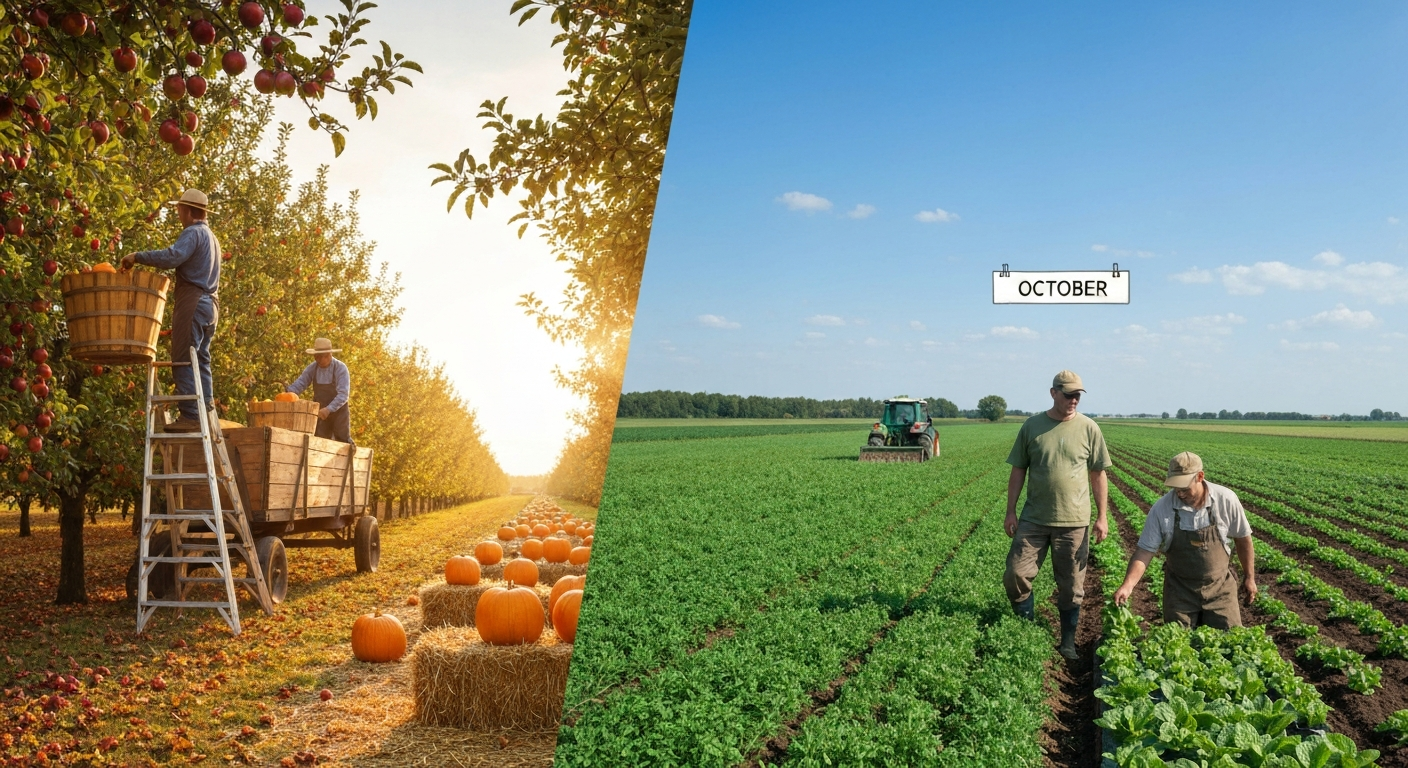
A map showing U.S. average first frost dates by county (available from NOAA and several extension services) is highly useful alongside this article. It lets readers immediately see their own deadline for October warm-season crop harvest and their planting window for fall crops. A companion image showing a split-view of an October apple harvest in the Northern Hemisphere alongside an October maize planting in the Southern Hemisphere visually captures the hemisphere-contrast point better than any amount of prose.
Putting it all together: your October action list
- Check your average first frost date (NOAA or your local extension office) and count back to know your remaining warm-season harvest window
- Harvest frost-sensitive crops (pumpkins, winter squash, sweet potatoes, peppers) before the first hard frost at 28°F (-2°C) or below
- Cure winter squash, sweet potatoes, and onions at the appropriate temperature and humidity before moving to long-term storage
- Take soil temperature readings at 4-inch depth to time garlic planting: aim to plant near 50°F (10°C)
- Plant garlic 4–6 weeks before your soil freezes hard; select hardneck varieties for cold-winter climates
- Seed cover crops (winter rye, hairy vetch, cereal oats) as soon as main-season crops are out to establish ground cover before freeze
- Transplant or direct-seed cool-season vegetables (spinach, kale, Asian greens) with row cover protection for extended fall harvest
- Plant short-day onion sets in the Southeast and California for spring bulb production
- Set up row covers or high tunnel poly to extend brassica and leafy green harvest through November
- Scout newly planted beds for slugs and rodent activity as temperatures drop
FAQ
Title and short description for an article about crops in October
What Crops Grow in October — A regional, seasonal guide. Discover which crops are harvested or planted in October across U.S. regions, global climate zones, and selected ancient civilizations. (<=160 chars)
Which crops are commonly harvested in October?
Common October harvests in temperate Northern Hemisphere regions include apples, pumpkins and winter squash, late maize/corn (depending on hybrid maturity), root crops (carrots, beets, turnips, potatoes), brassicas (cabbage, broccoli, Brussels sprouts), and late-season grapes. In Mediterranean climates many table olives and some citrus begin harvest windows. In the Southern Hemisphere October is a spring month: spring leafy greens, early brassicas and some vegetable plantings are harvested or harvested earlier.
Which crops are commonly planted in October?
Typical October plantings (Northern Hemisphere temperate zones): garlic and shallot sets, overwintering onions in some areas, cover crop seedings (rye, vetch, clover), fall/winter leafy greens (lettuce, spinach, Asian greens) in milder zones or under protection, and strawberries in some production systems. In the Southern Hemisphere October is a prime month for sowing many warm-season crops and establishing spring plantings.
How to tell whether October is a planting or harvest month in your location?
Use hemisphere and local climate: Northern Hemisphere temperate/Mediterranean = autumn harvests and fall plantings (garlic, cover crops). Southern Hemisphere = spring planting and early growth. Check local last-first frost dates, soil temperature (rule: garlic planted when soil ~50°F/10°C at 4 in/10 cm depth), and accumulated growing degree days (GDD) for heat‑driven crops like corn to predict maturity.
What climatic, temperature and photoperiod cues determine October crop success?
Key cues: daytime/nighttime temperatures and cooling trigger ripening and color (fruiting crops), soil temperature controls root establishment for fall‑planted bulbs like garlic (~50°F/10°C threshold), and photoperiod influences bolting/flowering in some vegetables. Chill‑hour accumulation through autumn/winter affects fruit tree dormancy and cultivar selection. GDD accumulation (base temp often 50°F for corn) predicts maturity dates and harvest timing.
How do October cropping calendars differ by U.S. region?
Generalized U.S. patterns: Pacific Northwest/Coastal CA – cool‑season vegetables planted/harvested into winter, apples and pumpkins harvested; Corn Belt/Upper Midwest – late corn and soybeans often harvested in October, root crops and apples; Northeast/Mid‑Atlantic – pumpkins, apples, brassicas and root crops harvested; Southeast – longer warm season: late sweet potatoes, some fall brassicas and transplants; Southwest/Desert – harvests of winter squash, grapes, and earlier citrus; Mountain/High‑altitude – shorter season; many crops finished by October.
Next Articles
Best Crops to Grow in June: What to Plant Now by Region
Region-by-region June planting guide with best crops, what to sow now, and care tips for frost, heat, pests, and harvest
What Did the Delaware Colony Grow: Crops, Uses & Legacy
Colonial Delaware’s main crops, grains, hay, flax, fruits, vegetables, livestock, why they thrived and how they were sold.
What Did Jamestown Grow and How They Farmed It
Learn what Jamestown colonists grew and the methods they used to plant, harvest, and adapt crops to Virginia conditions.