
India grows an enormous range of crops, from rice and wheat to cotton, sugarcane, turmeric, and tea, because it spans nearly every climate zone on Earth. If you want the short answer: the country's major crops are rice, wheat, maize, pulses (lentils, chickpea, pigeon pea), oilseeds (mustard, groundnut, soybean), sugarcane, cotton, and jute, plus a wide array of fruits, vegetables, and plantation crops like tea and coffee. What you should actually grow depends almost entirely on where you are, what season it is, and whether you have reliable water access.
What Crops Grow in India by Region, Climate, Season

Samuel Rourke
15 Apr 2026
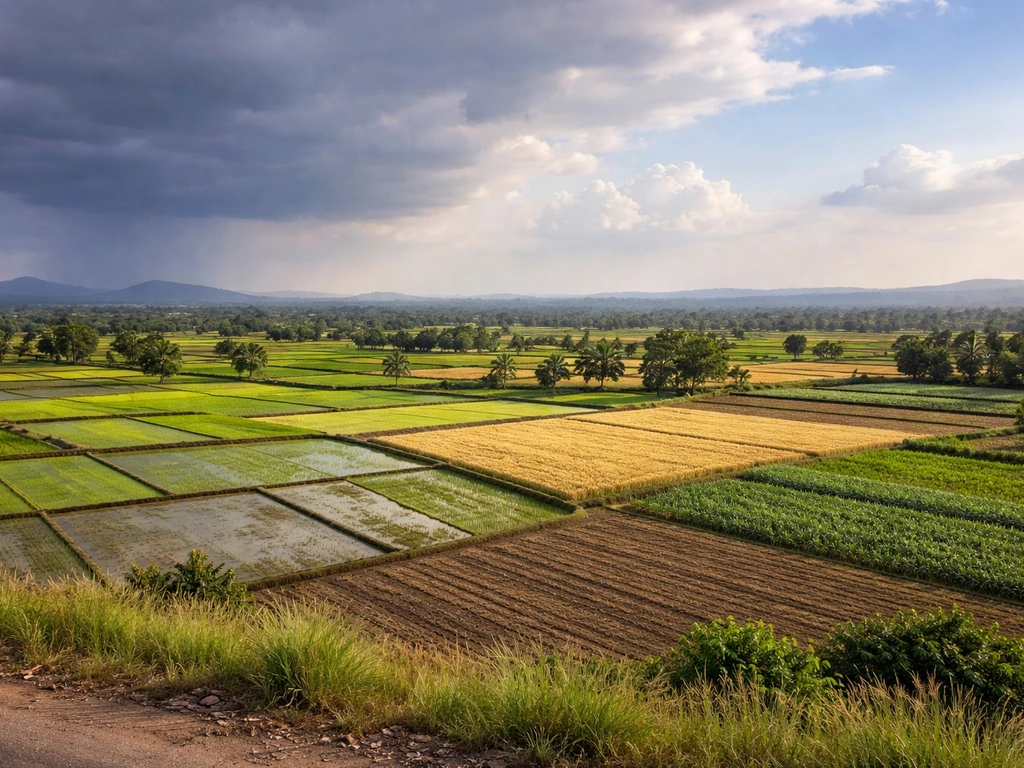
Big picture: what India actually grows
India is one of the world's top agricultural producers, and the Ministry of Statistics (MoSPI) tracks area and production figures across all major crop categories: cereals and foodgrains, pulses, oilseeds, sugarcane, cotton, and jute. Looking at those categories gives you a clear hierarchy. Rice and wheat together dominate foodgrain production. Maize is the third big cereal, and globally FAO data confirms that maize, wheat, and rice account for 91% of total cereal production, which tells you why these three appear everywhere in Indian cropping systems too. Sugarcane is India's dominant sugar crop, consistent with FAO's finding that sugar cane globally produces more than 2 billion tonnes annually, dwarfing any other sugar source.
Beyond the staples, India produces more than 90 distinct crops at commercial scale. Mustard dominates oilseed production in the north and west. Groundnut is the leading oilseed in the south and dry peninsular belt. Cotton and jute are the two main fiber crops. Tea, coffee, cardamom, and rubber dominate plantation agriculture in specific hill and coastal zones. Fruits and vegetables round it out: India is one of the world's top producers of bananas, mangoes, onions, tomatoes, and potatoes.
Crops by climate and region
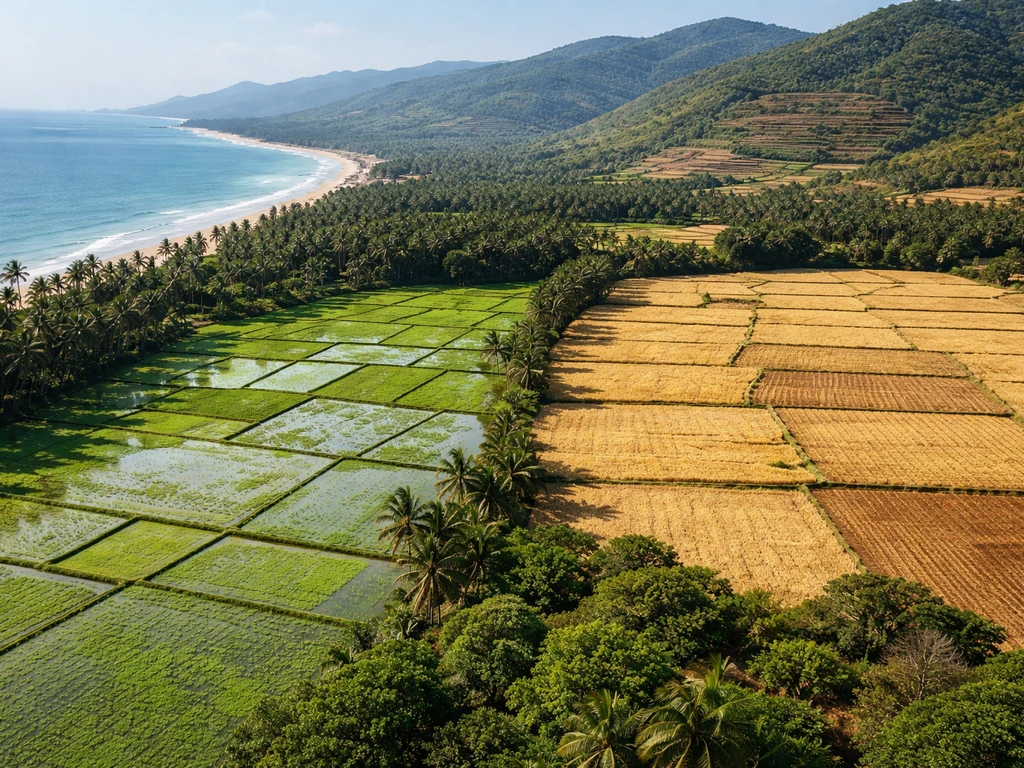
India's geography is the key driver here. The monsoon, altitude, temperature range, and soil type each push farmers toward different crops. Here is how it breaks down across the four main agro-climatic zones.
Monsoon and humid zones (eastern plains, West Bengal, Odisha, Assam)
These areas get 1,200 mm or more of annual rainfall, most of it concentrated between June and September. Rice is the obvious dominant crop, grown as a Kharif (monsoon) crop across virtually all of this belt. Jute grows in West Bengal and Assam in the same season. After the monsoon, farmers here shift to lentils, mustard, and vegetables as Rabi (winter) crops. Assam extends into tea plantation territory, where consistent humidity and acidic soils in the foothills produce some of the world's most traded teas.
Dry and semi-arid zones (Rajasthan, parts of Maharashtra and Andhra Pradesh)
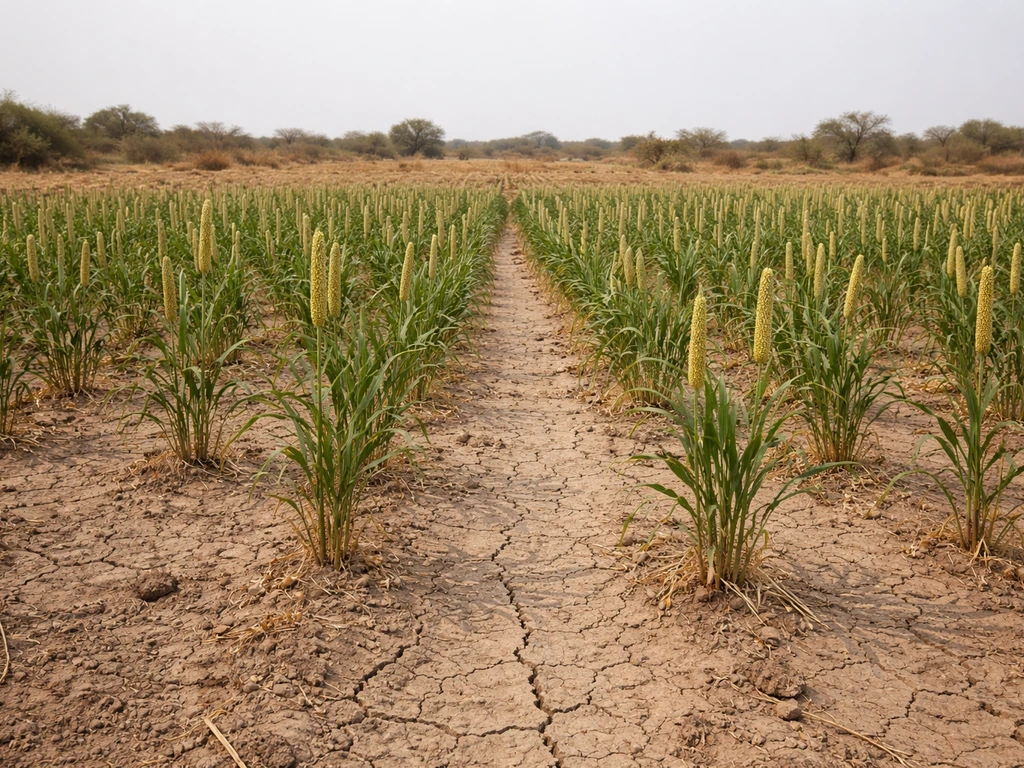
Rajasthan and the semi-arid Deccan get less than 500 mm of rainfall in many districts. Pearl millet (bajra) is the workhorse here because it is genuinely drought tolerant and responds less to irrigation than other grain crops, which matters when water is scarce. Sorghum (jowar) is another dry-zone staple. Groundnut, cluster bean (guar), and moth bean fill the oilseed and pulse roles in this belt. ICAR's Central Arid Zone Research Institute (CAZRI) maintains crop-weather watch bulletins specifically tailored to dryland conditions in these areas, which shows just how specialized the agronomic advice needs to be when rainfall is unpredictable.
Coastal zones (Kerala, coastal Karnataka, Tamil Nadu, Andhra coast)
Coastal India gets high humidity, relatively stable temperatures, and often two monsoon pulses (southwest and northeast). Rice is grown in two or even three seasons along the Kerala and Tamil Nadu coast. Coconut is the signature plantation crop across the entire coastal belt. Kerala and coastal Karnataka also grow pepper, cardamom, arecanut, and cashew. Banana and tapioca are major food crops in Kerala. The best crops to grow in Karnataka include ragi (finger millet), sugarcane, and cotton in the interior districts, while coconut and arecanut dominate the western coastal strip.
Hill and mountain zones (Himachal Pradesh, Uttarakhand, northeastern hills, and the Himalayas)
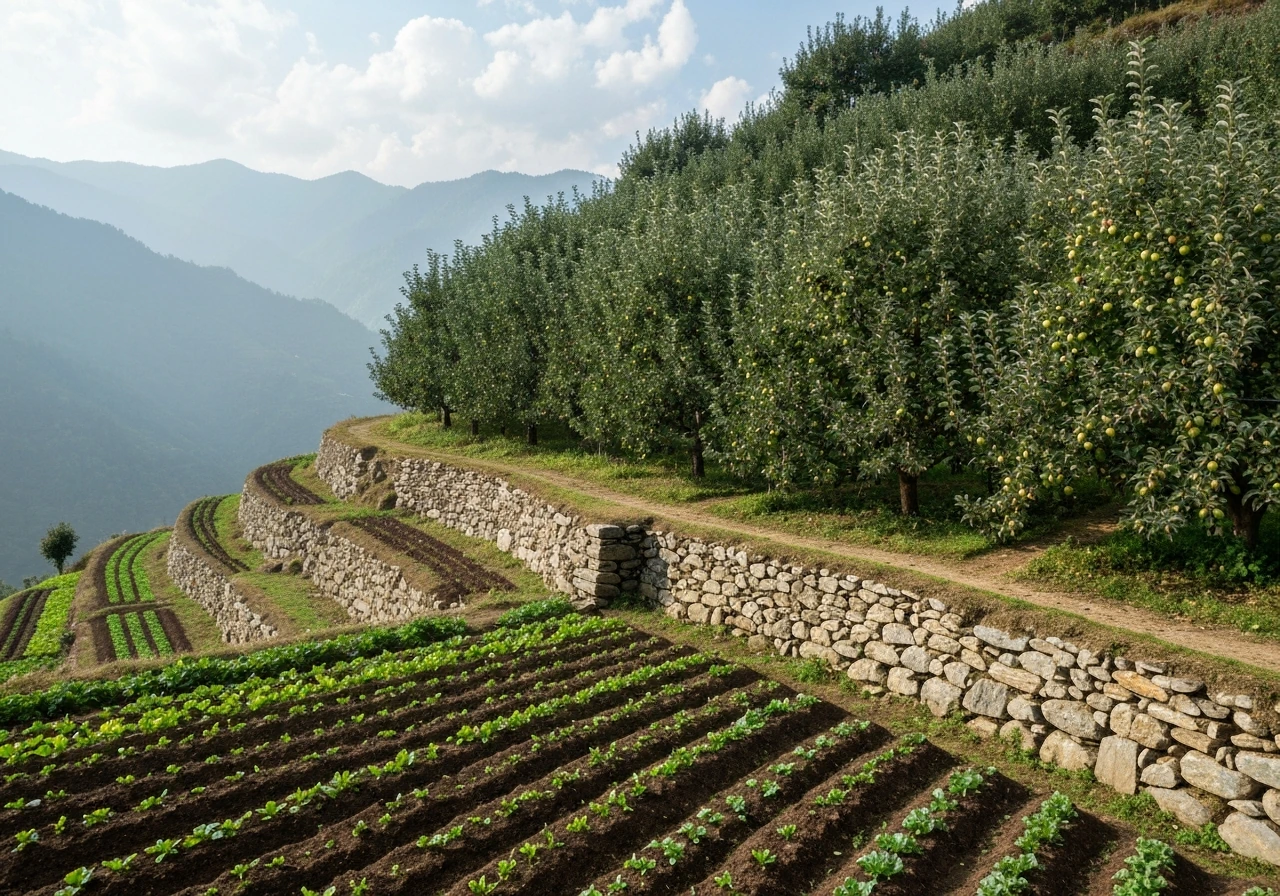
Cooler temperatures, shorter growing seasons, and terraced hillsides define agriculture here. Apple orchards are the economic backbone of Himachal Pradesh. Temperate vegetables like peas, potatoes, and cabbage thrive in the cooler months. Barley and buckwheat are traditional Himalayan grains. If you want a detailed breakdown, the article on what crops grow in the Himalayas goes deep on how altitude and aspect shape crop choices across that specific geography.
What farmers typically grow: a category-by-category look
Most Indian farmers grow a combination of subsistence staples and at least one cash crop or oilseed. Here is the practical breakdown by category.
| Category | Major Crops | Primary Regions |
|---|---|---|
| Cereals (staples) | Rice, wheat, maize, sorghum, pearl millet, barley | Pan-India; rice in east/south, wheat in north/central, millets in dry zones |
| Pulses | Chickpea (chana), pigeon pea (tur/arhar), lentil (masoor), mung bean, urad | Madhya Pradesh, Uttar Pradesh, Rajasthan, Maharashtra |
| Oilseeds | Mustard, groundnut, soybean, sunflower, sesame, linseed | Rajasthan (mustard), Gujarat/Andhra (groundnut), Madhya Pradesh (soybean) |
| Cash crops | Sugarcane, cotton, jute, tobacco | UP/Maharashtra (sugarcane), Gujarat/Maharashtra/Telangana (cotton), West Bengal (jute) |
| Plantation crops | Tea, coffee, rubber, coconut, cashew, arecanut | Assam/West Bengal (tea), Karnataka/Kerala (coffee), Kerala/coastal zones (coconut, rubber) |
| Fruits | Banana, mango, apple, grapes, citrus, papaya | Andhra/Maharashtra (banana), UP/Andhra (mango), Himachal (apple), Maharashtra (grapes) |
| Vegetables | Potato, onion, tomato, cauliflower, peas, brinjal | UP/West Bengal/Bihar (potato), Maharashtra/Karnataka (onion), widespread |
Pulses deserve extra attention because India is both the world's largest producer and largest consumer of pulses. Chickpea is the dominant Rabi pulse grown across Madhya Pradesh, Rajasthan, and Uttar Pradesh. Pigeon pea (arhar/tur) is the leading Kharif pulse in peninsular India. Lentils and mung beans fill gaps in the northeast and eastern states. These crops matter especially for rainfed farmers because most pulses fix nitrogen, reducing fertilizer input.
How Indian farmers actually grow crops: seasons, water, and timing
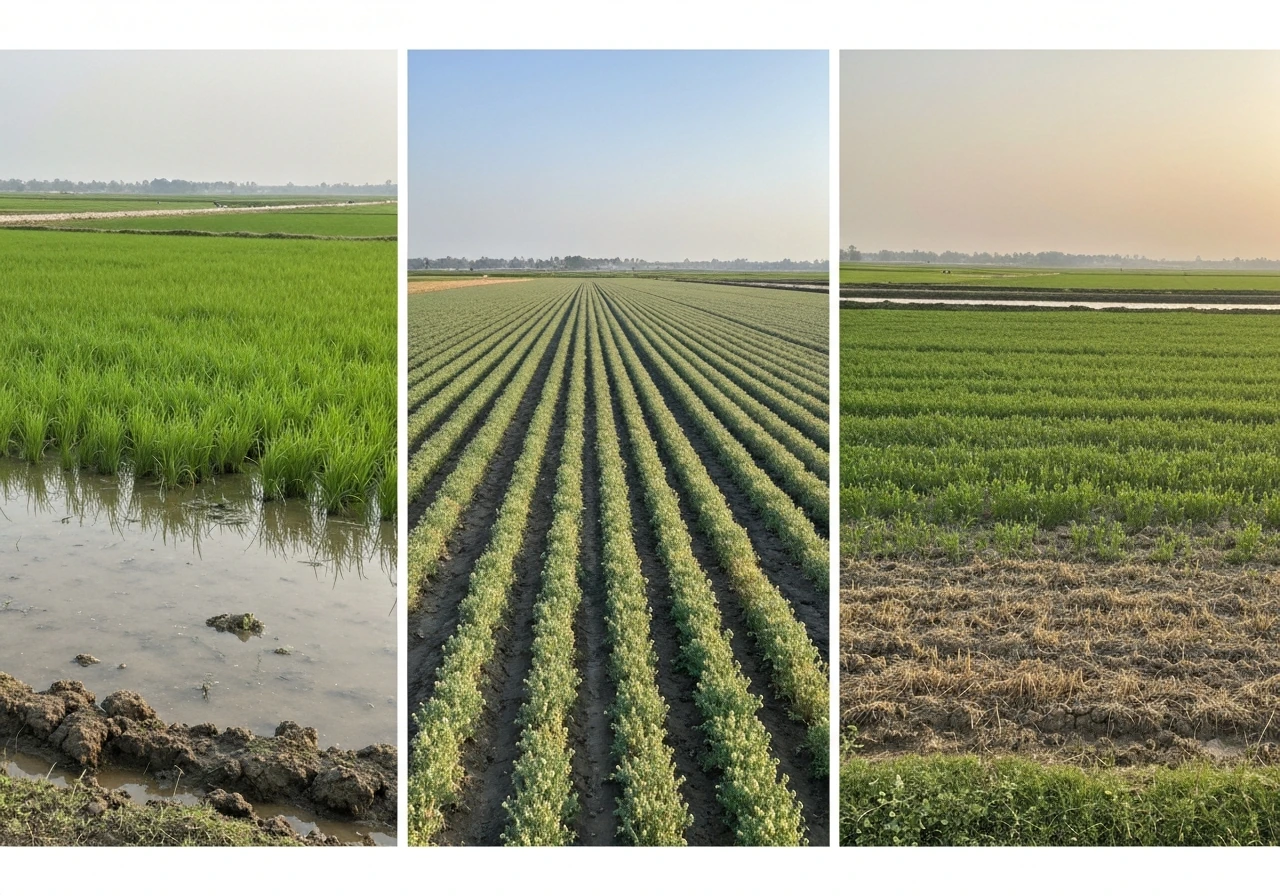
India has three main cropping seasons: Kharif (monsoon), Rabi (winter), and Zaid (short summer bridge between Rabi and Kharif). Most farmers operate primarily in Kharif and Rabi; Zaid is limited to irrigated areas. Understanding these seasons is the single most useful framework for crop planning in India.
Kharif (monsoon season): June to October
Kharif crops are sown at the onset of the monsoon and harvested in autumn. Major Kharif crops include rice, maize, cotton, groundnut, soybean, pearl millet, sorghum, pigeon pea, and urad bean. Sowing windows are tied tightly to monsoon onset. ICAR's Kharif agro-advisories specify crop-by-crop sowing timings: for pearl millet in north and central India, the recommended window is the first fortnight of July, coinciding with established monsoon rains. For groundnut, the advisory recommends sowing across the entire month of July in many advisory zones. If you want to understand when Kharif crops grow more precisely by crop and region, the timing details matter a lot for germination success.
Rabi (winter season): October to April
Rabi crops are sown in October through December and harvested in March to April. Wheat, barley, chickpea, mustard, lentil, and peas are the key Rabi crops. ICAR's Rabi advisories explicitly differentiate sowing windows by water availability. For wheat in a region like Jharkhand, timely irrigated sowing falls in the first week of October, while rainfed conditions push the window to the last week of October through the first week of November, and unirrigated timely sowing shifts further to mid-November. blank" rel="noopener noreferrer">ICAR’s Rabi agro-advisory for Jharkhand gives region-specific wheat sowing windows by water availability: timely irrigated in the first week of October, timely unirrigated in the second week of November, late irrigated in the first week of December, and rainfed conditions from the last week of October through the first week of November. This differentiation is not subtle; planting even two weeks late can noticeably reduce yields.
Rainfed vs irrigated: the biggest practical divide
Rainfed agriculture covers about 51 percent of India's net sown area and contributes nearly 40 percent of total food production. That means the majority of Indian farmland is working without guaranteed water supply, relying entirely on monsoon rainfall. On rainfed land, crop choice has to prioritize drought tolerance, shorter maturity periods, and the ability to survive an erratic monsoon. Pearl millet and sorghum are the classic rainfed cereals. Chickpea, lentil, and mung bean are the go-to rainfed pulses. Mustard handles rainfed Rabi conditions well across the northwest.
On irrigated land, the calculus shifts toward higher-yielding crops with larger water demands: wheat (especially in Punjab and Haryana), rice in the Indo-Gangetic plain, sugarcane, and vegetables. ICAR's Kharif advisories note practical irrigation management details, such as stopping irrigation 10 to 12 days before harvest for certain crops to support grain filling and ease of harvest. ICAR-CRIDA's contingency planning materials also guide farmers on adaptation when the monsoon arrives late or fails, including switching to short-duration varieties or adjusting to life-saving irrigation for critical growth stages. ICAR-CRIDA district contingency planning guidance recommends short-duration and drought-resistant crops when the monsoon is delayed by more than two weeks, including options such as pearl millet and groundnut.
Best crops to grow in India: matching options to your conditions
Picking the best crop comes down to four things: your rainfall or irrigation access, your soil type, the season, and your market proximity. Here is a practical decision framework.
| Your Situation | Best Crop Options | Why It Works |
|---|---|---|
| Low rainfall (under 500 mm), no irrigation | Pearl millet, sorghum, moth bean, cluster bean (guar) | All drought tolerant; pearl millet especially thrives in dry warm climates with minimal irrigation |
| Moderate rainfall (500–1,000 mm), some irrigation | Maize, groundnut, pigeon pea, cotton, soybean | Good yield potential with monsoon rainfall; irrigation at critical stages boosts output |
| High rainfall (over 1,000 mm) or good irrigation | Rice, sugarcane, jute, banana | These crops need consistent moisture; high water availability makes them viable and profitable |
| Cool hilly zone | Wheat, barley, peas, potato, temperate vegetables, apple | Temperature-sensitive crops thrive where plains crops would struggle |
| Coastal humid zone | Coconut, rice (2–3 seasons), banana, arecanut, cashew | Humidity and stable temps favor plantation and tropical fruit crops |
| Irrigated flat plains, near market | Wheat, rice, vegetables, mustard, sugarcane | High-input high-output systems work when water and market access are reliable |
If profitability is your primary concern, the answer is not always the highest-yielding crop but the one with the best margin for your input costs and access to buyers. The question of what is the most profitable crop to grow in India is worth exploring separately because it factors in commodity prices, contract farming options, and agro-processing proximity, all of which shift the answer depending on your state and district.
A few practical rules of thumb: short-duration varieties of rice, maize, and mung bean are your best hedge in uncertain rainfall zones because they can be harvested before a late-season dry spell hits. In the semi-arid belt, intercropping pearl millet with cluster bean or mung bean spreads risk and improves soil nitrogen. In the Rabi season, chickpea on residual moisture (zero irrigation) is viable across large parts of central India. Mustard is one of the most input-efficient Rabi oilseeds and tolerates mild frost.
Quick start: practical next steps for planning what to grow
If you are a farmer, gardener, or student trying to act on this information, here is the fastest path from general knowledge to a local decision.
- Identify your agro-climatic zone first. Knowing whether you are in a semi-arid, sub-humid, humid, or hilly zone narrows your realistic crop list immediately. Your state's Agriculture Department website or the ICAR-CRIDA zonal contingency plan for your district will confirm this.
- Check your annual rainfall and irrigation availability. If you are below 600 mm and have no borewell or canal access, your Kharif options are essentially millets, sorghum, and short-duration pulses. Above 900 mm or with irrigation, your options open up substantially.
- Match your season. Confirm whether you are planning for Kharif (sow June to July, harvest October to November), Rabi (sow October to December, harvest March to April), or Zaid (irrigated summer crops like cucumber, watermelon, and fodder). Crop choice inside a season still depends on your water access.
- Check local soil type. Sandy loam suits groundnut and pearl millet. Heavy clay suits rice and wheat. Black cotton soil (Vertisols) in Maharashtra and Telangana is named after cotton for good reason, but it also suits sorghum and chickpea.
- Talk to your local Krishi Vigyan Kendra (KVK). Every district has one. They run demonstration plots with recommended varieties for that specific district and can tell you which seed varieties perform best under your rainfall and soil conditions.
- Look at ICAR's current Kharif or Rabi agro-advisory for your state. These are published seasonally and include crop-specific sowing windows, recommended seed rates, and irrigation scheduling. They are practical and free to download.
- Factor in market access before finalizing your choice. A high-value crop like vegetables or onion only makes sense if you can get produce to a mandi or cold storage within a day or two. Otherwise, a staple crop with guaranteed minimum support price (MSP) is less risky.
The bottom line: India's agricultural diversity means there is almost always a viable crop option for your location, season, and water situation. The farmers who make the best decisions are not necessarily the ones with the most land or water; they are the ones who match crop choice to local conditions tightly, use season-appropriate varieties, and plan around the monsoon calendar rather than against it. Start with your zone, your water, and your season, and the right crop list becomes obvious quickly.
FAQ
If I only know my state, what’s the quickest way to narrow down what crops grow in India there?
Start by mapping your location to the nearest agro-climatic pattern from the article (high-rain monsoon belt, dry semi-arid, coastal multi-season, or cooler hill zone), then choose only crops that fit your current season (Kharif, Rabi, or Zaid). Finally, check whether you’re rainfed or irrigated, because the same state can support different “best” crops depending on water access.
Can I grow rice or wheat anywhere in India if I have irrigation?
Irrigation helps, but it does not make every crop equally suitable. Temperature, soil drainage, and local pest pressure still matter. For example, water-demanding crops like rice work best where the growing environment supports the full crop calendar, while wheat often performs better in cooler, drier winter conditions typical of many Rabi regions.
What crops are the safest choices if my rainfall is unreliable or my irrigation is limited?
Prioritize drought-tolerant cereals and early-maturing varieties, such as pearl millet (bajra) and sorghum (jowar), and shorter-duration pulses like chickpea or mung bean where they fit your Rabi timing. The key decision is to select cultivars and sowing windows that let you harvest before the season turns dry or stress peaks.
Is Zaid (short summer) practical for most farmers?
Zaid is usually limited to irrigated pockets because it depends on a dependable water supply between the Rabi and Kharif cycles. If you are rainfed, it is often safer to plan around Kharif and Rabi windows instead of assuming Zaid will work with only rainfall.
How important is sowing timing, and does “two weeks late” really change yields?
Yes, timing can make a noticeable difference, especially for Rabi crops on rainfed or limited-irrigation fields where planting too late can reduce flowering and grain-fill success. Even within the same season, yield risk increases when your sowing window misses the local moisture and temperature window needed for germination and early growth.
What should I do if the monsoon arrives late or is weaker than expected?
Use contingency choices rather than sticking to the original crop plan. The article mentions life-saving irrigation for critical stages and switching to short-duration varieties. Practically, confirm whether your crop is still within a workable sowing window, then adjust to a cultivar or crop that can mature before moisture runs out.
Are pulses always a good choice because they fix nitrogen?
They help reduce fertilizer needs, but they are not automatically “easy.” Your success still depends on matching the pulse to the season, choosing suitable soil conditions, and managing weeds and moisture at establishment. In rainfed areas, pulse survival is often more about timely sowing and drought tolerance than nitrogen fixation alone.
What crop choices work best for soil problems like poor drainage or salinity?
The article emphasizes soil type as a key driver, but the practical takeaway is to avoid forcing crops that require stable moisture patterns into unsuitable soil. For poor drainage or salinity, you typically need salt-tolerant varieties and improved field management (like drainage or soil amendments), then pick crops known to handle those conditions better.
Which crop is best if my main goal is profit rather than maximum yield?
Profit depends on input costs, yield risk, and market access, not just productivity. If you have limited buyers nearby or higher transport costs, a crop with a lower but more predictable net margin can outperform a high-yield option. Consider contract farming or agro-processing proximity when comparing alternatives.
Can intercropping help in dry areas, and what’s the usual approach?
Intercropping can spread risk and improve resource use, especially in semi-arid zones. A common example from the article is pairing pearl millet with cluster bean or mung bean to help stabilize returns when rainfall fluctuates, but keep sowing dates and spacing compatible for both crops.
What are typical mistakes people make when choosing crops in India?
Common mistakes include choosing based on what is “popular” in another region, ignoring whether the farm is rainfed versus irrigated, and assuming calendar-based sowing without checking local monsoon onset. Another frequent issue is planting the wrong variety length for your rainfall pattern, which raises the chance of late-season stress.
Next Articles
What Did the Delaware Colony Grow: Crops, Uses & Legacy
Colonial Delaware’s main crops, grains, hay, flax, fruits, vegetables, livestock, why they thrived and how they were sold.

What Did Jamestown Grow and How They Farmed It
Learn what Jamestown colonists grew and the methods they used to plant, harvest, and adapt crops to Virginia conditions.
What Did the New England Colonies Grow? Major Crops
Major New England colonial crops explained by climate and soil, from corn and wheat to beans and hay, plus today’s paral