If you had to pick one state, California is the best overall state to grow crops in the U.S. by cash receipts and sheer diversity, leading the nation in fruits, vegetables, nuts, and high-value specialty crops through 2024 according to USDA Economic Research Service data. But 'best' shifts fast depending on the crop: Iowa and Illinois dominate corn, Kansas anchors wheat, Arkansas leads rice, and Texas rules cotton. No single state wins every category, which means the real answer depends entirely on what you want to grow.
Best State to Grow Crops: Top U.S. States, Crops & Reasons

Samuel Rourke
15 Jul 2026
What 'best' actually means for crop production
Before ranking states, it helps to agree on what we're measuring. There are at least five distinct ways to call a state 'best' for crops, and they don't always point to the same place.
- Total cash receipts: the dollar value of all crops sold. California consistently tops this list because high-value fruits, nuts, and vegetables fetch far more per acre than commodity grains.
- Harvested acreage: sheer land under cultivation. Kansas, North Dakota, and Texas rank high here because of vast, low-cost plains acreage devoted to wheat, sunflowers, and cotton.
- Yield per acre: how efficiently a state converts land into output. Iowa and Illinois routinely achieve corn and soybean yields above the national average thanks to deep, fertile soils and a long, warm growing season.
- Crop diversity: the number of distinct crops produced commercially. California again leads, producing over 400 agricultural commodities, followed by Florida and Texas.
- Climate suitability and reliability: how well a state's natural conditions match a crop's growing requirements with minimal costly inputs. This is where frost-free days, growing degree days (GDD), precipitation patterns, and USDA plant hardiness zones all come into play.
For a student or curious gardener, diversity and climate suitability probably matter most. For a commercial farmer making a land decision, yield, profitability, and water infrastructure are the practical scorecards. This article covers all of them.
Top states for general crop production
Here are the states that consistently rank at or near the top across multiple crop-production metrics, along with the core reason each one excels.
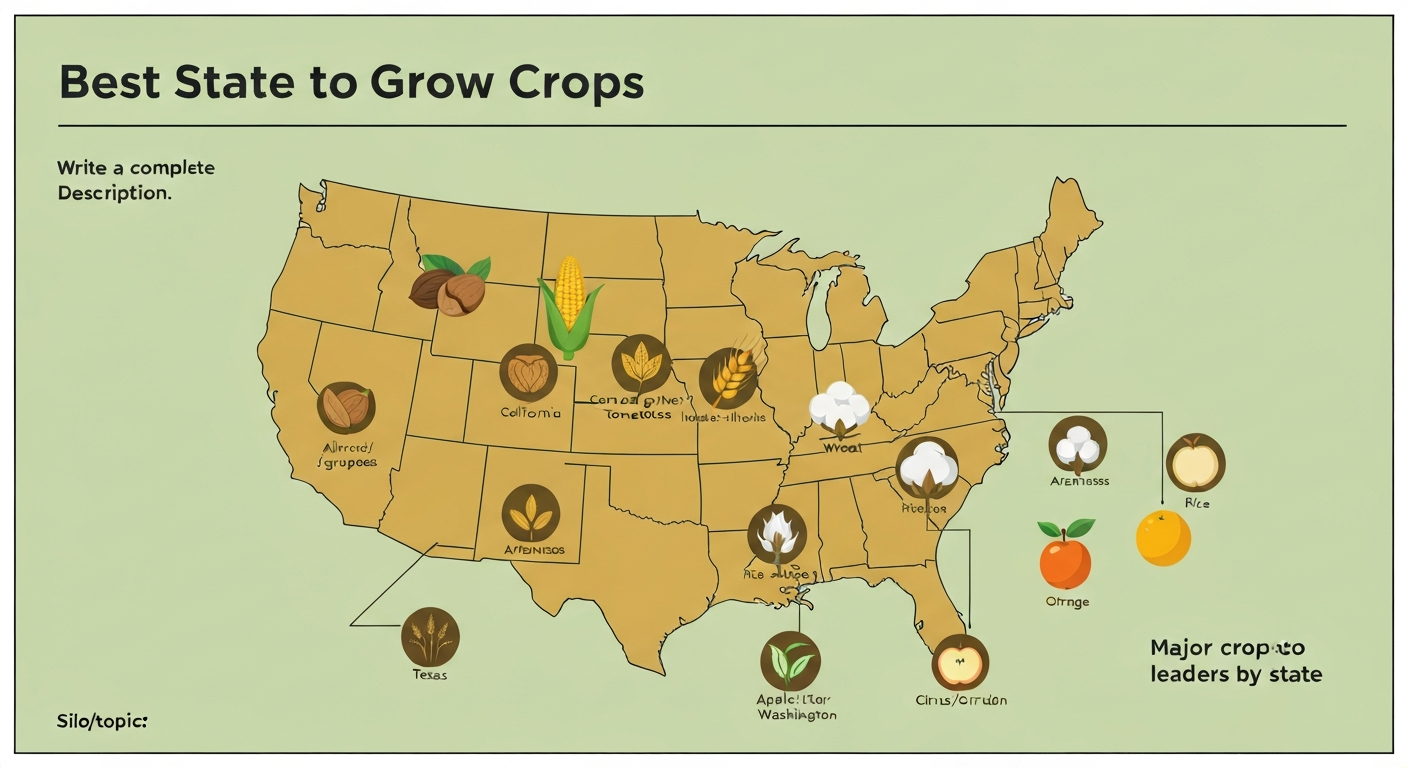
- California: Leads all states in crop cash receipts. The Central Valley alone produces the majority of U.S. almonds, pistachios, tomatoes, strawberries, grapes, and lettuce. A Mediterranean climate with warm, dry summers and mild winters, combined with one of the most developed irrigation systems on earth, lets growers produce year-round in many regions.
- Iowa: The heart of the Corn Belt. Deep Mollisol soils (some of the most fertile on the planet), 140–165 frost-free days, and reliable summer rainfall make Iowa the nation's top or second-top corn producer every year, and typically the top soybean state by total production.
- Illinois: Neck-and-neck with Iowa for corn and soybean supremacy. Illinois regularly ranks first in total soybean production and shares Iowa's advantage of rich prairie soils and a long enough growing season for two major row crops in rotation.
- Kansas: The Wheat State. Flat topography, dry continental climate, and well-drained silt loam soils across the Great Plains make Kansas the consistent leader in winter wheat acreage and production.
- Texas: The largest U.S. cotton producer and a major player in sorghum, hay, corn, and vegetables. Texas's sheer size (over 127 million acres of farmland) means it ranks in the top five for harvested acreage almost regardless of crop.
- Nebraska: Strong across corn, soybeans, and hay, backed by the Ogallala Aquifer for irrigation. Nebraska's pivot-irrigated fields in the Sandhills and Platte River Valley produce some of the country's highest corn yields.
- Minnesota: Top-tier soybeans, corn, and sugar beets. The Red River Valley's black glacial soils are among the most productive in North America.
- Arkansas: The leading U.S. rice state, also significant for soybeans and cotton. The alluvial soils of the Mississippi Delta lowlands and abundant water from the Mississippi River system support intensive flooded rice cultivation.
- Florida: Dominates citrus (historically), tomatoes, strawberries, and sugarcane in the continental U.S., with a subtropical climate that allows virtually year-round outdoor production.
- Washington: Leads in apples, hops, and cherries, and ranks among the top wheat states for soft white wheat. The Columbia Basin's combination of volcanic soils, sunny summers, and Columbia River irrigation underpins the state's fruit industry.
State-by-state quick reference
The table below covers the most agriculturally significant U.S. states with a one-line suitability note, primary crops, general USDA hardiness zone range, and typical irrigation dependence. Zone ranges are broad because most large states span multiple zones.
| State | Primary Crops | USDA Hardiness Zones | Irrigation Level | Suitability Note |
|---|---|---|---|---|
| California | Almonds, grapes, tomatoes, lettuce, strawberries, rice, cotton | 5b–11a | Very High (surface water/canals) | Highest-value, most diverse crop state in the U.S. |
| Iowa | Corn, soybeans, hay, oats | 4a–5b | Low (mostly rainfed) | Top corn/soy yields on deep Mollisol prairie soils |
| Illinois | Soybeans, corn, wheat | 5a–6b | Low to Moderate | Consistent #1 soybean producer; ideal Corn Belt climate |
| Kansas | Winter wheat, corn, sorghum, soybeans | 5a–7a | Moderate (Ogallala wells) | Undisputed winter wheat leader of the Great Plains |
| Texas | Cotton, corn, sorghum, wheat, hay, vegetables | 6a–10b | High (varied sources) | Largest U.S. cotton producer; enormous farmland acreage |
| Nebraska | Corn, soybeans, hay, sorghum | 4b–6a | High (Ogallala Aquifer) | Pivot-irrigated corn yields among the nation's highest |
| Minnesota | Soybeans, corn, sugar beets, wheat, hay | 3a–5a | Low to Moderate | Red River Valley soils world-class for sugar beets and soy |
| Indiana | Corn, soybeans, wheat | 5a–6b | Low to Moderate | Third-largest soybean state; Corn Belt core |
| Arkansas | Rice, soybeans, cotton, corn | 6a–8a | Very High (alluvial wells) | Nation's #1 rice state; rich Delta alluvial soils |
| North Dakota | Spring wheat, canola, sunflowers, barley, soybeans | 3a–4b | Moderate | Top spring wheat and sunflower state; short but intense season |
| Montana | Winter/spring wheat, barley, hay, pulses | 3a–6a | Low to Moderate | Large-acreage dryland wheat; vast northern plains |
| Washington | Apples, wheat, potatoes, cherries, hops | 4a–9b | High (Columbia River) | Fruit and soft white wheat leader; Columbia Basin irrigation |
| Florida | Oranges, tomatoes, sugarcane, strawberries, peppers | 8a–11a | High (rainfall + irrigation) | Subtropical year-round production; leads citrus and sugarcane |
| Georgia | Peanuts, cotton, blueberries, pecans, peaches | 6b–9a | Moderate | Top peanut and pecan state; leads U.S. blueberry production |
| Idaho | Potatoes, hay, wheat, dairy (feed crops), barley | 3a–7b | Very High (Snake River) | Produces more potatoes than any other U.S. state |
| Wisconsin | Corn, soybeans, hay, cranberries, ginseng | 3b–6a | Low to Moderate | Top cranberry state; strong dairy-feed crop base |
| Michigan | Corn, soybeans, blueberries, tart cherries, apples | 4a–7a | Low to Moderate | Leads U.S. in tart cherries and is a top blueberry state |
| Ohio | Corn, soybeans, wheat, tomatoes | 5a–6b | Low to Moderate | Solid Corn Belt state with strong processing-vegetable sector |
| Missouri | Soybeans, corn, cotton, rice, hay | 5a–7a | Low to Moderate | Bridges Corn Belt and Cotton Belt; versatile crop mix |
| Louisiana | Rice, sugarcane, cotton, soybeans, corn | 8a–10a | Very High | Second-largest sugarcane state; top-five rice producer |
Crop-by-crop: which states lead and why
Corn
Iowa and Illinois together typically account for roughly one-third of total U.S. corn production, and together with Indiana, Nebraska, and Minnesota they form the core of the Corn Belt. The reason is straightforward: this region sits on deep, well-drained Mollisol soils built up over thousands of years of prairie grass decomposition, accumulates enough growing degree days (roughly 2,500–2,700 GDD base 50°F for full-season hybrids), and receives 28–36 inches of annual rainfall concentrated in the growing season. Iowa consistently produces around 2.2–2.4 billion bushels annually, often with corn yields exceeding 200 bushels per acre in top counties.
Soybeans
Illinois, Iowa, and Indiana are the top three soybean-producing states, together accounting for more than 37% of U.S. soybean production in 2024 according to USDA ERS data, with over 80% of U.S. soybean acreage concentrated in the Midwest overall. Soybeans thrive on the same Corn Belt soils as corn, and the two crops are rotated together across tens of millions of acres. The soybean's nitrogen-fixing ability makes it an ideal rotation partner on Corn Belt farms, reducing fertilizer costs and maintaining soil health.
Wheat
Wheat production splits into distinct classes, each anchored in a different region. Kansas is the dominant winter wheat state, consistently leading U.S. production with its flat, well-drained silt loam soils and dry continental climate that suits winter wheat's dormancy period. North Dakota and Montana lead in spring wheat production, where cold winters prevent winter wheat cultivation but the short, intense northern summer supports rapid spring wheat maturation. Washington State leads in soft white wheat production, grown in the Palouse region's deep volcanic loess soils with a maritime-influenced climate. USDA NASS small grains summaries consistently rank these four states at the top.
Rice
Arkansas is the nation's leading rice state, followed by California, Louisiana, Mississippi, and Texas, according to USDA ERS Rice Yearbook data. Arkansas's dominance comes from the flat alluvial soils of the Mississippi Delta lowlands, abundant groundwater from shallow alluvial aquifers, hot and humid summers, and a long tradition of flooded paddy production. California's Sacramento Valley is the second major production region, relying entirely on snowpack-fed surface water delivered through an extensive canal system to flood fields in a very different climate: hot, dry summers with near-zero natural rainfall during the growing season.
Cotton
Texas is by far the largest U.S. cotton-producing state, with the Texas High Plains and Rolling Plains accounting for the majority of Texas production and a significant share of total U.S. output. The rest of the Cotton Belt runs through Georgia, Arkansas, Mississippi, and the Carolinas. Cotton needs a long frost-free season (at least 180–200 days), high summer temperatures, and moderate moisture with well-drained soils. Texas's sheer land area and the hot, semi-arid climate of its plains suit upland cotton well, though the state's western regions require irrigation from the Ogallala Aquifer.
Fruits
California dominates U.S. fruit production in terms of both value and variety, leading in grapes, strawberries, peaches, nectarines, and many others. Washington State dominates apples and cherries; Michigan leads tart cherries; Florida historically led citrus (though citrus greening disease has substantially cut Florida orange production since the mid-2000s); and Georgia is historically associated with peaches, though its commercial peach sector has declined significantly. The pattern here reflects climate: perennial fruit crops need specific chilling hours in winter, warm dry summers to minimize fungal disease, and frost-free windows long enough for fruit development.
Vegetables
California is far and away the top U.S. vegetable state, producing the majority of the nation's processing tomatoes, head lettuce, broccoli, cauliflower, garlic, artichokes, and spinach. The Salinas Valley is often called 'the salad bowl of the world.' Florida is the leading state for fresh-market tomatoes, snap beans, and sweet corn in the winter and early spring window, exploiting its frost-free subtropical climate when most of the country can't produce field vegetables. Arizona's Yuma County plays a similar role in winter lettuce and leafy greens, supplying the bulk of U.S. romaine and iceberg lettuce from November through March.
Specialty crops
A few specialty crop leaders are worth singling out. Idaho produces more potatoes than any other U.S. state, with volcanic soils in the Snake River Plain and Columbia Basin providing ideal drainage and mineral content. Georgia leads in peanuts and ranks high in pecans. Wisconsin dominates cranberry production, accounting for roughly 60% of the U.S. crop from its glacially formed boggy lowlands. Hawaii is the only U.S. state that commercially produces coffee, cacao, macadamia nuts, and vanilla. California commands the entire U.S. almond, pistachio, artichoke, and walnut industry, with those crops barely viable outside the state's specific climate.
Why crops grow where they do: the key geographic and agronomic factors
Understanding why certain states dominate specific crops means thinking through a checklist of natural conditions. These factors interact with each other, and changing any one of them changes the crop map. This is the same framework used throughout this site when mapping where crops grow across different regions and time periods.
Climate and temperature
Every crop has a minimum, optimum, and maximum temperature for germination and growth. Corn won't germinate well below 50°F soil temperature; rice wants standing water and air temperatures above 70°F for most of its growing season; citrus is killed by hard freezes below about 28°F sustained for more than a few hours. USDA plant hardiness zones (based on average annual minimum winter temperatures) give a rough guide to what perennial crops can survive a winter. For annual crops, frost-free days matter more: the number of days between the last spring frost and the first fall frost. PRISM Climate Group data from Oregon State University, one of the most widely used sources for gridded U.S. climate normals, maps these frost-free windows in detail across every county in the country.
Growing degree days (GDD)
GDD is a heat accumulation metric that predicts crop development better than calendar days alone. Corn needs roughly 2,500–2,700 GDD (base 50°F) to reach maturity; soft red winter wheat needs around 1,700–2,200 GDD (base 32°F) from planting to harvest. States with longer, hotter growing seasons accumulate GDD faster, which is why the Deep South can grow long-season cotton varieties that Midwestern states cannot, and why Iowa can grow full-season corn hybrids that North Dakota cannot.
Precipitation and drought risk
The eastern U.S. receives enough natural rainfall (generally 30–50+ inches annually) that most field crops can be grown without irrigation. The 100th meridian running roughly through the Great Plains is the traditional dividing line between rainfed and irrigated agriculture. West of that line, rainfall drops below 20 inches in many areas, and successful cropping depends on either drought-tolerant varieties (winter wheat in Kansas, dryland sorghum in West Texas) or supplemental irrigation. The Pacific Coast receives most of its precipitation in winter, meaning summer crops require irrigation almost without exception.
Soil texture and drainage
Soil type is often the deciding factor between a good farm and a great one. The deep, dark Mollisols of the Corn Belt (formed under native tallgrass prairie) hold moisture and nutrients exceptionally well while draining adequately to prevent waterlogging. The volcanic loess soils of eastern Washington's Palouse region are extraordinarily fertile for winter wheat. Florida's sandy soils drain quickly, which suits strawberries and tomatoes when managed with irrigation but limits large-scale grain production. Alluvial soils along major river systems (the Mississippi Delta, Sacramento Valley, Arkansas Delta) tend to be high in nutrients and organic matter but often need drainage infrastructure to be farmable. USDA NRCS soil databases, particularly SSURGO for detailed local survey units, are the standard reference for mapping these soil characteristics at the county level.
Soil pH and crop pH ranges: what every grower needs to know
Soil pH controls how available nutrients are to crop roots. Most nutrients, including nitrogen, phosphorus, potassium, calcium, and magnesium, are most available to plants in the slightly acidic to near-neutral range of roughly pH 6.0 to 7.0. According to Virginia Tech Extension guidance and standard agronomy references, this is the window where most row crops, vegetables, and small grains perform best. Outside that range, specific nutrients lock up in the soil or become toxic, regardless of how much fertilizer you apply.
| Crop Group | Optimal pH Range | Notes |
|---|---|---|
| Most vegetables (tomatoes, peppers, lettuce) | 6.0–6.8 | Phosphorus availability drops sharply below pH 6.0 |
| Corn | 6.0–6.8 | Sensitive to manganese toxicity below pH 5.5 |
| Soybeans | 6.0–7.0 | Rhizobium nodulation (N fixation) impaired below 6.0 |
| Wheat (winter and spring) | 6.0–7.5 | Tolerates slightly more alkaline soils than most vegetables |
| Rice | 5.5–7.0 | Flooded conditions alter effective pH; wider tolerance |
| Cotton | 5.8–7.0 | Sensitive to boron deficiency at higher pH |
| Potatoes | 4.8–5.5 | Lower pH reduces common scab disease incidence |
| Blueberries | 4.5–5.5 | Strong acid requirement; amend with sulfur on neutral soils |
| Peanuts | 5.8–6.2 | Calcium availability at pod zone is critical |
| Alfalfa | 6.5–7.5 | Requires near-neutral pH for optimal nitrogen fixation |
| Cranberries | 4.0–5.0 | One of the most acid-tolerant commercial crops |
From a practical standpoint, if your soil pH is below the optimal range, apply agricultural limestone (calcitic or dolomitic depending on your magnesium needs) and work it in before planting. If pH is too high (alkaline soils common in the arid West), elemental sulfur or ammonium-based fertilizers can gradually lower pH, though this takes time and repeated applications. Every state's cooperative extension service offers free or low-cost soil testing, and it is the single most cost-effective thing a new grower can do before putting seed in the ground. For a deeper look at pH across different crop groups, this topic connects directly to the broader question of at which pH most crops grow best.
Water, irrigation, and how they shape the best states for crops
Water availability is arguably the single biggest constraint on where crops can grow in the U.S., and it divides the country into fundamentally different agricultural systems. Understanding this divide is essential to understanding why western states like California and Idaho can grow high-value crops at all, and why the Midwest can farm at large scale with relatively little irrigation infrastructure.
The rainfed East vs. the irrigated West
In the humid eastern U.S., most corn, soybeans, wheat, and vegetables are grown entirely on natural rainfall. Iowa, Illinois, Indiana, and Ohio rarely irrigate more than a small fraction of their cropland because average growing-season precipitation is sufficient for most years. In the arid and semi-arid West, it's the opposite: without irrigation, large-scale crop production is simply not possible. USGS water-use estimates document that agriculture accounts for roughly 80% of consumptive water use in the western U.S., with California, Nebraska, Idaho, Texas, and Colorado consistently among the top irrigated-acre states.
Surface water, canals, and reservoirs
California's Central Valley Project and State Water Project deliver Sierra Nevada snowmelt through hundreds of miles of canals and aqueducts to farms in the San Joaquin and Sacramento Valleys. This infrastructure, built largely in the mid-20th century, is what makes California's extraordinary crop diversity possible. Similarly, the Columbia River irrigation systems in Washington and Oregon, the Snake River Plain's canal networks in Idaho, and the Rio Grande irrigation districts in New Mexico and Texas all convert arid landscapes into highly productive farmland. Without these surface water delivery systems, most of the western crop production discussed in this article would not exist.
Groundwater and the Ogallala Aquifer
The High Plains of Kansas, Nebraska, Texas, Colorado, Oklahoma, and New Mexico sit over the Ogallala Aquifer, one of the world's largest groundwater reserves. Millions of acres of corn, wheat, sorghum, and cotton in this region depend on Ogallala water pumped through center-pivot irrigation systems. The challenge is that the Ogallala is a fossil aquifer, recharging at a tiny fraction of the rate it is being depleted. USGS monitoring data show that water levels in parts of the Texas High Plains and southwestern Kansas have dropped by more than 100 feet over the past several decades. This is one of the most significant long-term threats to U.S. crop production geography, and it is actively reshaping which parts of the Great Plains remain competitive for irrigated crops.
Water rights and policy
Water rights in the West operate under the prior appropriation doctrine ('first in time, first in right'), meaning senior water rights holders can continue diverting water during droughts while junior rights holders are cut off. In practice, this means that the viability of a farm in Arizona, Colorado, or California depends heavily on the seniority and security of its water rights, not just the availability of water in a given year. Eastern states generally operate under riparian rights (water use tied to land ownership along a water body), with less strict allocation. For anyone evaluating states for crop production, water rights and infrastructure are just as important as soil type or climate.
How U.S. states compare to the best crop-growing places in the world
When you step back and look globally, U.S. crop-growing states hold up remarkably well by any measure. The Corn Belt soils are comparable to the black chernozems of Ukraine and the Russian steppe, which together form the other great grain-producing region of the world. California's Central Valley shares climate characteristics with the Po Valley of northern Italy and the Murray-Darling Basin of Australia, all of which produce high-value horticultural crops under irrigation. The Nile Delta and the Ganges Plain are among the few regions globally that match or exceed Midwestern productivity for rice and wheat, but they typically lack the crop diversity, infrastructure reliability, and output consistency of the U.S. system. For a broader view of where crops grow best across the world, the patterns of climate, soil, and water that define U. For a global comparison, see our guide to the best place to grow crops in the world. S. production regions repeat themselves in analogous environments on every inhabited continent.
Practical guidance for choosing where to grow your crop
Whether you're a farmer evaluating a new state or a gardener planning your first serious vegetable plot, here is a condensed decision framework based on everything above.
- Match your crop's climate needs first. Look up the frost-free season requirement for your target crop, then use PRISM or USDA climate tools to find states or counties that reliably meet it. A single late frost can wipe out a fruit crop; a summer that is too short will never ripen long-season corn.
- Check soil type and pH before you invest. Use USDA Web Soil Survey (SSURGO) to look up any parcel of farmland you're considering. Confirm soil texture, drainage class, and mapped pH. Budget for lime or sulfur amendments if needed, and plan for drainage tile if the land is heavy clay.
- Audit your water situation honestly. If you're in the West, understand what water right comes with the land, its seniority date, and its reliability in drought years. In the East, check whether supplemental irrigation infrastructure exists for drought years; many Corn Belt operations now run limited-capacity pivot systems as insurance.
- Factor in land cost vs. crop value. Land in the Central Valley can exceed $20,000–$30,000 per acre because its productivity for high-value crops justifies it. Cropland in western Kansas may cost a fraction of that but produces lower-value dryland wheat. Match land cost to realistic crop revenue.
- Think about market access and logistics. Specialty crops and fresh vegetables need proximity to packing facilities, cold storage, and transport corridors. Commodity grains need elevator access and rail or barge infrastructure. Both California and the Corn Belt have exceptional logistics networks built up over decades; newer production regions may lack them.
- Check state-level regulations. Some states have stricter pesticide, water-use, or land-conversion regulations than others. California, for example, leads the country in agricultural regulatory complexity, which raises costs but also means California produce often meets the strictest buyer standards globally.
A simple explanation for new learners: where farmers grow crops
For readers just starting to learn about agriculture, here is the core idea in plain terms. For a concise summary of where crops grow best, see our guide on where do crops grow best. Farmers grow crops wherever the land, water, and weather work together to let a plant grow well. See where do farmers grow crops for a concise overview. Corn farmers in Iowa have dark, rich soil, warm summer rain, and enough warm days for corn to grow tall and produce grain before the first cold snap. Rice farmers in Arkansas have flat land that can be flooded, hot summers, and plenty of water from rivers and wells. Apple farmers in Washington State have mountains nearby that collect snow, rivers that bring that snowmelt water to their orchards, and cool winters that the apple trees need to rest before spring. In every case, the farmer is matching the crop to the place, and the best states are simply the places where the match is closest to perfect for a given crop. For a classroom-friendly summary of these ideas, see the short guide where do farmers grow crops class 1.
Useful data tools and maps for exploring crop geography
Several publicly available tools make it straightforward to explore the crop patterns described in this article. The USDA NASS Cropland Data Layer (CDL) is an annual satellite-based crop map that covers the entire contiguous U.S. at 30-meter resolution (with 10-meter products available beginning with the 2024 release). It is freely downloadable through CroplandCROS and the Geospatial Data Gateway and is invaluable for visualizing exactly where each crop is planted in any given year. USDA Web Soil Survey provides detailed county-level soil data including pH, drainage, and texture for any location in the U.S. PRISM Climate Group maps give gridded frost-date, precipitation, temperature, and GDD data. USGS water-use data rounds out the picture with irrigation and withdrawal statistics by county and state. Together these four tools can answer nearly any geographic crop question at whatever scale you need, from a single field to a multi-state region.
FAQ
Short answer: Which U.S. state is best for growing crops in general?
There is no single “best” state for all crops. For overall agricultural value and diversity, California leads (highest farm cash receipts; dominant for fruits, vegetables, nuts and specialty crops) (USDA ERS). For large‑scale row‑crop production of staples such as corn and soybeans, Midwestern states—especially Iowa and Illinois for corn and Illinois, Iowa and Indiana for soybeans—are best because of fertile soils, favorable climate and infrastructure (USDA ERS). Choice depends on the crop, market, water access and farm goals (USDA ERS, USDA NASS).
Which states are top for corn?
Top corn states are Iowa and Illinois (together often ~one‑third of U.S. corn production), followed by Nebraska, Minnesota and Indiana. Reasons: deep, productive Mollisols, long frost‑free seasons and well‑developed grain storage/transport networks (USDA ERS; NASS Cropland Data Layer).
Which states are top for soybeans?
Top soybean states (2024) include Illinois, Iowa and Indiana, which together account for a large share of U.S. soybean acreage and production. The Midwest’s climate, soils and farm scale favor high yields and mechanized production (USDA ERS).
Which states are top for wheat?
Wheat is regionally split by class. Hard red winter/wheat: Kansas and southern Plains states. Hard red spring: North Dakota and Montana. Soft white: Washington (and Pacific Northwest). Distribution reflects climate (winter dormancy vs. spring wheat), rainfall patterns and soil types (USDA NASS Small Grains summary).
Which states are top for rice?
Arkansas is the leading U.S. rice producer (followed by California and several Delta states such as Louisiana and Mississippi). Rice production concentrates where flooded-field irrigation and warm growing seasons are feasible (USDA ERS Rice Yearbook).
Which states are best for fruits, vegetables and specialty crops?
California dominates fruits, vegetables, nuts and many specialty crops by acreage and cash value (large irrigated production, mild Mediterranean climate, long growing seasons, processing and export infrastructure). Other specialty regions: Florida (citrus, fresh vegetables), Washington/Oregon (apples, cherries, pears), and the Southeast/California for many vegetable specialties (USDA ERS).
Next Articles
Best Place to Grow Crops in the World: How to Choose Regions
A practical guide to the best crop regions by climate, water, soil and season length, with real examples and how to choo
Where Do Crops Grow Best? Climate, Soil, Water by Crop
Learn where crops grow best by climate, soil, and water, match crops to regions, and check local frost, heat, and draina
Where Do Crops Grow? Climate, Soil, and Water Rules
Learn where crops grow by climate, soil, and water, with U.S. examples and steps to map matches for any location.