
Mission Santa Inés, founded in 1804 near present-day Solvang in California's Santa Ynez Valley, grew wheat, barley, corn, beans, peas, and a range of garden vegetables alongside orchards of figs, pomegranates, olives, citrus, apples, pears, and almonds. The mission also maintained vineyards for wine production. These crops were documented in periodic mission reports called informes, held today at the Santa Barbara Mission Archive-Library, and are supported by archaeological investigations at the site (CA-SBA-518). The mission's own history notes that its acreage produced plentiful harvests and that livestock numbered in the thousands, painting a picture of a genuinely productive agricultural operation during its peak years.
What Crops Did Mission Santa Inés Grow? Historic List

Samuel Rourke
14 Jul 2026
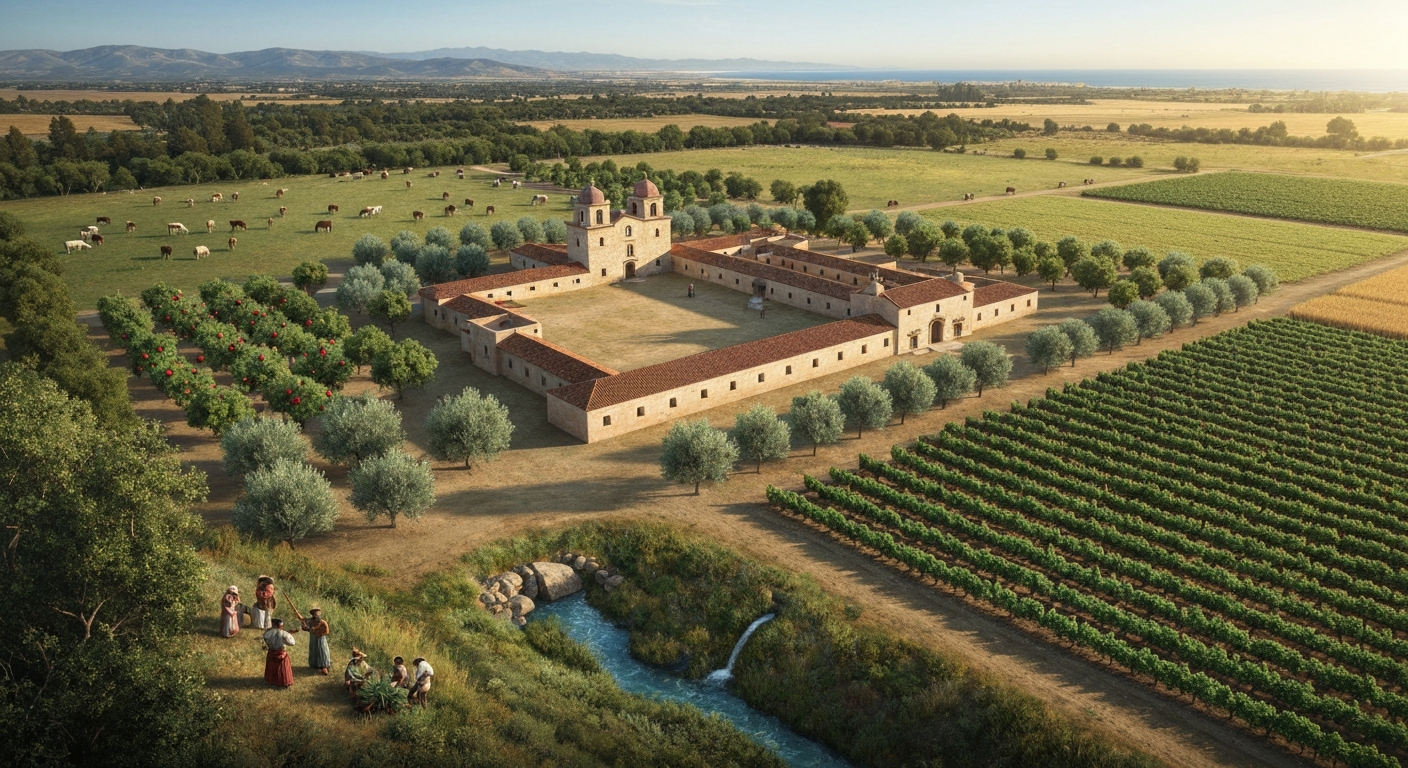
Where Mission Santa Inés sits and why the land worked
Mission Santa Inés was founded on September 17, 1804, and sits at roughly 800 feet elevation in the Santa Ynez Valley, within what is now the city of Solvang in Santa Barbara County. The valley runs east-west, oriented to catch marine airflow from the Pacific through the Lompoc corridor, which moderates summer heat and keeps winters frost-light. PRISM 30-year climate normals for the Santa Ynez River Basin show mean annual precipitation ranging from about 17 to 36 inches across subwatersheds depending on elevation, with the Solvang area falling in the mid-range. That is enough moisture to support dry-farmed grain in good years, but consistent orchard and garden production required supplemental water.
The Spanish padres addressed that need with an acequia (irrigation canal) system drawing from the Santa Ynez River. A documented aqueduct-mapping and GIS project has traced surviving irrigation features at the mission site, confirming that water infrastructure was central to agricultural planning here, not an afterthought. The dominant soils around the Old Mission Drive and Alamo Pintado area include Diablo silty clay, Santa Ynez gravelly fine sandy loam, and Agueda silty clay loam, according to USDA Web Soil Survey data cited in Solvang planning documents. Solvang planning documents cite USDA Web Soil Survey outputs for the Old Mission Drive / Alamo Pintado area, listing Diablo silty clay, Santa Ynez gravelly fine sandy loam, and Agueda silty clay loam as the dominant SSURGO map units (City of Solvang, Storm Water Control Plan) City of Solvang — Storm Water Control Plan (Web Soil Survey outputs for Old Mission Drive / Alamo Pintado area; lists Diablo, Santa Ynez, Agueda mapunits). Silty clay soils retain moisture well and are fertile for grain and vegetables; the gravelly sandy loam drains more freely and, with adequate irrigation, suits vines and orchard trees. Together, these soil types explain why the mission could sustain such a diverse agricultural portfolio in one compact landscape.
What the Chumash were already growing and gathering here
Before the mission was established, the Santa Ynez Valley was Chumash territory. The Chumash were not farmers in the European sense, but they managed an extraordinarily rich plant economy. Jan Timbrook's Chumash Ethnobotany, the standard modern reference on the subject, documents extensive use of acorns processed into meal, native bunch grasses harvested for seed, wild bulbs (including brodiaea species), yucca fibers for cordage and food, and dozens of medicinal and basketry plants. Archaeobotanical analyses from mission-era contexts across California, including flotation samples from comparable sites, routinely recover native taxa alongside introduced cereal weeds, confirming that indigenous plant use continued well into the mission period.
This matters for understanding mission agriculture because the padres and the Chumash neophytes who provided the labor were not working a blank landscape. The Chumash brought deep knowledge of local hydrology, seasonal plant cycles, and land management. Some of that knowledge almost certainly shaped where the mission placed its fields, orchards, and water channels, even if that contribution went unrecorded in the formal informes. The wild resources of the valley, from oak woodland to riparian corridors, also continued to supply food and materials alongside the introduced Spanish crops.
Native plants versus Spanish introductions: what came from where
Every staple field crop, orchard tree, and garden vegetable cultivated at Mission Santa Inés was a Spanish introduction brought north from earlier missions in Baja California and ultimately originating in Europe, the Mediterranean, and the Near East. Wheat, barley, grapevines, olives, figs, pomegranates, citrus, peas, onions, garlic, and most culinary herbs were all Old World species with no pre-contact presence in California. Corn and beans had a longer New World history, but they too were introduced to this particular valley by the mission system rather than by local Chumash agricultural practice. The Chumash diet relied on gathered and managed wild plants rather than cultivated crops in the European sense.
| Crop or Plant | Origin | Introduced by Spanish? | Primary Mission Use |
|---|---|---|---|
| Wheat | Near East / Mediterranean | Yes | Flour for bread and trade |
| Barley | Near East / Mediterranean | Yes | Flour, animal fodder, porridge |
| Corn (maize) | Mesoamerica | Yes (via mission chain) | Porridge, tortillas, feed |
| Beans (common, tepary) | Americas | Yes (via mission chain) | Food, protein staple |
| Peas | Mediterranean / Near East | Yes | Food, protein staple |
| Onions | Central Asia / Mediterranean | Yes | Cooking, preservation |
| Garlic | Central Asia | Yes | Cooking, medicine |
| Squash | Americas | Yes (via mission chain) | Food, seeds |
| Figs | Mediterranean | Yes | Fresh and dried fruit, trade |
| Pomegranates | Mediterranean / Central Asia | Yes | Fresh fruit, juice, trade |
| Olives | Mediterranean | Yes | Olive oil for cooking and liturgy |
| Citrus | Southeast Asia / Mediterranean | Yes | Fresh fruit, vitamin C |
| Apples and pears | Europe / Central Asia | Yes | Fresh fruit, cider, preserves |
| Almonds | Mediterranean / Central Asia | Yes | Nuts, oil, trade |
| Grapevines | Mediterranean | Yes | Wine for sacrament and commerce |
| Acorns (Quercus spp.) | Native California | No | Chumash food staple; continued use |
| Yucca | Native California / Southwest | No | Fiber, food; Chumash use continued |
| Native bunch grasses | Native California | No | Seed food (Chumash); displaced by grazing |
Grains and legumes: the caloric engine of the mission
Wheat was the single most important field crop at Mission Santa Inés, as it was across Alta California's mission system. Milled into flour, it supplied the daily bread that the padres considered both a nutritional and a civilizing necessity. Mission accounting records used the unit fanega (roughly 1.6 bushels) to measure grain harvests and disbursements, and Marie Christine Duggan's archival research on mission financing draws directly on these figures to reconstruct production and trade in the 1810s and 1820s. Barley was grown alongside wheat, serving double duty as both a human food grain (milled into a coarser flour or boiled into porridge) and as fodder for the mission's horses and mules, which were essential for field work and transport.
Corn was grown at Santa Inés, as it was at most Alta California missions, though it was typically a secondary crop to wheat. The Santa Ynez Valley's relatively mild summers made corn viable but not as dominant as it was in hotter inland valleys. Beans and peas rounded out the protein side of the mission diet. Common beans and likely tepary beans, both of New World origin but brought north through the mission chain, were dried and stored for year-round use. Peas, a Mediterranean introduction, were planted in the cooler season and also dried for storage. Together these legumes fixed atmospheric nitrogen back into the soil, providing a modest fertility benefit in a farming system that relied heavily on animal manure and fallow rotation for soil management.
Vegetables and garden crops: the huerta
Every California mission maintained a huerta, a walled or fenced kitchen garden producing vegetables and herbs for daily cooking and medicinal use. At Santa Inés, the huerta would have been placed close to the domestic quarters and within reliable reach of the acequia. Onions and garlic were staples across all the missions, stored in braids or dried in the sun after harvest. Both tolerate the well-drained loamy soils found near the mission and handle the Mediterranean-pattern dry summers with some irrigation.
Squash, in multiple varieties, was another huerta staple. Its large fruit could be dried in strips for long-term storage, a practice that suited a mission economy dependent on feeding a large resident population through the dry season. Secondary literature on mission agriculture lists cabbage, lettuce, and root crops such as turnips and carrots as standard garden plantings at Alta California missions, and there is no reason to exclude Santa Inés from that pattern. Leafy greens were cool-season crops planted in fall and harvested through winter and early spring, when the valley's mild temperatures (rarely freezing at this elevation and proximity to the coast) kept them productive. These fresh vegetables supplemented the dried grain and legume diet and helped prevent nutritional deficiency in the resident neophyte population.
Orchards and nut trees: long-term investment in the landscape
Fruit and nut orchards represent one of the most enduring legacies of mission agriculture because trees take years to establish and, once productive, reshape the landscape for generations. At Mission Santa Inés, secondary studies of mission landscapes confirm that pomegranates, olives, figs, stone fruits, and other orchard trees were planted during the mission period, and stewardship groups have re-established and labeled mission-era plantings at the site for interpretation. This is consistent with what we know from comparable missions: San Luis Obispo de Tolosa, for instance, also maintained orchards of these same species in its own Mediterranean-climate valley setting.
Figs thrived particularly well in the Santa Ynez Valley's dry summers, needing minimal irrigation once established. The mission fig (Ficus carica) could be eaten fresh, dried in the sun, or made into preserves, and dried figs were a tradeable commodity. Pomegranates, likewise Mediterranean in origin, tolerate dry heat and thin soils once their roots are established; they produce fruit that stores well without refrigeration. Citrus (most likely oranges and lemons, with some limes) required more water and care but was valued for fresh fruit and for the vitamin C it provided in a diet otherwise dominated by starch. Apples and pears, more typically associated with cooler European climates, can perform well in valleys with cool nights, and the Santa Ynez Valley's elevation and maritime influence provided enough chilling hours for some production. Almonds, which bloom early and need long dry summers to mature, are well matched to the Mediterranean climate pattern here and were used as food and potentially traded.
Vineyards, wine, olive oil, and what they meant to the mission economy
Grapevines and olive trees were not optional additions at a Spanish California mission: they were structural to the entire enterprise. Wine was required for the Mass, which meant every mission needed to produce it or receive it through trade. Brandy distilled from mission wine was a commercial product used in trade, particularly as the hide-and-tallow economy developed in the early nineteenth century. Mission Santa Inés maintained vineyards consistent with this system, and the Santa Ynez Valley's climate (warm days, cool nights, low summer humidity) is genuinely excellent for viticulture, as the region's modern wine industry, one of California's most productive, makes clear.
The grape variety planted across Alta California's missions was the so-called Mission grape (Vitis vinifera 'Mission'), a cultivar of Spanish or possibly Canary Island origin brought up the mission chain from Baja California. It produces a hearty, moderately tannic red wine suitable for sacramental use and a potent brandy. Mission grape vines were typically planted in rows with some spacing for cultivation by hand or with animal-drawn implements, and they would have been trained low in the bush-vine style common to Spanish colonial viticulture.
Olive trees at Santa Inés produced fruit that was pressed into oil used for cooking, lamp fuel, and liturgical purposes. Olive oil was also a trade commodity: mission accounts used the unit arroba (roughly 25 pounds) for recording oil and tallow, and Duggan's research on mission financing references these units in reconstructing how missions funded their operations before and after Mexican independence in 1821. The olive groves at Santa Inés, like those at San Diego de Alcalá and other coastal missions, were long-lived plantings; some mission-era olive trees across California are still productive today, a testament to how well these Mediterranean species adapted to California's climate. The connection between Spanish tree crops and California's agricultural identity is explored more broadly in the context of which Spanish crops specifically grow on trees, and the Santa Inés orchards are a strong regional example of that pattern.
How Santa Inés compares with neighboring missions
In broad terms, Mission Santa Inés grew the same suite of Spanish-introduced crops as every other Alta California mission, because the mission system was deliberately standardized in its agricultural model. The differences between missions were driven by local climate, soil, water access, and the labor available. Compared to San Diego de Alcalá, the southernmost mission, Santa Inés had a somewhat cooler, better-watered valley setting that may have made wheat production more reliable. San Luis Obispo de Tolosa, situated farther north in its own coastal valley, shares many parallels with Santa Inés in terms of crop mix and orchard composition, reflecting the consistent Mediterranean growing conditions that run up California's central coast. For specific details about crops at that site, see what did Mission San Luis Obispo grow. What sets Santa Inés apart is its documented irrigation infrastructure (the mapped acequia system), its archival record in the Santa Barbara Mission Archive-Library, and the active heritage interpretation of its mission-era plantings at the site today.
Evidence: what the archives and archaeology tell us
The crop record for Mission Santa Inés rests on two main evidence types. First, the written informes: periodic reports submitted to mission superiors, including surviving documents such as the Informe dated December 31, 1806, held at the Santa Barbara Mission Archive-Library. These reports recorded grain quantities in fanegas, livestock head counts, and other production data that modern researchers use to reconstruct the mission economy. Second, archaeology: excavations at CA-SBA-518 (the mission site's official archaeological designation), including fieldwork documented in 2002 and later investigations, have produced material evidence of mission-era occupation. See the Society for California Archaeology newsletter / abstracts, 'Excavations at Mission Santa Inés, 2002' for conference abstracts and field‑school reports documenting the 2002 excavations Society for California Archaeology newsletter / abstracts — 'Excavations at Mission Santa Inés, 2002'. Flotation and macrobotanical sampling from comparable California mission sites typically recover charred wheat and barley grains, corn cobs or kernels where present, bean fragments, and weed species associated with introduced cereal agriculture alongside native taxa. The mission's own archival center holds manuscripts and material culture from the mission period, and the California Missions Foundation and Santa Barbara Trust for Historic Preservation have supported ongoing documentary and archaeological projects here.
What this means for gardeners and regional farmers today
If you garden or farm in the Santa Ynez Valley or anywhere in California's Central Coast region, the mission crop list is essentially a validated planting guide for your climate zone. Wheat, barley, figs, pomegranates, olives, almonds, grapevines, onions, garlic, squash, and beans all succeeded here under Spanish colonial management with hand tools, animal labor, and gravity-fed irrigation. They succeeded because the Mediterranean climate of coastal California is climatically similar to the crops' regions of origin. The mission's acequia system is a reminder that even in a reasonably well-watered valley, supplemental irrigation was necessary to stabilize production through the dry season, something that remains true for anyone growing vegetables or maintaining an orchard in this region today. For a broader picture of how these historical crops fit into California's agricultural landscape across time and geography, the patterns that start at missions like Santa Inés scale up across the entire state. For a statewide overview, see what crops grow in California for how these and other crops are distributed across the state.
FAQ
What crops did Mission Santa Inés grow?
Direct answer: Mission Santa Inés produced a mix of introduced Mediterranean crops and some native plants used or managed by the mission community. Documented mission-era crops and products include: grain (wheat, barley), legumes (beans, peas), garden vegetables (cabbage, lettuce, onions, garlic, potatoes), fruit and nut trees (fig, pomegranate, peach and other stone fruits, apricot), grapevines (for wine), olive trees (for oil), citrus (where planted), and pasture/forage to support livestock (cattle, sheep, pigs, horses, goats) whose products (meat, tallow, hides, wool) were central to mission economy. Archaeological and archival evidence also records native plant use in the surrounding Chumash landscape (acorn, native grasses, yucca) but the mission’s cultivated huerta focused on Spanish-introduced crops used for bread, wine, oil, preserves and animal feed.
Where is Mission Santa Inés and what were its growing conditions?
Location and climate: Mission Santa Inés was founded in 1804 in the Santa Ynez Valley near present-day Solvang. Climate and soils that shaped crop choices: - Mediterranean climate: cool, wet winters and warm, dry summers; annual precipitation in the basin averages roughly mid-teens to low-thirties inches depending on spots and elevation. - Local soils include silty clays and gravelly fine sandy loams that, combined with irrigation from mission acequias, supported vineyards, orchards and grain fields. - The mission mapped and maintained irrigation infrastructure (acequias/aqueducts) to water gardens, orchards and fields, making Mediterranean crops practical despite dry summers.
Which crops were introduced by the Spanish versus native to the Santa Ynez/Chumash landscape?
Introduced by the Spanish (typical mission introductions): wheat, barley, grapes (Vitis vinifera), olives, citrus, figs, pomegranates, peaches and other stone fruits, many garden vegetables (cabbage, lettuce, onions, garlic, beans, peas, potatoes) and European pasture grasses. Native or pre-contact Chumash plants routinely used in the region: oak (acorns), native grasses and bunchgrasses, bulbs and roots, yucca, and many wild fruits and medicinal plants documented in Chumash ethnobotany. Missions often incorporated both regimes: cultivating European crops in huertas and relying on native plants for some supplementary uses.
How and why were different crops grown (fields, orchards, vineyards, irrigation, pastures)?
Production methods and rationale: - Vineyards: planted on well-drained soils near water to produce sacramental and table wine; vines were trained and often planted in rows with nearby storage (presses, bodegas). - Orchards and huertas: figs, pomegranates, stone fruits, olives and citrus were grown in walled gardens or orchard plots near the mission compound to protect tender plants and simplify irrigation and harvest. - Grain fields: wheat and barley were planted in open fields and processed for flour; cereals were central to bread production for the mission population. - Vegetables and kitchen gardens: small plots adjacent to the mission provided fresh produce for daily use, medicines and preserves. - Pasture and fodder: large pastos and cultivated forage grasses supported cattle, sheep and horses; livestock provided meat, tallow (for candles and soap), hides, and wool. Irrigation (acequias/aqueducts) and labor organization (missionized Chumash labor) made sustained cultivation possible in the seasonal climate.
What were the primary uses of those crops at Mission Santa Inés?
Primary uses: - Bread and staples: wheat and barley milled to flour for daily bread and gruel. - Wine: grapes for sacramental, household, and limited trade wine. - Oil and preserves: olives for oil; fruits (figs, pomegranate, stone fruits, citrus) for fresh use, drying, jams and vinegars. - Cooking and fresh food: vegetables supplied daily diets and medicines. - Animal feed and pasture: grasses and grains (grain byproducts) fed livestock. - Trade and craft: tallow and hides from livestock for sale or barter; wool for textiles; small surpluses of wine, wheat or fruit could be traded regionally.
What kinds of archaeological and archival evidence support these crop lists?
Evidence types: - Archival records: mission informes, accounting ledgers, inventories and correspondence in repositories (mission archives, Santa Barbara Mission Archive‑Library, Mexican archives) record fanegas of grain, arrobas of tallow, headcounts of livestock and lists of orchard and vineyard plantings. - Archaeobotanical remains: macrobotanical and flotation samples at California mission sites commonly recover charred grains (wheat, barley), grape seeds/pips, olive pits, fruit stones and weed taxa associated with introduced cereals. - Landscape and structural remains: mapped acequias, storage features (granary, bodegas), presses and vineyard/ orchard terraces identified in archaeological surveys. - Material culture and museum collections: tools, tools for viticulture/olive pressing, and botanical specimens preserved or replanted for interpretation. Together these lines of evidence create a corroborated picture of mission agriculture.
Next Articles
What Crops Did San Diego de Alcalá Grow? Mission Lists
Mission agriculture list for San Diego de Alcalá: grains, vegetables, fruit trees, vines and staples with context and so
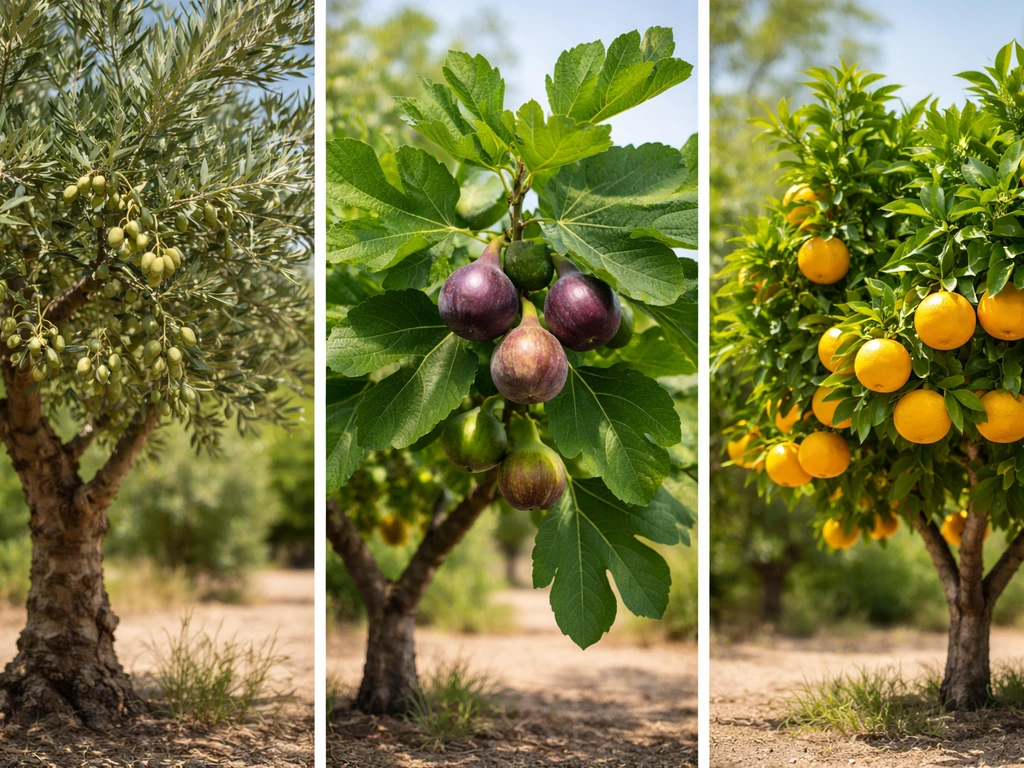
Which 3 Spanish Crops Grow on Trees: Olive, Fig, Citrus
Olive, fig, and citrus tree crops in Spain: where they grow, how to spot them, and key planting and harvest tips.
What Did Mission San Luis Obispo Grow Crops and Plants
Direct list of crops and plants grown at Mission San Luis Obispo, with climate reasons and research tips.