
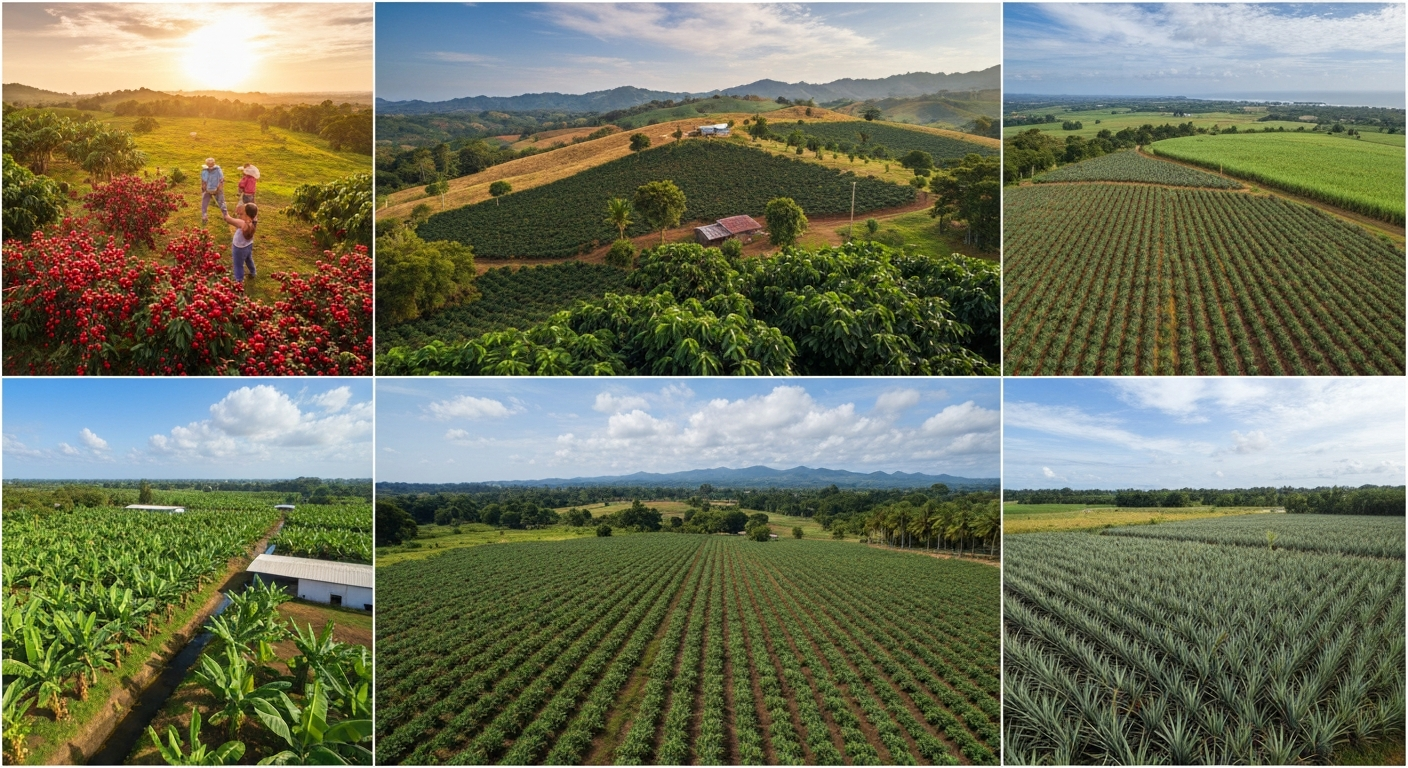
Costa Rica grows an impressive range of crops across its varied terrain: bananas and pineapples dominate the humid lowland plantations, coffee thrives in the volcanic highlands, and a rich mix of staples, fruits, vegetables, ornamentals, and timber fills in the spaces between. The country's agricultural exports topped US$5.6 billion in 2021, driven largely by banana, pineapple, coffee, and live ornamental plants. What makes Costa Rica so productive is a combination of tropical heat, reliable rainfall, fertile volcanic soils, and a remarkable range of elevations that lets farmers grow crops from sea level up to around 2,000 meters. If you want to know what grows here and why, geography is always the starting point.
What Does Costa Rica Grow: Major Crops by Region & Use

Samuel Rourke
22 Jul 2026
Who this guide is for and how to use it
This reference is built for students researching Central American agriculture, farmers evaluating what to plant in tropical climates, gardeners curious about tropical crops, and anyone comparing crop systems across the region. I've organized it by crop category rather than pure geography, but I tie every section back to specific regions and elevations so you can see the spatial logic. If you're comparing Costa Rica with nearby countries, the parallels and contrasts with Puerto Rico, Cuba, and El Salvador are worth noting. Those countries share some of the same crops but differ meaningfully in soil type, land tenure, and trade infrastructure.
Costa Rica's agricultural zones, climate bands, and soils
Costa Rica sits between 8° and 11° N latitude and covers about 51,100 square kilometers, but that small footprint hides an extraordinary range of growing environments. The country is essentially divided by the Cordillera Central and Cordillera de Talamanca mountain chains, which create a Caribbean slope to the northeast and a Pacific slope to the southwest. Each slope has its own rainfall pattern, temperature range, and soil character, and those differences drive almost everything about what gets planted where.
The Caribbean lowlands (Limón province and its cantons: Matina, Siquirres, Pococí, Sarapiquí) receive year-round rainfall often exceeding 3,000 mm annually with no true dry season. Temperatures stay between 24 and 30°C. These conditions are ideal for bananas and a significant share of pineapple. Soils here are mainly Entisols and Inceptisols on alluvial plains, deep and moderately fertile when drained properly. The Northern zone (Zona Norte, centered on San Carlos and Upala) has a similar warmth and high rainfall profile, which is why it has become the dominant pineapple belt.
The Central Valley sits at 900 to 1,500 meters above sea level, with mean annual temperatures around 18 to 22°C and moderate, well-distributed rainfall. The volcanic soils here, classified largely as Andisols and Inceptisols derived from volcanic parent material, are deep, well-drained, and naturally fertile with good structure. This is the heartland of coffee, specifically the appellations of Tarrazú (up to 1,900 m in parts), Central Valley, West Valley, Tres Ríos, and Orosi. Turrialba to the east also sits in this volcanic highland band.
The Pacific lowlands (Guanacaste province north, Puntarenas coast south) have a pronounced dry season from December through April, with rainfall concentrated in the wet season. This makes irrigation important for some crops but also creates conditions favorable for certain fruits and sugarcane. The South Pacific and Brunca region (around Pérez Zeledón and the Osa Peninsula) is wetter than Guanacaste and is one of the country's frontier zones for cacao, African palm oil, and some coffee production.
| Zone | Key Areas | Elevation (m) | Rainfall (mm/yr) | Primary Crops |
|---|---|---|---|---|
| Caribbean lowlands | Matina, Siquirres, Pococí, Sarapiquí | 0–200 | 2,500–4,000+ | Banana, pineapple, cacao, plantain |
| Northern zone (Zona Norte) | San Carlos, Los Chiles, Upala | 50–400 | 2,500–4,000 | Pineapple, plantain, cassava, ornamentals |
| Central Valley highlands | Tarrazú, Central Valley, West Valley, Tres Ríos, Orosi | 900–1,900 | 1,800–3,000 | Coffee, vegetables, ornamentals, dairy |
| Pacific lowlands (Guanacaste) | Nicoya, Liberia, Bagaces | 0–300 | 1,200–2,000 | Sugarcane, melons, rice, cattle |
| South Pacific / Brunca | Pérez Zeledón, Osa, Golfito | 0–1,200 | 2,500–5,000 | African palm, cacao, coffee, plantain, pineapple |
| Turrialba / Atlantic highlands | Turrialba canton | 600–1,200 | 2,500–3,500 | Coffee, sugarcane, macadamia, vegetables |
Quick reference: major crops by category
| Category | Key Crops |
|---|---|
| Export cash crops | Banana, pineapple, coffee (café oro), African palm (palm oil), sugarcane, cacao, ornamentals/live plants |
| Staple and subsistence crops | Rice, maize, common beans, plantain, cassava, sweet potato |
| Fresh fruits (local + export) | Mango, papaya, avocado, citrus (orange, lime, grapefruit), watermelon, melon, starfruit, rambutan |
| Vegetables | Tomato, sweet pepper, chili pepper, onion, potato, chayote, carrot, yuca |
| Root and tuber crops | Cassava (yuca), sweet potato (camote), tiquisque (taro), malanga, ñampí |
| Ornamentals/nursery | Heliconia, anthurium, orchids, tropical foliage, ferns, bromeliads, cut flowers |
| Timber and forestry | Teak (Tectona grandis), melina (Gmelina arborea), pochote, native hardwoods (almendro, laurel) |
The major export cash crops
Costa Rica's export agriculture is anchored by a handful of high-value commodities. According to SEPSA and MAG analysis of official trade data, the top agricultural exports ranked by value are banana first, pineapple second, gold-processed coffee third, and live plants/ornamentals fourth. Together with palm oil and processed foods, these crops account for the vast majority of the country's agricultural export earnings.
Bananas
Banana production is overwhelmingly concentrated on the Caribbean slope, specifically in the cantons of Matina, Siquirres, Pococí, and Sarapiquí in Limón province. Cavendish varieties dominate commercial production, requiring mean annual temperatures of 24 to 30°C, annual rainfall above 1,500 mm (ideally 2,000 to 3,000 mm), and flat or gently rolling terrain that supports the mechanized packing lines and aerial tramways used to move fruit from field to packinghouse. Drainage is critical: banana plants cannot tolerate waterlogged roots, so the alluvial plains of the Caribbean coast are channeled with drainage canals throughout. Costa Rica regularly exports over two million tonnes of bananas per year, making it one of the top global suppliers. Production is almost entirely industrial-scale, run by vertically integrated plantation companies with dedicated port facilities at Puerto Limón and Moín.
Pineapple
Costa Rica is the world's leading exporter of fresh pineapple and pineapple juice, a position it has held for years according to FAO trade analyses. Production is spread across three main zones: roughly 56% of national pineapple area falls in the Northern zone (San Carlos, Upala), about 25% in the Atlantic/Caribbean zone, and around 19% in Pacific zone plantations. MD-2 (extra sweet) is the dominant commercial variety. Pineapple tolerates a wider range of conditions than banana: the plant prefers warm lowlands at 22 to 30°C, handles a seasonal dry spell better than most tropical fruits, and does well in free-draining sandy-loam soils. The Northern zone's combination of warm temperatures, high rainfall, and relatively flat terrain with younger volcanic-derived soils explains its dominance. Like banana, commercial pineapple is a plantation crop with strong vertical integration into export packing.
Coffee
All commercial Costa Rican coffee is Arabica (Coffea arabica), and by law only Arabica is permitted for export. The main producing regions, as institutionally defined by ICAFE, are Tarrazú, Central Valley, West Valley, Brunca, Orosi, Turrialba, Tres Ríos, and Guanacaste. Elevation drives quality grading: Strictly Hard Bean (SHB) coffee comes from above approximately 1,200 meters where cooler temperatures slow bean maturation and concentrate sugars and acids; Good/Medium Hard Bean grades come from 1,000 to 1,200 meters; lower-grown coffee falls below that. Ideal growing conditions are mean annual temperatures of 15 to 24°C, well-distributed rainfall of 1,800 to 2,500 mm, and the deep, well-drained volcanic Andisols and Inceptisols of the highlands. Tarrazú, at elevations from roughly 1,200 to 1,900 meters in the Talamanca foothills, produces some of the country's most prized specialty lots. Unlike banana and pineapple, coffee has a significant smallholder and family-farm sector, and many farms use shade-grown agroforestry systems incorporating nitrogen-fixing trees like Erythrina and timber species like Cordia, a practice extensively studied by CATIE in Turrialba. blank" rel="noopener noreferrer">FAO country profile: Costa Rica (background on coffee importance) notes that coffee has historically been the single most important crop in land use in Costa Rica and remains economically significant. See blank" rel="noopener noreferrer">CATIE: Publications on coffee agroforestry and shade management (technical material and case studies) for documented examples of shade tree species, nitrogen‑fixing companions, and multi‑purpose tree roles in Costa Rican coffee farms.
African palm (palm oil)
African oil palm (Elaeis guineensis) is grown primarily in the humid lowland areas of the South Pacific (Osa, Golfito, Quepos corridor) and parts of the Northern zone. The crop needs year-round warmth, high and reliable rainfall, and deep, moderately fertile soils with good drainage. It is a long-cycle plantation crop harvested year-round, and much of production is processed into crude palm oil for domestic use and regional export. The South Pacific climate, with annual rainfall often exceeding 3,000 mm and minimal dry season, suits palm oil extremely well.
Sugarcane
Sugarcane is grown on the Pacific lowlands of Guanacaste and in parts of the Central Valley, particularly the Turrialba area which has a long history of sugar milling. Guanacaste's drier climate, which provides a pronounced dry season to facilitate harvesting, suits sugarcane well. The crop needs high solar radiation, warmth, and a dry spell to trigger sucrose accumulation before harvest. Most Costa Rican sugar goes to the domestic market and regional Central American trade.
Cacao
Cacao (Theobroma cacao) has deep historical roots in Costa Rica, having been cultivated by indigenous communities along the Caribbean coast long before European contact. Commercial production today is concentrated in the South Atlantic zone (Talamanca, Limón) and increasingly in the South Pacific. Cacao thrives under partial shade in humid lowland and lower-mid-elevation settings (roughly 0 to 700 m), with temperatures between 18 and 32°C and well-distributed rainfall. Smallholder and indigenous community farms, many of them certified organic or fair-trade, characterize the sector, especially in Talamanca where indigenous Bribri and Cabécar communities have traditional cacao agroforests.
Ornamentals and live plants
Live plants and ornamentals rank fourth among Costa Rica's agricultural exports by value, which surprises many people who think of the country purely as a fruit and coffee producer. The ornamental sector is covered in its own section below, but from an export cash-crop perspective, it is a major contributor to agro-export earnings and a significant employer in highland peri-urban zones around the Central Valley.
Staple and subsistence crops
Beyond the export economy, Costa Rican farmers grow a suite of staple crops that supply the domestic food system and sustain smallholder households. Rice and beans together form the cultural core of the diet (gallo pinto being the national dish), and their cultivation geography reflects both climate suitability and historical settlement patterns.
Rice
Rice is grown in two main systems: irrigated paddy and rainfed upland. The Guanacaste Pacific lowlands and the Parrita/Quepos corridor on the Central Pacific coast are the main producing areas for large-scale mechanized paddy rice. The crop benefits from Guanacaste's flat terrain, clay-heavy alluvial soils in the lowland valleys, and the ability to manage irrigation during the dry season. Upland rice is grown in more scattered smallholder plots in the Caribbean and Northern zones, often as part of mixed cropping systems with beans and maize.
Maize
Maize is cultivated throughout the country but is not a major export commodity. It grows widely in the Pacific lowlands and on mid-elevation hillsides, mostly at altitudes from sea level to about 1,400 meters. Production is largely for domestic consumption, animal feed, and as part of traditional milpa-style mixed systems where it is intercropped with beans. Pre-Columbian populations across this region, including in what is now Costa Rica, relied on maize as a staple, and that legacy continues in smallholder farming traditions.
Beans
Black beans and red beans (common bean, Phaseolus vulgaris) are grown across a wide range of elevations and zones. The Central Valley highlands and the Brunca region (Pérez Zeledón area) are significant producing areas. Beans are generally a smallholder crop, often relay-planted after maize or grown in rotation with rice. They tolerate the well-drained, slightly acidic volcanic soils of the highlands well, and the cooler nighttime temperatures at mid-elevations (800 to 1,400 m) suit the crop.
Plantain and cassava
Plantain (cooking banana, Musa paradisiaca) is ubiquitous in Costa Rican cuisine and grown extensively in the Caribbean lowlands, Northern zone, and South Pacific. It requires the same basic conditions as dessert banana but is more tolerant of smallholder, less-intensively managed production systems. Cassava (yuca) is another deeply important staple crop, grown in warm lowland and mid-elevation zones (sea level to about 800 m) with well-drained soils. It tolerates poor soil fertility better than most crops, making it a valuable food security crop in marginal farming areas. Sweet potato (camote) follows a similar distribution and is grown in small plots throughout the country.
Fruits and vegetables for local and export markets
Costa Rica has a diverse fresh-produce sector that supplies both domestic markets and export buyers, particularly in North America and Europe. Fruits like mango, papaya, avocado, and citrus are grown across different elevation bands, while vegetables including tomatoes, sweet peppers, and onions are concentrated in highland areas where temperatures moderate quality.
Mango and papaya
Mango trees are common throughout Costa Rica's Pacific lowlands and in the warmer parts of the Central Valley, thriving at elevations from sea level to about 600 meters. They like a distinct dry season to trigger flowering, which makes Guanacaste a natural fit. Papaya grows rapidly in warm, humid lowlands on both coasts and in the Northern zone. It needs well-drained soils (papaya is particularly sensitive to root rot), high heat, and consistent moisture, preferring elevations below about 500 meters.
Avocado
Avocado production sits primarily at mid-elevations from about 800 to 1,600 meters in the Central Valley and highland regions. These zones provide the cooler temperatures that avocado trees prefer (15 to 22°C mean annual), good drainage on volcanic slopes, and lower humidity that reduces the risk of fungal issues. Costa Rica's avocado is sold mainly in the domestic and regional market, and the country's highland volcanic soils are well-suited to Hass and local varieties.
Citrus
Orange, lime, and grapefruit are grown across a range of zones from the warm Pacific lowlands up to about 1,000 meters in highland foothills. The Atlantic zone and Northern lowlands produce significant volumes of oranges, some of which supply the domestic juice processing industry. Limes are especially common in Pacific coastal areas and are deeply integrated into everyday cooking.
Tomatoes, peppers, and onions
These vegetables are predominantly a highland crop in Costa Rica. The cooler temperatures above 1,000 meters in the Central Valley and Brunca highland areas reduce disease pressure and produce firmer, higher-quality fruit compared to lowland production. Tomatoes and sweet peppers are grown in greenhouse and open-field systems in areas like Cartago and the highlands of San José province. Onions are notably concentrated in the Cartago region, particularly around Tierra Blanca and volcanic highland soils at 1,400 to 2,000 meters, where cooler temperatures and well-drained Andisols produce good bulb quality. Chayote (a native Central American squash) is another highland vegetable prominently grown in Cartago.
Root crops and specialty vegetables
Beyond cassava and sweet potato, Costa Rica grows several traditional root crops: tiquisque (a taro relative), malanga, and ñampí are cultivated in the Caribbean lowlands and Northern zone, primarily for domestic consumption and regional Caribbean markets. Potatoes grow in the high volcanic zones above 1,500 meters, particularly in the Cartago highlands where the cool temperatures mimic Andean potato-growing conditions.
Ornamental horticulture and nursery crops
Costa Rica's ornamental sector is one of its agricultural success stories and a significant source of export revenue, ranking fourth among all agro-exports in recent value rankings. The country exports live tropical plants, cut flowers, foliage, and nursery stock primarily to the United States and the European Union.
Production is concentrated in the Central Valley and its highland periphery, particularly in cantons like Alajuela, Heredia, and Cartago, where elevations between 1,000 and 1,600 meters provide a mild climate (18 to 22°C), moderate humidity, and excellent access to port connections via the Central Valley highway network. Key commercial species include heliconia, anthurium (a specialty of the Caribbean and Northern slopes at lower elevations), orchids, tropical foliage plants (philodendron, dieffenbachia, ferns), bromeliads, and a variety of cut tropical flowers.
Production systems range from open-field shade structures to fully protected greenhouse and screenhouse operations. Post-harvest handling is critical in this sector: ornamentals are highly perishable and air-freighted rather than shipped by container, so proximity to Juan Santamaría International Airport in Alajuela is a real locational advantage. Many ornamental farms are small to medium family operations with highly skilled workforces, and the sector shows some of the highest labor productivity and value-per-hectare figures in Costa Rican agriculture. Anthurium in particular does well at lower elevations (200 to 600 m) on the Caribbean slope and Northern zone, preferring warm humid conditions and well-drained, organically rich soils.
Timber and plantation forestry
Costa Rica transformed its forestry sector dramatically after the mid-20th century, going from one of the most heavily deforested nations in Central America to a country that now has over 50% forest cover, thanks partly to payment-for-ecosystem-services programs (Pagos por Servicios Ambientales, PSA). Commercial plantation forestry occupies a distinct niche alongside this natural forest recovery.
Teak (Tectona grandis) is the most commercially prominent plantation species. It is grown primarily in the Pacific lowlands of Guanacaste and Puntarenas at elevations from near sea level to about 500 meters. Teak thrives in the seasonally dry climate of Guanacaste, where the pronounced dry season helps produce the dense wood structure that makes teak valuable. Well-drained, deep soils with moderate fertility suit the species well. Rotation cycles are typically 20 to 25 years for high-value timber.
Melina (Gmelina arborea) is a fast-growing species used in plantation forestry for pulpwood, boards, and lower-grade timber. It grows in the humid Caribbean lowlands and Northern zone at elevations below 400 meters, tolerating the high-rainfall, year-round humid conditions of those zones better than teak. Melina rotations can be as short as 8 to 12 years for pulpwood production.
Native hardwood species including pochote (Bombacopsis quinata), almendro (Dipteryx panamensis), laurel (Cordia alliodora), and cedar (Cedrela odorata) appear in plantation reforestation programs and in agroforestry systems integrated with coffee and cacao farms. Cordia alliodora (laurel) is particularly common as a shade tree in coffee agroforestry across the highland zones, doubling as a valuable timber tree. At higher elevations in the Talamanca and Central Cordillera, reforestation programs favor native oak (Quercus spp.) and other montane hardwoods suited to the cooler, wetter conditions above 1,500 meters.
Soil considerations for plantation forestry in Costa Rica mirror those for agricultural crops: the volcanic Andisols and Inceptisols of the highlands support agroforestry and native species reforestation well, while the Entisols and alluvial soils of the lowlands suit fast-growing species like melina. The national soil mapping, anchored in the MAG's soil association maps, continues to guide site selection for both plantation forestry and reforestation efforts.
Farm systems: plantations, smallholders, and agroforestry
One of the most important things to understand about Costa Rican agriculture is the structural divide between plantation export agriculture and smallholder production. For a local example of crop mix and scale, see what Suarez Farms grow. Banana and pineapple are almost entirely plantation crops with vertical integration from farm to export container. These are capital-intensive, highly mechanized operations with company-controlled packinghouses, drainage infrastructure, and aerial tramways. In contrast, coffee retains a large smallholder and family-farm tradition, particularly in Tarrazú and the Central Valley where small parcels of 1 to 5 hectares are common. Many of these coffee farms use shade-grown agroforestry systems, with Erythrina (immortal tree) as a nitrogen-fixing shade canopy and Cordia or Cedrela as taller timber shade trees, a model well-documented by CATIE researchers.
Ornamentals and vegetable production in the Central Valley highlands also tend to be small to medium family enterprises. The agricultural workforce across the whole sector was estimated at about 238,000 persons in 2021, representing roughly 11.7% of the national employed population. Agriculture and agroindustry together account for approximately 10% of national GDP, a significant figure for a country of Costa Rica's income level.
A brief history: from pre-Columbian crops to modern exports
Before Spanish colonization, the indigenous peoples of Costa Rica cultivated maize, beans, cassava, cacao, sweet potato, and various root crops in systems suited to the local terrain. Cacao was particularly important along the Caribbean coast, traded across the broader Mesoamerican network. The Spanish introduced cattle, sugarcane, and a range of Old World crops, transforming land use in the Central Valley and Pacific lowlands over the 16th through 18th centuries.
Coffee arrived in the late 18th century and became the engine of Costa Rica's 19th-century economy, shaping the Central Valley landscape profoundly as highland forests were cleared for coffee farms. The United Fruit Company's arrival in the 1870s and 1880s brought large-scale banana production to the Caribbean coast, a development that restructured land tenure and labor patterns in Limón province for generations. Pineapple's ascent to the top of the export value rankings is a more recent story, accelerating sharply in the 1990s and 2000s as the MD-2 variety captured global fresh-fruit markets.
Sustainability pressures and challenges
Pineapple expansion in the Northern zone and Caribbean region has been associated with deforestation, waterway contamination from agrochemicals, and soil compaction on intensively farmed land. The banana sector deals with ongoing pressure from Fusarium wilt (TR4 strain), black Sigatoka, and heavy pesticide inputs, which remain significant environmental and health concerns in Caribbean communities. Coffee faces climate-change-driven shifts in optimal altitude bands as temperatures rise, along with coffee leaf rust (Hemileia vastatrix) pressure.
On the positive side, Costa Rica has invested heavily in sustainability certification (Rainforest Alliance, organic certification, C.A.F.E. Practices for coffee), and the country's PSA forest payment program is internationally recognized. Many ornamental and specialty coffee producers operate under certified systems, and the agroforestry tradition in coffee gives the sector some resilience against both climate variability and price shocks.
Practical guidance for gardeners and small-scale farmers
If you're farming or gardening in a tropical lowland climate similar to Costa Rica's Caribbean or Northern zones (year-round heat, high rainfall, well-drained soils), pineapple, plantain, cacao, cassava, and papaya are all highly practical choices. Pineapple is particularly low-maintenance once established, tolerates brief dry spells, and produces reliably. Cassava is your best bet on marginal, less-fertile soils where other crops struggle.
For highland tropical gardeners at 900 to 1,500 meters with volcanic soils, coffee (even a few plants for household use), avocado, chayote, beans, and cool-season vegetables like tomato and onion are all natural fits. Shade-grown coffee with a nitrogen-fixing Erythrina companion is a particularly rewarding home garden or small-farm system: the shade tree improves soil nitrogen, modulates temperature, and provides biomass for mulch.
In seasonally dry Pacific lowland conditions similar to Guanacaste, focus on drought-tolerant crops during the dry months: mango, cashew, teak (if you have the land and time horizon), and drip-irrigated vegetables. Sugarcane is viable at scale but demands equipment and market access to be worthwhile for small farmers.
How Costa Rica compares to neighboring countries
Costa Rica shares significant crop overlap with its regional neighbors but differs in important ways. Cuba and Puerto Rico both have deep histories with sugarcane as a dominant export crop, whereas Costa Rica's sugar sector is secondary to banana, pineapple, and coffee in the modern export mix. For more on Cuba's agricultural profile, see the guide on what does Cuba grow. El Salvador shares the coffee highland tradition, with its own volcanic cordillera producing Bourbon and Pacamara varieties, but lacks the humid Caribbean lowland zone that makes Costa Rica's banana and pineapple sectors possible. For a focused overview of what does El Salvador grow, see the separate country guide on what does El Salvador grow. Puerto Rico, like Costa Rica, grows plantain, cacao, coffee, and tropical fruits, but its agricultural sector has contracted significantly compared to Costa Rica's, which has maintained strong institutional support through MAG, ICAFE, CORBANA, and CANAPEP. For more on suitable crops in a similar Caribbean context, see a guide to the best crops to grow in Puerto Rico. The ornamental export sector is a particular differentiator: Costa Rica's live-plant exports are exceptional for a country of its size and have no close parallel in Cuba or El Salvador's current export profiles.
| Country | Top Export Crops | Key Growing Strength | Distinctive Crop |
|---|---|---|---|
| Costa Rica | Banana, pineapple, coffee, ornamentals | Humid Caribbean lowlands + volcanic highlands | Fresh pineapple (world #1 exporter) |
| Puerto Rico | Coffee, plantain, tropical fruits | Mid-elevation volcanic terrain, Atlantic moisture | Specialty coffee (mountain regions) |
| Cuba | Sugarcane, citrus, tobacco, coffee | Flat lowland plains, warm subtropical climate | Tobacco (Vuelta Abajo quality) |
| El Salvador | Coffee, sugarcane, corn, beans | Volcanic cordillera highlands, Pacific slope | Specialty Bourbon/Pacamara coffee |
Understanding what Costa Rica grows, and why it grows so well there, comes down to this: a small country with an outsized diversity of climates and soils, a well-developed export infrastructure, and a farming tradition that spans thousands of years. The volcanic highlands that built the coffee economy, the warm rainy Caribbean lowlands that sustain the world's top pineapple and banana exports, and the ornamental farms clustered around the Central Valley all reflect the same underlying logic: match the crop to the climate and soil, build the market infrastructure to get it out, and manage the land well enough to keep producing. That combination is what makes Costa Rica's agricultural map as interesting as it is productive.
FAQ
What are Costa Rica’s major crops (by type)?
Costa Rica grows a mix of export cash crops, staples, fruits, vegetables, ornamentals and timber. Major commercial/export crops: banana, pineapple, coffee (Arabica), oil palm, ornamental plants (live plants, cut flowers), and some sugarcane. Staples and food crops: rice, beans, corn (maize), plantain and basic vegetables for local markets. Fruit and tropical horticulture: mango, papaya, watermelon, melon, guava, citrus, passionfruit. Vegetables for market and gardens: tomato, pepper, squash, yucca (cassava), sweet potato. Timber and agroforestry species: teak, native hardwoods, Erythrina and other shade/cover trees used on coffee farms.
Which crops are the top agricultural exports and how important are they economically?
Top export crops by value are banana, pineapple and high‑value Arabica coffee and live plants/ornamentals. Together these crops (plus palm oil and processed agricultural products) have driven much of Costa Rica’s agro‑export earnings; in recent years agro‑exports have been worth several billion USD annually, with bananas and pineapples among the world’s leading exporters.
Where are bananas grown in Costa Rica and what conditions do they need?
Bananas are concentrated on the Caribbean (Limón) lowlands — main producing cantons include Matina, Siquirres, Pococí and Sarapiquí. They favour humid warm lowlands with mean temperatures ~24–30°C, high annual rainfall (>1,500 mm) or irrigation, flat to gently rolling terrain, deep fertile soils with good drainage, and low frost risk. Plantation scale, mechanised production and quick access to ports are also important.
Where and at what elevations is coffee produced?
Commercial Arabica coffee is grown in highland/volcanic zones: Tarrazú, Central Valley and West Valley, Orosi/Turrialba, Tres Ríos, Brunca and parts of Guanacaste. Typical elevation bands for quality Arabica: about 800–2,000 m (specialty SHB often above ~1,200 m). Coffee prefers cool tropical highland climates (mean annual temps ~15–24°C) and well‑drained volcanic soils.
Where is pineapple produced and what soils/climates suit it?
Pineapple production is concentrated in the Northern zone and on both Atlantic and Pacific lowlands (large plantation areas in the North and Limón). Pineapple thrives in warm lowland tropics (mean temps ~22–30°C), well‑drained sandy‑loam soils, moderate to high rainfall with good drainage, and tolerance of seasonal dryness. Large, vertically‑integrated plantations dominate commercial production.
How do soils and climate shape crop choices across regions?
Costa Rica’s landscape ranges from lowland Caribbean and Pacific plains to volcanic highlands and humid mountains. Lowland Entisols/Inceptisols and hydromorphic soils on the coasts suit bananas, pineapple, plantain, oil palm and tropical fruit where heat, humidity and drainage conditions are met. Volcanic Andisols/Inceptisols and Ultisols of the highlands provide deep, fertile, well‑drained soils ideal for coffee and agroforestry. Rainfall patterns (Caribbean wetter year‑round vs Pacific pronounced dry season), elevation (temperature lapse rate ~6°C per 1,000 m) and local drainage determine which crops succeed.
Next Articles
Best Crops to Grow in Puerto Rico: Regional Picks for Now
Best crops to grow in Puerto Rico by region, with timing, climate fit, and practical site-matching tips for now.
What Does Cuba Grow Main Crops and Where They Grow
Main Cuba crops and where they grow by region, with climate and soil notes, plus historical shifts and growing tips.

What Does Suarez Farms Grow? Crops, Climate, and Verification
What Suarez Farms grows, crop list and climate fit, plus steps to verify current plantings via farm and local sources.