El Salvador grows maize, beans, coffee, sugarcane, rice, cacao, sesame, and a broad range of tropical fruits and vegetables. Maize and beans are the backbone of domestic food production, grown by smallholders across nearly every department. Coffee, sugarcane, cacao, and sesame are the main export and cash crops, with coffee concentrated in the western and central highlands and sugarcane running through the coastal lowlands. If you want the short version: most of the country's farmland feeds its own people, while a smaller but economically significant portion supplies global markets.
What Does El Salvador Grow: Top Crops, Regions & Gardening Tips

Samuel Rourke
27 Jul 2026
El Salvador's climate and growing regions
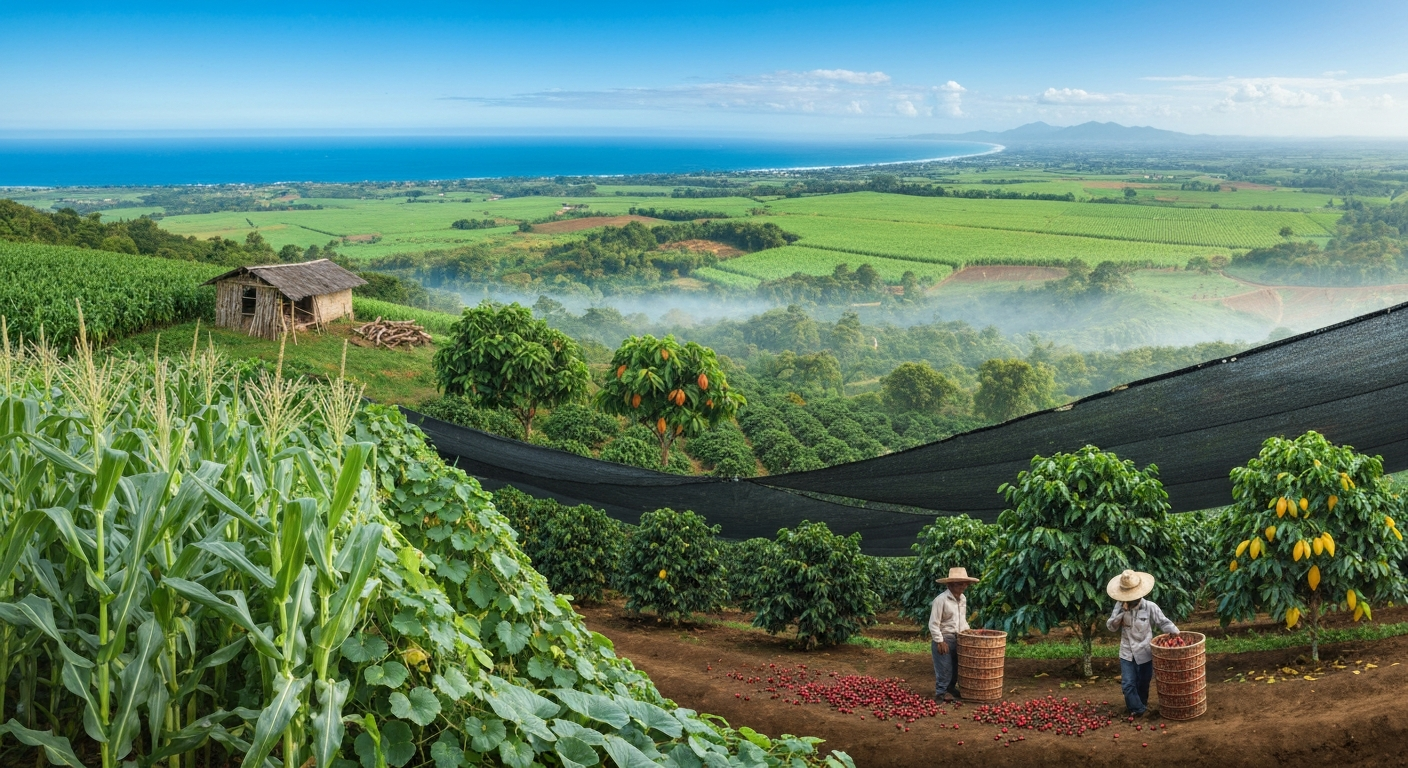
El Salvador is the smallest country in Central America, but it packs remarkable agricultural diversity into a compact area. The country runs roughly from a Pacific coastal plain inland and upward through volcanic highlands, then drops into interior valleys and river basins near the Honduran border. Those elevation changes are the single biggest reason different crops end up in different places.
The coast and lower elevations (below about 500 meters) are hot and humid, classified broadly as tropical savanna (Köppen Aw) with a pronounced dry season from November through April and a wet season from May through October. Temperatures here stay above 25°C year-round and rainfall can be intense during the wet season. These conditions suit sugarcane, rice, sesame, tropical fruits like mango and papaya, and the lowland vegetable crops. The major lowland agricultural zones follow the coastal strip and the broad river valleys of the Lempa, Paz, and Grande de San Miguel rivers.
Moving up into the interior highlands between roughly 500 and 1,500 meters, temperatures cool noticeably and cloud cover increases. The departments of Ahuachapán, Santa Ana, and parts of Sonsonate in the west, along with sections of La Libertad and Cuscatlán in the center, form the classic coffee belt. Arabica coffee thrives here precisely because of the combination of altitude-cooled temperatures, well-distributed rainfall, and volcanic soils rich in organic matter. These same highland farms often run maize and bean plots alongside coffee, and increasingly support cacao under agroforestry systems.
The central and eastern valleys, including the Jiboa and the broad eastern plains of Usulután and San Miguel, are important for maize and bean production, along with commercial vegetables and some rice cultivation. ENSO events (El Niño and La Niña cycles) layer additional variability on top of the base seasonal pattern: El Niño years tend to bring drought stress during the wet season and can seriously hurt rainfed maize harvests, while La Niña years bring heavier-than-normal rainfall and flooding risks in low-lying fields. ENSO (El Niño–Southern Oscillation) strongly affects Central American seasonal rainfall and crop outcomes; peer‑reviewed work mapping Köppen changes and El Niño signals shows climate classification shifts and year‑to‑year variability that influence Salvadoran cropping (droughts, heavy rains) Peer‑reviewed mapping of Köppen classification changes and El Niño signals (El Niño and the Köppen–Geiger Classification: methodology for mapping impacts in Central America) shows ENSO strongly affects seasonal rainfall and year‑to‑year variability that influences Salvadoran cropping, including droughts and heavy‑rain impacts..
Three broad agricultural zones to keep in mind
- Pacific coastal plain and lower valleys (below ~500 m): sugarcane, rice, sesame, mango, papaya, plantain, tomato, chili
- Highland coffee belt and volcanic slopes (500–1,500 m, mainly western and central departments): coffee, cacao, maize, beans, cardamom, avocado
- Interior valleys and eastern plains: maize, beans, sorghum, vegetables, some rice and sesame
Major crops at a glance
| Crop | Primary Use | Main Growing Region(s) | Typical Planting Season | Harvest Window |
|---|---|---|---|---|
| Maize (corn) | Domestic staple food | Countrywide; central and eastern valleys dominant | Primera: May–June; Postrera: July–Aug | Primera: Aug–Sep; Postrera: Nov–Dec |
| Beans (common bean) | Domestic staple food | Countrywide; intercropped with maize | Intercropped with maize or relay-planted | Sep–Dec depending on cycle |
| Coffee (Arabica) | Export cash crop | Western/central highlands: Ahuachapán, Santa Ana, Sonsonate, La Libertad | Planted as nursery seedlings; permanent crop | Harvest (picking): Nov–Feb |
| Sugarcane | Export and domestic sugar/ethanol | Coastal lowlands, Zapotitán valley, Usulután | Planted year-round; ratoon cycles | Zafra (harvest): Nov–Apr (dry season) |
| Rice | Domestic food | Lowland valleys, Lempa River basin, eastern plains | Wet season: May–June planting | Sep–Oct |
| Cacao | Export/specialty niche | Highland and mid-elevation agroforestry plots, western departments | Permanent crop; main pods | May–July and Nov–Jan (two flushes) |
| Sesame (ajonjolí) | Export oilseed | Coastal lowlands, Usulután, San Miguel, La Paz | May–June (wet season onset) | Aug–Sep |
| Mango | Domestic and informal export | Lowland and mid-elevation, Pacific slope | Permanent tree; flowers dry season | Mar–June |
| Banana/Plantain | Domestic food | Humid lowlands and valley floors, nationwide smallholder plots | Year-round planting; permanent | Year-round harvests |
| Tomato | Domestic market | Irrigated plots, central valleys, peri-urban areas | Dry season (Nov–Apr) under irrigation | Feb–May |
| Chili pepper | Domestic food and spice | Smallholder gardens and valley plots | Wet and dry seasons | Variable; 60–90 days after transplant |
| Squash/Ayote | Domestic food | Intercropped in milpa systems nationwide | May–June with milpa planting | Aug–Oct |
Staple crops: maize, beans, and rice
Maize
Maize is the single most widely planted crop in El Salvador. Agricultural area surveys have placed it as occupying roughly 40 percent of total cultivated area in national summaries, making it the dominant field crop by coverage. It is grown across all 14 departments, from coastal lowlands to highland edges, though the central and eastern departments see the highest concentrations of commercial production.
Most maize in El Salvador is grown in small rainfed plots under what agronomists call the Mesoamerican maize-bean system: family farms typically under two hectares, relying entirely on seasonal rainfall, producing primarily for household consumption with limited surplus to sell. There are two main planting cycles. The primera cycle is planted with the onset of the wet season in May or June and harvested in August or September. The postrera cycle follows in July or August and harvests in November or December. Both cycles are vulnerable to dry spells, particularly in El Niño years when the wet season can be interrupted by extended dry corridors (the canicular or canicula dry spell in July and August is especially risky).
National research programs (CENTA, working with CIMMYT) have developed and disseminated improved maize cultivars adapted to Salvadoran conditions, including varieties evaluated for protein quality and drought tolerance. Local trials have assessed cultivars like Platino, Oro Blanco, and Protemas in different agro-ecological zones of the country. Gardeners growing maize in similar tropical lowland conditions should look for early-maturing varieties that can get in and out before the canicula hits, and plan for rain-fed cultivation with organic matter-rich soil amendments to retain moisture.
Beans
Common beans (Phaseolus vulgaris) are almost always grown alongside maize in El Salvador's smallholder system. The classic milpa combination of maize, beans, and squash, inherited from pre-Columbian agriculture, is still practiced across the country. Beans are relay-planted into standing maize or sown immediately after the primera maize harvest, taking advantage of the residual soil moisture and the physical support the dry maize stalks provide. Red and black bean varieties dominate local preferences.
National and university-based research programs (including work published through Agrociencia at the University of El Salvador) have characterized local bean lines for phenological and agronomic performance under Salvadoran conditions. CIAT germplasm has been incorporated into local breeding work. Beans are primarily for domestic food security, consumed daily in Salvadoran households as a protein staple alongside tortillas made from maize. Very little bean production is exported.
Rice
Rice holds a smaller but steady place in Salvadoran agriculture, planted mainly in the lowland river valleys where flat terrain and water availability support paddy-style or upland cultivation. The Lempa River basin, parts of Usulután, and the eastern plains are the primary production areas. Planting aligns with wet-season onset in May or June, with harvests coming in September or October. Domestic rice production does not fully meet consumption demand, so El Salvador imports rice to fill the gap. Still, rice cultivation provides income for lowland farmers and contributes to food security in rice-producing communities.
Export and cash crops: coffee, sugarcane, cacao, and sesame
Coffee
Coffee is El Salvador's most historically significant export crop and still one of its most economically important agricultural products. All commercial production is Arabica, and it is concentrated almost entirely in the western and central highlands: the departments of Ahuachapán, Santa Ana, and Sonsonate together form the heart of the coffee belt, with additional production in La Libertad and Cuscatlán. Altitude, volcanic soil, and shade canopy are the three pillars of Salvadoran coffee quality.
What distinguishes El Salvador's coffee farms from many other crops in the country is their agroforestry structure. Coffee is grown under mixed shade trees, creating what ecologists describe as a man-made forest. These shade systems support biodiversity, protect soils from erosion on steep slopes, cycle nutrients, and buffer coffee plants against temperature extremes. Cooperatives and producer associations manage a significant share of production, and farms pursuing specialty and organic certification have grown in number as the specialty coffee market has expanded. The harvest (picking) season runs from November through February, when the red coffee cherries are hand-picked, pulped, fermented, and dried before export as green (unroasted) beans.
Green coffee has historically appeared among El Salvador's top agricultural export products, with data compiled through UN Comtrade and reported in Banco Central de Reserva economic summaries. The country markets coffee to specialty roasters in the US, Europe, and Japan, and origin-specific certifications (shade-grown, fair trade, organic) command price premiums in those markets.
Sugarcane
Sugarcane is the dominant crop of El Salvador's coastal lowlands and broader plains. The sector is agro-industrial in character: a small number of large sugar mills (ingenios) vertically integrate planting, harvesting, processing, and marketing. The industry is overseen institutionally by the National Council of the Agroindustry of Sugar (CONSAA), which coordinates among producers, mills, and the government on pricing, quota management, and export logistics. The harvest season, known as the zafra, runs through the dry season from roughly November to April, when mechanical harvesting and burning of cane fields are common practices, though environmental pressure is pushing the sector toward greener harvest methods.
Sugar and molasses produced from Salvadoran sugarcane supply both the domestic market and export markets. Ethanol production from cane is a growing part of the sector's output. Unlike the smallholder-dominated maize and bean system, sugarcane is largely a plantation-scale industry, though some smaller growers supply cane to the mills under contract arrangements.
Cacao
Cacao has deep pre-Columbian roots in El Salvador and is currently in a phase of active revival. The crop largely collapsed during the 20th century under competition, disease pressure, and land-use change, but donor-supported programs and market interest in origin-specific fine cacao have brought it back to mid-elevation agroforestry plots, particularly in the western departments. These cacao systems typically integrate shade trees, fruit trees, and timber species alongside the cacao plants, making them ecologically similar to the coffee agroforestry systems in the same region.
Regional technical organizations including CATIE and IICA have supported cacao rehabilitation and market development in El Salvador, linking smallholder producers to specialty chocolate markets. Cacao trees produce pods in two main flushes, roughly May through July and November through January, and require careful fermentation and drying to develop flavor quality that commands specialty pricing.
Sesame (ajonjolí)
Sesame is one of El Salvador's less-publicized but consistently important export crops. It is grown in the hot, dry-friendly coastal lowlands and plains of the eastern departments, particularly Usulután, San Miguel, and La Paz. Sesame is planted at wet-season onset in May or June, taking advantage of early rains to establish, then maturing as the dry season approaches in August or September. The short growing cycle (roughly 90 to 110 days) and tolerance for dry finishing conditions make it well-suited to the Salvadoran coastal climate. Most production is exported as raw seed, with Japan, the United States, and regional buyers as key markets.
Fruits and vegetables grown across El Salvador
Mango
Mango is ubiquitous in El Salvador, lining roadsides and filling markets from March through June. For more detail on the specific crops grown by individual producers, see what does suarez farms grow. Trees grow on the Pacific slope and in the lowlands, flowering during the dry season and producing fruit as the rains begin. Many mangoes are consumed fresh domestically, sold informally with salt and lime as a street snack. Commercial cultivation uses varieties like Tommy Atkins, Haden, and local landraces. The country exports some mango, primarily to regional Central American markets and occasionally to the US, though phytosanitary requirements limit larger-scale fresh exports.
Banana and plantain
Bananas and plantains grow year-round across the humid lowlands and valley floors of El Salvador. They are not a large-scale export crop here the way they are in neighboring countries like Costa Rica or Guatemala, but they are enormously important for household food security and local markets. Plantains are a daily food staple, fried, boiled, or roasted. Smallholder garden plots almost always include a few banana or plantain plants along fence lines or at the edges of the milpa.
Papaya
Papaya does well in El Salvador's hot lowlands and is grown both in family gardens and in small commercial plots. It matures relatively quickly from transplant (around 6 to 9 months to first fruit) and produces almost continuously once it begins. Maradol and Hawaiian-type varieties are common. Papaya is sold in local markets and sometimes exported informally to regional buyers.
Tomato, chili, and squash
Tomatoes are grown commercially in the dry season (November through April) under irrigation in the central valleys and peri-urban areas around San Salvador and San Miguel, where market access makes the investment in irrigation worthwhile. Chili peppers are grown in both small family gardens and slightly larger commercial plots, with local varieties like chile verde (a small green chile) central to Salvadoran cooking. Squash, particularly the local ayote variety (Cucurbita argyrosperma), is a traditional milpa crop intercropped with maize and beans, contributing both vegetable flesh and edible seeds to the household diet.
Deep roots: pre-Columbian and colonial agricultural history
The land that is now El Salvador has been under continuous cultivation for thousands of years. The dominant agricultural tradition before Spanish contact was the Mesoamerican milpa system: maize, beans, and squash grown together in an intercropped polyculture that was both nutritionally complete and ecologically sustainable on volcanic soils. The Pipil people, who were the largest Indigenous population in the region at the time of Spanish contact, were accomplished maize farmers. Cacao had ceremonial and economic importance as well, used as currency and in ritual beverages. Chili peppers, tomatoes, avocado, sapote, jocote (hog plum), and a range of other native fruits and vegetables filled out the pre-Columbian food system.
Spanish colonization from the 1520s onward fundamentally reorganized what the land produced. The colonial economy needed export commodities, not subsistence staples. Indigo (añil) became the defining crop of colonial El Salvador, transforming the agricultural landscape for nearly three centuries. El Salvador and Guatemala together supplied the majority of the indigo used to dye European textiles, and the indigo trade shaped everything from land tenure to labor systems. Large haciendas dedicated to indigo production displaced Indigenous community farming on the best lowland soils, and the dyeing process polluted watercourses and degraded soils around processing vats.
Cotton also had periods of prominence, particularly in the 20th century when the coastal plains were converted to large cotton plantations. The cotton boom brought heavy pesticide use to the Pacific coast, resulting in significant environmental damage that persisted for decades. Both indigo and cotton left legacies in land tenure and environmental degradation that still shape Salvadoran agriculture today. Spanish colonists also introduced crops that are now deeply embedded in the Salvadoran food system: rice, sugarcane, mango, citrus, and cattle (which displaced cropland with pasture across large areas of the country).
How Salvadoran agriculture got to where it is today
The collapse of the indigo trade in the 19th century, as synthetic dyes replaced natural ones, forced El Salvador's agricultural economy to find a new export engine. Coffee stepped into that role with remarkable speed. By the late 1800s, the Salvadoran government was actively encouraging coffee cultivation in the western highlands, and land laws of that period effectively dispossessed many Indigenous and mestizo communities of communal lands (ejidos) to make way for coffee haciendas. Coffee became the dominant force in Salvadoran rural society, politics, and export earnings well into the 20th century.
Sugarcane expanded significantly through the mid-20th century as agroindustrial infrastructure was built out along the coast. The cotton era of the 1950s through 1970s was followed by collapse in the 1980s, partly due to the civil war (1979 to 1992), which severely disrupted agriculture throughout the country. The land reform programs of the 1980s redistributed some hacienda land to cooperatives and smallholders, reshaping tenure patterns particularly in coffee and sugar zones, though implementation was incomplete and contested.
Since the peace accords of 1992, agriculture has continued to shift. The coffee sector faced severe price crises in the late 1990s and early 2000s that pushed many smallholders and mid-size farms into abandonment or conversion to other uses. Some formerly productive coffee land has been subdivided for housing or has shifted to fruit production. Maize and bean smallholders remain dominant in number but face persistent challenges: low yields on degraded soils, limited market access, climate variability, and migration pressures that drain agricultural labor from rural households. At the same time, specialty coffee, cacao revival, and niche export markets for sesame and organic vegetables represent growth opportunities that some farmers and cooperatives are actively pursuing.
Farming systems, seasonality, and notes for gardeners
Salvadoran agriculture runs on two main production systems that operate nearly side by side: the smallholder rainfed milpa system and the commercial or agro-industrial plantation sector. The milpa system is family-scale, labor-intensive, ecologically diverse, and tied to the rainy season calendar. Coffee and cacao agroforestry occupies a middle ground, combining permanent woody crops with shade trees and sometimes food crops underneath, managed at cooperative or family-farm scale. Sugarcane and large-scale irrigated vegetables represent the plantation and commercial end.
For gardeners working in tropical or subtropical climates with similar conditions to El Salvador's lowlands (hot, with a distinct wet and dry season), the Salvadoran planting calendar is a useful guide. Maize and beans go in at the start of the wet season in May, with a second planting possible in July or August. Tomatoes and chili are best started in the dry season with irrigation support, transplanting in November or December for harvest in February through April. Sesame, if you want to try it, thrives in poor sandy-loam soils with good drainage and minimal water after establishment. Mango and papaya need almost no supplemental water in a tropical lowland garden once established and will produce reliably year after year.
For those interested in the coffee agroforestry model, the key lesson from El Salvador is that shade diversity matters: farms with higher shade tree diversity tend to have better soil health, more stable microclimates, and stronger ecosystem resilience than those under monoculture or low-diversity shade. Integrating cacao or fruit trees into a coffee system, as many Salvadoran farms do, adds income diversification and ecological function at the same time.
Markets, trade, and certification niches
On the export side, green coffee and raw sugar are the two historically dominant agricultural export earners. Sesame seed, cacao, and some fresh and processed vegetables contribute to a smaller but diversified export basket. El Salvador's Banco Central de Reserva tracks and publishes export composition data, and green coffee (HS code 090111) consistently appears among top agricultural export items in UN Comtrade and WTO trade profiles for the country. Agro-industrial products including sugar and cacao-based goods appear in broader manufacturing and food-processing export categories.
Specialty coffee certification is the most developed niche market in Salvadoran agriculture. Fair trade, organic, and shade-grown certifications are pursued by cooperatives targeting premium buyers in the United States, Europe, and Japan. The Cup of Excellence competition, which has included El Salvador in past editions, has been a key vehicle for raising the profile of Salvadoran single-origin coffees. Cacao is following a similar trajectory at smaller scale, with fine-flavor and fermentation-quality positioning in specialty chocolate markets.
Challenges and opportunities facing Salvadoran agriculture
Climate change sits at the top of the challenge list. El Niño-driven drought years already cause serious maize crop losses in rainfed smallholder systems, and projections suggest the dry corridor affecting Central America will intensify and shift northward, placing more of El Salvador's prime agricultural land under moisture stress. Soil erosion on the steep volcanic slopes where coffee and maize are grown is a chronic problem: without adequate shade cover and soil conservation practices, heavy wet-season rainfall strips topsoil and reduces long-term productivity.
Pests and disease are persistent pressures. Coffee leaf rust (Hemileia vastatrix) caused devastating losses across Central America in the 2012 to 2013 epidemic and affected El Salvador significantly, pushing producers toward rust-resistant varieties that sometimes trade cupping quality for disease tolerance. Coffee berry borer (Hypothenemus hampei) is also widespread. Maize is susceptible to fall armyworm (Spodoptera frugiperda), which has expanded as a regional threat. Cacao faces witches' broom and Phytophthora pod rot in humid conditions.
On the opportunity side, the combination of volcanic soils, diverse microclimates, and existing agroforestry knowledge puts El Salvador in a reasonable position to develop more climate-resilient and market-differentiated agriculture. Programs from CATIE, IICA, and CGIAR institutions continue to work with Salvadoran farmers on improved varieties, agroforestry integration, and soil health. Irrigation infrastructure in the lowland valleys, if expanded carefully, could allow dry-season vegetable and fruit production that currently relies on a small number of equipped farms. The specialty food export niche, for coffee, cacao, and potentially organic sesame, remains underdeveloped relative to the country's production potential.
El Salvador's agricultural story shares important threads with its Central American and Caribbean neighbors. For a quick comparison with a neighboring country's production, see what does Costa Rica grow. For a nearby comparison, see the best crops to grow in Puerto Rico for guidance on suitable Caribbean crop choices and practices. The shift from colonial export monocultures toward diversified agroforestry systems, the tension between smallholder food production and commercial cash cropping, and the influence of climate variability on crop calendars are patterns that run through the region. For a regional comparison of crops and production in a nearby country, see what does Cuba grow. Those connections make El Salvador worth comparing with what Costa Rica grows, what Cuba grows, and what Puerto Rico grows when building a broader picture of tropical American agriculture.
FAQ
Lead answer — What does El Salvador grow (top crops and export vs domestic)?
Top crops: maize (corn), common beans, coffee (Arabica), sugarcane, rice, cacao, sesame (ajonjolí) and a wide mix of fruits and vegetables (bananas/plantains, mango, citrus, papaya, tomatoes, squash, chile). Maize and beans are primarily grown by smallholders for household consumption and local markets. Coffee, sugarcane and (to a lesser extent) cacao and sesame are the main cash/export crops processed through cooperatives or agro‑industry. Fruits and vegetables supply domestic markets and local trade; some specialty coffee, cacao and sesame enter export/organic/foreign‑market niches.
Why do particular crops grow where they do (climate and region overview)?
El Salvador’s landscape: coastal lowlands and Pacific plains, central valleys, and western/central highlands. Climate is tropical with wet/dry seasonality; higher elevations have cooler, wetter microclimates. How this maps to crops: - Highlands (Ahuachapán, Santa Ana, parts of Sonsonate): cooler temperatures and elevation favor Arabica coffee and shade‑grown agroforestry systems. - Pacific lowlands and coastal plains: warm, flat terrain suits sugarcane, rice (in irrigated lowlands), tropical fruits (bananas, mango) and sesame. - Central valleys and smallholder plots across the country: rainfed maize–bean intercrops, home gardens and seasonal vegetables. ENSO (El Niño/La Niña) causes strong year‑to‑year rainfall variability that affects planting windows and yields.
Crop-by-crop profiles (staples and cash crops): maize, beans, rice, coffee, sugarcane, cacao, sesame
Maize: staple for food and tortillas; mostly rainfed smallholder plots, short to medium season varieties; planted primarily at start of rainy season. Beans: complementary staple in maize–bean systems, key for household nutrition; many smallholder varieties and local landraces. Rice: grown in irrigated lowlands and paddies for domestic consumption; usually mechanized at larger farms. Coffee (Arabica): grown in highland areas under shade or agroforestry; important cash export—organized in cooperatives and producer associations. Sugarcane: agro‑industrial, concentrated near sugar mills (ingenios); main input for national sugar production and related industries. Cacao: smallholder and rehabilitated plots often in agroforestry systems; increasing support for market development and shade‑grown cacao. Sesame (ajonjolí): grown in drier lowland areas as a cash crop for domestic use and export niches; grown seasonally during dryer windows.
Comparative table — Major crops: typical uses, main regions, main season
Crop | Typical use | Main regions | Main season Maize | Staple food, fresh/processed | Central valleys, smallholder plots nationwide | Start of rainy season (planting), harvest after rains Beans | Staple protein, intercrop with maize | Same as maize | Follows maize cycle (rainfed) Rice | Staple grain | Pacific lowlands, irrigated paddies | Irrigated season(s) tied to water availability Coffee (Arabica) | Export cash crop, domestic specialty | Western & central highlands | Flowering with rainy season onset; main harvest in dry months depending on elevation Sugarcane | Sugar/industrial feedstocks | Pacific coastal plains | Long cycle (months to harvest), harvest year‑round in harvest campaigns Cacao | Chocolate ingredient, export & domestic | Lowland to mid‑elevations, agroforestry plots | Flowering and harvest vary by local rainfall patterns Sesame | Oilseed export/domestic | Drier lowland plots | Planted in dry season windows
Historical context — pre‑Columbian and colonial crops, indigo/cotton legacy and changes to present
Pre‑Columbian: Indigenous peoples cultivated maize, beans, squash, chilies, cacao, gourds and other staples—forming the classic Mesoamerican milpa/maize–bean system. Colonial era: Spanish colonization introduced cattle, sugarcane, rice, cotton, indigo and new fruits/vegetables; plantation systems expanded coastal lowlands. 19th–20th centuries: coffee became the dominant cash crop shaping landholding, social structures and export orientation; indigo and cotton were important earlier but declined as coffee and sugarcane industrialized. Contemporary shift: fragmentation of coffee landholdings, renewed interest in cacao and agroforestry, growth of mechanized sugarcane and diversification into fruits/vegetables for local markets and niche exports.
Farming systems and seasonality (smallholder vs plantation, planting/harvest calendar, shade‑grown coffee, agroforestry)
Smallholder systems: very small plots (often <2 ha), maize–bean intercropping, mainly rainfed, focused on household food security with occasional market sales. Plantations/agribusiness: sugarcane and some commercial rice and coffee estates with mechanization and processing infrastructure. Seasonality: planting typically aligned to the rainy season onset; harvests vary—maize/beans harvested after rains, coffee harvest concentrated in drier months for each elevation, sugarcane harvested in campaign cycles. Shade‑grown coffee and agroforestry: common in highlands—trees provide shade, biodiversity benefits and microclimate regulation; cocoa and mixed tree species are integrated into smallholder plots and restoration projects.
Next Articles
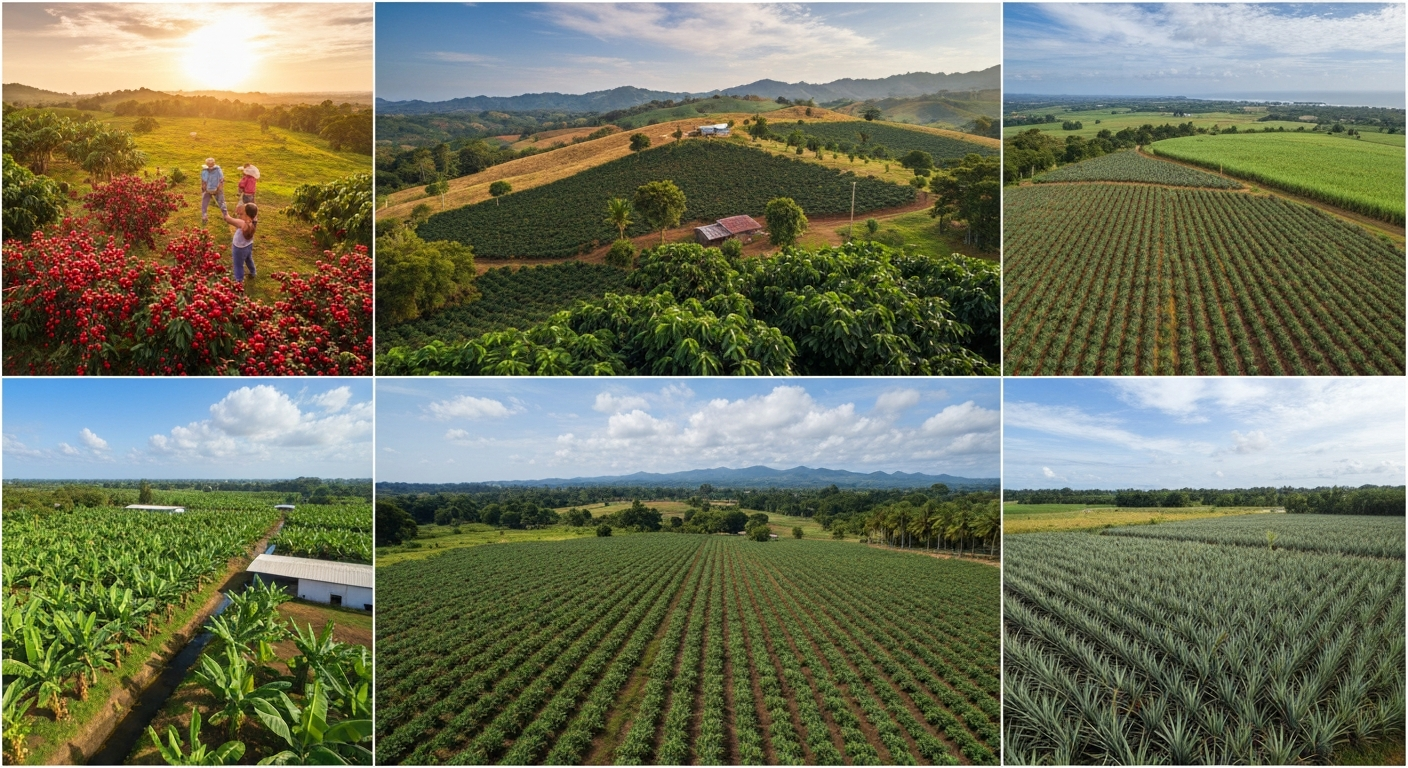
What Does Costa Rica Grow: Major Crops by Region & Use
What does Costa Rica grow: regional crop guide, major crops, elevations, climates, farming types and grower tips.
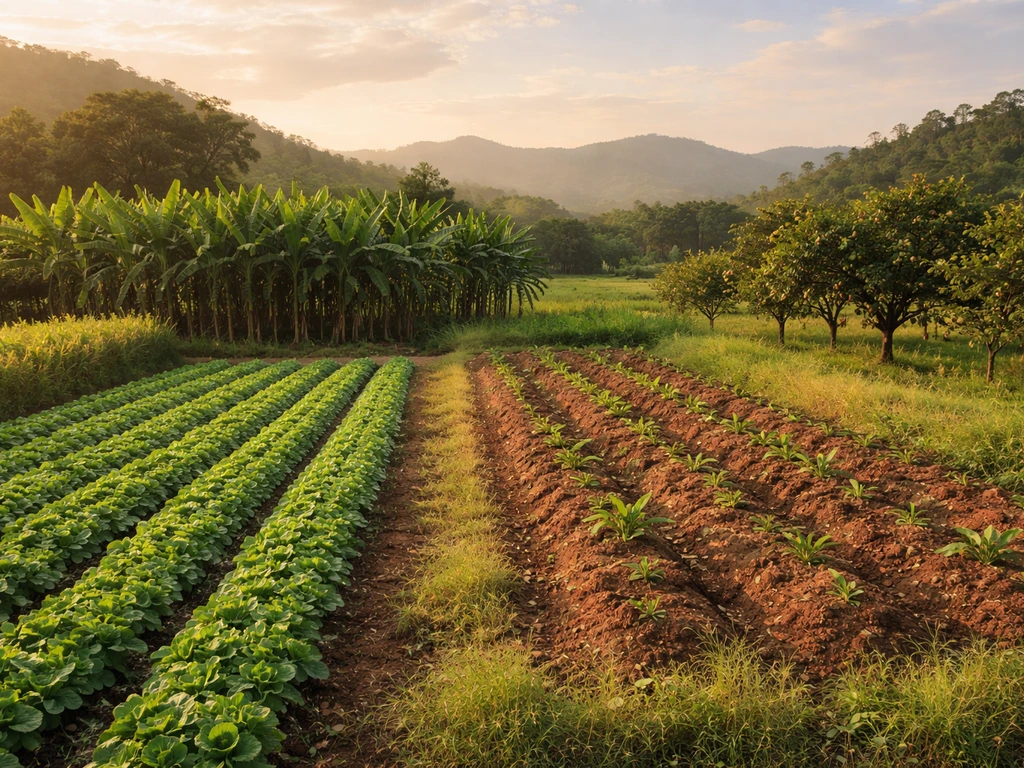
Best Crops to Grow in Puerto Rico: Regional Picks for Now
Best crops to grow in Puerto Rico by region, with timing, climate fit, and practical site-matching tips for now.
What Does Cuba Grow Main Crops and Where They Grow
Main Cuba crops and where they grow by region, with climate and soil notes, plus historical shifts and growing tips.