
Farmers grow field beans (also called broad beans or fava beans) primarily because they fix atmospheric nitrogen into the soil, reducing fertilizer costs for the crops that follow. They also break disease cycles, improve soil structure, and open up multiple market channels including human food, animal feed, and green manure. On top of those agronomic benefits, field beans are one of the most regionally flexible grain legumes in the world, grown commercially from Ethiopia and China to the UK and Australia, and cultivated by humans for at least 10,000 years.
Why Do Farmers Grow Field Beans: Benefits, Uses, Regions

Samuel Rourke
6 Aug 2026
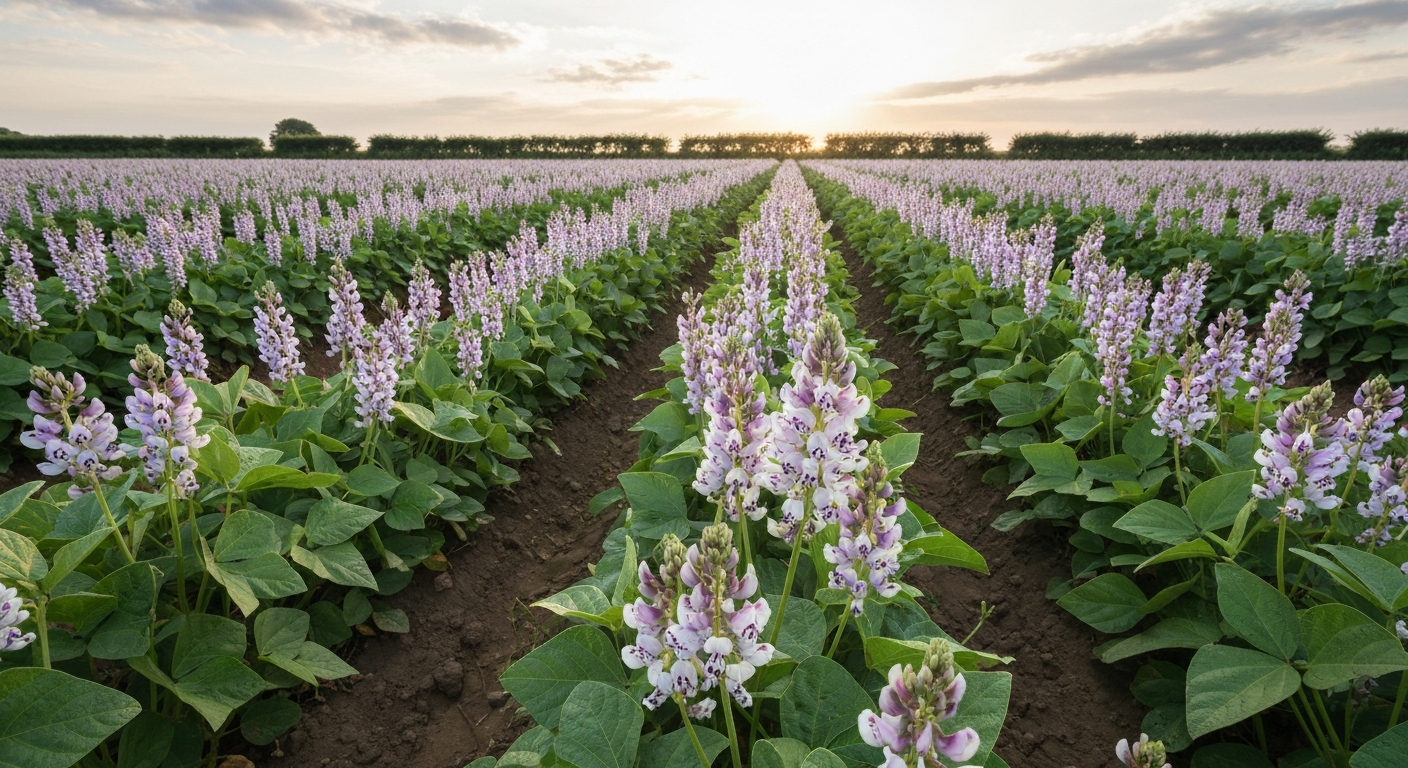
What exactly are field beans?
Field beans, broad beans, and fava beans are all the same species: Vicia faba. The naming just reflects how they are used. 'Field bean' is the term most common in the UK and Europe for large-area commercial crops grown for feed or export. 'Broad bean' is the traditional garden and fresh-market name in Europe and the Middle East. 'Fava bean' is widely used in North America, North Africa, and the Middle East. No matter the label, you are dealing with the same species, and the agronomic reasons for growing it are the same across all regions.
Within the species there are several distinct variety groups, and the differences matter for farmers choosing which type to grow.
| Variety Group | Seed Size | Primary Use | Key Trait |
|---|---|---|---|
| Major (Vicia faba var. major) | Large | Human food (fresh, dried) | Large seeds preferred for fresh markets in Europe and Middle East |
| Equina (Horse/field bean) | Medium | Animal feed, export | High-yielding, suited to commercial field-scale production |
| Minor (Bell/tick bean) | Small | Feed, green manure, cover crop | Hardy, early-maturing, widely used as a cover crop |
| Windsor types | Large | Fresh/green market | Popular in UK gardens; shorter growing season |
All varieties are cool-season annuals with an upright growth habit, typically reaching 0.5 to 1.8 meters tall. They produce pods containing 2 to 9 seeds, and they nodulate readily with Rhizobium leguminosarum biovar viciae, which is the bacterium that makes their nitrogen fixation possible. The smaller minor/bell bean types are particularly common as cover crops and green manures, while equina types dominate commercial feed and export markets in the UK, Australia, and Europe.
The big agronomic reasons farmers choose field beans
Nitrogen fixation: the main economic driver
This is the single biggest reason most commercial growers add field beans to a rotation. Working with soil bacteria, field beans pull nitrogen gas from the atmosphere and convert it into plant-available nitrogen in the soil. A recent synthesis reported a revised seed‑yield‑based scaling factor of 49.1 kg N fixed per Mg (1,000 kg) of dry‑matter faba bean seed yield, used to convert seed yield into BNF estimates blank" rel="noopener noreferrer">A recent synthesis reported a revised seed‑yield‑based scaling factor of 49.1 kg N fixed per Mg (1,000 kg) of dry‑matter faba bean seed yield, used to convert seed yield into BNF estimates.. blank" rel="noopener noreferrer">The global average input from this biological nitrogen fixation (BNF) in faba bean crops has been estimated at around 148 kg of nitrogen per hectare, though the real-world range in field studies is enormous, from as low as 15 kg N/ha in poorly managed or drought-stressed crops up to over 600 kg N/ha in highly productive, well-inoculated systems. The variation comes down to cultivar, climate, rhizobial inoculation, soil moisture, and how much fertilizer nitrogen was applied (high inorganic N suppresses nodulation).
What this means in practice is that the wheat, barley, or other cereal planted after field beans typically needs significantly less synthetic nitrogen fertilizer. Multiple reviews report fertilizer-N savings in the following cereal crop in the range of 100 to 200 kg N/ha, system depending. A field trial from the northern Ethiopian highlands gave a concrete number: replacing continuous wheat with a faba bean-wheat rotation increased wheat grain yield by 2,196 kg/ha, a large, economically meaningful boost driven largely by improved nitrogen availability. These are the kinds of numbers that make field beans genuinely attractive in a crop budget.
Crop rotation benefits beyond nitrogen
Nitrogen fixation is the headline, but field beans also improve the following crop through several other mechanisms. They break cereal disease cycles (particularly take-all and eyespot in wheat rotations), improve soil structure through their deep tap roots, and increase soil microbial diversity. A two-year field experiment in Morocco found that wheat grown after faba bean, or intercropped with it, showed biomass increases of 24 to over 100 percent across various measured metrics compared with wheat monoculture, including improvements in soil microbial functional indicators. These combined effects are why many farmers describe the 'break-crop benefit' of field beans as being worth more than the nitrogen alone.
Understanding this dynamic is central to the broader question of why farmers grow different crops in a field rather than repeating the same species year after year. Field beans are one of the most practical tools for managing that diversity in cool-temperate and Mediterranean farming systems.
Soil improvement and cover-crop use
When field beans are grown as a green manure or cover crop and incorporated before harvest, the soil benefits are concentrated and fast. For information on whether liberty caps grow in cow fields, see Do liberty caps grow in cow fields. Residue incorporation increases soil organic matter, improves bulk density and porosity, and releases mineral nitrogen as the residues break down. In high-productivity systems, the residual fixed nitrogen left in above-ground residues and roots after grain harvest can exceed 150 kg N/ha. For farmers using field beans specifically as a cover crop or green manure, the smaller minor/bell bean types (Vicia faba var. minor) are often preferred because of their rapid establishment, extensive root system, and relatively low seed cost.
Where field beans grow: regional and climatic fit
Field beans are cool-season crops that tolerate heavier soils better than most other grain legumes such as peas or vetch. For readers interested in crops suited to waterlogged or flooded systems, see the related topic on what do farmers grow in paddy fields. They prefer well-drained silt or clay loams, a soil pH of roughly 6.5 to 9, and germination temperatures of 15 to 18°C (60 to 65°F). Optimum growth occurs between 18 and 29°C (65 to 85°F). Some Mediterranean-origin cultivars can handle frost down to around -9°C (14°F), which gives them a foothold as an autumn-sown crop in mild maritime climates like the UK and northwestern Europe.
In warmer or continental regions, field beans are planted in spring and harvested as a warm-season crop. This flexibility, combined with tolerance for heavier soils, is a key reason they appear in farming systems across such a wide geographic band. The table below summarizes major producing regions and the conditions that make field beans viable in each.
| Region | Growing Season | Main Soil Type | Primary Use | Notes |
|---|---|---|---|---|
| China | Spring (temperate) / winter (south) | Variable; yellow-brown soils | Dry seed for food and feed | Largest single producer globally |
| Ethiopia | Rainy season (highland, June–Oct) | Clay Vertisols | Food, local markets | Major staple legume in highlands |
| UK and Northern Europe | Autumn-sown winter crop | Heavy clay loams | Animal feed, export | Winter field beans common; strong export market |
| Egypt and North Africa | Winter crop (Oct–Mar) | Nile alluvial soils | Human food (ful medames) | Deeply embedded in food culture |
| Australia | Winter/spring (southern states) | Well-drained loams | Export to China and North Africa | Key global exporter |
| Mid-Atlantic USA | Spring (Apr–May planting) | Silt loam, clay loam | Specialty food, cover crop | Emerging market; limited commercial scale currently |
Global production numbers show just how widely distributed this crop is. In 2022, global dry faba bean production reached approximately 6.77 million tonnes harvested across around 6.63 million acres, while green faba bean production added another 1.81 million tonnes from roughly 640,000 acres. China and Ethiopia together account for close to half of global dry production, with Australia, the UK, and Egypt rounding out the major producing countries. The balance between fresh/green markets, dry food, and feed varies significantly by region, which is worth noting if you are trying to map market opportunities.
One practical note: regional data on yields and BNF can vary widely depending on climate year and management, so any agronomic planning should prioritize locally generated trial data over global averages.
A very old crop: field beans through history
Field beans have one of the longest agricultural histories of any food crop. Archaeobotanical evidence from el-Wad (Mount Carmel, present-day Israel) shows charred faba bean seeds present around 14,000 years before present, suggesting wild exploitation. By approximately 10,200 years ago, intensive farming of faba bean was underway in the Lower Galilee, making the Levant the most likely center of origin for the domesticated crop. These dates place faba bean among the earliest cultivated legumes of the Neolithic agricultural revolution in the Fertile Crescent.
From that Levantine origin, cultivation spread westward through the Mediterranean and into Europe, northward into Central Asia, and eventually east into China and south through Africa. By classical antiquity, fava beans were a dietary staple across Egypt, Greece, and Rome. In medieval Europe, field beans were a critical winter-grown protein and nitrogen-management tool in the open-field system, long before the chemistry of nitrogen fixation was understood. Farmers knew that land planted with beans produced better cereal yields the following year, even if they could not explain why. This empirical knowledge shaped European crop rotations for centuries before synthetic fertilizers arrived in the 20th century.
The crop's decline in parts of Western agriculture in the 20th century came with cheap synthetic nitrogen and a shift toward soybean-dominated feed markets. The current revival of interest in field beans across Europe, North America, and Australia is driven by the economics of reducing fertilizer inputs, growing demand for plant-based proteins, and recognition of the environmental costs of high-nitrogen farming systems.
What farmers actually do with field beans: uses and markets
One of the reasons field beans appear in such diverse farming systems is that they have multiple end-use channels, and the dominant one shifts depending on where you are.
- Human food (dry seed): In Egypt, Ethiopia, the Middle East, and parts of Europe and Asia, dry faba beans are a direct food crop. Egypt's national dish ful medames is made from them. Dry beans are sold through commodity markets, processors, and retail.
- Human food (fresh/green): In Europe, the UK, and parts of the Middle East, fresh or frozen broad beans are a vegetable crop sold at premium prices through fresh produce markets.
- Animal feed: In the UK, Australia, and northern Europe, field beans are processed into high-protein animal feed, used in poultry, pig, and cattle rations as a partial soy substitute. This is the dominant use in commercial UK field bean production.
- Export trade: Australia is one of the world's largest faba bean exporters, shipping significant volumes to China and North Africa. The UK also exports commercially. Export premiums can be an important part of the financial case for growing field beans.
- Green manure and cover crop: Whole plants or residues are incorporated pre-harvest to supply nitrogen and organic matter. Minor/bell bean types are most commonly used for this purpose.
- Seed production: Certified seed for the commercial pulse market represents a smaller but higher-margin channel, especially for improved cultivars.
The relative weight of these channels matters when making a growing decision. A UK farmer with access to a merchant buying feed beans will make different variety and management choices than a California grower targeting a fresh fava bean market or a cover-cropper in the Mid-Atlantic states looking purely for nitrogen and soil improvement. Understanding regional use patterns is essential context, much like mapping what farmers grow in California or charting production patterns in other specific agricultural regions.
How to grow field beans: practical production basics
Variety selection
Start by matching the variety type to your end use and climate. Winter-hardy cultivars (mostly equina types in the UK and Europe) are autumn-sown and suited to maritime climates. Spring types, used across cooler continental and highland regions, are planted once soil temperatures reach 15°C. If your goal is green manure or cover cropping, minor/bell bean types are generally the best fit due to their rapid growth and lower seed cost. For fresh markets, large-seeded major types are preferred. Check local extension recommendations or trial data for your specific region, as variety performance varies significantly across climates.
Planting dates and establishment
In the UK and mild maritime climates, winter field beans are typically sown October through November. Spring crops in cooler continental areas go in from February through April, depending on soil conditions. In subtropical zones like Egypt, sowing runs October through March. Aim for a seedbed with good moisture retention and soil temperatures above 7°C for germination, though optimal germination occurs at 15 to 18°C. Seed should be placed at 4 to 6 cm depth. Inoculation with Rhizobium leguminosarum biovar viciae is strongly recommended in fields without a recent history of legume cultivation, as effective nodulation is essential for nitrogen fixation performance.
Fertility management
Field beans do not need nitrogen fertilizer as a main input because of BNF, but they do respond to adequate phosphorus. A starter application of around 30 to 45 kg P2O5/ha has been reported to stimulate nodulation and improve yields in phosphorus-limited soils. Modest starter nitrogen applications (often in the 18 to 48 kg N/ha range) have also been shown in some systems to improve early establishment without significantly suppressing nodulation, though this is management- and region-specific. Avoid high nitrogen inputs, as these suppress nodulation and reduce the core benefit of growing the crop.
Irrigation and water management
Field beans are relatively drought-tolerant once established, but moisture stress at flowering and pod-fill significantly reduces yield and BNF. In rain-fed systems, timely planting to capture seasonal rainfall is the primary management tool. In irrigated systems, targeted irrigation during flowering (typically around 60 to 80 days after planting, depending on cultivar) gives the largest yield response. Waterlogging is damaging, so field selection and drainage management matter, particularly on the heavier soils where field beans are often grown.
Harvest and storage
For dry grain harvest, field beans are typically combined at around 16 to 18 percent moisture and dried down to 14 percent or below for safe storage. Delay in harvest can result in pod shatter losses. Green/fresh crops are harvested manually or mechanically at the green pod stage, well before physiological maturity. Dry beans store well at cool, dry conditions (below 15°C, 14 percent moisture) and can maintain viability for 2 to 3 years under good conditions. Anti-feedant compounds (vicine, convicine, and tannins) in the seed affect palatability and nutritional value in some feed and food markets, and low-vicine cultivars are available and increasingly preferred for human consumption and certain livestock rations.
Pests, diseases, and management risks
Field beans face a consistent set of biotic and abiotic pressures that any grower should understand before making a planting decision. The table below covers the main threats and practical management responses.
| Problem | Type | Impact | Practical Management |
|---|---|---|---|
| Chocolate spot (Botrytis fabae) | Fungal disease | Major yield loss in wet conditions | Fungicide applications at early flowering; good canopy management; avoid dense seeding in wet climates |
| Ascochyta blight (Ascochyta fabae) | Fungal disease | Pod and stem lesions; seed quality loss | Use certified disease-free seed; rotate away from field beans for 3+ years; fungicide if warranted |
| Rust (Uromyces viciae-fabae) | Fungal disease | Leaf lesions; early defoliation | Resistant cultivars where available; fungicide at first sign in susceptible crops |
| Broomrape (Orobanche crenata/foetida) | Parasitic weed | Severe yield loss in Mediterranean regions | Long rotations (6+ years); resistant cultivars; strict field hygiene |
| Black bean aphid (Aphis fabae) | Insect pest | Virus transmission; direct feeding damage | Pinch out shoot tips (small-scale); insecticide at threshold; encourage natural enemies |
| Bean leaf weevil (Sitona spp.) | Insect pest | Root nodule damage; reduced BNF | Seed treatments; monitor at establishment; avoid stressed seedbeds |
| Broad bean mosaic virus (BBMV) | Viral disease | Mosaic, distortion; yield reduction | Aphid control; certified virus-free seed; resistant cultivars where available |
| Frost/cold injury | Abiotic | Seedling and bud damage in exposed sites | Use cold-tolerant winter cultivars; avoid frost pockets for autumn sowing |
| Waterlogging | Abiotic | Root death, nodule failure, disease promotion | Select well-drained fields; tile drainage on heavy soils |
| Drought stress at flowering | Abiotic | Pod abortion; significant yield and BNF loss | Timely planting to match rainfall; supplemental irrigation if available |
Rotation length is probably the single most important disease management tool. Returning field beans to the same field more than once every four to six years encourages build-up of Sclerotinia, Botrytis, and Ascochyta inoculum, as well as soil-borne pathogens. In Mediterranean regions, broomrape (Orobanche species) is a particularly serious constraint that can make field bean cultivation unviable on infested land without resistant cultivars or very long rotations. Always check regional disease pressure history before committing to a field.
Should you grow field beans? A practical decision checklist
Field beans are a strong fit for a wide range of farming situations, but they are not the right choice everywhere. Work through these questions before committing.
- Is your soil pH between 6.5 and 9, and does it drain reasonably well? Field beans tolerate heavy soils but not sustained waterlogging.
- Does your climate allow soil temperatures above 7°C at planting time, with adequate moisture through the growing season? If your region is arid without irrigation access, yield and BNF performance will be compromised.
- Do you have a cereal crop following in the rotation that will benefit from the nitrogen credit? The economics of BNF only work if you capture the residual nitrogen in the next crop.
- Is your rotation interval at least four years since the last field bean crop? Shorter intervals risk disease and broomrape build-up.
- Do you have access to a viable market channel (feed merchant, fresh market, processor, or the crop is going back into the soil as green manure)? The answer shapes which variety type to choose.
- Have you checked local extension or trial data for variety recommendations in your specific region? Global averages for yield and BNF vary widely; local data is more reliable for planning.
- In Mediterranean or North African conditions: is the field free of established Orobanche infestations? If not, field beans carry significant risk.
- Are you in a region where inoculant Rhizobium strains may not be present in the soil? If yes, plan to inoculate seed at planting to ensure effective nodulation.
If most of those boxes check out, field beans are likely worth serious consideration. The combination of nitrogen fixation, rotation break, soil improvement, and multiple market channels makes them one of the most genuinely multi-purpose grain legumes available to cool-season and Mediterranean farmers. The 10,000-plus year cultivation history is not just an interesting footnote: it reflects the fact that farmers across very different regions and time periods have independently recognized the practical value of this crop, long before the science caught up with the observation.
FAQ
Quick answer: Why do farmers grow field beans (broad/fava beans)?
Farmers grow field (broad or fava) beans because they are multipurpose: they fix large amounts of nitrogen via symbiotic N2 fixation, improve soil structure and organic matter, fit well in rotations or intercropping systems to boost subsequent cereal yields, provide diverse market options (fresh green, dried seed, animal feed, seed trade), and are adapted to a wide range of soils and climates. Regional yields, nitrogen benefits and market value vary substantially by cultivar, management and climate, so local data should guide decisions.
Agronomic reasons: how do field beans benefit cropping systems?
Major agronomic benefits include: high biological nitrogen fixation (BNF) — syntheses report averages near ~148 kg N/ha and %Ndfa ~70% but with very wide reported ranges (roughly 15–600+ kg N/ha depending on method, cultivar and environment); substantial residue N and organic matter that can raise N availability and soil quality for the following crop; strong role in crop rotations and intercropping to increase cereal yields and reduce fertilizer N needs (documented rotation yield and N-savings in many regions); tolerance of heavier soils relative to many other pulses (good for silt/clay soils); and flexibility as a cover crop/green manure if not harvested for seed. Note: BNF and subsequent-crop benefit are highly management- and region-dependent (inoculation, starter N, P nutrition, moisture and cultivar matter).
Economic reasons: when are field beans attractive financially?
Field beans can be economically attractive when: there is a reliable market for fresh or dry beans (local processing, export channels — Australia exports heavily to China/North Africa; Europe and Middle East have strong green‑pod/fresh markets); rotational benefits reduce fertilizer and production costs for following crops; crop insurance or support policies favor pulses; or mixed-livestock systems value on‑farm feed and straw. Profitability depends on yield potential, input costs (seed, inoculant, fertilizer, fungicide), harvest costs and local prices — so run enterprise budgets with local price and yield estimates.
Regional and climatic suitability: where do field beans thrive and how are they grown seasonally?
Geography and climate: major producing regions include parts of Asia and Africa (China, Ethiopia large producers), Europe (UK, Mediterranean countries), Australia (major exporter) and regional niches in the Americas. Faba bean prefers cool to mild seasons: germination best ~15–18°C, growth optimum ~18–29°C; some cultivars tolerate brief subzero temperatures (varies by type). It suits heavier silt/clay soils and tolerates moderately alkaline pH (~6.5–9). Crop-calendar: long‑day species — often sown as a winter annual in warm temperate/subtropical zones and as a spring/warm‑season crop in cooler zones. Choice of autumn vs spring types and drought-tolerant varieties depends on local climate and risk of frost/drought. Regional data vary; consult local extension for cultivar recommendations and sowing windows.
Historical context: how long have people cultivated field beans?
Archaeobotanical evidence places wild/prehistoric faba-bean relatives in the southern Levant ~14,000 cal BP and shows intensive cultivation in the Lower Galilee by ~10,200 cal BP, supporting a Levantine origin and early Neolithic domestication. Since then faba beans have had continuous use across Eurasia and North Africa as a staple pulse, fodder and green vegetable, adapting to many farming systems and cultural cuisines.
Main uses and market channels for field beans
Primary uses: human food (fresh/green pods and immature pods, and dry seed for soups, flour, traditional dishes), livestock feed (whole-plant forage, grain for rations, straw), seed production, and green‑manure/cover-crop use. Market channels vary by region: local fresh markets and processing in Europe/Middle East; dry seed and feed markets in China/Ethiopia; export-oriented commercial packing in Australia. Diversifying end-uses (e.g., direct sales for fresh markets plus contract seed or feed sales) can reduce market risk.
Next Articles

Do Liberty Caps Grow in Cow Fields and Horse Pastures?
Do liberty caps grow in cow or horse fields? Evidence-based guide on habitat, ID, seasonality, risks, and management.
What Do Farmers Grow in Paddy Fields: Crops & Systems
What do farmers grow in paddy fields: rice varieties, non-rice crops, and integrated systems by region and season.
Why Farmers Grow Different Crops in a Field: Rotation & Regions
Why farmers grow different crops in a field: soil, pests, markets, rotations, examples, maps & decision framework.