
The best crops to grow after canola are non-Brassica cereals (wheat, barley, oats), pulses (peas, lentils), and soybeans or corn, depending on your region and climate. These crops break disease cycles, allow volunteer canola control with herbicides that would damage canola itself, and give depleted soils a chance to recover nutrients before another high-demand crop comes through. Most extension programs across North America recommend a minimum two-year break between canola crops, and a three-year break anywhere clubroot has been detected.
Best Crop to Grow After Canola: Regional, Seasonal Guide

Samuel Rourke
13 Aug 2026
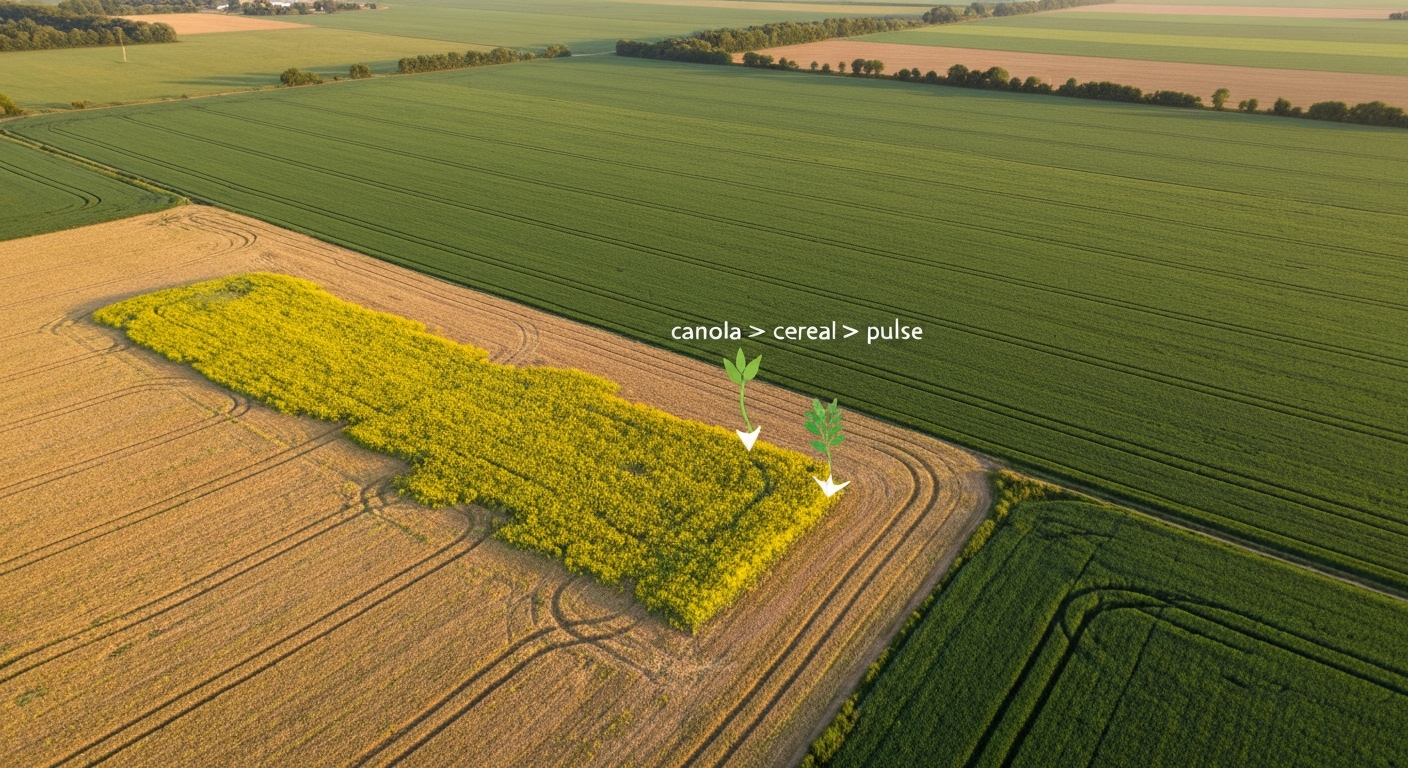
Why what you plant after canola really matters
Canola is a heavy feeder. A 2-tonne-per-hectare crop removes roughly 80 kg of nitrogen, around 50 kg of P2O5, and close to 95 kg of K2O from the soil. If you go straight into another demanding crop without accounting for those removals, you're setting up a yield penalty before you even plant. Soil testing after canola harvest and replacing nutrients based on regionally calibrated removal tables is the practical baseline that extension programs like the Canola Council of Canada and the Canola Research Hub now emphasize through tools like the Prairie Nutrient Removal Calculator.
Beyond fertility, canola introduces disease pressure that lingers. Clubroot (Plasmodiophora brassicae) produces resting spores with a half-life of roughly 3 to 5 years, and some spores can survive in soil for up to 17 to 20 years. Once it's in a field, you can't eradicate it. You can only manage it by choosing crops that don't feed it. Every year you grow a susceptible Brassica on contaminated ground, you multiply the inoculum load. A break of two to three years with non-Brassica crops measurably reduces that pressure, though it won't eliminate it.
There's also the herbicide and volunteer question. Canola volunteers are competitive and hard to kill in many broadleaf crops. Cereals, on the other hand, allow grassy-weed herbicides that knock out canola volunteers cleanly. If you're running GM herbicide-tolerant canola, this matters even more because volunteers carry that trait into subsequent seasons. Many growers deliberately sequence a cereal crop after canola for exactly this reason before coming back to soybeans or another broadleaf crop.
Finally, there's an emerging soil microbiome consideration. blank" rel="noopener noreferrer">Long-term trials in the Pacific Northwest (Schillinger and Paulitz, 2018) recorded an average 17% reduction in spring wheat yields when following winter canola versus following winter wheat. Researchers point to reduced mycorrhizal fungi and altered microbial biomass after canola introductions as likely contributors. A 2019 peer‑reviewed study in Frontiers in Microbiology reported reduced soil microbial biomass and fungal indicators (including arbuscular mycorrhizal fungi) after canola introductions into long‑term wheat rotations blank" rel="noopener noreferrer">A 2019 peer‑reviewed study in Frontiers in Microbiology reported reduced soil microbial biomass and fungal indicators (including arbuscular mycorrhizal fungi) after canola introductions into long‑term wheat rotations.. This doesn't make canola a bad crop, but it does mean the follow-on crop choice and soil health management genuinely influence what your rotation looks like two or three seasons out.
Best cash crops to plant after canola
The following crops consistently appear in extension recommendations across temperate growing regions as economically sensible and agronomically sound choices to follow canola. Regional climate and market access will narrow this list for any individual operation, but these are the options with the broadest evidence base. For more tailored, region-specific recommendations and crop lists, see best crops to grow palia.
| Crop | Agronomic Rationale | Key Considerations |
|---|---|---|
| Winter or Spring Wheat | Controls volunteer canola with selective herbicides; restores mycorrhizal populations; established market in most canola-growing regions | Watch for sclerotinia and blackleg residue overlap; allow full nutrient replacement first |
| Barley | Similar herbicide flexibility to wheat; lower input costs; fits short-season Prairie rotations well | Susceptible to some of the same foliar diseases as wheat; avoid if fusarium pressure is high |
| Oats | Breaks cereal disease cycles when used after wheat-canola sequences; strong mycorrhizal recovery | Lower commodity value in some markets; best used strategically rather than every rotation |
| Field Peas | Fixes atmospheric nitrogen, reducing fertilizer cost in the following crop; excellent rotational fit on the Prairies and in the Midwest | Do not follow with another legume; watch for aphanomyces root rot buildup with frequent pea rotations |
| Lentils | High-value pulse with similar rotation benefits to peas; suited to dry Prairie and interior PNW climates | Very sensitive to herbicide carryover from some canola programs; check residual periods carefully |
| Soybeans | Major cash crop in Midwest and Eastern Prairie rotations; nitrogen-fixing; benefits from volunteer canola cleanup in a preceding cereal year | Requires adequate heat units; herbicide carryover from some canola traits can affect establishment |
| Corn (Maize) | High biomass; different pest and disease spectrum from canola; fits Midwest rotations well after a cereal or directly after canola in high-yield environments | Nutrient-demanding; conduct soil test before assuming canola residue fertility is adequate |
| Dry Beans | High value; non-Brassica broadleaf that fully breaks the disease cycle; suits shorter-season Midwest zones | Sensitive to herbicide carryover; needs warm, well-drained soils |
The most universally recommended sequence in North American Prairie cropping systems remains canola followed by a cereal (wheat or barley), then a pulse (pea or lentil), then back to canola on a minimum three-year gap. That pattern addresses disease, herbicide flexibility, volunteer control, and nitrogen cycling in a single rotation design.
Best cover crops to follow canola
Cover crops after canola serve two different functions depending on where you are in the growing calendar. If you're terminating canola in late summer and have a window before fall freeze-up, a fast-establishing cover can protect soil, scavenge residual nitrogen, and set up the following cash crop. In regions with mild winters, a winter-killed or overwintering cover bridges the gap. The one firm rule: if clubroot is present or suspected in the field, avoid all Brassica cover crops. Daikon radish and other oilseed radishes have shown some promise as 'bait crops' that stimulate resting-spore germination without allowing completion of the life cycle, but extension caution around this practice is consistent. The risk of amplifying inoculum on a symptomatic plant outweighs the experimental benefit in most practical field situations.
- Winter cereal rye: Fast establishment, excellent winter hardiness, aggressive weed suppression, no Brassica disease risk. One of the most reliable options after canola harvest in both Prairie and Midwest settings.
- Oats (fall-seeded, winter-kill): Quick soil cover, good nitrogen scavenging from canola residue, dies over winter leaving residue that is easy to plant through in spring. Widely used in the Northern Plains.
- Hairy vetch: Nitrogen-fixing legume cover that overwinters in many temperate zones; excellent nitrogen contribution (up to 100 kg N/ha under good conditions) ahead of a high-demand cash crop. Combine with rye for erosion control.
- Crimson clover: Shorter season than vetch; suited to PNW and mild-winter Midwest areas; fixes nitrogen and suppresses weeds.
- Field peas (cover crop blend): In shorter growing windows, a fast-maturing pea variety adds nitrogen and biomass without competing with fall-seeded cereals.
- Phacelia: Non-Brassica broadleaf with zero clubroot risk; attracts beneficial insects; used in European and PNW mixed-farming systems as a rotational break crop.
- Sorghum-sudangrass (warm-season): Suited to Midwest post-canola summers; builds organic matter; allelopathic properties help suppress weeds including volunteer canola in warm conditions.
In any clubroot-risk field, cereal and legume covers are the safe defaults. Rye and hairy vetch mixed together is a practical combination that covers both erosion control and nitrogen goals without introducing Brassica disease risk. USDA NRCS cover crop guidance and multiple state extension publications flag brassica cover crops specifically as potential hosts for Brassica diseases, so this is not a fringe concern.
Region: Canadian Prairies
This is where canola rotation science is most developed, because the Prairies grow more canola than anywhere else in the world. Saskatchewan, Alberta, and Manitoba extension services, along with the Canola Council of Canada, have produced the most detailed crop rotation guidance available. The standard recommendation is a 1-in-3 rotation (one canola crop every three years), moving to 1-in-4 in any field with confirmed or suspected clubroot. Alberta's clubroot management plan is explicit that rotation alone won't stop pathogen introduction, but it does significantly slow buildup once spores are present.
On the Prairies, the most common and economically proven post-canola sequence runs canola, then hard red spring wheat or durum, then field peas or lentils, with a possible fourth year of barley or oats before returning to canola. This rotation is not just theoretical; it's what the majority of commercial Prairie producers have converged on over the past two decades because it manages blackleg, sclerotinia, and clubroot risk while keeping nitrogen and herbicide costs in check.
Planting windows in the Prairie context often mean a spring-only planting timeline. Canola is typically harvested in late August through September. Winter wheat can be established after canola harvest in southern Manitoba and parts of Saskatchewan if conditions allow, but most Prairie growers are working with spring-seeded cereals and pulses. Soil testing in fall after canola harvest and applying fertilizer recommendations before spring seeding is the standard practice.
Saskatchewan extension specifically advises scouting field entrances and low spots for clubroot symptoms and extending rotations proactively even before symptoms appear. Once clubroot establishes in a field on the Prairies, the consensus is that a three-year break in susceptible Brassica crops is the minimum meaningful management tool, combined with equipment sanitation to avoid spreading infested soil.
Region: U.S. Midwest and Northern Plains
Canola acreage in the U.S. Midwest and Northern Plains is smaller than the Canadian Prairies but has been growing, particularly in North Dakota, which is the largest canola-producing state in the U.S. NDSU Extension guidance on post-canola crop choice closely mirrors Canadian Prairie recommendations: cereals first to manage volunteers, then pulses or soybeans, with careful attention to herbicide carryover from canola programs.
In the Northern Plains (North Dakota, South Dakota, Montana), the rotation logic is nearly identical to the Prairie provinces. Wheat, barley, field peas, and lentils are the practical alternatives. Clubroot is a growing concern in North Dakota, and the same 1-in-3 or 1-in-4 rotation advice applies. One additional consideration specific to this region is pre-seed burn-off management: volunteer canola populations can be significant, and growers planting soybeans after canola are advised to run a cereal year in between specifically to use grassy-weed herbicides for volunteer cleanup.
Moving further south into Kansas, Nebraska, and the Central Plains, winter canola has a presence in wheat-based rotations. Here, post-canola options expand to include grain sorghum, corn, and soybeans alongside wheat. The longer growing season allows more flexibility. Winter wheat planted after winter canola harvest is a natural sequence in these systems because the harvest timing for canola (late June into July) still allows winter wheat planting in fall. Corn planted after canola on good fertility ground tends to respond well, though a soil test is non-negotiable given canola's nutrient removal profile.
The Midwest is also where the interaction between canola and soybean rotations gets interesting. Soybeans and canola are both broadleaf crops, and there's limited direct disease or pest break benefit from following one with the other. Growers who produce both typically run them with a cereal year between, creating a canola-wheat-soybean-corn type rotation that captures the benefits of both broadleaf crops while maintaining disease and herbicide management.
Region: Pacific Northwest
The Pacific Northwest is where the post-canola crop decision is most complicated, because the research here has produced some counterintuitive results. The Schillinger and Paulitz (2018) long-term trials reported an average 17% yield reduction in spring wheat following winter canola compared to following winter wheat. WSU's oilseeds program attributes this partly to reduced mycorrhizal fungi and altered soil microbial biomass after canola. This doesn't mean canola is off the table in PNW rotations, but it does mean the follow-on crop and soil health management deserve extra attention.
Dryland PNW (eastern Washington, northern Idaho, Oregon dryland wheat belt)
In dryland systems, winter wheat has long been the backbone crop, and canola enters as a rotation crop to break the wheat-on-wheat cycle. The practical issue is that if canola is also causing measurable wheat yield drag in the following year, you need to weigh that rotation benefit carefully. Current recommendations from WSU lean toward ensuring full fertility replacement, using varieties suited to local soil conditions, and considering spring barley or spring wheat rather than continuous winter wheat as the immediate follow-on crop to give mycorrhizal populations more time to recover.
Dryland eastern Washington and Oregon have limited warm-season crop options, so the rotation essentially runs between winter wheat, spring wheat or barley, winter canola, and sometimes dry peas or lentils. The crop timing matters here: winter canola is harvested around July, which allows direct seeding of fall cereals in the same year. This is one of the tighter rotational windows in North American agriculture, and getting volunteer canola under control before establishing the following wheat crop is critical.
Irrigated PNW (Columbia Basin and Snake River Plain)
Irrigated systems in the Columbia Basin and Snake River Plain have more flexibility. Corn, dry beans, sugar beets, and potatoes all enter the rotation picture, and canola fits as one component in a more diverse multi-year rotation. Here, the mycorrhizal depression concern is less acute because crops like corn and soybeans also have their own mycorrhizal relationships that help restore soil fungal communities. The irrigated PNW is also one of the few North American regions where following canola directly with a warm-season crop like corn or dry beans is logistically feasible and economically attractive.
Clubroot pressure in the PNW has historically been lower than in the Prairie provinces, but it is not absent, and the pathogen has been identified in parts of Oregon and Washington. The same management principles apply: avoid back-to-back Brassicas, scout regularly, and sanitize equipment when moving between fields.
Managing soil fertility, volunteers, and disease after canola
Regardless of region, there are three practical management tasks that need to happen before the next crop after canola: soil testing, volunteer assessment, and a disease history check. The Canola Council and regional extension programs consistently emphasize 4R nutrient stewardship (right source, right rate, right time, right place) after canola because the nutrient removal is substantial and uneven across fields depending on yield variability. A soil test taken in fall after harvest gives you the data to set fertility rates for the following spring planting.
Volunteer canola is competitive and can emerge in waves through the following growing season. In cereals, grass herbicides applied post-emergence control most volunteer canola effectively. In pulses, the options depend on herbicide traits in the canola variety grown, and some cases require a pre-seed burn-off before establishment. In soybeans, volunteer canola with herbicide-tolerant traits is a more significant problem that makes the intermediate cereal year strategically valuable even if the direct economics of that cereal crop are not outstanding.
For clubroot, the management hierarchy is: prevent introduction (equipment sanitation, avoid moving infested soil), choose resistant varieties when returning to canola, extend the rotation break to at least three years in affected fields, and scout aggressively at field entrances and low-lying areas where water movement concentrates spores. There is no chemical treatment that eradicates clubroot once it's in the soil. The resting spore longevity of up to 17 to 20 years means you are managing around a permanent soil resident, not eliminating it.
Sample rotation plans by region
| Region | Year 1 | Year 2 | Year 3 | Year 4 (if 1-in-4) |
|---|---|---|---|---|
| Canadian Prairies (standard) | Canola | Spring wheat or durum | Field peas or lentils | Barley, then back to canola |
| Canadian Prairies (clubroot risk) | Canola (resistant variety) | Spring wheat | Field peas | Oats, then canola |
| Northern Plains / North Dakota | Canola | Spring wheat or winter wheat | Field peas or dry beans | Soybeans or barley |
| Central Plains (winter canola) | Winter canola | Winter wheat | Grain sorghum or soybeans | Corn, then back to canola |
| PNW Dryland | Winter canola | Spring barley or spring wheat | Dry peas or lentils | Winter wheat, then canola |
| PNW Irrigated (Columbia Basin) | Winter canola | Corn or dry beans | Spring wheat | Sugar beets or potatoes, then canola |
A brief historical note on Brassica rotations
The logic behind rotating away from Brassica crops is not new. European farmers were managing the consequences of growing turnips, rape, and cabbage repeatedly on the same land well before modern pathology identified clubroot. Medieval English farming texts noted that fields used heavily for turnips and related crops needed resting periods under cereals or grass before they would produce well again. The Norfolk four-course rotation, developed in 18th-century England, included turnips as one of four crops in a strict sequence with wheat, barley, and clover. While the agronomists of that era didn't know about Plasmodiophora brassicae, they had empirically figured out the core principle: Brassicas fit into rotations, they don't dominate them.
Modern canola rotation science is, in many ways, the quantified and mechanistically explained version of agricultural knowledge farmers have acted on for centuries. The specific numbers around nutrient removal, resting spore longevity, and mycorrhizal recovery are new; the fundamental rotation principle is not.
Planting window notes for June and October
If you're planning around a June or October planting window specifically, the post-canola options shift depending on which end of the season you're working with. In June, late-planted spring crops like soybeans, dry beans, corn, or summer cover crops (sorghum-sudangrass, phacelia) are viable in Midwest and PNW irrigated settings if canola was harvested early. October planting is primarily a winter cereal window: winter wheat, winter barley, and winter rye are the practical options in most temperate North American zones following a canola harvest completed by late August or September. In the Prairie provinces, fall seeding opportunities after canola harvest are limited to the southern fringe; most fields go into spring-seeded crops. Gardeners and small-scale growers in temperate regions thinking about seasonal timing after a brassica crop will find more context in related guides on what crops to plant in specific months. For month-specific planting recommendations, see our guide on what crops grow in October. For more localized month-by-month recommendations, see the Icarus best crops to grow guide. Gardeners and small-scale growers will find month-specific planting recommendations in our guide to the best crops to grow in June.
Quick comparison: top post-canola cash crops
| Crop | Best Regions | Rotation Benefit | Main Risk to Manage |
|---|---|---|---|
| Spring wheat | Prairies, Northern Plains, PNW dryland | Volunteer canola control, breaks Brassica disease cycle | Mycorrhizal recovery time; full fertility replacement needed |
| Winter wheat | Central Plains, PNW dryland, Midwest | Fits canola harvest timing for same-year planting | Same mycorrhizal concern as spring wheat; sclerotinia residue overlap |
| Field peas | Prairies, Northern Plains, PNW dryland | Nitrogen fixation, high commodity value on Prairies | Aphanomyces root rot with frequent repetition |
| Lentils | Prairies, PNW dryland interior | High value, low input, suits dry climates | Herbicide carryover from canola; check residuals |
| Soybeans | Midwest, Eastern Prairies | Nitrogen fixing, major cash crop, different disease spectrum | Volunteer canola herbicide conflict; best after a cereal year |
| Corn | Midwest, PNW irrigated, Central Plains | High biomass, different pest/disease profile | High nutrient demand; soil test required after canola |
| Barley | Prairies, PNW, Northern Plains | Flexible herbicide program, lower input costs | Lower value than wheat in many markets; disease overlaps with wheat |
The bottom line on rotating out of canola
There isn't one single best crop to follow canola everywhere. What exists is a clear set of principles that consistently hold across regions: grow a non-Brassica crop, replace nutrients based on measured removal, control volunteer canola before it becomes a population, and don't return to canola for at least two years, preferably three or four if disease pressure is present. Cereals are the most universally applicable first choice because they address the herbicide and volunteer issue directly while giving soil biology time to recover. Pulses are the most strategically valuable second choice because they rebuild nitrogen and diversify the disease environment. How you sequence those, and which specific crops make economic sense, is where local climate, markets, and field history take over from general principles.
FAQ
Headline and meta description
Headline: Best crop to grow after canola — regional, seasonal, and disease-aware choices. Meta description: Practical, evidence-based guidance on the best cash and cover crops to follow canola by region (Prairies, Midwest/Plains, PNW, Europe, Australia/NZ, temperate gardens), seasonal planting windows (June/October notes), soil fertility and volunteer/disease (clubroot) management, rotation timelines, and sample crop sequencing plans. See regional crop guides on Crops By Region for details.
Quick answer (one paragraph)
The best crop to grow after canola is usually a non‑Brassica cash crop—most commonly a cereal (wheat, barley, oats) or a pulse (pea, lentil), or soybean/corn where climate permits—combined with non‑Brassica cover crops when disease risk is present. This approach reduces clubroot and other brassica disease risk, manages volunteer canola and herbicide carryover, and complements nutrient replacement needs. Specific choices depend on region, soil moisture, and timing (e.g., planting in June vs October) and should follow local extension rotation recommendations (commonly a 1‑in‑3 to 1‑in‑4 canola interval in high‑disease areas). For regionally tailored plans, consult the Crops By Region guides.
Best cash crops to follow canola (evidence-based list and rationale)
- Cereals (spring wheat, winter wheat, barley, oats): commonly recommended because they are non‑Brassica, allow different herbicide modes of action to control volunteer canola, and fit many grain markets. Rationale: reduces pathogen buildup and breaks Brassica host cycle. (Canola Council; WSU; USDA ARS). - Pulses (field pea, lentil, chickpea): add protein value and often fit into rotations that improve N economy; useful in Prairies and Mediterranean climates. Rationale: non‑host for clubroot and different residue effects. - Soybean: in suitable zones (Midwest/Plains), provides high cash value and different disease/herbicide profiles; watch for herbicide carryover. - Corn/sorghum/other warm‑season grains: where climate permits, give a long break from Brassicas and different rooting/microbiome interactions. - Oilseeds other than Brassicas (sunflower, flax) where agronomically and marketable: reduce brassica pathogen hosts and offer crop diversification.
Best cover crops to use after canola (evidence-based list and cautions)
- Non‑Brassica covers recommended in fields with clubroot risk: cereal rye, oats, triticale, winter wheat, mixed cereal/legume blends; purpose: erosion control, weed suppression, biomass and microbial recovery. (NRCS; extensions). - Legume covers (hairy vetch, crimson clover, field pea mixes): add N via fixation and assist fertility fill‑in between cash crops. - Avoid brassica cover crops (daikon radish, mustards) in fields with known or suspected clubroot; some research shows radish can act as a bait under research conditions but also can host disease—use only on clean fields with caution. - Timing: choose covers that fit planting window (establish quickly after harvest in June/July or use overwintering cereals drilled in October where winters are mild).
Region-by-region recommendations — U.S. Prairie Provinces (Saskatchewan, Alberta, Manitoba)
Recommendations: - Preferred follow‑crops: spring wheat, barley, oats, field pea, lentil, flax (site dependent). - Rotation interval: aim for at least a 1‑in‑3 (two‑year break) and preferably 1‑in‑4 in clubroot/high‑risk areas; use clubroot‑resistant varieties when Brassica returns are needed. (Canola Council; Saskatchewan/Alberta/Manitoba extensions). - Covers: cereal rye, oats, vetch/pea mixes; avoid brassica covers if clubroot is present. - Planting windows: June seeding of cover crops (after early canola harvest) can establish before frost; October sowing of winter cereals possible in milder zones—ensure adequate establishment before winter. - Notes: test soils for nutrients and P. brassicae where symptoms or history exist; sanitize equipment, monitor field edges for clubroot.
Region-by-region recommendations — U.S. Midwest/Plains
Recommendations: - Preferred follow‑crops: soybean, corn (where irrigated/warm), winter wheat, sorghum, spring cereals, and pulses (chickpea/pea where adapted). - Rotation interval: 1‑in‑3 is common; extend to 1‑in‑4 if clubroot detected or high volunteer pressure. - Covers: cereal rye, oats/pea mixes, winter wheat as cover, hairy vetch for N. - Planting windows: June: plant short‑term covers or relay crops after early canola harvest; October: winter wheat or rye can be drilled—ensure proper seedbed and herbicide rotation compatibility. - Notes: watch herbicide trait carryover for soybeans; use small grains to help control volunteer canola.
Next Articles
Icarus Best Crops to Grow: Top Picks for Game & Garden
Icarus: top crops to grow, in-game and Mediterranean real-world picks, seasonal calendar, rotations & planting tips.
Best Crops to Grow Palia: Game & Palia Kalan Farming Guide
Best crops to grow Palia: game yields, Palia Kalan planting calendars, rotations, soil & seed tips.
What Crops Grow in October: Regional Harvests & Plantings
What crops grow in October: harvests vs plantings, regional calendars, climate cues, storage & quick tips.