Growing crops in the desert is genuinely hard because the environment stacks multiple problems on top of each other at once: almost no rain, soil that either won't hold water or is loaded with salt, brutal daytime heat that can shut down germination entirely, low humidity that forces plants to slam their stomata shut, and wind that strips moisture from leaves and erodes the topsoil. No single fix resolves all of that. But it is solvable when you match the right crops to the right conditions and build your growing system around desert realities rather than temperate-farm assumptions.
Why It Is Difficult to Grow Crops in the Desert and What to Do

Samuel Rourke
31 May 2026
What makes desert climates hard on plants
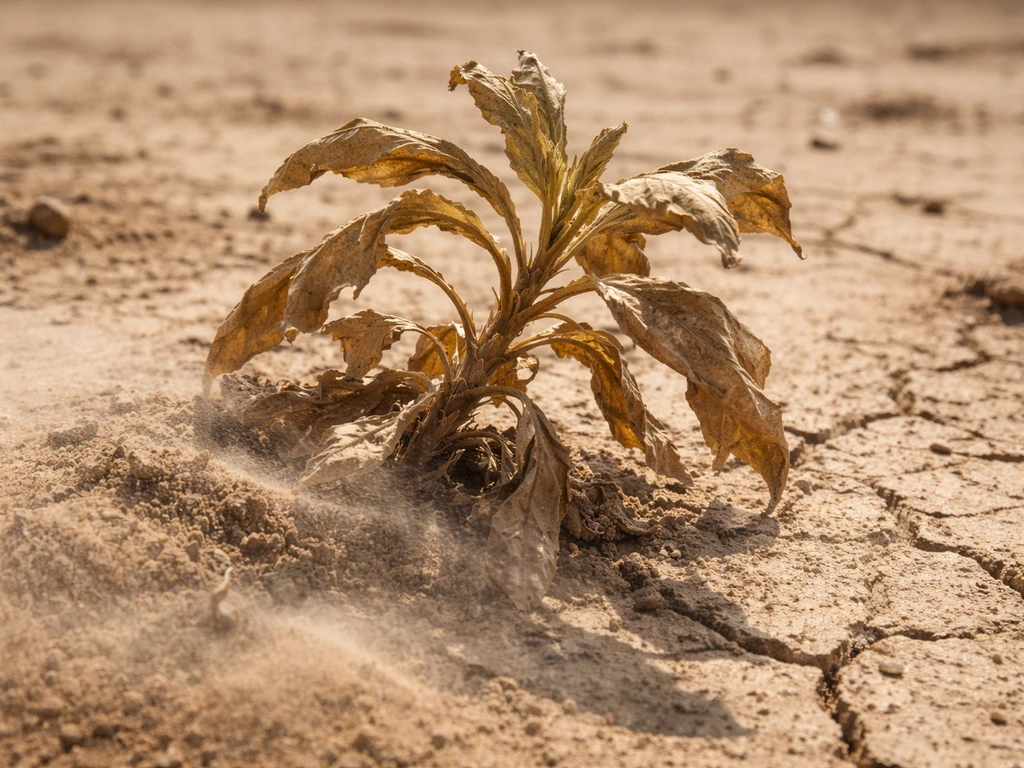
The defining feature of a desert is that water leaves faster than it arrives. Potential evaporation rates in most deserts run between 2,500 and 3,500 mm per year. Death Valley has recorded potential evaporation approaching 4,262 mm per year. Total annual rainfall in those same places might be 100 to 250 mm, sometimes less. That gap is the core problem. Plants cannot survive when the atmosphere is pulling out ten to forty times more water than rainfall is putting in, unless something else intervenes.
Wind makes everything worse. It drives up evapotranspiration from both soil and plant surfaces, which means crops need even more water than the heat alone would suggest. Wind also erodes bare or disturbed soil, carrying away the fine particles and organic matter that would otherwise help retain moisture. Once topsoil starts moving, establishing and holding a crop becomes a moving target. FAO describes this compounding effect across arid regions as one of the binding constraints to crop establishment and growth.
The result is that desert farming failures usually come in clusters. A farmer dealing with water scarcity is almost always also dealing with soil salinity, poor soil structure, and heat stress at the same time. Understanding each constraint separately helps you address them in the right order.
Water problems: scarcity, evaporation, and salinity
The obvious problem is that there simply isn't enough rain. But even when irrigation is available, two secondary water problems undermine crop production: evaporation losses from the soil surface, and salt accumulation in the root zone.
Evaporation from bare soil in a desert can consume a huge share of whatever water you apply before it reaches roots at any useful depth. Lack of infiltration and storage compounds this, because water that sits on the surface instead of soaking in is exposed to full atmospheric demand. This is why surface mulching, drip irrigation, and anything that gets water below the surface quickly matters so much in arid growing systems.
Salinity is the slower, sneakier problem. In arid climates, water evaporates from the soil but salts stay behind. Over time, especially with flood or furrow irrigation, salt concentrations in the root zone build to levels that interfere with how plants absorb water. Even if water is present in the soil, a highly saline root zone creates osmotic stress: the plant effectively can't pull the water in.
FAO crop yield research makes it clear that salinity can constrain crop performance even when irrigation is being applied. The only real fix is leaching: moving water through the soil in sufficient volume to flush salts below the root zone. Utah State University Extension describes operational leaching with a leaching fraction, the proportion of applied water that must drain past the root zone to keep salts from accumulating.
In practice, this means you need more irrigation water than the crop actually consumes, which creates a real tension in water-scarce systems.
Salinity tolerance varies significantly by crop species. Wheat is considered moderately tolerant. Date palms handle high salinity better than most fruit trees. Crops like lettuce and beans are sensitive and will show yield losses at relatively low salt concentrations. If your irrigation source is brackish or your soils are naturally saline, crop selection becomes as important as irrigation management. Researchers at ICBA in Dubai demonstrated that halophytic (salt-tolerant) vegetables can be grown using treated desalination reject brine, which is an extreme case but shows the principle: match the crop to the water quality.
Soil constraints and how deserts differ from fertile land
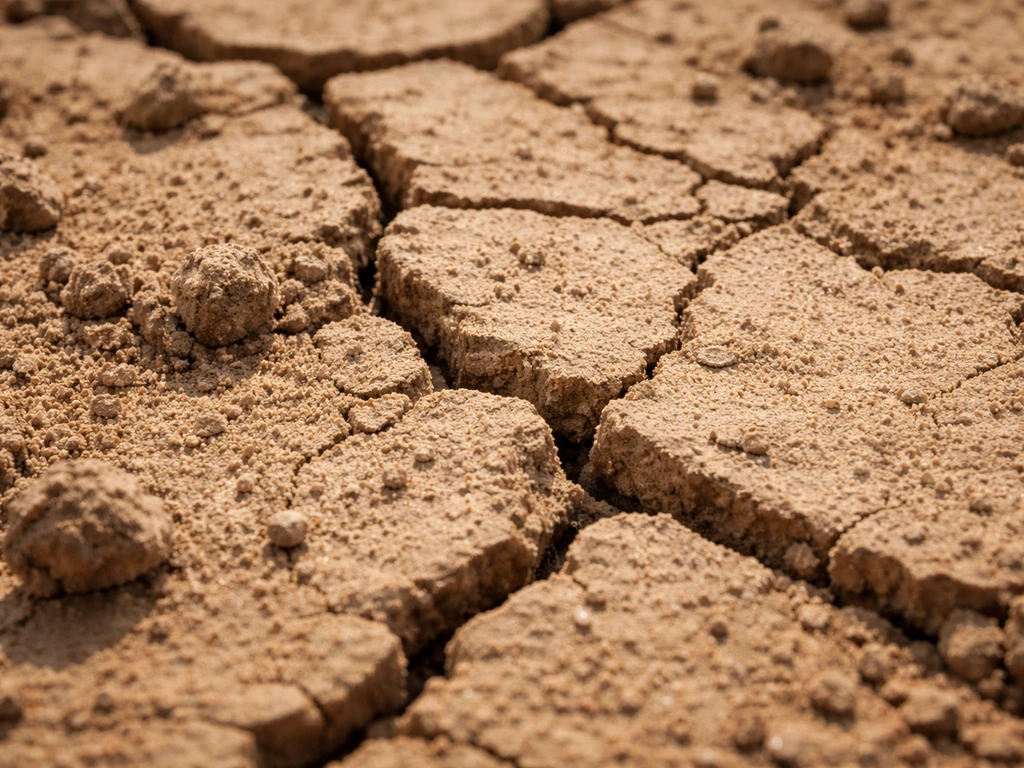
Desert soils are not just dry versions of good agricultural soil. They tend to be structurally poor, nutrient-limited, and prone to specific physical problems that directly block crop establishment.
Soil surface crusting is one of the most underappreciated barriers. When rain or irrigation water hits a bare desert soil, the impact breaks down soil aggregates and fine particles seal the surface as it dries, forming a hard crust. That crust dramatically reduces infiltration, so subsequent water runs off instead of soaking in. FAO research documents that crusts reduce macroporosity and can be a primary reason for low infiltration rates. The same crust that blocks water from entering also physically blocks seedlings from emerging. A seed can germinate below the surface and then fail to push through the hardened layer above it. This is a direct chain from soil physical condition to crop failure.
Beyond crusting, desert soils often present a combination of chemical problems: high pH, sodium (sodicity) that disperses soil aggregates and makes the soil nearly impermeable when wet, micronutrient deficiencies or toxicities, and very low organic matter. Low organic matter means poor water retention, low cation exchange capacity (the soil's ability to hold nutrients), and limited biological activity to cycle nutrients. FAO's agronomic factor analysis specifically flags salinity, sodicity, pH, and micronutrient issues as the key chemical constraints to arid-region crop production.
The nutrient and water problems also reinforce each other. When soil moisture is low, nutrient movement to roots slows down dramatically. FAO research on dryland hydrology describes how drought and low soil water continuity can severely reduce nutrient uptake rates. So even if you've added fertilizer, a dry or poorly structured soil will limit how much of it the crop can actually access. Root penetration through compacted or mechanically impeded layers compounds this further: restricted root room means less water and less nutrient uptake, and that translates directly to lower yields.
Heat, temperature swings, and humidity stress
Deserts are famous for heat, but the specific ways heat damages crops are worth understanding concretely. Germination is one of the most vulnerable stages. Cotton, for example, has an optimal air temperature for development of around 31 to 33 degrees Celsius, but germination is completely blocked above roughly 40 to 42 degrees Celsius. Soil surface temperatures in full desert sun can reach significantly higher than air temperature, especially in dark or bare soils. This is why timing (planting at night, early morning, or in cooler seasons) and soil shading matter so much for stand establishment.
Desert climates also swing hard between day and night temperatures. Daytime highs can exceed 45 degrees Celsius while nights drop to near or below freezing in cold desert regions. Many crops that tolerate the daytime heat struggle with the rapid thermal shift, and some cool-season crops that could theoretically handle the cold nights are killed by the daytime extremes. Research on the Sonoran Desert found that compound heat and drought events drive widespread plant stress even in native vegetation adapted to the region, which gives you a sense of how extreme these conditions are for crops with no evolutionary preparation for it.
Low humidity is a related stressor that operates through a different mechanism. When relative humidity drops, vapor pressure deficit (VPD) rises: the difference between how much water the air could hold and how much it actually holds becomes very large. Plants respond to high VPD by triggering stomatal closure through abscisic acid (ABA) signaling, essentially shutting the pores they use for gas exchange and transpiration. This is a survival mechanism, but it also slows photosynthesis and carbon gain, which reduces growth and yield. In a desert growing season, a plant can spend large parts of the day in a partially or fully closed-stomate state, dramatically cutting productive growing time even when temperatures are otherwise within range.
Crop selection: which crops tolerate deserts best
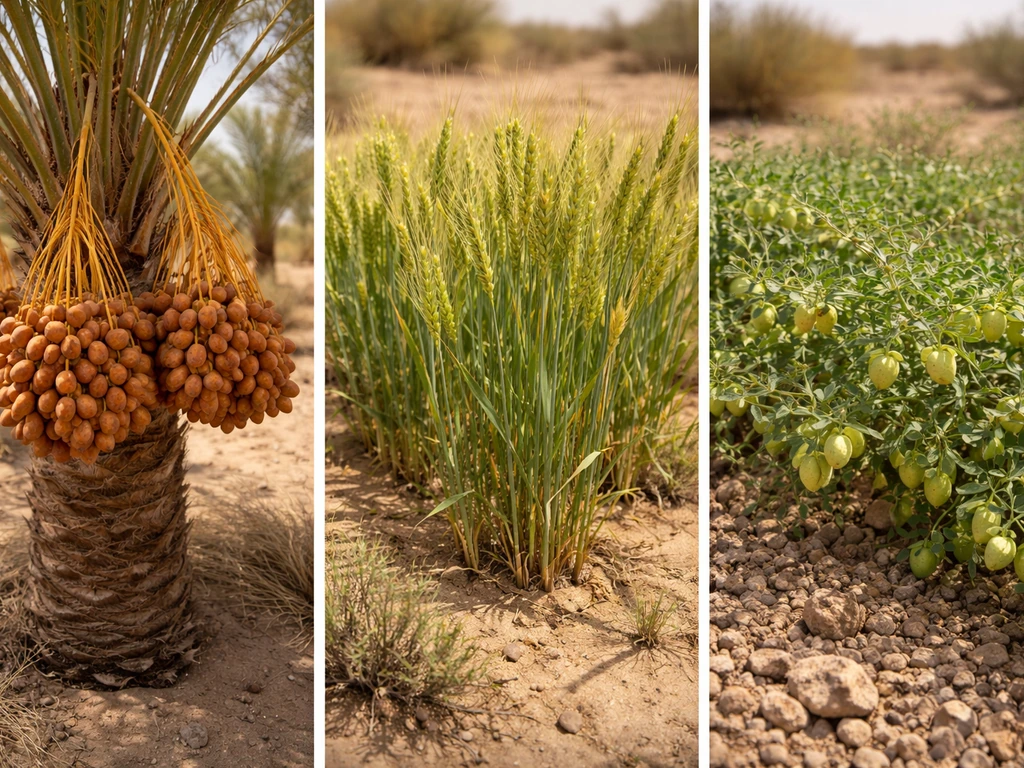
The single most effective thing you can do for desert crop production is start with the right crop. Trying to grow water-hungry, heat-sensitive crops in a desert is fighting the environment on every front simultaneously. If you try to force the wrong crop into the wrong desert conditions, crops will not grow. Choosing crops adapted to aridity gives you a working system to improve rather than a losing battle.
| Crop | Key Tolerance | Main Limitation in Deserts | Salinity Tolerance |
|---|---|---|---|
| Date palm | Extreme heat, drought once established | Needs reliable groundwater or irrigation | High |
| Sorghum | Heat, drought | Needs some rainfall or supplemental irrigation | Moderate |
| Millet (pearl) | Extreme heat, low rainfall | Low yields without some moisture | Moderate |
| Quinoa | Moderate salinity, cold nights | Yield drops sharply with saline irrigation water | Moderate-High |
| Sesame | Heat, moderate drought | Sensitive to waterlogging and very high salinity | Low-Moderate |
| Jojoba | Extreme heat and drought | Not a food crop; oil crop for arid systems | Moderate |
| Cactus (nopal/prickly pear) | Extreme aridity, heat | Slow establishment | Moderate |
| Barley | Cool-season, moderate drought | Poor in extreme summer heat | Moderate-High |
| Wheat (winter) | Cool-season, moderate drought | Vulnerable to heat at grain fill | Moderate |
Date palms are the anchor crop of traditional desert agriculture for good reason: once established with access to water (shallow groundwater or reliable irrigation), they tolerate extreme heat and alkaline soils that would kill most other trees. Sorghum and pearl millet are the staple grain choices across the Sahel and Arabian Peninsula because they genuinely outperform wheat and maize under heat and drought.
For gardeners, low-water herbs like rosemary, thyme, and sage perform far better than moisture-loving crops like lettuce or cucumber without significant infrastructure investment. The site's dedicated resource on what crops grow in the desert goes deeper on regional crop patterns if you want to map this by specific desert type. You can also find examples of what foods grow in Mexico by looking at crops that match Mexico's arid and semi-arid regions.
Modern and historical desert cultivation approaches
Desert farming is not new. Civilizations from North Africa to the Arabian Peninsula to the American Southwest developed sophisticated systems for capturing, storing, and stretching water across thousands of years. The practical lessons from those systems are still directly relevant.
Traditional water harvesting and oasis systems
The ghout oasis system in Algeria's El Oued region is a striking example. Farmers there plant date palms in excavated pits that reach down to the water table, essentially letting the groundwater do the irrigation work passively. No pumps, no pipes, just a deep understanding of local hydrology matched to a crop that can handle the conditions. FAO documents this as a traditional hydro-agricultural system designed to leverage scarce groundwater for productive use. In Yemen, seasonal floodwater from wadis (dry riverbeds) is diverted using small earthen bunds to irrigate sorghum, millet, sesame, and cotton. These spate or flood-diversion systems work with the intermittent water availability of arid regions rather than against it.
The lesson from historical desert agriculture is consistent: successful systems are designed around the specific water source and timing available in that location, not around what a farmer in a humid climate would do by default.
Modern approaches: drip irrigation, windbreaks, and protected agriculture
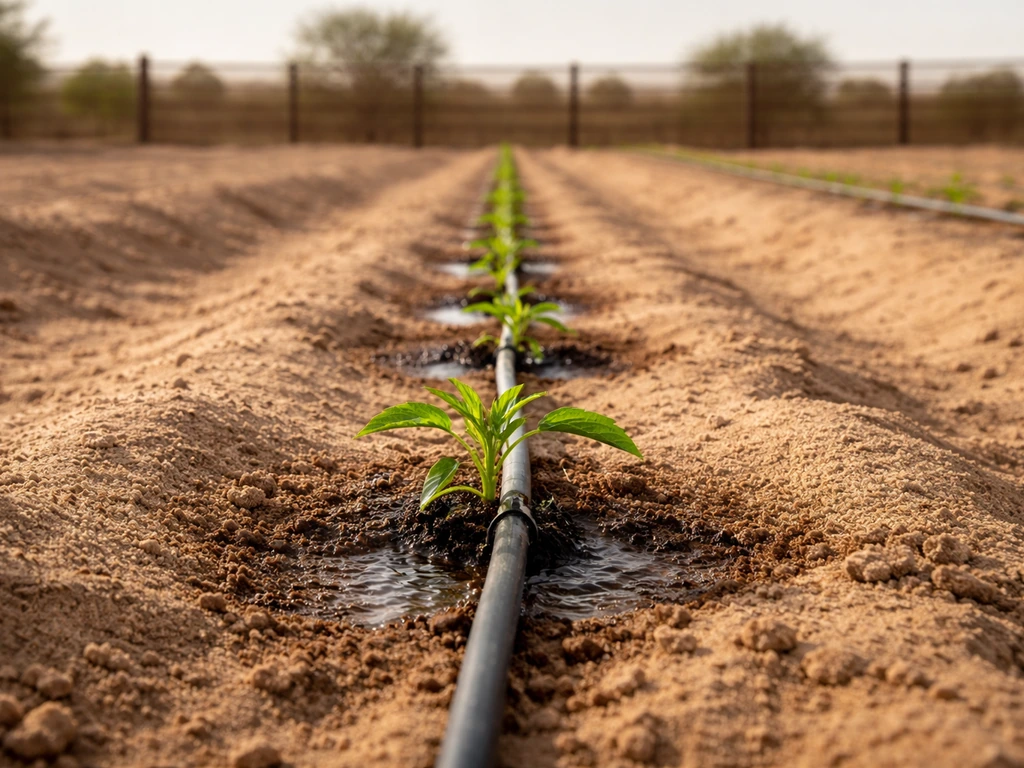
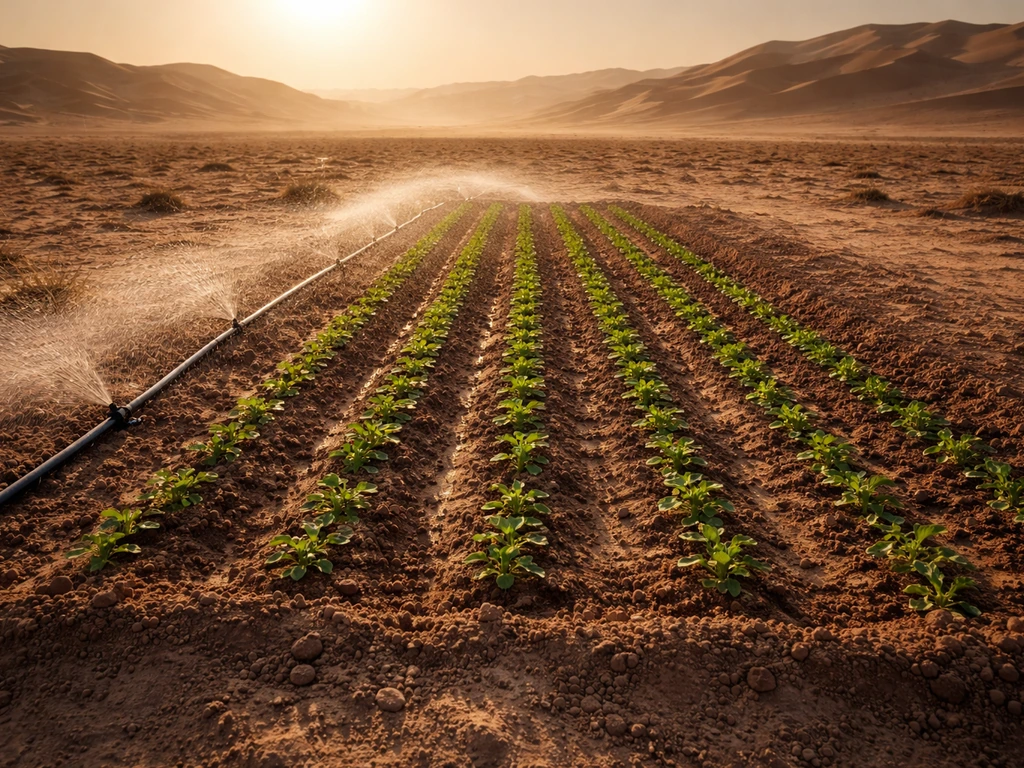
Modern desert farming builds on traditional water-matching logic with better technology. Drip irrigation delivers water directly to the root zone, dramatically cutting evaporative losses compared to flood or sprinkler systems. Combined with mulching to suppress surface evaporation, drip irrigation can reduce crop water use to closer to actual crop demand rather than the much higher gross application needed with surface methods. FAO’s crop water needs guidance uses the crop coefficient framework, where crop evapotranspiration is calculated from reference evapotranspiration and a crop factor expressed in mm per day (or similar time units).
Windbreaks are another high-impact intervention. A 2026 windbreak optimization study found that sheltered areas within windbreak systems experience evapotranspiration rates that are 10 to 30 percent lower, along with higher humidity and less extreme temperatures, conditions linked to yield increases in the 10 to 25 percent range. In northwest China's oasis protection systems studied over 40 years, wind velocity dropped by 75 percent and sand transportation rates dropped by 98 percent compared to unprotected desert settings. That's not a marginal improvement; it fundamentally changes the growing environment.
Protected agriculture (greenhouses and shade structures) takes microclimate control further, reducing VPD stress and heat load while keeping crops productive through the hottest months. ICBA research in Dubai has tested halophytic vegetables, heat- and salinity-tolerant fruit trees, and quinoa under desert protected agriculture conditions, which gives a current picture of what the frontier of desert crop production looks like. For most small-scale growers, even simple shade cloth over sensitive crops during peak afternoon heat can make a meaningful difference in yield and survival.
Soil building in desert contexts usually centers on adding organic matter to improve structure and water retention, breaking surface crusts mechanically before planting, and managing salt through leaching fractions in the irrigation schedule. In sodic soils, gypsum applications help replace sodium with calcium, restoring soil structure and infiltration. These aren't fast fixes, but they work over a season or two when applied consistently.
Your desert growing plan: where to start
If you're planning to grow crops in a desert environment, the following checklist gives you the most important first actions before you plant anything. The sequence matters: fixing water management before selecting crops, and selecting crops before trying to optimize fertility, will save you significant wasted effort. If you are wondering why do crops grow so slow in bedrock, the short answer is that desert water and soil limits make it hard for roots to establish and keep taking up moisture and nutrients. If you need a quick starting point, consider the different crop options that can thrive under desert conditions before you fine-tune irrigation and soil work what crops grow in the desert.
- Test your water and soil first. Get a basic irrigation water quality test for salinity (EC) and sodium (SAR), and a soil test for pH, salinity, sodicity, and texture. This tells you which constraints are real in your specific location, not just typical.
- Choose crops matched to your conditions. If your water is moderately saline, eliminate salt-sensitive crops from the list. If you're in a hot desert summer, eliminate cool-season crops or plan to grow them in the cooler months only.
- Design your irrigation system for efficiency before planting. Drip or subsurface drip is almost always the right choice in a desert. If surface irrigation is all you have, minimize ponding time and irrigate more frequently in smaller amounts.
- Build in a leaching fraction if your water has any measurable salinity. Applying 10 to 20 percent more water than crop demand (draining below the root zone) is the baseline for salt management. Adjust based on your soil and water test results.
- Break surface crusts before planting. Light tillage or raking immediately before seeding gives seedlings a better chance of emergence. Mulch immediately after planting to prevent re-crusting and reduce evaporation.
- Add organic matter every season. Compost, cover crops (where water allows), or even crop residue incorporated back into the soil will improve water retention and nutrient cycling over multiple growing cycles.
- Install windbreaks on your prevailing wind side. Even simple tree rows or brush barriers reduce ET losses and protect young plants from desiccating wind. Plan for the long term; windbreaks take a few seasons to establish but pay off substantially.
- Time planting to avoid peak heat at germination. Soil surface temperatures during peak summer in many deserts exceed germination thresholds for most crops. Planting in late afternoon, using shade cloth, or waiting for cooler seasons dramatically improves stand establishment.
- Start with a small test plot. Desert conditions vary significantly by location, water source, soil depth, and microclimate. Test two or three crop varieties side by side in a small area before committing to large-scale planting.
- Track what works by region and season. Keep notes on what germinated, what stalled, and what thrived. Desert agriculture is highly location-specific, and your own records over one or two seasons are the most valuable data you'll have.
Desert agriculture is genuinely possible, but it requires building your system around the desert's rules rather than assuming temperate-farm practices will transfer. The regions and civilizations that figured this out, from Algeria's oasis farmers to the flood-diversion irrigators of Yemen to modern researchers in Dubai, all succeeded by understanding their specific water source, matching it to the right crops, and protecting those crops from the environment's most damaging forces.
The same logic applies whether you're farming an acre in Arizona or a test garden in the Sahara. In the Sahara specifically, that usually means choosing highly drought- and heat-tolerant crops and relying on irrigation or oasis groundwater rather than rainfall grow crops in the Sahara. Start with what the land and water can actually support, and build from there.
If you are wondering why it is hard to grow crops in Mexico, the same constraints of water, heat, soil conditions, and crop choice are usually at the center of the problem.
FAQ
Is the lack of rain the only reason crops fail in desert conditions?
No. Even with irrigation, desert failures often come from evaporation losses at the soil surface and salt buildup in the root zone. If water is applied but most is lost to evaporation or salts accumulate faster than leaching can flush them, crops still stall or die.
Can I solve desert farming by adding more irrigation water to prevent heat stress?
Not always. More water can help, but it can also worsen salinity unless drainage and leaching are built into the plan. A practical approach is to pair irrigation scheduling (to reduce surface evaporation) with a leaching strategy that keeps salts below the root zone.
How do I know whether my main problem is salinity versus drought?
Look for patterns. Drought shows up as moisture stress across the profile, while salinity often causes reduced growth even when the soil looks wet, plus leaf tip burn or stunting over time. Soil tests for electrical conductivity and a basic profile check (not just topsoil) are the fastest way to avoid guessing.
What is soil crusting, and how can I tell if it is stopping seedlings?
Crusting is a sealed hard layer that forms after irrigation water hits bare soil and the surface dries. If seeds germinate but seedlings cannot emerge, or you see water run off instead of soaking in, crusting is likely. Breaking crust before seeding and using mulch or residue to keep the surface covered usually helps.
Do desert soils always have salt problems?
Not always, but salt issues are common because water evaporates and salts remain. The risk is higher if your irrigation water is brackish, your groundwater is saline, or your local soils are naturally salty. If you are using groundwater or desalination reject brine, assume salinity management will be required.
How can I prevent salt accumulation if water is scarce?
You usually cannot eliminate leaching, but you can reduce how often you trigger salt buildup by improving irrigation delivery (drip) and keeping water off the surface (mulch). Then, plan periodic leaching events sized to the soil and crop root depth rather than continuously over-irrigating.
Why does drip irrigation work better than sprinklers or flood irrigation in deserts?
Drip places water directly into the root zone and reduces exposure of soil to the air, cutting evaporation-driven losses. It also makes it easier to match application depth to infiltration and to manage salts, since you can target where water goes and avoid spreading salts through the upper soil.
Are heat-tolerant crops enough, or do I need to manage temperature swings too?
Heat tolerance helps, but desert day-night swings and VPD stress can still limit growth. For crops that are sensitive at germination, timing matters (plant during cooler periods, protect soil temperature with shading or reflective mulches, and avoid planting when surface temperatures are likely to exceed germination thresholds).
Does low humidity actually reduce yields, or is it just uncomfortable for growers?
Low humidity often reduces yields because it raises vapor pressure deficit (VPD). Higher VPD pushes plants to close stomata to conserve water, which reduces carbon uptake and slows growth. Shade, wind control, and irrigation scheduling can partially offset this by lowering plant water stress.
Will windbreaks help if I already use drip irrigation and mulching?
They can still help. Wind increases evapotranspiration and accelerates soil drying, especially in exposed areas, and it can erode fine topsoil. Windbreaks can also create a calmer microclimate with slightly higher humidity, which reduces daily water demand and supports more stable stand establishment.
What is the safest “first step” decision order when planning a desert garden or farm?
Start with the water source and irrigation method, then match crop choice to that water quality and local climate, then design soil work. If you choose the wrong crop first, you may spend seasons trying to overcome biological limits that soil amendments and fertilizer cannot fix.
If my desert site has bedrock near the surface, can I still grow crops?
It is possible but root establishment will be limited. Shallow bedrock reduces the soil volume available for water storage and root growth, which magnifies drought and nutrient uptake constraints. Raised beds, deeper soil pockets, and careful irrigation scheduling can help, but the economics and crop selection become more restrictive.
How long does desert soil improvement take, and what should I expect in year one?
Most soil-building changes are gradual. You can see early improvements from crust breaking, mulching, and better irrigation distribution, but structural and nutrient retention benefits often take a season or two. Plan for a learning period where yields may stay low even when you are doing the right things, especially if salts or sodicity are present.
Next Articles
Why Crops Grow So Slow in Bedrock and How to Fix It
Troubleshoot slow crop growth in Minecraft Bedrock with light, hydration, farmland setup, spacing, and a fast checklist
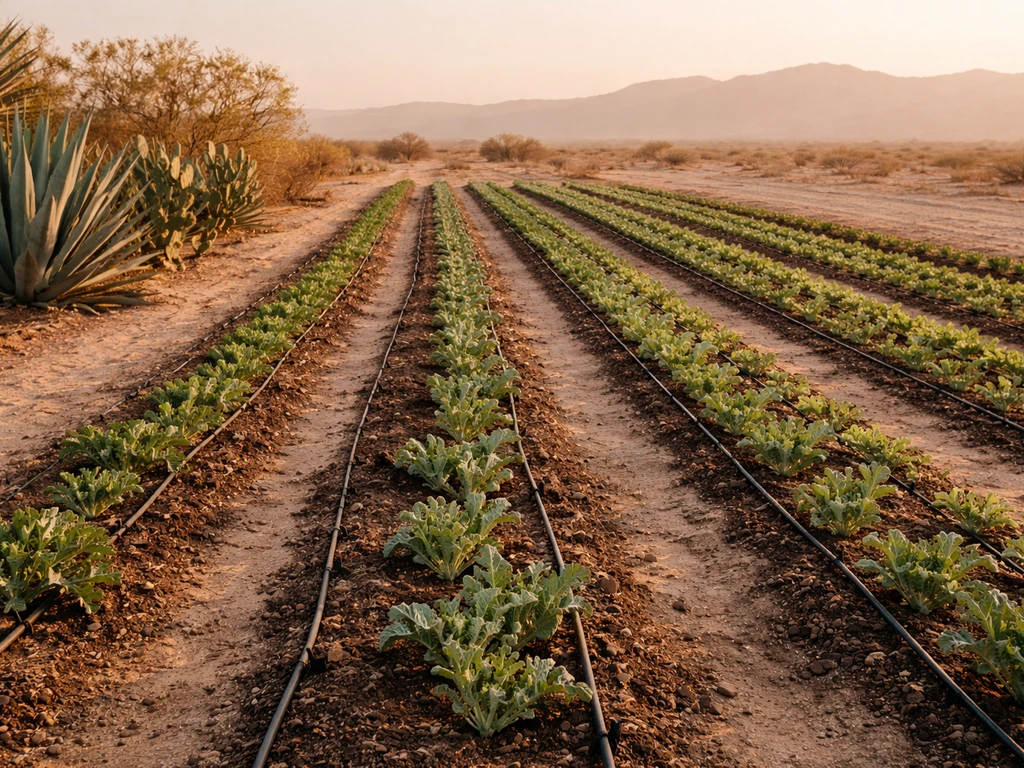
What Crops Grow in the Desert: Planting Guide and List
Curated list of desert-tolerant crops plus traits and step-by-step soil and drip irrigation guidance to grow them.
What Foods Grow in Mexico By Climate and Region
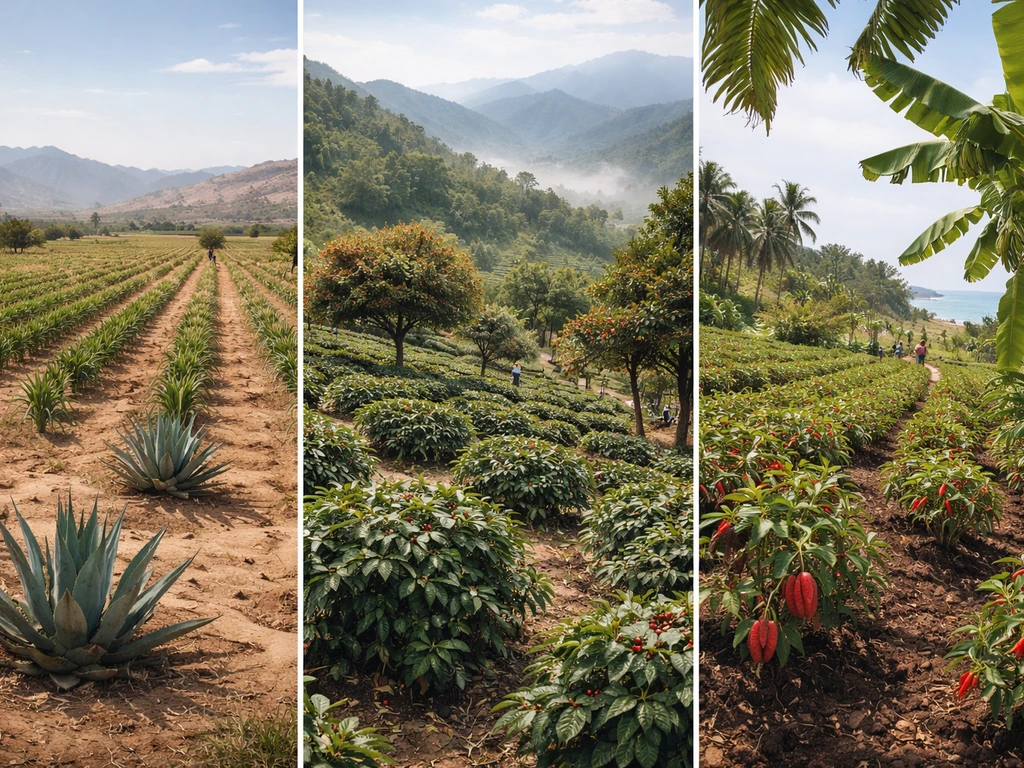
Region by region guide to what foods grow in Mexico: maize, beans, fruits, peppers, cacao, coffee, agave, and more.