Quick answer: does cotton need lots of water?
Yes, cotton needs a meaningful amount of water to produce a good crop, but "a lot" is relative. The short answer is that cotton is a moderate-to-high water user, somewhere between a drought-tolerant grain and a genuinely thirsty crop like sugarcane. The FAO puts total seasonal water requirement at 700 to 1,300 mm depending on climate and growing season length. That range is wide on purpose: a cotton crop grown in a hot, arid environment with a long season needs far more water than one grown in a humid region with frequent rain. how cotton grows
How much water cotton typically uses
The most useful real-world numbers come from both FAO global data and U.S. extension research. At the broadest scale, FAO reports total seasonal evapotranspiration (the actual water the crop uses) ranging from about 410 to 780 mm per season when looking at irrigated systems, and up to 1,300 mm for full crop water demand in hot, long-season climates. To put that in perspective, 700 mm is roughly 27.5 inches of water across the whole season.
At the field level, the numbers get more granular. During early growth, cotton uses only about 0.2 inches of water per week. As the crop develops, demand climbs to roughly 0.5 inches per week by around 30 days after planting. By mid-season, which is the peak demand window, a well-irrigated cotton crop can need around 1.5 to 2.0 inches per week, or about 0.22 to 0.28 inches per day. UGA Extension and Cotton Incorporated both land on roughly the same figure: plan for up to 1.5 inches per week during the busiest part of the season, and use 1.0 to 1.5 inches per week as a practical seasonal planning range.
| Growth Stage | Approximate Water Need | Notes |
|---|
| Early/Initial (first ~30 days) | ~0.2 inches/week | Low demand; seedling establishment |
| Crop Development | 0.2–0.5 inches/week | Demand climbs as canopy expands |
| Mid-Season (bloom to peak boll) | 1.5–2.0 inches/week (~0.22–0.28 in/day) | Peak demand window; most stress-sensitive |
| Late Season | Declining toward ~0.5 inches/week | Demand drops as bolls mature |
| Harvest/Open Boll | Minimal; irrigation typically terminated at ~10% open boll | Dry conditions preferred for harvest |
What drives cotton's water needs
Three things move the needle more than anything else: climate, soil, and growth stage. Understanding all three together is what separates a useful water estimate from a number pulled from a textbook.
Climate and geography
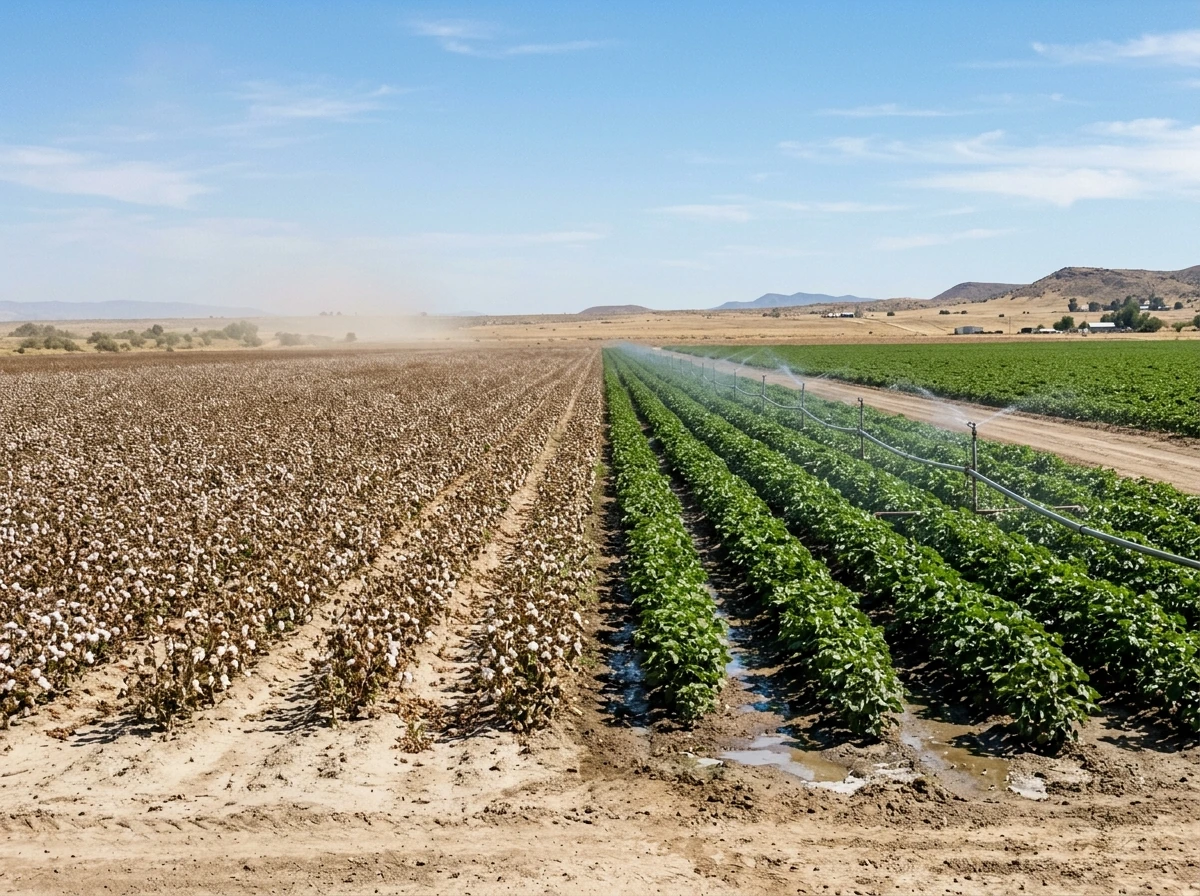
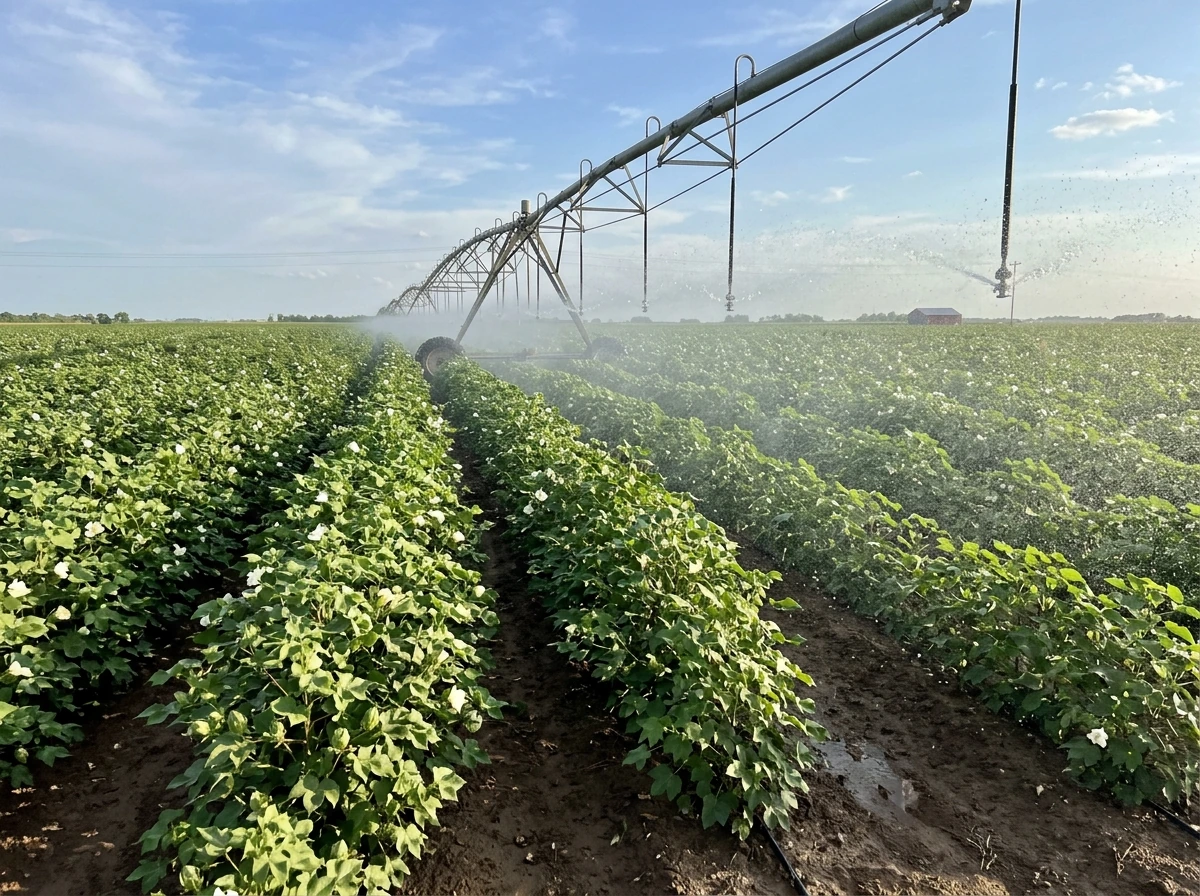
Cotton is grown commercially across a huge climate range, from the humid Mid-South U. S. (Mississippi, Tennessee, Arkansas) to semi-arid West Texas, the Arizona desert, and irrigated regions of Central Asia and Australia. In humid regions, seasonal rainfall covers a large chunk of the crop's water budget, but uneven distribution through the season means irrigation is still often needed at critical moments.
Cotton Incorporated specifically notes that in the humid Mid-South, irrigation management is complicated by variability in rainfall, temperature, and cloud cover during the growing season. In arid regions, almost the entire 700 to 1,300 mm requirement must come from irrigation.
The geography of where cotton grows tells you a lot about how much supplemental water it needs, which is worth keeping in mind if you're researching where cotton grow tells you a lot about how much supplemental water it needs, which is worth keeping in mind if you're researching why cotton thrives in certain regions but not others. why does cotton grow well in the south
Soil type
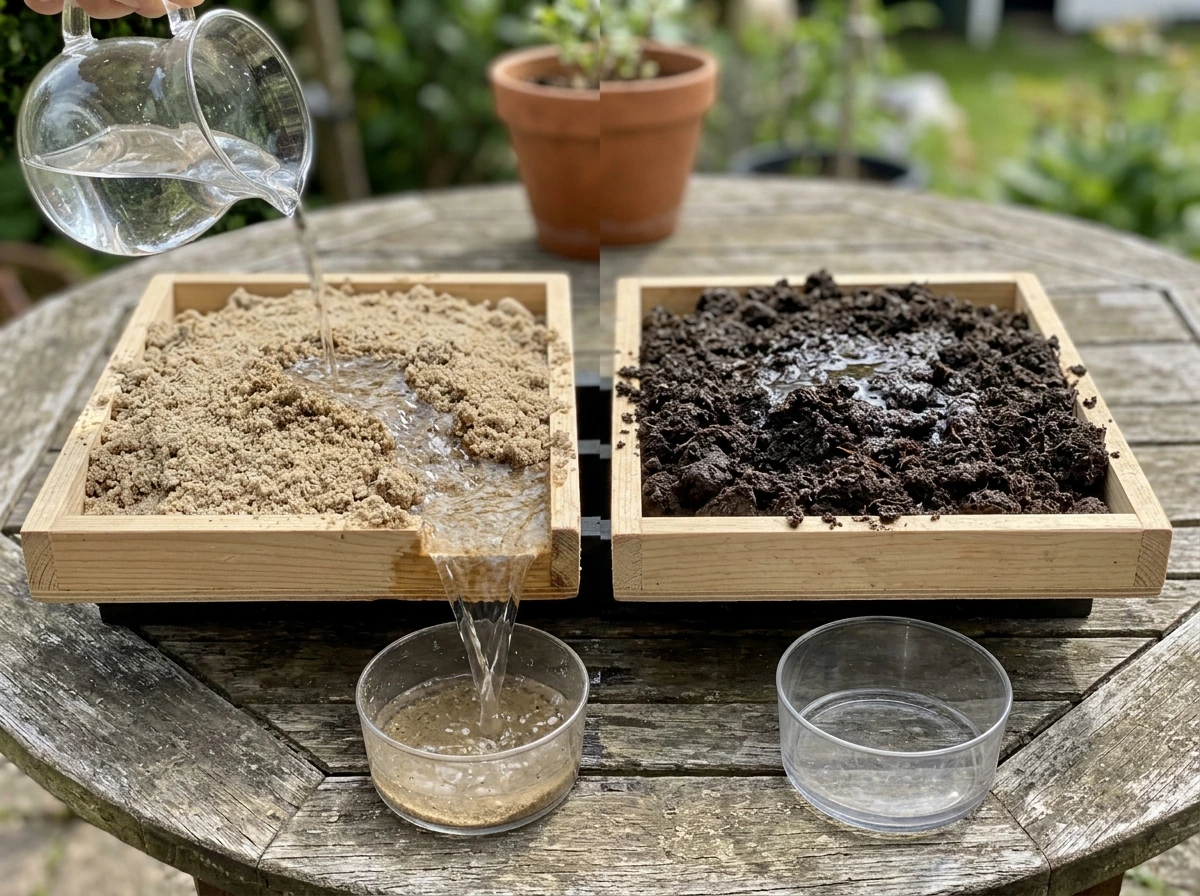
Soil affects how efficiently water is stored and delivered to roots. Sandy soils drain quickly and hold less water between irrigation events, meaning more frequent applications are needed even if total seasonal volume is similar. Clay-heavy soils hold more water but can become waterlogged if over-irrigated. The soil's total available water capacity, a concept formalized in FAO-56's irrigation guidelines, determines how large a "buffer" exists between rain or irrigation events. FAO-56 provides irrigation guidelines that formalize concepts like total available water capacity, helping define the buffer between rain or irrigation events FAO-56's irrigation guidelines. Good soil management, such as maintaining organic matter, directly reduces the real-world irrigation burden.
Stage of growth
Water demand is not flat across the season. Cotton starts slow, ramps up sharply through the flowering and boll-development stage, then declines toward harvest. The most critical window is from first flower to peak bloom. Water stress during this period causes shedding of young bolls and permanent yield loss. UGA Cooperative Extension flags bloom as the most critical period for irrigation. At the other end of the season, UGA recommends terminating irrigation around 10 percent open boll because demand has dropped enough that additional water adds cost without improving yield.
Rainfall vs irrigation: how to estimate for your region
The basic formula is simple: Irrigation Need = Crop Water Requirement minus Effective Rainfall. But the effective rainfall part is where people often go wrong. Not every inch of rain that falls counts toward your crop's water budget. Rain that runs off, falls at the wrong time, or exceeds soil storage capacity doesn't help the crop. FAO defines effective rainfall as the portion of total rainfall that is actually useful for crop production at the site, and calculating it properly requires accounting for rainfall timing, intensity, and soil conditions.
For a practical regional estimate, start by looking up your area's average monthly rainfall during the cotton growing season (typically April or May through September in the U.S. South). Compare that against the crop's expected water demand for the same months using the per-week figures above as benchmarks. The gap between the two is roughly what irrigation needs to fill. In the Mississippi Delta, for example, average summer rainfall might cover 50 to 70 percent of mid-season demand in a good year, but a dry July can wipe that out fast. In West Texas or Arizona, assume rainfall covers very little and plan irrigation for nearly the full seasonal requirement.
A practical field tool for tracking this is the checkbook irrigation scheduling method. The approach treats soil water like a bank account: you add deposits (rain and irrigation) and subtract withdrawals (crop evapotranspiration each day). University of Minnesota Extension recommends placing at least two rain gauges within the field to accurately measure actual water inputs. UGA Extension uses the same checkbook concept, emphasizing that hot, sunny days drive higher withdrawals while cloudy, humid days reduce them. The checkbook method is not perfect, but it turns abstract seasonal totals into actionable weekly decisions.
Water-use terms explained
If you start reading research on cotton water requirements, you'll hit a set of technical terms quickly. Here's what they actually mean in plain language.
- Evapotranspiration (ET): The total water lost from the crop system through both plant transpiration (water moving through the plant and out through leaves) and soil evaporation. When sources say cotton uses 700 to 1,300 mm per season, they mean ET.
- Reference Evapotranspiration (ETo): A standardized calculation of how much water a reference grass crop would use under local weather conditions. It's essentially a measure of atmospheric demand for water. The FAO Penman-Monteith equation is the standard method for calculating it.
- Crop Evapotranspiration (ETc): The actual water demand of the cotton crop at a specific growth stage. Calculated as ETc = Kc × ETo, where Kc is the crop coefficient.
- Crop Coefficient (Kc): A multiplier that adjusts ETo to reflect cotton's actual water use at each stage of growth. FAO values for cotton range from about 0.4 to 0.5 during early growth, up to 1.05 to 1.25 at mid-season, then back down to around 0.65 to 0.75 as the crop approaches harvest.
- Crop Water Requirement (CWR): The total amount of water a crop needs to grow without stress over the full season. In practice, CWR equals total seasonal ETc.
- Irrigation Need (or Net Irrigation Requirement): CWR minus effective rainfall. This is the amount that actually has to come from irrigation.
- Effective Rainfall (P_eff): The portion of rainfall that contributes to meeting the crop's water need. Not the same as total rainfall.
Knowing these terms matters because they let you interpret data from different sources correctly. When a source says "cotton ET ranges from 410 to 780 mm," that's actual measured crop water use under irrigation. When another says "cotton needs 700 to 1,300 mm," that's full crop water requirement including what rainfall might supply. They're measuring different things, and treating them as interchangeable leads to bad irrigation planning.
Practical next steps: how to plan water use for cotton

If you're trying to estimate cotton's water needs for a specific location today, here's a step-by-step approach that uses the concepts above.
- Find your local ETo data. Your state's agricultural weather network (most U.S. states have one) publishes daily or weekly ETo values. NOAA and FAO's CLIMWAT database are good fallbacks for global locations.
- Apply the Kc for each growth stage using FAO values: initial ~0.45, development ~0.75, mid-season ~1.15, late season ~0.75. Multiply ETo by the relevant Kc to get ETc for that period.
- Estimate effective rainfall using monthly averages for your area. A conservative approach is to count only rainfall events above a minimum threshold (often 5 to 10 mm) and discount large single-storm events that exceed soil storage.
- Subtract effective rainfall from ETc to get your net irrigation requirement for each period.
- Set up the checkbook method in-field by recording actual rainfall with at least two gauges, tracking soil moisture with sensors or visual checks, and adjusting weekly based on weather.
- Pay closest attention to the bloom window. If water is limited, that's where to prioritize it. Consider terminating irrigation at around 10 percent open boll to avoid wasting water late in the season.
- Revisit your numbers after the first season. Local conditions like soil texture, microclimate variation, and irrigation system efficiency all affect real-world numbers. The FAO and extension figures are starting points, not final answers.
Common misconceptions about cotton and water
A few ideas about cotton and water circulate widely but don't hold up well under scrutiny.
"Cotton is an extremely thirsty crop"
This one comes up often, usually tied to statistics about total global water consumption by the cotton industry. The confusion comes from mixing up crop water requirement with the broader concept of embedded or virtual water in products. At the field level, cotton's water requirement (700 to 1,300 mm per season) is similar to many other row crops.
The larger water story for cotton involves how much of its global production happens in arid, irrigation-dependent regions where every liter has to be pumped. The crop itself isn't uniquely thirsty; the geography of where it's grown is what drives high aggregate water use. That pattern is why cotton tends to grow well in the South where long warm seasons and climate help the crop reach peak yield why does cotton grow well in the south.
"Cotton needs peak water right after planting"
Not true. In the first 20 to 30 days, cotton is establishing roots and its canopy is small, so evapotranspiration is low. FAO notes that initial-stage ETc is roughly 50 percent or less of mid-season demand. A 2021 review summarizing FAO-56 cotton crop coefficient (Kc) values by growth stage supports this initial-stage versus mid-season ETc relationship FAO notes that initial-stage ETc is roughly 50 percent or less of mid-season demand.. Overwatering at emergence can actually cause problems. The heavy water demand doesn't arrive until the crop is flowering and setting bolls.
"If it rains enough, you don't need to track water use"
Rainfall timing matters as much as total volume. A region that gets 600 mm of rain per season might still see severe water stress during the bloom window if that rain falls mostly in spring and fall but not in July and August when demand peaks. This is exactly why irrigation is used even in relatively humid cotton-growing regions like the Georgia and Mississippi delta areas. Total seasonal rainfall can look adequate on paper while the crop is stressed at the worst possible time.
"Cotton's water use is all irrigation"
Cotton draws on both rainfall (green water) and irrigation (blue water). Research on global cotton production specifically distinguishes between these two sources when assessing water consumption and yield links. In humid production regions, green water from rainfall covers a substantial share of the crop's total need. In arid regions, the balance tips heavily toward blue water. A Reddit r/water discussion also cites irrigation canals and Colorado River water as part of the context for why cotton can be water-intensive in arid, blank" rel="noopener noreferrer">irrigation-dependent regions, but it should not be treated as a precise measurement source. Understanding this distinction matters if you're trying to compare water efficiency across different cotton-growing regions or historical periods.