
Most food crops grow best in slightly acidic to neutral soil, with a pH between 6.0 and 7.0. If you want a single target to work toward, aim for around 6.5. At that point, the widest range of nutrients stays dissolved and available to roots, soil microbes do their best work, and the toxic metals that wreck root growth stay locked out of the soil solution. There are crop-specific exceptions worth knowing (blueberries want pH 4.5–5.5, potatoes often 5.0–5.5), but for the overwhelming majority of vegetables, grains, and legumes, 6.0–7.0 is the window that covers you.
At Which pH Do Most Crops Grow Best: Optimal pH Guide

Samuel Rourke
30 Jul 2026
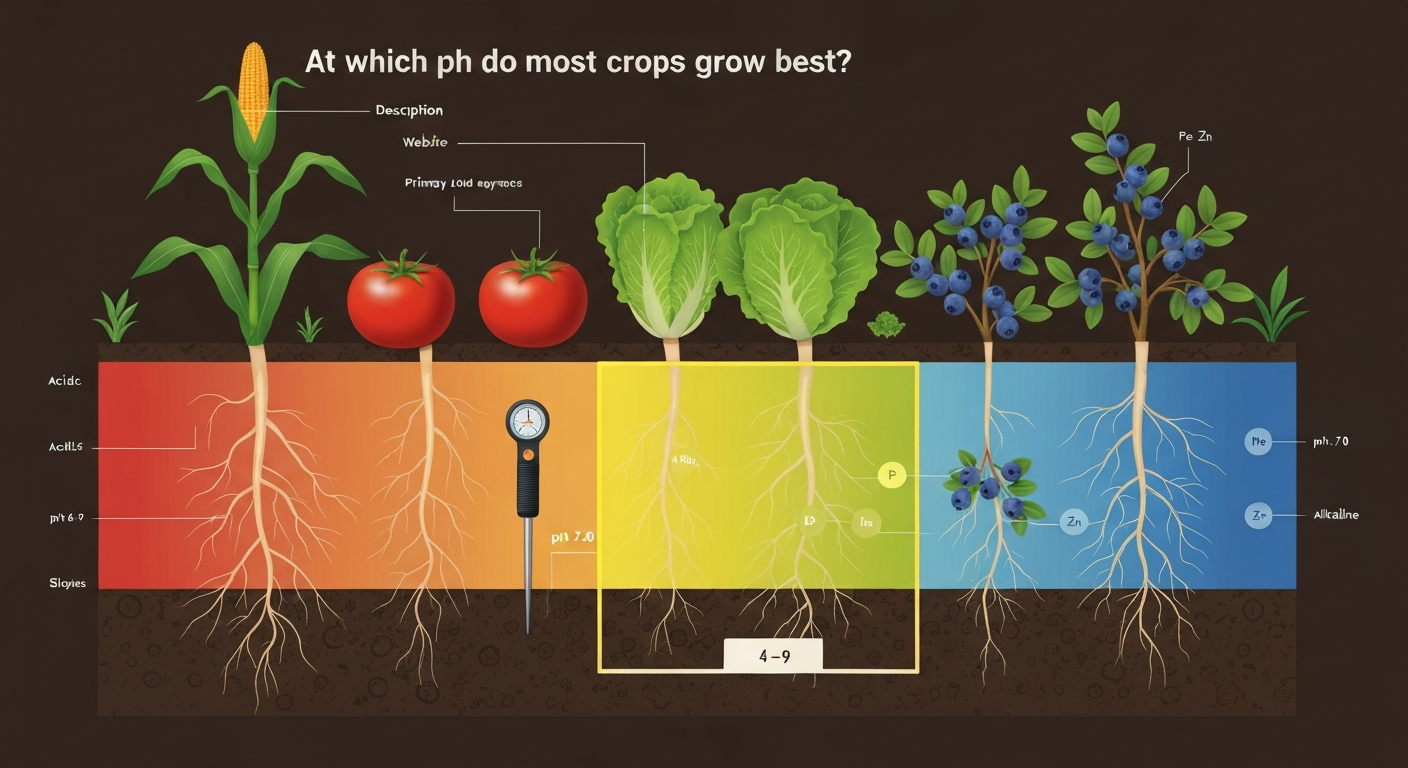
Why soil pH matters more than most people realize
Soil pH is a measure of hydrogen ion concentration on a log scale from 0 to 14, where 7.0 is neutral, values below 7 are acidic, and values above 7 are alkaline. What makes it so important in agriculture is that pH does not just describe the soil's chemistry, it actively controls it. The availability of nearly every essential plant nutrient depends on how acidic or alkaline the surrounding soil solution is. Adjusting pH is often the single highest-leverage action a farmer or gardener can take, because it affects everything from nitrogen cycling to whether iron and zinc are actually reachable by roots.
Three main mechanisms tie pH to crop performance: nutrient availability, soil biology, and direct metal toxicity. Understanding all three helps explain why the 6.0–7.0 consensus target is not arbitrary but reflects real chemistry happening in the soil.
How pH controls what your soil can and cannot deliver to a plant
Nutrient availability
Phosphorus availability offers the clearest example of a pH sweet spot. Phosphate ions react with iron and aluminum at low pH, forming insoluble compounds that roots simply cannot absorb. At high pH, phosphate binds to calcium with the same result. The practical window where phosphorus stays most available sits roughly between pH 5.5 and 7.2, which is one big reason the 6.0–7.0 target gets recommended so often. Micronutrients like iron, manganese, zinc, and copper work in the opposite direction: they become more soluble as pH drops, which sounds helpful until you realize that at strongly acidic pH those same metals reach concentrations that poison the plant.
Soil biology and microbial activity
The billions of bacteria and fungi in healthy soil are not passive bystanders. They decompose organic matter, cycle nitrogen, suppress disease, and form the mycorrhizal networks that extend root reach. Soil pH is one of the strongest predictors of microbial community structure and function in agricultural soils. Meta-analysis: global-change impacts on soil microbial diversity and function, Nature Communications (2020) found that soil pH is a dominant driver of bacterial and fungal community structure and of microbial processes (e.g., nitrification and organic matter mineralization) in agricultural soils Meta-analysis: global-change impacts on soil microbial diversity and function — Nature Communications (2020). Nitrification (the conversion of ammonium to plant-available nitrate) slows sharply in strongly acidic soils, meaning a field that tests low in pH is simultaneously losing its ability to process organic nitrogen sources efficiently. Keeping pH in the 6.0–7.0 range supports a diverse, active microbial community and keeps nitrogen cycling running at full speed.
Aluminum and manganese toxicity
When soil pH drops below about 5.5, aluminum (Al3+) starts dissolving into the soil solution. Below pH 5.0, Al3+ concentrations become genuinely toxic to most crops, primarily by stunting root elongation and disrupting the uptake of calcium, magnesium, and phosphorus. Plants with damaged root systems cannot access water or nutrients effectively, so the visible symptom above ground looks like general nutrient deficiency even when nutrients are technically present. Manganese follows a similar pattern: Mn2+ concentrations climb as pH drops, and toxicity symptoms (brown spots on leaves, reduced yields) become common below pH 5.0–5.5 on soils with naturally high total manganese. Both toxicities are largely avoided by keeping pH at or above 6.0 for sensitive crops.
pH targets for common crops
The table below pulls together widely cited extension-sourced pH ranges for common food crops. These are general targets, local soil type and climate can nudge the ideal range slightly, and your state extension office will have calibrated recommendations for your region. The ranges are for the root zone at field depth (roughly 0–6 inches / 0–15 cm) measured by standard water suspension method.
| Crop | Preferred pH Range | Notes |
|---|---|---|
| Corn (maize) | 5.8–7.0 | Yield often peaks near 6.5; tolerates moderate acidity |
| Wheat / small grains | 5.6–6.6 | Target 6.0–6.5 to avoid Al toxicity on acid soils |
| Soybean | 6.0–7.0 | Many guides recommend 6.3–6.6 as a rotation target |
| Rice (paddy) | 5.5–7.0 | Flooded conditions alter Fe/Mn dynamics; consult local IRRI/FAO guidance |
| Potato | 5.0–5.5 (scab mgmt) / 5.5–6.0 (general fertility) | Lower pH suppresses common scab; balance scab risk with yield |
| Tomato | 6.0–6.8 | Slightly acidic; calcium uptake becomes critical in this crop |
| Lettuce / leafy greens | 6.0–7.0 | Generally tolerant within this window |
| Brassicas (cabbage, broccoli, kale) | 6.0–7.0 | Tolerate slightly lower pH but perform best near 6–6.8 |
| Carrots / root vegetables | 6.0–6.8 | Loose, well-structured soil matters as much as pH |
| Common bean | 6.0–7.0 | Nitrogen fixation by rhizobia favored near neutral pH |
| Onion / garlic | 6.0–7.0 | Sensitive to both strong acidity and strong alkalinity |
| Blueberry | 4.5–5.5 | Require strongly acid soil; lime-amended ground is unsuitable |
| Strawberry | 5.5–6.5 | Slightly more tolerant of near-neutral than blueberry |
| Sweet potato | 5.5–6.5 | Tolerates mild acidity well |
| Peanut | 5.9–7.0 | Calcium availability especially important for pod fill |
A few historical patterns are worth noting here. Ancient Mesopotamian farmers cultivating wheat and barley on the alluvial soils of the Tigris and Euphrates were, often without knowing it, working soils that fell naturally in the 6.5–8.0 range, well within the workable window for those grains. Early Chinese paddy rice cultivation relied on the pH-buffering effect of flooded conditions, which tends to move strongly acid or alkaline soils toward a more neutral pH over time. The crops that dominated early agriculture were, not coincidentally, broadly adapted to near-neutral soils.
Testing your soil pH before you do anything else
No amendment plan makes sense without a current soil test. The standard protocol for field crops is to collect a composite sample: take 15–20 cores from random spots within a uniform management zone (same crop history, same fertilizer history, similar landscape position), pull each core to 0–6 inches (0–15 cm) depth, mix everything together in a clean bucket, and send roughly one cup of the blend to the lab. Timing matters too, fall sampling after harvest or early spring before planting gives results in time to apply lime and let it react before the growing season. Lime is slow; it needs weeks to months to fully shift soil pH depending on soil texture and lime particle size.
Home test kits vs. laboratory analysis
Home pH meters and colorimetric test kits can get you a rough reading quickly, and they are genuinely useful for a first pass, checking a spot after amendment, or monitoring a garden bed over time. For any serious production decision, though, a laboratory test is worth the small cost. Labs typically report pH measured in either a 1:1 or 1:2 soil-to-water suspension, or in 0.01 M calcium chloride (CaCl2) solution. CaCl2 readings run about 0.2–0.5 pH units lower than water-suspension readings for the same soil. That difference matters when you are comparing tests from different labs or tracking changes over time, so always note which method your lab uses and stick with the same lab if you want to see trends accurately. Most university extension labs also report a buffer pH (sometimes called lime buffer index), which tells you how much lime you actually need to reach your target, not just what the current pH is.
Raising or lowering soil pH: practical amendment options
Once you have a test result and a target pH in hand, the amendment decision is usually straightforward. Raising pH (reducing acidity) almost always means adding lime. Lowering pH (increasing acidity) is slower and harder, but sulfur-based amendments are the standard approach.
Raising pH with lime
Agricultural limestone (calcium carbonate, CaCO3) is the most widely used and cost-effective choice for most growers. Dolomitic limestone (which contains magnesium as well as calcium) is preferred where magnesium is also deficient. Application rates come directly from your soil test report and depend on your target pH, current pH, and the soil's buffering capacity (heavy clay soils need more lime to move pH than sandy soils do). A common guideline is that about 1–2 tons per acre of agricultural lime raises pH by roughly 0.5–1.0 units in a medium-textured soil, but treat that only as a rough orientation, always follow the lab's specific recommendation. Apply lime and incorporate it before planting if possible, and give it at least 2–3 months to react fully before expecting to see the target pH reflected in a follow-up test. Hydrated lime (calcium hydroxide) and quick lime (calcium oxide) act faster but are more caustic to handle and can overshoot if applied carelessly.
Lowering pH with sulfur and organic options
Elemental sulfur is the standard amendment for acidifying soil. Soil bacteria (primarily Thiobacillus species) oxidize the sulfur to sulfuric acid, which lowers pH. The process is biological, so it is slower in cold soils and takes several months to fully work in most climates. Rates of 1–2 lbs of elemental sulfur per 100 square feet can drop pH by roughly 0.5–1.0 units in sandy to loamy soils, but in highly buffered clay or high-lime soils, the amounts required can become impractical. For garden-scale plantings of blueberries or acid-loving crops, acidic organic mulches like pine bark or peat moss help maintain low pH over time and improve soil structure simultaneously. Ammonium-forming nitrogen fertilizers (ammonium sulfate, for example) have a modest acidifying effect and are sometimes used in high-pH irrigated systems in the West as a long-term management tool alongside elemental sulfur.
Timing and realistic expectations
Neither lime nor sulfur works overnight. For row crops, the standard advice is to apply lime in fall for the following growing season, or at least 6–8 weeks before planting. For perennial systems like orchards or blueberry plantings, getting the pH right before planting is far easier than trying to correct it once plants are established, because incorporation into the root zone is essentially impossible without disruption. Regular soil testing every 2–3 years (or annually for high-value production) lets you make incremental adjustments and avoid both under-correction and overshoot.
Matching your amendment strategy to soil type, climate, and scale
How much lime or sulfur you need, and how fast it works, depends heavily on where you are farming. Soil texture, organic matter content, clay mineralogy, and natural drainage all interact with pH management. A blanket "apply X tons per acre" recommendation can lead to either waste or ineffective correction if the local soil conditions are not considered.
- Sandy soils (common in the U.S. Southeast coastal plains, parts of the Pacific Northwest) have low buffering capacity, meaning pH moves easily with smaller lime or sulfur applications but also drifts back faster under rainfall leaching. More frequent but smaller applications work better than large infrequent ones.
- Clay-rich soils (much of the Midwest Corn Belt, river delta regions) have high buffering capacity. Significant amounts of lime are needed to move pH, but once corrected, the change holds for several years. Heavy soils also respond more slowly, so lead time before planting is important.
- Organic matter raises buffering capacity too, so high-OM soils (prairie-derived Mollisols, muck soils) need more lime than a simple current-pH number would suggest — again, this is why the buffer pH on your lab report matters.
- High-rainfall climates (Southeast U.S., Pacific Northwest, tropical regions) naturally acidify soils faster through leaching of base cations, so lime needs to be a routine part of the management calendar rather than a one-time fix.
- Arid and semi-arid climates (U.S. Great Plains, Mediterranean zones, Middle East) more often deal with alkaline soils (pH 7.5–8.5 or higher) due to low rainfall and natural carbonate accumulation. In these regions, sulfur acidification and careful irrigation water management (some irrigation water is high in calcium bicarbonate, which raises pH over time) are recurring challenges.
- Large-scale field operations should use variable-rate lime application based on GPS grid soil sampling or zone-based sampling — pH variation within a single field can span 1.0–1.5 units, and blanket applications waste lime in already-neutral zones while under-correcting acid hotspots.
- Small-scale gardeners and market farmers benefit from raised beds with imported soil mixes, which allow precise initial pH control and easier maintenance compared to amending native soil in place.
Soil pH patterns across U.S. states and regions
Native soil pH across the United States follows rainfall and geology very closely. Humid eastern states tend toward acidity because rain leaches base cations (calcium, magnesium, potassium) from the topsoil over time. Drier western states retain those cations and often develop alkaline or calcareous soils. Understanding these regional baselines helps explain why certain crops historically concentrated in particular regions, and why some soils require more amendment investment than others. See our guide to the best state to grow crops for region-specific recommendations on soil pH baselines and crop suitability.
| U.S. Region / State Examples | Typical Native Soil pH | Common Crops | Main pH Challenge |
|---|---|---|---|
| Corn Belt (Iowa, Illinois, Indiana, Ohio) | 5.5–7.0 (variable by field history and parent material) | Corn, soybean, wheat | Acidification from cropping; annual lime inputs common |
| Southeast (Georgia, Alabama, South Carolina) | 4.5–6.0 (strongly to moderately acid) | Cotton, peanuts, sweet potato, tobacco | Naturally acid soils; Al/Mn toxicity risk without lime; blueberries thrive here naturally |
| Mid-Atlantic (Virginia, Maryland, Pennsylvania) | 5.0–6.5 | Vegetables, small grains, hay | Widespread acidity; liming a standard practice |
| Great Plains (Kansas, Nebraska, South Dakota) | 6.5–8.0 (near-neutral to alkaline) | Wheat, corn, sorghum, sunflower | High-pH soils in drier areas limit micronutrient availability |
| Pacific Northwest (Washington, Oregon) | 5.5–7.0 (varies widely) | Wheat, potatoes, hops, berries | Coastal/mountain soils strongly acid; inland irrigated soils can be alkaline |
| California Central Valley | 6.5–8.5 (alkaline dominant in irrigated areas) | Fruits, nuts, vegetables, rice | Alkaline soils and irrigation water high in bicarbonate; Fe and Zn deficiency common |
| Upper Midwest / Great Lakes (Minnesota, Wisconsin, Michigan) | 5.5–7.0 | Corn, soybeans, potatoes, sugar beets | Sandy lake plain soils very acid; requires regular lime; potatoes grown at lower pH intentionally |
| Southwest (Arizona, New Mexico, parts of Texas) | 7.0–8.5+ | Cotton, chile, pecans, alfalfa | Strongly alkaline caliche soils; micronutrient deficiencies without acidification or chelated fertilizers |
Class I farmland (the best-quality agricultural land by USDA land capability classification) is characterized by deep, well-drained soils with few limitations. In the U.S., much of this land sits in the Corn Belt and Midwest, where natural soil pH falls in the 5.5–7.0 range and regular liming is economically practical at scale. Where you find farmers consistently growing crops, as explored in depth across this site, you very often find soils that either naturally fall in the 6. See our guide on where do farmers grow crops for regional patterns and practical advice. 0–7.0 window or have been managed for decades to stay there.
Global pH hotspots and regions naturally suited for crop production
At a global scale, the regions best suited for crop production by soil pH are broadly those with temperate climates, moderate rainfall, and deep, weathered but not over-leached soils. See our guide on where do crops grow best for a regional soil pH overview. For a broader discussion of where soils, climate, and water combine to make the best place to grow crops in the world, see our regional comparisons and maps within this site. Tropical rainforest soils (Oxisols and Ultisols in the Amazon basin, Central Africa, and Southeast Asia) are often strongly acidic (pH 4.0–5.5) with high aluminum saturation, making them challenging for most staple crops without intensive lime inputs. Arid region soils (Middle East, North Africa, Central Asia) commonly run alkaline (pH 7.5–8.5 or higher) and limit iron, manganese, and zinc availability.
| World Region | Typical Soil pH | Naturally Well-Suited Crops | Main pH Consideration |
|---|---|---|---|
| North American Midwest (U.S. / Canadian Prairies) | 5.8–7.5 | Corn, wheat, soybean, canola | Near-optimal with routine liming; best global farmland by many measures |
| Western Europe (France, Germany, UK) | 5.5–7.5 (variable) | Wheat, barley, sugar beet, vegetables | Long history of liming; pH well-managed on arable land |
| North China Plain | 6.0–8.0 | Wheat, maize, vegetables | Some alkaline areas in semi-arid north; well-suited in major crop zones |
| South and Southeast Asia (Indo-Gangetic Plain) | 6.0–8.0 | Rice, wheat, sugarcane | River alluvium near-neutral; paddy systems buffer pH under flooding |
| Sub-Saharan Africa (savanna belt) | 5.0–6.5 (acid savanna soils common) | Millet, sorghum, cassava, cowpea | Acid-adapted crops historically dominant; lime investment increasing |
| Amazon / humid tropics | 4.0–5.5 | Cassava, tropical fruits (naturally acid-tolerant) | High Al saturation; major challenge for introduced staple crops |
| Nile Delta / Mesopotamia alluvium | 7.0–8.0 | Wheat, barley, cotton, vegetables | Ancient grain civilizations developed on near-neutral alluvial soils |
| Australian wheat belt | 5.5–7.5 (variable; acid patches common) | Wheat, barley, canola, legumes | Soil acidity spreading on cropped land; national liming program active |
| Andes highlands (Peru, Bolivia) | 5.5–7.0 (varies by elevation/geology) | Potato, quinoa, maize | Native crops evolved on acid-to-neutral Andean soils |
| Mediterranean basin (Spain, Italy, Turkey, Morocco) | 6.5–8.0 (calcareous dominant) | Wheat, olives, grapes, vegetables | Alkaline calcareous soils; chlorosis risk for sensitive crops |
The deep alluvial soils of the Nile Delta and Mesopotamia stand out historically because they were naturally buffered near neutral pH by mineral-rich river deposits renewed by annual floods. Wheat and barley, two crops that thrive in the 6.0–7.5 range, became the foundation of those early civilizations partly because the soil environment suited them so well without any deliberate pH management. The same logic applies to the Indo-Gangetic Plain and the Yellow River valley in China, where river alluvium created naturally productive near-neutral soils that supported dense agricultural populations long before modern soil science existed. Understanding what crops grow where, across both history and the modern world, almost always leads back to the underlying soil chemistry, and pH sits near the top of that story.
For growers today, whether working a backyard vegetable plot, a large commercial farm in the Midwest, or a smallholding on acid tropical soils, the practical takeaway is the same: test first, correct to your crop's target range, choose the right amendment for your soil type and climate, and revisit the soil regularly. The 6.0–7.0 window works for most crops in most places, but knowing your specific soil, your region, and your crop-specific targets is what separates a good harvest from a great one.
FAQ
At which pH do most crops grow best?
Short answer: most common food crops perform best in slightly acidic to neutral soils — roughly pH 6.0–7.0. Many extension services use ~6.5 as a general target for row and vegetable crops, with crop-specific adjustments as needed.
Why does soil pH matter for crop growth?
Soil pH controls nutrient solubility and availability (e.g., P is most available ~5.5–7.2; micronutrients like Fe, Mn, Zn become less available as pH rises), influences toxic metal solubility (Al3+ and Mn2+ increase in strongly acidic soils), and drives soil microbial communities and nutrient cycling (nitrification, organic matter breakdown). These combine to affect root growth, nutrient uptake and yields.
Do all crops want the same pH?
No. While many crops do best near pH 6.0–7.0, some are pH specialists. Acid‑loving crops (blueberries, cranberries) prefer pH 4.5–5.5; potatoes and some root crops often do well at slightly lower pH (~5.0–5.5) to reduce diseases like common scab. Always check crop‑specific extension guidance before major adjustments.
What are typical pH ranges for common crops (quick reference)?
Typical extension ranges: - Corn (maize): ~5.8–7.0 (optimum near 6.5) - Wheat/small grains: ~5.6–6.6 (many recommend 6.0–6.5) - Soybean: ~6.0–7.0 (rotation targets ~6.3–6.6) - Potato: ~5.0–5.5 for scab control (general fertility 5.5–6.0) - Rice (paddy): ~5.5–7.0 (redox/flooding alters chemistry) - Blueberries/cranberries: ~4.5–5.5 - Brassicas/leafy greens: ~6.0–6.8 - Beans/peas: ~6.0–7.0 (consult local guides for details)
How should I test soil pH for a field or garden?
Collect composite cores from the root zone (typical field depth 0–6 in / 0–15 cm): take 15–20 random subsamples per management zone or field, combine, mix and send to a reputable lab. Sample in fall or early spring before major liming/amendment activity. Use the same lab/method over time; know whether the lab reports pH in water or 0.01 M CaCl2 (CaCl2 values are usually ~0.2–0.5 lower).
How do I raise soil pH (correct acidic soils)?
Most common amendment is agricultural lime (ground limestone). Guidance: 1) Base lime rates on a soil test and buffer pH provided by the lab; 2) apply recommended lime well before the crop (fall application for spring crops is common because lime reacts slowly); 3) finer lime reacts faster; 4) retest pH 6–12 months after application to confirm change. Consult local extension for rates—soil texture and buffering capacity greatly affect required amounts.
Next Articles
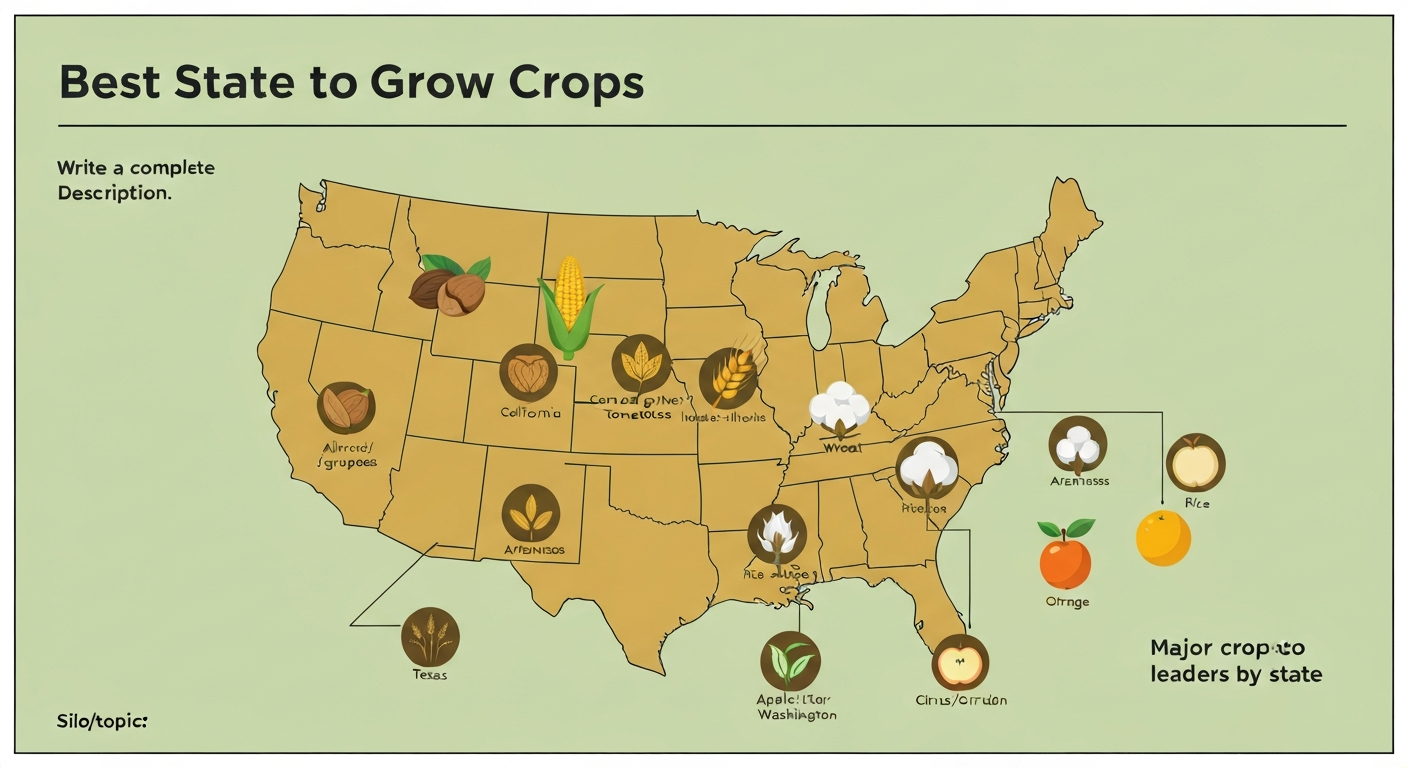
Best State to Grow Crops: Top U.S. States, Crops & Reasons
Discover which U.S. states are best for growing major crops, why they excel, and how to choose the right region.
Best Place to Grow Crops in the World: How to Choose Regions
A practical guide to the best crop regions by climate, water, soil and season length, with real examples and how to choo
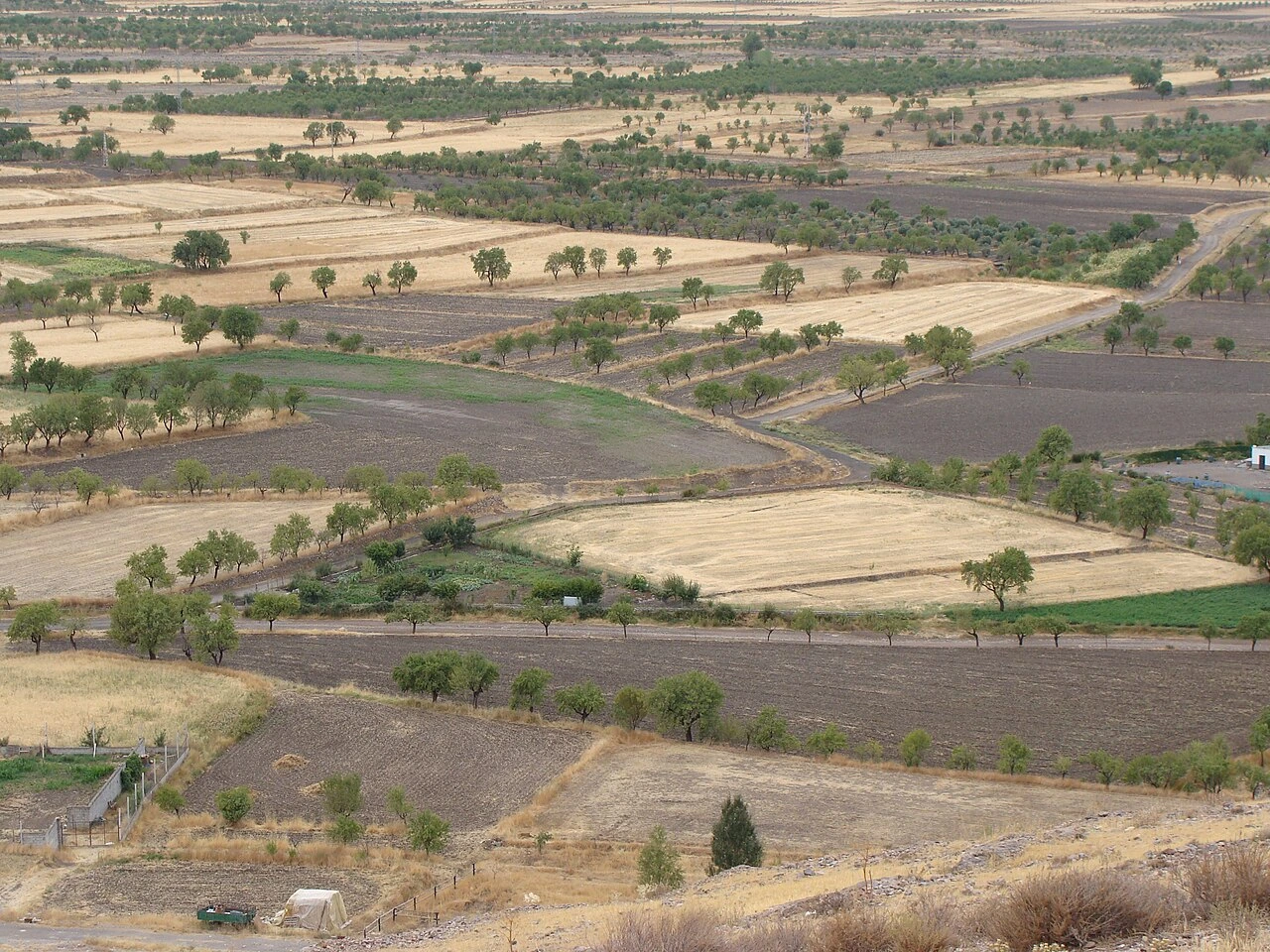
Where Do Crops Grow Best? Climate, Soil, Water by Crop
Learn where crops grow best by climate, soil, and water, match crops to regions, and check local frost, heat, and draina