
Ryots were reluctant to grow indigo primarily because it paid less than the crops it replaced, demanded more labour, and came with contracts that trapped them in debt. In colonial Bengal and Bihar, a ryot who signed an indigo contract received a cash advance from a European planter, was required to plant indigo on at least 25% of their land, and then sold the harvest back at a price the planter largely controlled. Since indigo consistently returned less per acre than rice and other food crops, and since the advance created a debt that could follow a family for generations, the math was straightforwardly bad for the cultivator.
Why Ryots Were Reluctant to Grow Indigo in Colonial India

Samuel Rourke
8 Jun 2026
Who were the ryots, and what does indigo have to do with them?
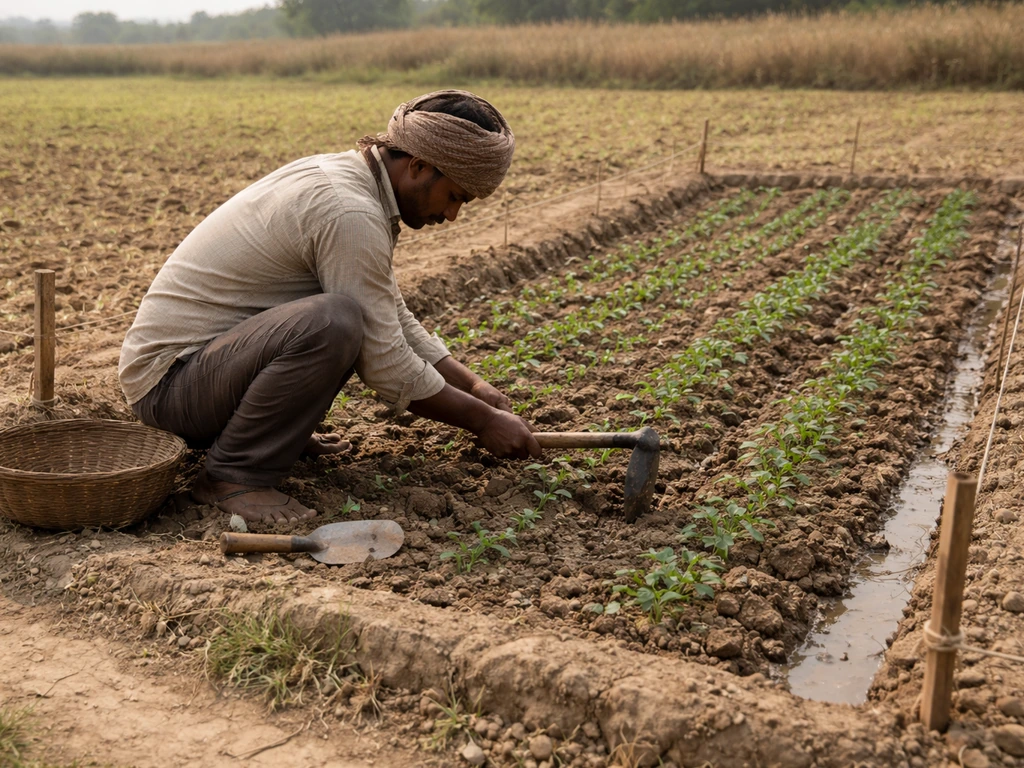
The word "ryot" (also spelled "raiyat") referred to the actual cultivating tenant, the person who physically worked the land and was liable for revenue assessment. This is distinct from a zamindar, who was a landholder who collected rent. In the Bengal and Bihar context that most people are asking about, ryots were peasant farmers who rented or held small parcels of agricultural land, often with multiple obligations stacked on top of them: revenue to the zamindar, and then, from the late 18th century onward, pressure from European indigo planters to devote part of their holdings to indigo cultivation.
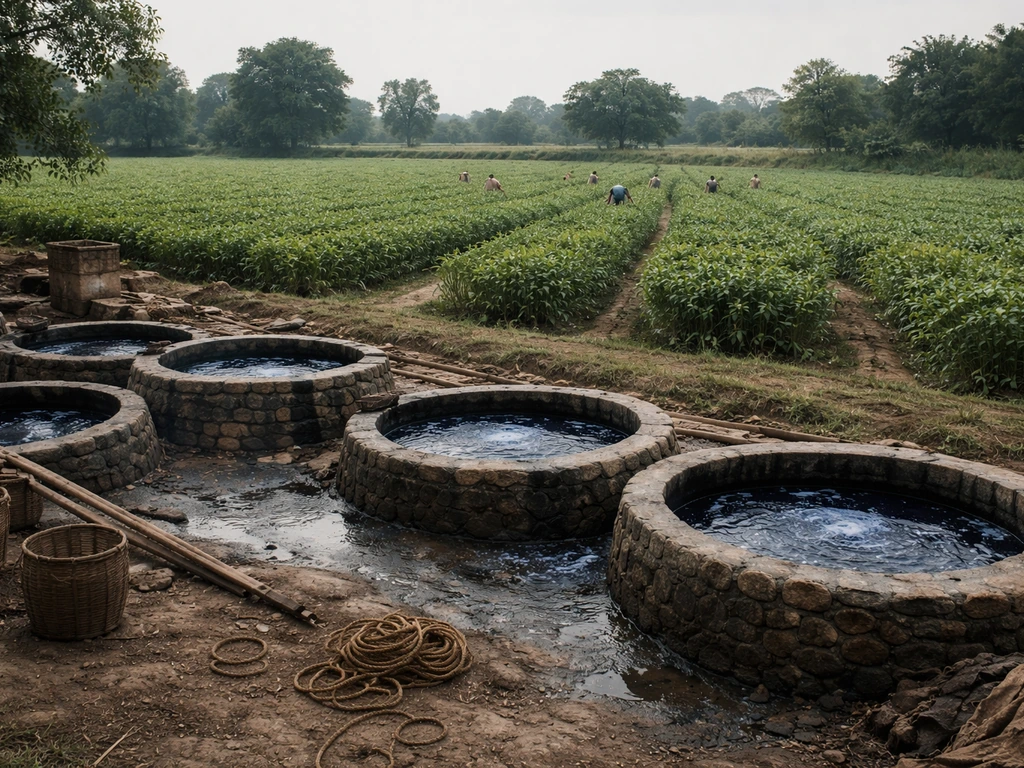
Indigo as a commercial crop in colonial India was largely driven by European planters who brought vat-processing techniques from the West Indies to Bengal in the late 1700s. Some historians also discuss how enslaved people were brought from Africa to work on plantation systems that inspired parts of the indigo processing business in the West Indies Indigo as a commercial crop in colonial India was largely driven by European planters. Planters leased land from zamindars and then brought ryots into the production chain, either by hiring wage labour directly (the "zerat" method, where the planter ran the cultivation himself) or by advancing money to ryots under contract and receiving the indigo harvest in return (the "ryoti" method). The ryoti arrangement was attractive to planters because it shifted cultivation costs and risks onto the farmer. For the ryot, it was almost always a bad deal.
The Indigo Revolt of 1859 to 1860 in Bengal is the historical flashpoint most students encounter. Ryots in Nadia district organized a collective refusal to grow indigo for British planters, a strike that spread across the region and eventually forced the British government to convene the Indigo Commission of 1860. The Commission collected depositions from ryots, planters, zamindars, missionaries, and government officials, and it remains one of the best documented cases of organized agrarian resistance in colonial history. The 1860 Indigo Commission record with depositions documented the indigo production chain, including indigo cultivation, contracts, profit and debt, and interactions between ryots and European evidence in Bengal blank" rel="noopener noreferrer">The Commission collected depositions from ryots, planters, zamindars, missionaries, and government officials. The quote that perhaps captures the mood best comes from Hadji Mulla, an indigo cultivator who testified before the Commission on June 5, 1860: "I would rather beg than sow indigo."
The economic case against indigo, from the ryot's perspective
The core financial problem was simple: indigo paid less than rice. Britannica is direct about this, noting that ryots were paid less for indigo than they could earn from growing rice or other crops. This was not a marginal difference. Rice was a food staple with strong local demand, and the price a cultivator could get for it on the open market reflected that demand. Indigo was an export dye crop whose price was set by the planter, not the market, at least from the ryot's perspective.
The advance system made this worse. A ryot who accepted cash from a planter before planting season was legally bound to deliver the indigo harvest at whatever price the contract specified. The Bengal Indigo Contracts Regulation of 1823 formalized this structure, allowing planters to hold a lien on the produce from a defined quantity of land. If the harvest was poor, the debt rolled forward. If the price set in the contract was below what the ryot could have earned elsewhere, there was no legal remedy. Contracts could also specify either a fixed price or a price pegged to some future market rate, which introduced settlement uncertainty at harvest time. Either way, the ryot bore the risk.
Middlemen added another layer of cost. Agents who collected contract revenues on behalf of planters or owners took a cut in the process, further eroding what the ryot actually received. The net return from indigo, after repaying the advance, accounting for middlemen, and absorbing any yield shortfall, was frequently below subsistence-level compensation for the land and labour involved.
There was also a generational debt trap. Once a ryot accepted an advance and the harvest was poor or the price settlement unfavorable, the outstanding debt carried forward. Contracts and obligations were passed down across generations, keeping peasant families locked into indigo cultivation long after the original agreement. According to multiple historical accounts, it was common for a farmer to remain in debt for his entire life before passing that obligation to his children.
Labour intensity and production problems
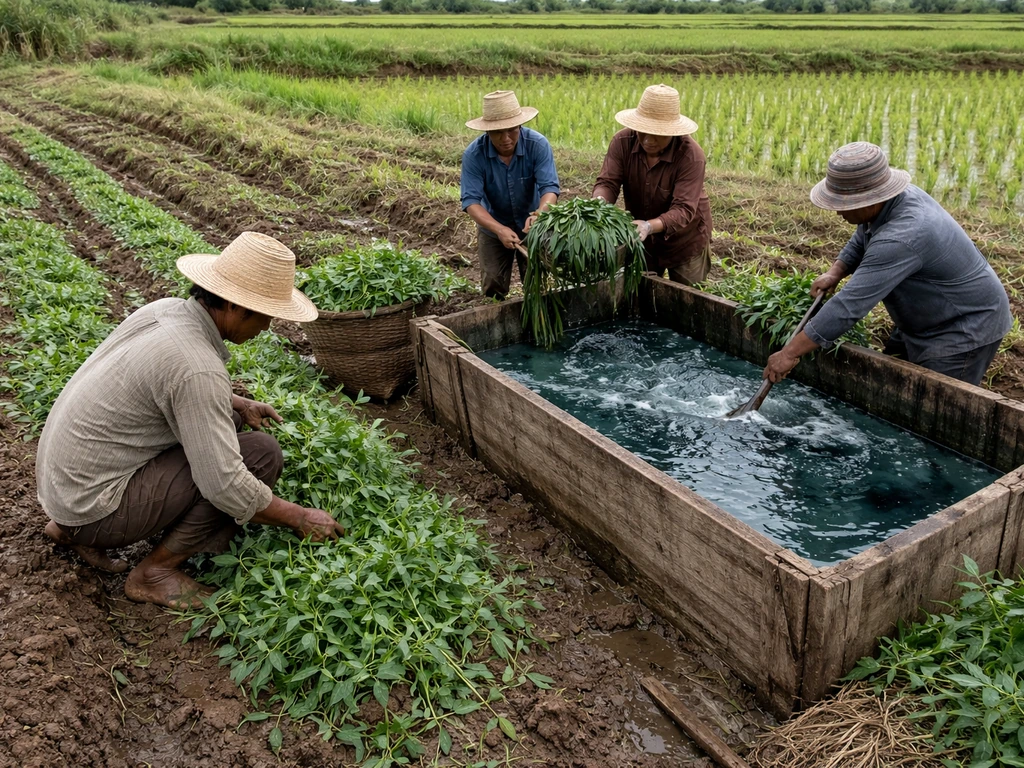
Indigo was demanding to grow and process. Unlike rice, which ryots knew intimately and could manage with family labour on a known seasonal schedule, indigo required intensive cultivation timed precisely to its growth cycle. The leaves had to be harvested at exactly the right moment and processed quickly in vats, which meant coordination between field work and the planter's factory. If a ryot was late, or if yields were lower than expected, the consequences fell on them, not the planter.
Indigo also depleted soil nutrients faster than food crops, which meant land devoted to indigo year after year degraded in productivity. Ryots who depended on their land for food as well as income could not afford to sacrifice soil quality for a crop that paid poorly anyway. The combination of high labour input, time-sensitive processing, soil exhaustion, and yield variability made indigo a genuinely risky crop from a production standpoint, not just a financial one.
The opportunity cost was also concrete: land assigned to indigo under contract could not be used for rice or other locally valuable food crops. World History Encyclopedia records that growers were generally not permitted to plant more lucrative food crops on indigo-designated land because those crops had strong local markets and could not be exported profitably by the planters. A ryot who needed rice to feed their family and sell locally was giving up that option on every acre the planter claimed for indigo.
Contracts, coercion, and who actually controlled the terms
The contract system was structured from the start to favour planters. Under the Bengal Indigo Contracts Regulation of 1823, a planter (the "capitalist" in the legal language) provided money or seed as an advance, and in return held a lien on the produce from a specified area of the ryot's land. The Bengal Indigo Contracts Act of 1836 went further, specifying when a ryot was considered legally "bound" by a contract and how earlier advances affected liability for breach. These laws gave planters legal tools to compel performance, while giving ryots limited recourse when the terms worked against them.
The 1830 Regulation did include a procedure for cultivators to petition courts if a proprietor or agent refused to settle accounts at the end of a contract, which shows there was at least nominal legal contest available. But in practice, ryots had little power to negotiate or refuse. Planters had capital, legal representation, and connections to colonial administration. Ryots had subsistence-level resources and a debt already outstanding.
Coercion was not subtle. Banglapedia records that planters openly coerced ryots to continue growing indigo even when cultivation was clearly non-remunerative for the farmers. When peasants refused en masse during the 1859 revolt, planters applied pressure because they had already committed capital to their processing facilities and needed a reliable supply. One clear example is blank" rel="noopener noreferrer">the Indigo Revolt of 1859 to 1860, where ryots organized refusal to cultivate indigo amid the coercive contract-and-price arrangements planters imposed. Violence was involved on both sides, with ryots organizing armed resistance and planters using their own enforcers. This was not a system that relied on voluntary participation.
The Tinkathia system in Champaran (Bihar) formalized this coercion further: ryots were required by custom and contract to devote a fixed portion of their land (roughly three of every twenty parts, or "teen katha" per bigha) to indigo for the planter. Gandhi's 1917 investigation of this system in Champaran is one of the more famous examples of how indigo coercion persisted well into the 20th century in parts of Bihar even as Bengal had largely moved on.
Legal, social, and cultural dimensions of the reluctance
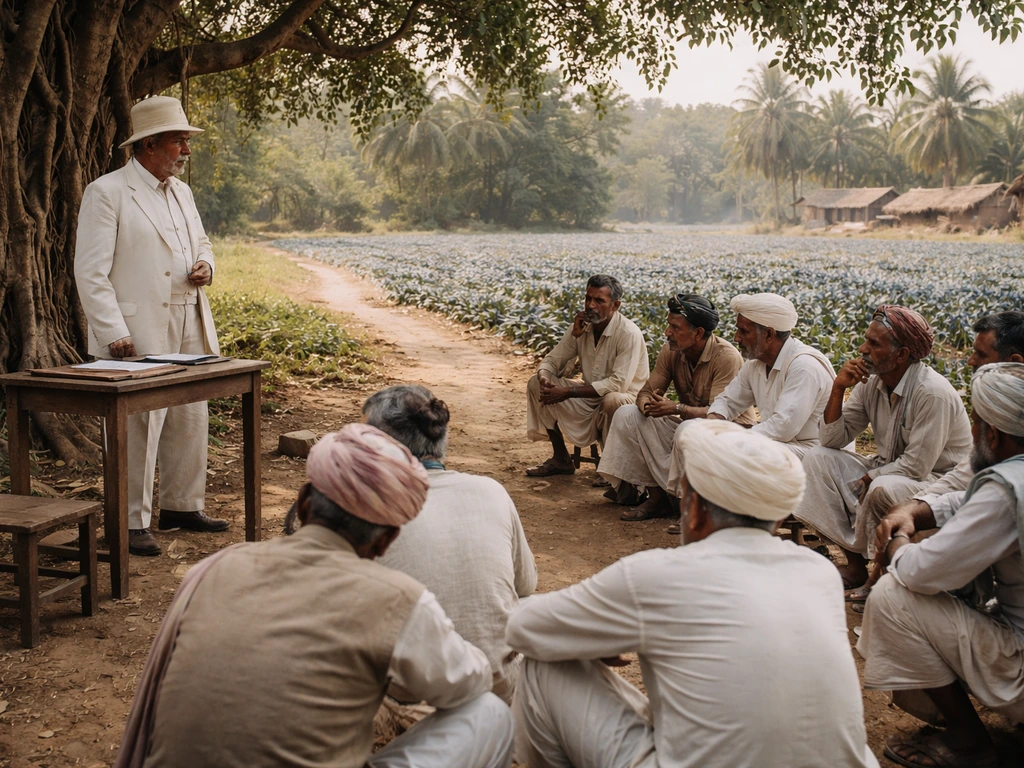
Indigo cultivation sat at the intersection of colonial law, local social hierarchy, and cultural identity in ways that compounded the purely economic objections. Zamindars, who were the landholders above the ryots in the agrarian hierarchy, sometimes resented the planters' growing power and control over land use in their districts. Britannica notes that many zamindars initially supported the ryots' refusal during the 1859 revolt, precisely because planter control undermined zamindar authority. This means the resistance was not just ryots versus planters; it was a broader social conflict over who controlled agricultural decisions in rural Bengal.
Culturally, forcing a cultivating family to grow a dye crop instead of rice touched something deeper than income calculations. Rice cultivation in Bengal was not just an economic activity; it was tied to food security, to ritual cycles, and to the identity of farming communities. Being compelled to grow a colonial export crop on land that could have fed your family carried a social stigma and a practical threat that purely monetary analysis misses.
Contemporary written accounts reflected these tensions. The Indigo Commission's collected depositions, taken between May and August 1860, preserve voices from ryots, zamindars, missionaries, and planters that show how widely the grievances were understood and documented even at the time. Colesworthy Grant's "Rural Life in Bengal," published around the same period, described indigo cultivation and manufacture in detail and was read by an English-language audience that included policymakers. The existence of this documentary record, and the fact that a playwright named Dinabandhu Mitra wrote "Nil Darpan" ("The Indigo Mirror") in 1858 to dramatize ryot suffering under indigo planters, shows that the reluctance of farmers was not a secret. It was a widely acknowledged, publicly debated fact of colonial agricultural life.
What ryots would have grown instead
The clearest alternative was rice. In Bengal especially, rice was the dominant food crop, had established local markets, and gave cultivators control over both food supply and sale price. A ryot freed from an indigo contract could plant their entire holding in rice and expect better returns with lower risk and less labour intensity per unit of income. After the 1860 revolt, the legal right of ryots to choose their own crops was formally restored, and indigo cultivation in Bengal collapsed rapidly. Planters shifted operations to Bihar, where coercive systems like Tinkathia still operated, but even there, indigo eventually lost ground to synthetic dyes after the 1890s.
Other food crops, oilseeds, and jute also offered alternatives depending on the region and soil. The point is that ryots understood crop options and opportunity costs clearly. Their reluctance to grow indigo was not ignorance of farming; it was a rational response to a system that consistently delivered worse outcomes than the crops they knew how to grow and could sell freely. In practice, colonial farmers often tried to prioritize the food crops and market staples they could grow for themselves rather than taking on indigo under contract, which raises the question of what did colonial farmers grow when they had the choice. The contrast with colonial farmers in other contexts is worth noting: in regions where cash crops aligned with farmer incentives and market access (like wheat in the Middle Colonies of North America), farmers embraced them. In the Middle Colonies, though, cash-crop cultivation could pay off because farmers had incentives and market access that aligned with their interests Middle Colonies cash crops. In Bengal, indigo never offered those incentives.
How to research this for a specific region or time period
If you are researching ryot reluctance for a specific district, decade, or exam question, here is how to focus your work efficiently.
- Identify the region and period first. Bengal (Nadia, Jessore, Murshidabad districts) and Bihar (Champaran) are the two main centres of documented indigo conflict. The 1859 to 1860 revolt is the most studied moment, but Champaran agitation continued until around 1917. Make sure you know which context your question is actually asking about.
- Go to primary sources for depositions and testimony. The Report of the Indigo Commission (1860) is digitized and contains direct testimony from ryots, planters, zamindars, and missionaries. This is the single most useful primary document for understanding what farmers said about their own situation.
- Check contemporary descriptive sources. Colesworthy Grant's "Rural Life in Bengal" (1860) describes the cultivation and manufacture chain in practical detail. Dinabandhu Mitra's "Nil Darpan" is the literary record of how indigo coercion was publicly understood.
- Look at the legal texts. The Bengal Indigo Contracts Regulation (1823), the 1830 Regulation, and the Contracts Act (1836) are all available through IndiaCode and related repositories. Reading the actual contract structure shows you exactly how the advance-and-lien system worked and where the power imbalance was embedded in law.
- Cross-check with secondary scholarship. SAGE's journal of agrarian history has articles specifically on indigo plantation and agrarian relations in Champaran. Cambridge Core has peer-reviewed work on plantation science and the indigo industry's decline. Banglapedia's entries on the Indigo Resistance Movement are well-sourced for Bengal-specific detail.
- For modern agricultural decision-making lessons, map the historical case onto contemporary contract farming frameworks. The same dynamics that made indigo dangerous for ryots, fixed-price contracts with advance payments, restricted crop choices, debt rollover, and asymmetric risk, appear in some modern contract farming arrangements. Evaluating any contract farming scheme against these historical red flags is practical, useful work.
If you are a student preparing for an exam, the key points to anchor your answer are: lower returns than rice, advance-based debt traps, legally enforced contracts under colonial law, planter coercion, and the collective refusal of 1859 to 1860 as evidence of how widespread the grievance was. If you are a researcher or historian, the Indigo Commission depositions and the legal regulation texts will give you the documentary foundation you need. And if you are thinking about modern crop-risk decisions, the ryot case is an unusually well-documented historical example of what happens when contract terms systematically favour the buyer over the grower.
FAQ
Was indigo reluctance only about low prices, or were there other pressures too?
Low per-acre returns were the core issue, but reluctance also came from the contract structure (advance creates binding debt), extra labor, and the planter controlling key settlement terms. Even if a ryot wanted to hedge by planting more food crops, the contract often restricted what could be grown on indigo-designated land.
Why did the advance and debt system matter so much to ryots, beyond the immediate season?
The advance turned an unfavorable outcome into a long-term liability, because poor yields or unfavorable price settlement could roll the debt forward. That meant a ryot who could not repay in one year could be constrained across multiple years and sometimes across generations.
Could ryots refuse the contract after the planter gave the advance?
In theory there were legal procedures, but in practice refusal or negotiation was difficult because enforcement power and legal resources largely favored planters. Ryots also lacked the capital to buy out the advance or absorb the risk of not delivering the harvest under the terms.
Did ryots have any way to sell indigo harvest independently to get a better price?
Usually not. The model described in Bengal involved planter control through delivery obligations and contractual pricing, with a lien on the produce. That meant the ryot’s main market choice was limited compared with food crops sold locally.
Was indigo only risky because it required more labor, or was there an operational timing problem too?
There was a timing problem, not just more labor. Indigo leaves had to be harvested at precise stages and the crop had to be processed quickly in vats, so delays or lower yields harmed the ryot’s outcome while processing coordination depended heavily on the planter’s setup.
How did soil exhaustion increase reluctance in addition to financial loss?
Repeated indigo cultivation could deplete nutrients faster than staple crops, reducing future productivity on the same land. For ryots who needed land to feed families and earn revenue, the long-run drop in soil fertility made the low-return contract even harder to justify.
Were indigo contract terms the same everywhere in Bengal and Bihar?
They varied by region and local arrangements, but the recurring pattern was planter-backed leverage through advances, delivery obligations, and restricted crop choice. Bihar’s later persistence through systems like Tinkathia shows how coercive practices could continue even when Bengal’s indigo system weakened.
Did zamindars support ryots because they were against European planters, or for farmers’ welfare?
Support was often tied to power competition. Some zamindars backed the refusal because planter control undermined zamindar authority and land-use influence, even if the zamindars were not necessarily acting as protective advocates for ryot welfare in a modern sense.
If rice was the clearest alternative, why didn’t all ryots switch immediately?
Switching depended on legal rights, local enforcement, and practical land obligations. In periods and places where contracts or custom still constrained planting decisions, ryots could face pressure to maintain a portion of land under indigo, delaying full substitution with rice or other food crops.
What does the Indigo Revolt of 1859 to 1860 show about why ryots were reluctant?
It shows the reluctance was collective and strategic, not individual hesitation. A widespread refusal indicates many ryots perceived the contract and return structure as consistently disadvantageous, and that organization was necessary to counter planter coercion and administrative support.
Next Articles
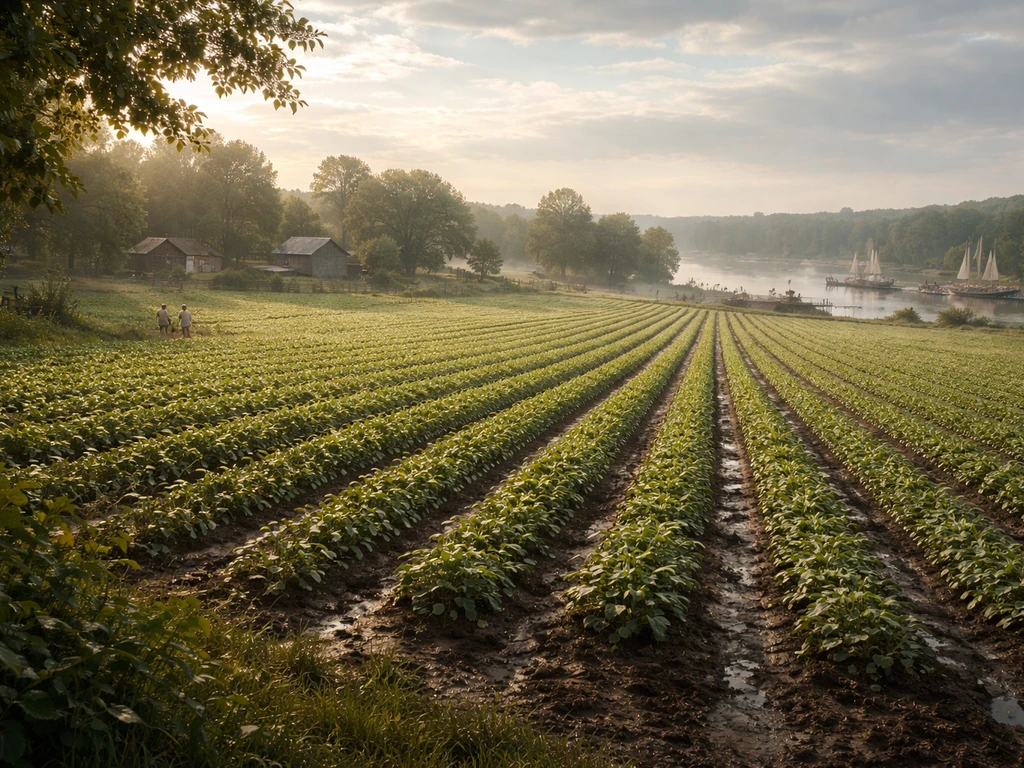
Middle Colony farmers grew cash crops because fertile soil and ports
Fertile soil, steady rainfall and mild temps, and ports for shipping let Middle Colony farmers profitably grow cash crop

What Crops Did Slaves Grow on Plantations by Region
See which crops enslaved people grew by region: sugar, cotton, rice, tobacco, plus processing tasks and how to verify lo
Why New England Farmers Couldn’t Grow Cash Crops Reliably
New England farmers struggled with warm-season cash crops due to frost, short seasons, poor soils, rain, and distant mar