
The cheapest crops to grow, across almost every measure, are starchy staples: dry beans, potatoes, sweet potatoes, maize (field corn), and cassava. These crops produce the most calories per acre, require the least specialized equipment, and carry the lowest startup costs of any food group. Which one wins for your situation depends on your climate, your scale, and exactly what you mean by "cheap", because cheapest to plant, cheapest to feed a family from, and cheapest per acre of input cost are three genuinely different questions.
What Is the Cheapest Crop to Grow: Guide, Picks & Regions

Samuel Rourke
13 Jul 2026
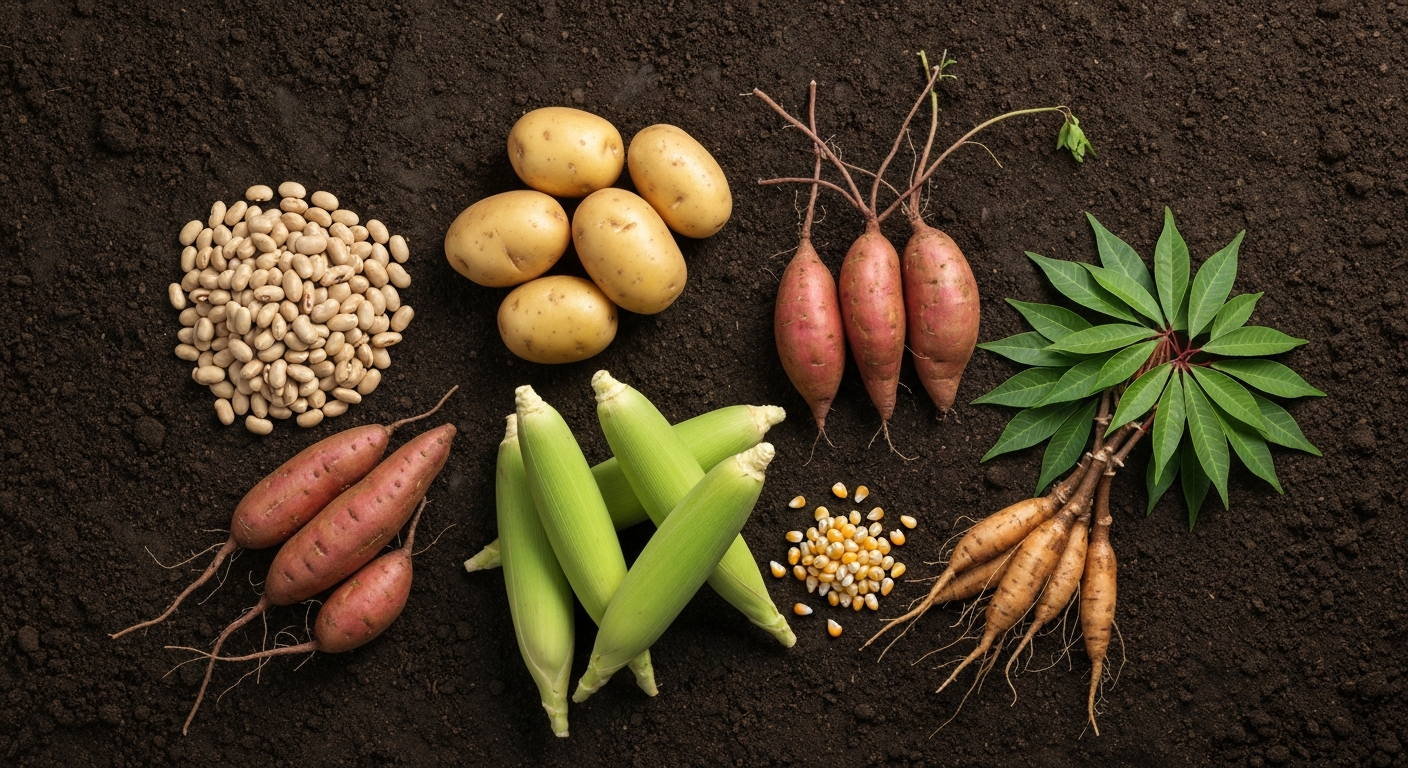
What "cheapest" actually means, and who this guide is for
If you're a student trying to understand global food systems, a backyard gardener on a tight budget, a homesteader planning a first-season plot, or a small-scale farmer looking at enterprise budgets, the word "cheap" points at very different numbers. A backyard gardener worries about seed money and water bills. A market farmer worries about input cost per acre versus sale price. A food-security planner worries about how many calories a fixed land area can produce for the least money. All of those are valid questions, and this guide addresses all of them, with the understanding that the answer shifts depending on your region, your climate, and your scale.
This is also a topic that connects directly to history. The crops that built ancient civilizations, wheat in Mesopotamia, maize in Mesoamerica, rice in East and Southeast Asia, cassava across tropical Africa, were adopted precisely because they were cheap to grow relative to the calories they returned. Understanding why those crops were economical then helps explain why they remain economical in those same regions today.
The five cost metrics you need to understand
Farm economists use precise definitions, and it pays to know them before comparing crops. Mixing up variable cost with total cost, or startup cost with annual operating cost, leads to bad decisions fast.
| Metric | Definition | Typical Unit | Why It Matters |
|---|---|---|---|
| Startup cost | Capital outlay required before first harvest: seed, soil amendments, basic tools, irrigation hardware | USD (one-time) | Determines who can afford to start growing at all |
| Cost per acre | Total variable + fixed costs allocated to one acre in a given season | USD/acre/year | Standard comparison unit in extension enterprise budgets |
| Cost per calorie | Total production cost divided by edible calories produced | USD per 1,000 kcal | Best measure for food-security and subsistence planning |
| Labor intensity | Human hours required to plant, tend, and harvest | Hours/acre or hours/ton | Critical for solo gardeners and small homesteads without hired help |
| Risk-adjusted cost | Expected cost accounting for yield variability, pest pressure, post-harvest loss, and price volatility | USD/acre (expected value) | Captures the true cost when things go wrong — important for staple crops with storage issues |
Following FAO and USDA ERS methodology, variable costs are expenses that change with output, seed, fertilizer, pesticides, hired labor. Fixed costs don't change with short-run output, depreciation on equipment, land opportunity cost, insurance. Total cost equals variable plus fixed. Most backyard and small-farm comparisons are really comparing variable costs only, which understates true economic cost but is a practical starting point when you own land and basic tools already.
How to measure and compare costs, simple formulas
Extension enterprise budgets (the standard tool from state land-grant universities) use two core break-even formulas. Break-even price equals total cost per acre divided by expected yield. Break-even yield equals total cost per acre divided by expected price. These two equations let you quickly stress-test any crop: if your total cost per acre for dry beans is $400 and you expect 1,800 lbs per acre, your break-even price is about $0.22/lb. If the going price is $0.30/lb, you have a reasonable margin.
For cost-per-calorie comparisons, the math is straightforward. Multiply your yield in pounds per acre by the calorie density of the crop (from USDA FoodData Central), then divide your total cost per acre by that calorie total. Maize grain runs about 1,640 kcal per pound (360–370 kcal per 100g). A modest dryland corn yield of 100 bushels per acre (5,600 lbs of grain) produces roughly 9.2 million kcal per acre. At a total variable cost of $400/acre, that works out to about $0.04 per 1,000 kcal, extraordinarily cheap by any food standard. Cassava is roughly 160 kcal per 100g raw; at a typical smallholder yield of 7–9 tonnes of fresh root per hectare, a hectare of cassava delivers roughly 11–15 million kcal, making it similarly competitive on a cost-per-calorie basis in tropical regions.
One important adjustment: always factor in post-harvest loss before finalizing a cost-per-calorie figure. FAO documents that roots and tubers, cassava, sweet potato, Irish potato, can lose 5% to 40% of production depending on storage systems. A 30% post-harvest loss on cassava (FAO's commonly cited estimate for low-input tropical systems) effectively raises your cost per calorie by 43% if you're relying on informal storage. That alone can shift a crop from "cheapest" to "risky" depending on your infrastructure.
Crop families that structurally lower costs
Certain plant families and growth habits are inherently low-cost because of their biology, not just their market price. Understanding this helps you pick candidates that will stay cheap across different inputs and years.
Legumes
Dry beans, cowpeas, lentils, and field peas fix atmospheric nitrogen, which directly reduces or eliminates one of the biggest variable-cost line items in any crop budget: nitrogen fertilizer. In 2022–2023, fertilizer prices spiked sharply (tracked by the World Bank fertilizer price index), and legume growers were insulated from much of that volatility. Cowpeas in particular are drought-tolerant, low-input, and have been a subsistence staple across sub-Saharan Africa and the southern United States for centuries. Dry beans are one of the most economical crops a North American small farmer can plant: seed costs are modest, they need minimal chemical inputs, and they store well without refrigeration.
Grains and cereals
Maize, wheat, sorghum, millet, and oats have the lowest cost-per-calorie of any crop group at commercial scale. They've been the economic backbone of agriculture from Mesopotamian wheat fields 10,000 years ago to today's U.S. Corn Belt. At scale, grains benefit enormously from machinery: a combine can harvest dozens of acres per day, dropping labor-hours per bushel to fractions of a minute. At small scale (under 2 acres), that machinery advantage disappears unless you can custom-hire equipment, so small gardeners often find grains less practical than root crops or legumes.
Root crops and tubers
Potatoes, sweet potatoes, cassava, and turnips produce very high calorie yields per acre with relatively modest inputs. Sweet potatoes are notable for their tolerance of poor soils, warm climates, and minimal fertilizer, they were a critical survival crop in the American South and remain a subsistence staple across much of sub-Saharan Africa and East Asia. Cassava is arguably the most cost-efficient calorie crop in tropical regions: it tolerates drought, poor soils, and delayed harvest (it can stay in the ground for months without immediate processing needs). Commercial temperate potato systems can exceed 40 tonnes per hectare, but even low-input smallholder systems routinely return high calorie yields per dollar spent.
Leafy greens and fast-cycling vegetables
Kale, collards, Swiss chard, and lettuce have some of the lowest startup costs per plant of any crop, a packet of kale seed costs under $3 and can cover a large raised bed. They cycle fast (30–60 days to harvest), produce multiple cuts, and thrive in cool climates with minimal inputs. They are not low-cost per calorie, leafy greens are nutrient-dense but calorie-light, but they are extremely low-cost in terms of startup money and garden space, making them the right answer for a budget-constrained backyard gardener trying to reduce grocery bills.
Perennial staples
Asparagus, established fruit trees, Jerusalem artichokes, and perennial herbs have high startup costs (2–4 years before productive yield for tree fruits) but near-zero annual replanting costs once established. Over a 10-year horizon, a well-managed apple or pear orchard on suitable land can deliver a very low cost per pound of food. Jerusalem artichokes are exceptional: plant once, harvest for years, require almost no inputs, and produce high starch yields. They were used as a subsistence food across North America by Indigenous peoples and early European settlers for exactly this reason.
Top low-cost crop candidates by metric
Here are the leading candidates sorted by the metric that matters most. No single crop wins every category, but several names appear consistently across multiple metrics, which is the clearest signal that they're genuinely cheap to grow. For more on selecting crops by region, climate, and market fit, see our guide to the best agricultural crops to grow.
Lowest startup cost
- Dry beans: seed is cheap, widely available, and requires no treatment; plants need no transplanting
- Kale and collards: seed packets cost under $3, no transplant infrastructure needed, direct sow outdoors
- Zucchini/summer squash: 5–10 seeds produce a full-season harvest; needs minimal soil preparation
- Sunflowers: dual-use (food and oil), cheap seed, drought-tolerant, no specialized equipment
- Radishes and turnips: fastest-cycling food crops (25–35 days), seed costs are negligible
Lowest cost per calorie
- Maize (field corn): highest calorie density grain with lowest input cost per acre at commercial scale — roughly $0.03–$0.05 per 1,000 kcal at moderate yields
- Cassava: unmatched in tropical regions for calorie output per dollar of variable input; stores in-ground reducing need for capital storage
- Sweet potato: thrives in warm climates on poor soils with minimal fertilizer; delivers 500,000–800,000 kcal per acre on modest inputs
- Wheat: backbone of calorie economics in temperate regions; 40–60 bushels/acre at $180–$250/acre input cost in the U.S. Plains
- Potato: at commercial yields of 300+ cwt/acre, delivers more calories per acre than almost any other temperate crop
Lowest cost per acre (variable inputs)
- Cowpeas: near-zero fertilizer cost (N-fixing), minimal pesticide requirement, thrives in heat and drought
- Dry beans (non-irrigated): low chemical requirements, modest seed cost, gravity or rain-fed in suitable climates
- Winter wheat (Great Plains dryland): well-adapted to regional climate, minimal irrigation requirement, low input-cost per acre versus yield
- Sorghum: among the lowest-input grain crops in semi-arid regions; bred for drought tolerance and minimal fertilizer
Lowest labor intensity
- Field corn (at scale with machinery): once planting and harvest are mechanized, labor-hours per acre are extremely low
- Winter wheat: planted in fall, minimal spring intervention, combine-harvested — very low labor demand relative to yield
- Sorghum: similar to wheat in labor demand; tolerates late planting without major yield penalty
- Cassava: in tropical subsistence systems, cassava is planted with stem cuttings, essentially weed-suppresses itself at canopy closure, and is harvested by hand on a flexible schedule
Backyard and community gardens: lowest-budget choices
At the backyard scale, let's call it under 2,000 square feet, the cost calculus is almost entirely about seed and soil. You already own or can borrow the hand tools. You're not renting machinery. Your "labor" is often recreation or education, not a cash expense. That means the cheapest crops to grow in a backyard are the ones with the lowest seed cost, the highest yield per square foot, and the lowest need for purchased inputs like fertilizer and pesticide.
Kale, Swiss chard, and collard greens consistently win on this measure. A $2–3 seed packet plants a 20-foot row that yields cuttings for 4–6 months. Bush beans are nearly as economical and add nitrogen to your soil. Zucchini is almost embarrassingly productive, four plants in good soil and adequate water will produce more than most households can eat. For calorie production in a small space, sweet potatoes are the standout: plant slips (rooted cuttings from a single stored tuber) in a warm-climate garden and you can realistically harvest 50–100 lbs of food from a 100 square foot bed.
Radishes and turnips deserve mention as the cheapest insurance crop in any garden. They cost almost nothing, mature in 3–5 weeks, and fill gaps between slower crops. In a cool spring or fall, a 10-foot row of turnips seeded at $0.50 worth of seed will yield 10–15 lbs of food. Community gardens in urban areas, particularly in food-insecure neighborhoods, use exactly this combination: leafy greens for immediate nutrition, beans for protein and soil health, and a root crop like sweet potato or turnip for calorie bulk.
Small market farms and homesteads (1–5 acres): balancing cost and return
At 1–5 acres, the picture changes meaningfully. You're now thinking about whether you can afford seed at 1-acre quantities, whether you need to rent or own a tractor, and whether you're growing for sale or for subsistence. Labor-hours per acre become a real cost, not an incidental one. Extension enterprise budgets, published annually by state land-grant universities, are your best tool here. Nebraska's 2026 crop budgets, for example, use $27/hour for hired labor and apply ASABE machinery-cost formulas to derive per-acre equipment costs, giving you a realistic line-item picture of what each crop actually costs.
For a homestead of 1–3 acres focused on food production at the lowest total cost, the most reliable combination is: dry beans or cowpeas for protein and soil fertility, sweet potatoes or potatoes for calorie density, and winter squash for storage. See a guide on the best crops to grow on a small farm for crop lists and layouts tailored to 1–5 acre operations. This trio has essentially no irrigation requirement in well-watered climates, very low fertilizer demand (especially if you compost and rotate), and can be managed entirely with hand tools or a small walk-behind tractor. All three store well without refrigeration, which reduces post-harvest loss, a critical consideration at this scale.
For a small market farm at 3–5 acres where you need some revenue to cover costs, the cheapest crops to grow aren't necessarily the most profitable. Dry beans and field corn have very low production costs but also very low wholesale prices. You're often better served growing crops that are cheap to produce AND command a local premium, garlic, dry heirloom beans, and specialty squash can be grown at modest input cost while selling at farmers' market prices well above commodity rates. For options focused on market return rather than minimal cost, see resources on the best cash crops to grow. This is where cheapest to grow intersects with most profitable crops, a distinction worth keeping clear.
Planning a 5-acre operation: cost drivers and practical choices
Five acres is a meaningful threshold in small-farm planning. For tailored recommendations and layouts for a 10-acre operation, see best crop to grow on 10 acres (resource ID 2cf40f4b-d6d9-4fb1-8716-90866c1ef0eb). For specific crop recommendations and layouts for this scale, see our guide on the best crop to grow on 5 acres. It's large enough that hand tools alone become impractical for row crops, but small enough that a full-size tractor and combine are overkill. The most common cost drivers at this scale are: machinery access (own, rent, or custom-hire), irrigation infrastructure if your region requires it, and labor during planting and harvest windows.
On 5 acres, the lowest-cost crops to produce are those that fit a compact machinery system, a walk-behind two-wheel tractor or a small 25–40 HP utility tractor, and don't require intensive hand labor at harvest. Dry beans can be direct-seeded and harvested with modest equipment. Winter wheat on 5 acres requires a small combine or custom-hire arrangement, but input costs are very low: a dryland wheat budget in the Great Plains might run $150–$200 per acre in variable costs, and wheat stores exceptionally well, eliminating post-harvest loss concerns. Sweet corn and field corn are similarly mechanizable at this scale.
Irrigation is one of the biggest cost decisions at 5 acres. USDA and NRCS data show center-pivot installation can run from roughly $300/acre on large fields to over $1,500/acre on small fields, at 5 acres, a center pivot is rarely cost-effective, but a drip or overhead sprinkler system for a portion of the acreage is feasible. If your region is well-watered (eastern U.S., Pacific Northwest, much of Europe), forgo irrigation entirely and choose drought-tolerant crops: cowpeas, sorghum, dryland wheat, and dry beans all perform well without supplemental water in the right climate, keeping your fixed-cost baseline very low.
A practical 5-acre layout for minimum cost might allocate 2 acres to a dryland grain (wheat or field corn depending on climate), 1.5 acres to dry beans, 1 acre to sweet potatoes or potatoes, and 0.5 acres to a high-value specialty crop that offsets total operating costs. This diversification keeps your average cost per acre low while giving you calorie security, soil health benefits from the legume rotation, and at least one marketable product. Planning for this scale connects closely to understanding what crops thrive in your specific U.S. region or climate zone, a detail that changes the crop list significantly depending on whether you're in the Southeast, the Great Plains, or the Pacific Northwest.
How climate and region change the answer
The cheapest crop to grow is never a universal answer, it's always a regional one. The same basic principle (grow what your climate produces efficiently) explains both ancient and modern agricultural patterns.
| Region / Climate | Cheapest Staple Crops | Why They're Cheap Here |
|---|---|---|
| Tropical Africa (sub-Saharan) | Cassava, cowpeas, sorghum | Drought-tolerant, low-input, cassava stores in-ground; cowpeas fix N; sorghum needs no irrigation |
| Temperate Great Plains (U.S.) | Winter wheat, dryland corn, sorghum | Well-adapted to semi-arid climate, established commodity infrastructure, low input cost per acre |
| Southeastern U.S. | Sweet potatoes, cowpeas, field corn | Warm climate suits tubers and heat-loving legumes; long growing season enables multiple cycles |
| Pacific Northwest / Cool Temperate | Potatoes, dry beans, oats, kale | Cool moist climate ideal for tubers and leafy greens; minimal irrigation cost |
| South/Southeast Asia | Rice, sweet potato, cassava | Rice is the historical calorie backbone; sweet potato and cassava as low-input supplements |
| Mediterranean / Southwest U.S. | Dry beans, chickpeas, sorghum, winter wheat | Drought tolerance critical; legumes and dryland cereals match seasonal rainfall patterns |
| Mesoamerica (historical and modern) | Maize, squash, dry beans (Three Sisters) | Co-evolved with the climate; beans fix N for corn; squash suppresses weeds — all low-input together |
The historical pattern is worth noting explicitly. The crops that ancient civilizations adopted as dietary staples were almost always the cheapest to grow in their local conditions. Wheat and barley in Mesopotamia (modern Iraq) thrived in the alluvial plains of the Tigris and Euphrates with flood-recession agriculture, essentially free irrigation. Maize, beans, and squash (the Three Sisters) co-evolved in Mesoamerica as a mutually supportive polyculture that fixed nitrogen, suppressed weeds, and produced complementary nutrients with minimal inputs. Rice paddies in Asia leveraged monsoon rainfall and river systems to produce reliable calorie yields without expensive irrigation infrastructure. In each case, "cheapest to grow" was determined by what the climate and geography made easy.
Cheapest vs. most profitable: an important distinction
Cheapest to grow and most profitable to grow are often opposites. Field corn and dry beans are cheap to produce but sell at commodity prices with thin margins. Specialty herbs, heirloom tomatoes, and garlic can cost significantly more per acre to grow but return 5–20 times more revenue per acre at direct-market prices. If your goal is minimizing out-of-pocket cost and maximizing food security, grow the cheapest crops. If instead your goal is maximizing revenue, see our guide on what are the most profitable crops to grow for market-oriented small farms. If your goal is maximizing return on investment, the cheapest crops are usually the wrong answer at small scale.
Similarly, crops that are cheap to grow for subsistence are often the same ones used as survival or food-security crops: dry beans, sweet potatoes, potatoes, cassava, and sorghum show up consistently in emergency food planning and historical famine-response contexts. For a practical list and growing tips, see our guide to the best survival crops to grow. These crops are robust precisely because their low-input requirements mean they still produce when fertilizer, irrigation, or machinery is unavailable. That resilience is itself a form of cost reduction, a high-input crop that fails in a drought year costs more than a low-input crop that produces a partial harvest.
Decision checklist and simple cost-estimate template
Before committing to a crop, work through these questions in order. They map directly to the cost metrics above and will quickly narrow your field of candidates.
- What is your climate zone and average annual rainfall? (This eliminates most crops immediately — cassava won't work in Minnesota; winter wheat is inefficient in South Florida.)
- What is your scale: backyard, homestead acre, or 5+ acre farm? (Scale determines whether machinery cost matters and whether you can afford irrigation.)
- What is your primary cost concern: startup money, annual input cost, labor hours, or cost per calorie produced?
- Do you have irrigation, or are you dryland? (Irrigation adds $300–$1,500+/acre in fixed costs; dryland systems must match crops to natural rainfall.)
- Are you growing for subsistence, sale, or both? (Subsistence: optimize for cost per calorie. Sale: cheapest to grow may not be most profitable.)
- What are your storage options? (Roots and tubers with poor storage face 5–40% post-harvest loss; grains stored dry lose very little.)
- Estimate your variable cost per acre: add seed + fertilizer + labor + fuel/equipment rental. Divide by expected yield. Compare that break-even price to local market or subsistence value.
For a rough cost estimate, use this framework: total variable cost per acre divided by expected yield (in pounds or tonnes) gives you cost per unit of food. Multiply that by calorie density from USDA FoodData Central to get cost per 1,000 kcal. Adjust upward by your estimated post-harvest loss percentage. That single number, cost per 1,000 kcal after losses, is the most honest comparison across crop types, regions, and scales. A crop that looks cheap on a cost-per-acre basis but loses 35% to spoilage may be more expensive in real terms than a grain that costs more per acre but stores for two years with minimal loss.
A note on information sources and further reading
The most reliable cost data comes from three sources: USDA ERS commodity cost-and-returns reports (for U. ERS: Commodity costs and returns, documentation explains that ERS distinguishes cash, variable, and economic (total) costs and includes machinery capital recovery and opportunity costs of land in its commodity cost-and-returns methodology ERS: Commodity costs and returns — documentation. S. crops at scale), state extension enterprise budgets (for region-specific line-item costs, Nebraska, Missouri, and Kansas publish excellent annual crop budgets), and FAOSTAT for global yield baselines and cross-country comparisons. Calorie conversion should always use USDA FoodData Central values rather than rounded estimates, since even small differences in calorie density per 100g compound significantly when multiplied across a full acre's yield. For labor wage baselines, BLS reports a national median of roughly $17.30/hour for agricultural workers, but extension budgets often use locally adjusted rates, Nebraska's 2026 budgets, for example, used $27/hour, so pull your regional budget rather than applying a national average.
FAQ
How do we define “cheapest” when comparing crops?
“Cheapest” must be defined by the metric you care about. Common operational definitions used in farm accounting: variable costs (seed, fertilizer, pesticides, hired labor); fixed costs (machinery depreciation, interest, insurance, land opportunity cost); and total cost = variable + fixed. Useful crop‑cost metrics: startup cost (one‑time capital outlay, USD), cost per acre (USD/acre or USD/ha per season), cost per calorie (USD per 1,000 kcal), labor hours per acre (hours/acre), and cost per unit produced (USD/kg or USD/ton). Break‑even formulas used in extension budgets: break‑even price = total cost per acre ÷ expected yield; break‑even yield = total cost per acre ÷ expected price. Choose the metric that matches your goal (minimize cash outlay, maximize calories per dollar, or minimize hired‑labor demand).
Which crop families usually give the lowest cost per calorie?
Starchy staples (cereals, roots and tubers) typically have the lowest cost per calorie because they produce many calories per hectare and have inexpensive seed inputs. Examples: maize (corn) grain, wheat, rice, cassava, potato, sweet potato, and millet/sorghum in semi‑arid zones. Published cross‑country retail price studies and food‑composition/yield conversions consistently show starchy staples minimize USD per 1,000 kcal compared with fruits, vegetables and animal products.
What is a short list of specific low‑cost crop candidates and why are they low cost?
Candidates and why: - Cassava: cheap cuttings, low fertilizer needs in some systems, extremely high calories per hectare in tropical low‑input conditions. - Potato: very high yields per ha in temperate systems; low seed cost relative to output where seed systems exist; high calories per ha. - Maize (grain): widely adapted, high yield potential, mechanization lowers labor cost on larger fields. - Wheat/rice: staple cereals with scalable mechanization and existing markets. - Sweet potato: low seed cost (vine slips), good calorie yield, flexible harvesting. - Sorghum/millet: low input and drought tolerant in semi‑arid zones, low fertilizer/labor. These are low cost because of high yield per area, low seed cost per output, and ability to grow with modest inputs in appropriate climates.
How do startup and equipment costs change which crop is cheapest at different scales?
Scale matters: backyard/urban gardeners: cheapest crops minimize startup capital and household labor—e.g., potatoes, sweet potatoes, beans, leafy greens from saved seed or cuttings, and fast‑maturing root crops. Small diversified farms (1/4–2 acres): hand tools, small tillers, and low‑cost row crops (maize, beans, squash, potatoes). Small commercial farms (5–10 acres): mechanization amortization becomes important; crops that respond well to simple machinery (maize, wheat, potatoes, large‑scale vegetables with tractor attachments) will lower per‑acre labor cost. Larger scale favors crops with farm machinery economies and established markets (corn, wheat, rice). Include irrigation capital for irrigated crops — it can raise startup per‑acre costs dramatically.
What are recommended cheapest crops by scale (backyard, 1 acre, 5 acres, 10 acres)?
Backyard (≤0.1 acre): potatoes, sweet potatoes, beans, leafy greens, radishes — low startup and fast returns. 1 acre: mixed staples—maize with legumes, potatoes, sweet potato, or sorghum/millet in dry areas. 5 acres: maize, wheat or potato (mechanizable operations reduce labor cost); include rotation with legumes to lower fertilizer cost. 10 acres: fully mechanized cereals (corn, wheat, rice) or high‑yield potato operations where market access exists. Always match crop to climate, soil and labor availability; use local extension enterprise budgets for precise per‑acre estimates.
How should I compare cost per calorie across crops?
Steps: 1) Get typical yield (t/ha or t/acre) for your region (use FAOSTAT or local extension). 2) Convert yield to edible weight (account for inedible fraction and post‑harvest losses). 3) Multiply edible weight by calorie density (kcal/100 g) from a food composition database (e.g., USDA FoodData Central) to get kcal/ha. 4) Divide your total cost (USD/ha) by total kcal/ha to get USD per kcal, then scale to USD per 1,000 kcal. Include realistic post‑harvest loss assumptions (roots/tubers can have high losses) because they raise effective cost per kcal.
Next Articles
Best Agricultural Crops to Grow: Pick Right for Your Climate
Choose best agricultural crops for your climate with crop shortlist, grow-by-step plan, and rotation for soil health.
Best Cash Crops to Grow: Pick by Zone, Soil, and Market Demand
Best cash crops by zone, soil, and demand. Learn how to choose, test, and estimate profits for your farm.
Best Survival Crops to Grow: Regional Picks and Steps
Learn best survival crops to grow by region with climate-fit picks, why they thrive, and an immediate planting plan.