
The best crops to grow on a small farm are high-value specialty crops like salad greens, herbs, strawberries, garlic, and cut flowers, chosen to match your specific climate, soil, and nearest market. For a concise ranked list of the best agricultural crops to grow, see the guide on best agricultural crops to grow. On 5 to 10 acres, a focused mix of two or three intensively managed specialty crops almost always outperforms trying to compete with commodity growers on corn, soybeans, or wheat. This guide walks you through exactly how to make that match, with region-specific examples, realistic per-acre return ranges, and sample crop plans you can actually use.
Best Crops to Grow on Small Farm: Region-Based 5- & 10-Acre Plans

Samuel Rourke
23 Jul 2026
How to use this guide
This article is organized so you can read it cover to cover or jump directly to the section most relevant to your situation. If you are still deciding whether to grow for profit, food security, or both, start with the key decisions section and the profitability framework before looking at specific crops. If you already know your goals and climate, skip ahead to the high-value crop examples or the size-specific farm plans. Throughout, I connect crop choices to the regions and climates where they perform best, which is the core logic behind how this site is organized. Wherever relevant, I also note how certain crops have deep roots in specific geographies because understanding why a crop thrives somewhere is often the most practical piece of information a small farmer can have.
Key decisions before you choose a single crop
Five factors shape every good small-farm crop decision: available land and its soil quality, your climate and frost window, your market access, your available labor, and your starting capital. None of these works in isolation.
Land and soil
Before anything else, get a soil test. The USDA NRCS Web Soil Survey (using SSURGO data) lets you pull a detailed soil profile for any U.S. field, showing texture, drainage class, depth to restrictive layer, and organic matter. Shallow, rocky soils favor perennial herbs or garlic over root vegetables. Well-drained sandy loam is ideal for strawberries and salad greens. Heavy clay suits brassicas and some grains but will rot garlic bulbs. Matching the crop to the soil eliminates a major cost and risk right from the start.
Climate and frost dates
Your growing season length, defined by the window between your last spring frost and first fall frost, controls which crops are even feasible without season extension. NOAA's climatological freeze-date maps and the USDA Plant Hardiness Zone Map (2023 edition) are the two tools I use most. A grower in coastal California or Georgia might have a 270-day frost-free window; one in Minnesota or northern Vermont might have 120 days. That gap alone explains why California dominates U.S. strawberry and cut-flower production while New England leans toward hardy greens, root crops, and cold-tolerant berries. If your frost window is short, a USDA NRCS cost-share high tunnel through EQIP can extend your season by six to ten weeks and open the door to crops that would otherwise be impractical. See High Tunnel Initiative, NRCS (example state page) for state-specific EQIP cost‑share details, technical definitions, eligibility, and payment caps High Tunnel Initiative — NRCS (example state page).
Market access
Your crop list should be shaped by where you can sell. A farmers market within 30 miles justifies growing premium herbs, specialty tomatoes, and cut flowers that command retail prices. A CSA model works best when you can build a weekly box from at least eight to twelve crops across the season. Wholesale to restaurants or grocery stores requires volume consistency and food safety compliance under FDA's Produce Safety Rule. If you are more than an hour from a significant population center, lower-input crops sold through farm stands or online direct channels may be more realistic than highly perishable specialty items.
Labor and capital
High-value crops are usually high-labor crops. Salad mix can return $10,000 to $20,000 per acre but requires harvesting multiple times per week during the season. Garlic, by contrast, has concentrated labor at planting in fall and harvest in early summer, with low inputs in between. Be honest about how many hours you or your household can put in, and whether you have cash to cover seeds, amendments, and equipment before the first sale. SARE's enterprise budget worksheets and ATTRA's direct-marketing guides both provide structured templates for working through startup costs before you commit.
A practical profitability framework: how to evaluate any crop
Profitability on a small farm is not just gross revenue per acre. I use five metrics together to compare crops honestly.
| Metric | What it measures | Why it matters on small acreage |
|---|---|---|
| Gross revenue per acre | Yield (units/acre) × selling price | Sets the ceiling on what a crop can earn |
| Variable cost per acre | Seeds, inputs, labor, packaging | The expenses that scale directly with production |
| Gross margin | Revenue minus variable costs | The real measure of per-crop profitability |
| Labor hours per acre | Total hand and machine hours | Small farms often have fixed family labor; this reveals true cost |
| Time to first harvest | Days from planting to first sale | Crops with long cycles tie up land and cash longer |
| Risk profile | Price volatility, pest pressure, perishability | High-margin crops often carry higher loss potential |
For any crop you are considering, look up a land-grant university extension enterprise budget for your state or the nearest comparable region. University of Georgia, NC State, Penn State, and most other land-grant schools publish these for free. They will give you a realistic cost-of-production baseline specific to your climate and input costs, which is far more useful than generic internet figures. USDA NASS Quick Stats and AMS Market News provide corresponding yield-per-acre averages and seasonal wholesale price ranges so you can build a simple gross-margin estimate before spending a dollar.
Commodity, specialty, and cash crops: what the terms actually mean
These three terms get mixed together constantly, so it is worth being precise about each one before you decide which category suits your farm.
Commodity crops
Commodity crops are standardized, interchangeable goods traded at market-set prices: corn, soybeans, wheat, cotton, and rice are the main U.S. examples. They are grown at massive scale because the economics only work when you spread fixed machinery and land costs across hundreds or thousands of acres. A small farmer trying to compete on commodity corn at $4 to $5 per bushel will almost always lose. The historical and geographic context here matters: the Corn Belt, Great Plains wheat country, and Mississippi Delta cotton regions developed around commodity agriculture because their flat, fertile land and climate made large-scale mechanization viable. Those same conditions are rarely what a 5- or 10-acre operator has.
Specialty crops
Specialty crops, as defined by USDA, are fruits, vegetables, tree nuts, dried fruits, nursery crops, and floriculture. They are not produced under price-support programs and typically sell at prices set by local supply and demand rather than global commodity markets. This is where small farms compete effectively. A single well-managed acre of specialty vegetables can gross $15,000 to $30,000 at direct-market prices, which no commodity crop approaches per acre.
Cash crops
Cash crop is a broader, older term meaning any crop grown primarily for sale rather than for the farmer's own consumption. Historically, tobacco in the colonial Southeast, cotton across the antebellum South, and indigo along the Carolina coast were cash crops that defined regional agricultural identities. Today the term is used loosely to mean any crop a farmer grows for income. On a small farm, your best cash crops are almost always specialty crops: the ones that let you capture retail or near-retail prices.
When to choose each
- Choose specialty crops when you have direct market access (farmers market, CSA, restaurant accounts, online sales) and can manage higher labor.
- Consider small-scale commodity crops like dry beans or grain corn only if you have equipment, storage, and a local buyer with favorable pricing, or if you are growing them as part of a rotation to reduce input costs.
- Use the term cash crops to mean whatever specialty or direct-marketed crops generate your primary farm income.
Why high-value crops earn more on small acreage
The economics are straightforward: when you only have a few acres, the price per unit matters far more than yield per acre. A commodity grower needs volume to profit; a small specialty grower needs price. Crops that earn more per unit do so for predictable reasons: they are perishable (short shelf life forces buyers to source locally), they require skilled production (fewer growers are willing to do the work), they are sold fresh and direct (cutting out wholesale margin), or they fill a niche with limited local supply. Mushrooms, cut flowers, and microgreens hit all four of these criteria simultaneously, which is why they appear on nearly every high-value small-farm list. Garlic and specialty herbs occupy a slightly different niche: lower perishability, storage-friendly, and commanding 5 to 10 times the per-pound wholesale price of commodity equivalents.
High-value crop examples for small farms
Salad greens and mesclun mix
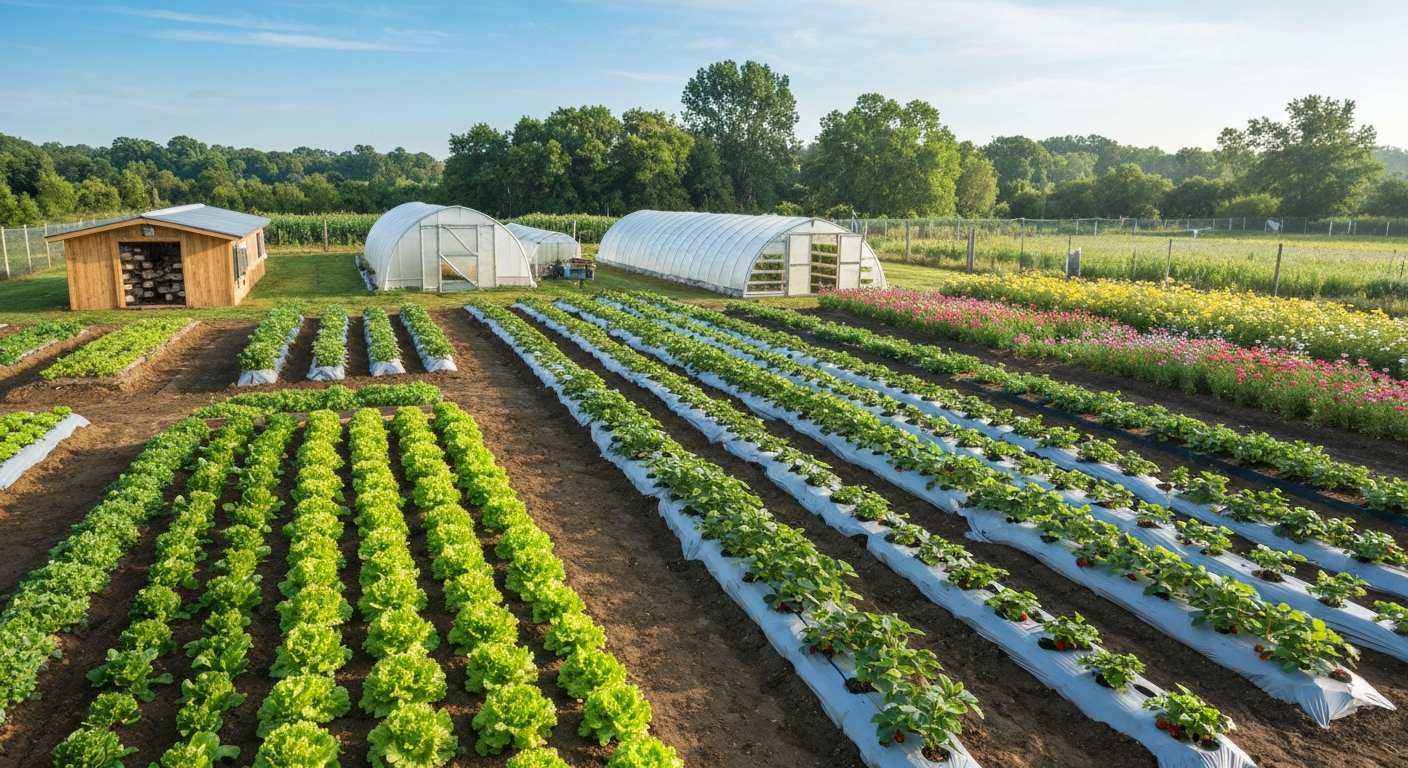
Salad greens are one of the fastest cash-flow crops a small farm can grow. For a broader comparison of returns across crops and to answer what are the most profitable crops to grow, see the profitability overview in this guide. Succession-planted every two weeks, a quarter-acre of cut-and-come-again lettuce mix can yield three to five harvests per planting with gross returns of $8,000 to $15,000 per acre per cycle at direct-market prices of $6 to $10 per pound. They prefer cool temperatures, making them well-suited to spring and fall production in most of the continental U.S. and year-round in coastal Pacific climates. High tunnel production extends the saleable window into winter in the Northeast and Midwest.
Herbs (culinary and medicinal)
Basil, cilantro, and chives turn over quickly and command $2 to $4 per bunch at farmers markets, while perennial herbs like thyme, rosemary, and oregano establish once and produce for years with minimal inputs. Garlic deserves special mention: hardneck varieties planted in October and harvested in late June or early July can return $8 to $12 per pound retail, and a single acre planted at around 1,500 pounds of seed stock can yield 8,000 to 10,000 pounds at harvest. The Pacific Northwest, upper Midwest, and Northeast are historically strong garlic regions because the cold winters garlic needs for bulb development are reliably available.
Strawberries
Plasticulture strawberries grown on raised beds with drip irrigation are a proven high-return model across the Southeast, Mid-Atlantic, and parts of the Pacific Northwest. NC State extension budgets put gross revenue for matted-row strawberries at $10,000 to $18,000 per acre depending on variety and marketing channel. The labor is intensive at planting and harvest but relatively concentrated. Day-neutral varieties extend the season in cooler climates. Pick-your-own operations layer agritourism income on top of crop income.
Mushrooms
Specialty mushrooms (oyster, shiitake, lion's mane) are unique because they grow indoors or in shaded outdoor settings, which means they are not land-constrained in the same way as field crops. A 1,000-square-foot production space can generate $20,000 to $50,000 annually at restaurant and farmers market prices of $8 to $14 per pound. They require modest startup capital for spawn and substrate, high attention to humidity and contamination control, and consistent labor. Because they are not weather-dependent, they reduce the seasonal income variability that affects most other crops.
Cut flowers
Cut flowers are among the highest-grossing crops per square foot available to small farms. Sunflowers, zinnias, dahlias, lisianthus, and specialty stems like celosias and anemones can return $25,000 to $50,000 per acre at direct retail prices. The U.S. imports roughly 80 percent of its cut flowers, primarily from Colombia and Ecuador, which means locally grown flowers are a genuine market differentiator at farmers markets and for florist accounts. Production is labor-intensive and requires post-harvest temperature management (the UC Davis Postharvest Technology Center notes temperature control is the single most important factor in reducing post-harvest losses), but the per-stem margins justify the investment.
Tree fruit and berries
Apples, peaches, pears, blueberries, raspberries, and blackberries require a multi-year establishment phase (two to five years before meaningful harvest), but once producing they deliver strong annual returns with relatively stable demand. Blueberries in the Southeast and Pacific Northwest, apples in the Northeast and Great Lakes region, and peaches across the Mid-Atlantic and Carolinas are regional anchors because the combination of chill hours, soil acidity preferences, and market density favor those geographies. At pick-your-own prices, blueberries can return $6,000 to $12,000 per acre. The tradeoff is the upfront wait and the capital tied up during establishment.
Microgreens and sprouts
Microgreens bridge the gap between field farming and indoor production. Grown in shallow trays under lights or in a greenhouse, they go from seed to harvest in 7 to 14 days and sell for $25 to $50 per pound at retail. They require very little space, no soil amendments, and minimal equipment, which makes them attractive as a startup or supplemental enterprise. A single 10-by-10-foot grow space managed intensively can gross several thousand dollars per month. Their limitation is that they do not scale easily to replace field crop income and require extremely consistent sales channels to avoid waste.
Low-input crops and survival crops for food security
Not every small farm is primarily oriented around maximum cash income. Some growers prioritize resilience, self-sufficiency, or reduced dependence on purchased inputs. Low-input crops are ones that can be grown with minimal fertilizer, pest management, and irrigation once established, often because they evolved in conditions similar to the farm's climate and soil.
Dry beans, potatoes, sweet potatoes, winter squash, and dry corn (for cornmeal or feed) form the backbone of most small-farm food-security planting in temperate North America. See our guide on what is the cheapest crop to grow for a quick comparison of low-cost vegetable and grain options. Historically, these were the crops that sustained subsistence farms across Appalachia, the Great Plains, and the rural Southeast precisely because they store well, provide dense calories, and tolerate less-than-ideal soil conditions. A quarter-acre of dry beans can yield 200 to 400 pounds of dried beans. A half-acre of winter squash stores through winter with no refrigeration. For a concise prioritized list and practical tips, see the guide to the best survival crops to grow. Sweet potatoes thrive in hot, sandy soils where other crops struggle, making them a staple in the Southeast.
Sunflowers serve double duty as a survival crop and a cash crop: the seeds store for months, provide edible oil and protein, and the dried heads can be sold at market. Perennial food crops like asparagus, Jerusalem artichoke, elderberry, and pawpaw require almost no annual inputs after establishment and provide food or income year after year. For growers in arid climates, drought-tolerant crops like amaranth, tepary beans, and sorghum are worth considering because they were developed specifically for low-water, high-heat conditions in the Southwest and Great Plains.
| Crop | Key benefit | Best U.S. regions | Storage life |
|---|---|---|---|
| Dry beans | High protein, minimal inputs, saves easily for seed | Midwest, Great Plains, Northeast | 1-2 years dried |
| Winter squash | Dense calories, no refrigeration needed | All temperate regions | 3-6 months |
| Sweet potatoes | Tolerates poor sandy soil, high yields | Southeast, Southern Plains | 6-12 months cured |
| Potatoes | Familiar staple, high calorie density | Northeast, Pacific Northwest, Midwest | 3-6 months in cool storage |
| Dry corn (flour/feed) | Stores indefinitely, multiple uses | Midwest, South, Mid-Atlantic | 2+ years dried |
| Sunflowers | Oil crop, edible seeds, also sold fresh | Great Plains, Midwest | 1+ year dried |
| Amaranth | Drought-tolerant, high protein grain | Southwest, Southern Plains | 1-2 years dried |
A note on rotation for low-input systems: even survival-oriented farms benefit enormously from basic rotation principles. Rotating legumes (beans, peas, clover) with grain or root crops rebuilds soil nitrogen naturally. Extension IPM programs at Penn State and UConn document that rotating out of a crop family for at least two to three years is the single most effective cultural control for soil-borne diseases like white mold in beans and Fusarium in squash. Rotation is free, unlike fungicides.
Size-specific farm plans: making it concrete
A 5-acre direct-market intensive model
Five acres is the scale where a direct-market specialty farm starts to make real economic sense for a full-time family operation. The key is not to spread those five acres thin across twenty crops but to build intensity and focus. Here is a sample layout that reflects how productive small farms in the Northeast and Mid-Atlantic tend to structure their land, though the crops would shift in a warmer southern or western climate.
| Block | Acreage | Crops | Primary market channel | Estimated gross revenue |
|---|---|---|---|---|
| Salad and greens | 0.5 ac | Lettuce mix, spinach, arugula, kale | CSA + farmers market | $10,000–$15,000 |
| Alliums and roots | 0.75 ac | Garlic, onions, carrots, beets | Farmers market + farm stand | $8,000–$12,000 |
| Tomatoes and peppers | 0.75 ac | Heirloom tomatoes, sweet and hot peppers | Farmers market + restaurants | $12,000–$18,000 |
| Cut flowers | 0.5 ac | Sunflowers, zinnias, dahlias, celosia | Farmers market + florist accounts | $12,000–$20,000 |
| Berries | 0.5 ac | Strawberries (plasticulture) or raspberries | PYO + CSA add-on | $6,000–$10,000 |
| Cover crop / rotation | 1.0 ac | Winter rye, crimson clover, buckwheat rotation | Soil building; no direct sale | $0 (cost offset by reduced inputs) |
| Infrastructure buffer | 1.0 ac | Parking, wash station, storage shed, pathways | — | — |
This layout concentrates productive acreage into roughly 3 to 3.5 planted acres, leaving room for rotation and infrastructure. At the midpoints of the ranges above, this model could gross $48,000 to $75,000 annually before subtracting variable costs. After inputs, the margin depends heavily on whether you are selling at retail prices directly or through wholesale, but direct-market farmers consistently report gross margins of 40 to 60 percent of revenue on well-managed specialty vegetables.
Scaling to 10 acres: what changes
At 10 acres, the math shifts toward either hiring seasonal labor or introducing light mechanization (a walk-behind tractor, bed-forming equipment, a small transplanter) to maintain per-acre productivity. The crop mix can remain similar but with expanded blocks. A 10-acre operation might add a half-acre of high tunnel space for season extension, a small orchard block of two to three acres in perennial tree fruit or blueberries, and a dedicated grain or dry bean rotation block that reduces purchased feed or provides a storable cash crop. For guidance on choosing the best crop to grow on 10 acres, consult the dedicated 10‑acre crop guide. SARE's planning worksheets are particularly useful at this scale because they help you model whether adding an enterprise covers its own costs or whether it just adds complexity.
Market strategies that work at small scale
The three market channels that consistently work at 5- to 10-acre scale are farmers markets, CSA subscriptions, and direct restaurant or food hub sales. Farmers markets give you real-time price feedback and customer relationships. CSAs provide upfront capital before the season starts, which is invaluable for cash flow. Restaurant accounts move volume on crops that are hard to sell retail (specialty herbs, unusual varieties, seconds). Wholesale to grocery chains or distributors is viable at 10 acres but requires food safety compliance under FSMA's Produce Safety Rule and consistent supply that small farms sometimes struggle to guarantee. Organic certification through USDA's National Organic Program adds a meaningful price premium at all three channels, but requires a documented three-year transition from synthetic inputs and annual compliance, so factor that timeline into your planning.
Matching the plan to your region
The 5-acre template above is calibrated for a temperate Northeast or Mid-Atlantic climate with a 150- to 180-day growing season. In the Southeast, swap the strawberries to fall-planted plasticulture, add sweet potatoes and Southern peas, and extend the greens season into winter. In the Pacific Northwest, add brassicas and salad crops as year-round enterprises, lean into small fruit, and consider cut flowers as a major enterprise given the long mild season. In the arid Southwest, drip irrigation efficiency becomes the central constraint, and crops like dry chiles, garlic, and melons that evolved in similar climates will outperform high-water-demand crops. The FAO's Global Agro-Ecological Zones dataset and USDA CDL can help international readers or those in less-studied U.S. regions assess crop suitability based on their specific climate, soil, and terrain.
A few honest caveats before you plant
Revenue-per-acre figures are ceilings, not guarantees. They assume good growing conditions, efficient marketing, no major pest or disease losses, and consistent buyers. In practice, a late frost, a disease outbreak, or a slow market week can cut a season's revenue significantly. That is why rotation (to reduce soil-borne disease pressure), postharvest temperature management (to reduce losses between harvest and sale), and a diverse crop mix (so a bad week for tomatoes is offset by a good week for flowers) matter as much as choosing the right crop to begin with. Start with two or three crops you can manage well, build your market relationships, and add complexity in year two or three once you understand your specific land and buyers.
FAQ
What primary geospatial and climate data are needed to match crops to place?
Required datasets: USDA Plant Hardiness Zone Map (ARS) for cold-hardiness; NOAA/NCEI growing-degree-days and frost dates for planting windows; FAO/IIASA GAEZ for global crop-suitability and attainable yield classes; USDA NRCS SSURGO and Web Soil Survey for field-level soils (texture, depth, drainage, limitations); USDA NASS Cropland Data Layer and NLCD for land‑use/cropping patterns and proximity-to-market mapping. These allow per-site suitability maps and planting calendars.
Which sources provide realistic per-acre yield and price benchmarks for specialty and commodity crops?
Use USDA NASS annual and commodity summaries for historical yield-per-acre and harvested acres; USDA AMS Market News for terminal/wholesale price series and seasonality; state land‑grant extension enterprise budgets and crop production guides for localized yield ranges and cost assumptions (examples: UGA, NC State guides). Combine these to build low/typical/high yield and price ranges.
What economic/financial metrics must be collected to evaluate profitability and compare crops?
Collect gross revenue (yield × price), variable costs (seed/seedlings, fertilizers, pesticides, irrigation, packing), fixed costs allocation (land, equipment, infrastructure depreciation), labor hours and wage rates, marketing costs and channel fees, postharvest loss rates, and subsidies/cost‑share (e.g., NRCS EQIP high tunnel). Compute gross margin, net profit per acre, profit per labor-hour, ROI, break-even price, and payback period for infrastructure investments.
What research questions define a robust 5‑ and 10‑acre enterprise plan?
Questions to answer: What mix of crops balances cash flow and labor across the season? Which high-value crops fit land, climate, and labor availability? How much area per crop to meet revenue targets and rotation needs? What infrastructure (season extension, cold storage) is required and cost-shared? What are expected per-acre yields, costs, and net returns under conservative and optimistic scenarios? What marketing channels and volumes are realistic within local market radius?
What data and methods are needed to identify high‑value and most profitable crops for a given region?
Combine USDA AMS price-seasonality data, local wholesale/retail price checks (farmers markets, CSA price lists), extension enterprise budgets (cost and labor inputs), and attainable yields from GAEZ/SSURGO/local trials. Evaluate profitability using profit-per-acre and profit-per-labor-hour, adjusting for market access, postharvest loss, and certification premiums (organic). Sensitivity analysis on price and yield ranges is essential.
How should low‑input and survival crops be identified and validated?
Use SSURGO to find soils suitable for low-input staples; GAEZ and hardiness/GDD data to confirm climatic viability; extension guides for management and seed-saving practices; and historical/regional cropping records for proven resilience. Estimate yields and calorie/ nutrient outputs per acre from extension or FAO production tables and compute labor and input minimal budgets. Prioritize storage-friendly crops (potatoes, winter squash, grains, dry beans) and perennials (apple, chestnut) for resilience.
Next Articles
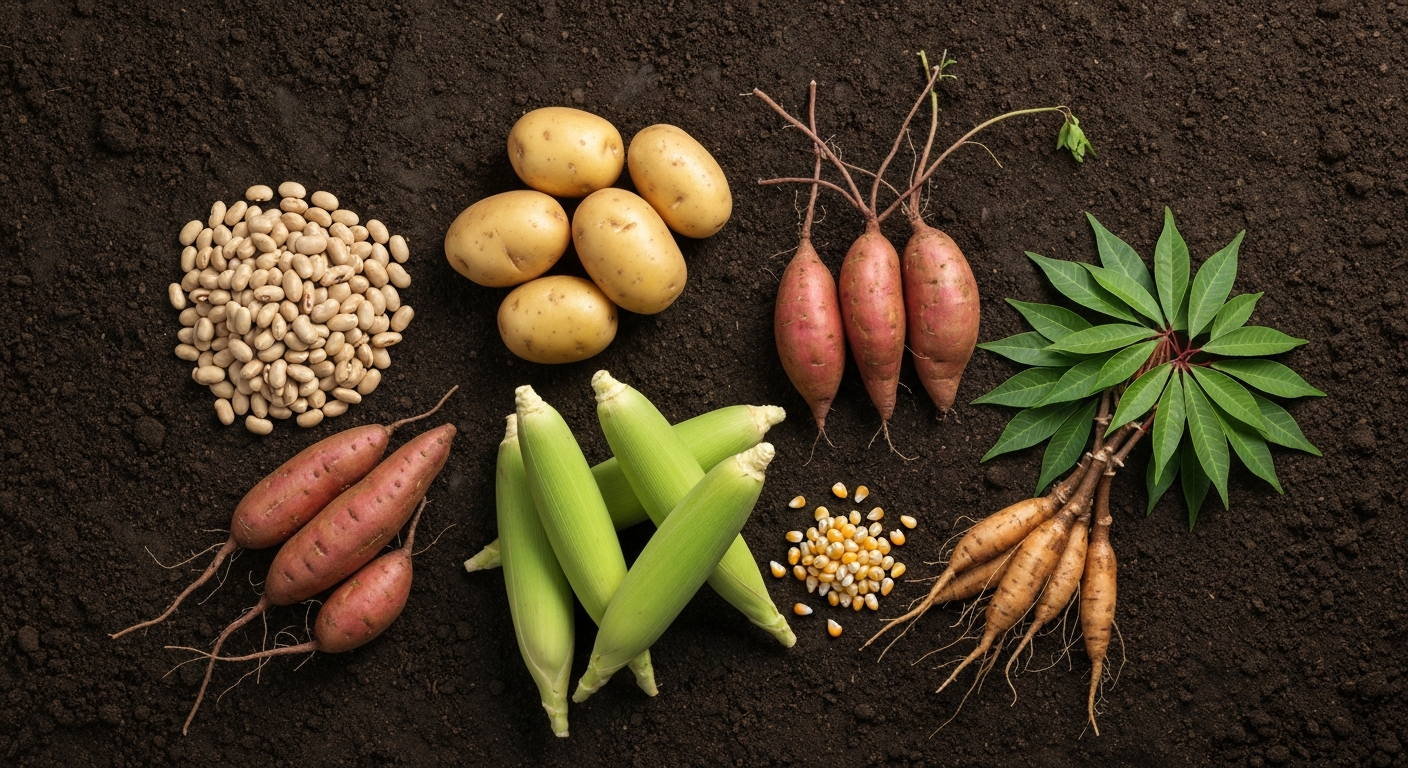
What Is the Cheapest Crop to Grow: Guide, Picks & Regions
What is the cheapest crop to grow: practical, region-aware guide with crop lists, cost metrics, scale-specific picks.
Best Agricultural Crops to Grow: Pick Right for Your Climate
Choose best agricultural crops for your climate with crop shortlist, grow-by-step plan, and rotation for soil health.
Best Cash Crops to Grow: Pick by Zone, Soil, and Market Demand
Best cash crops by zone, soil, and demand. Learn how to choose, test, and estimate profits for your farm.