
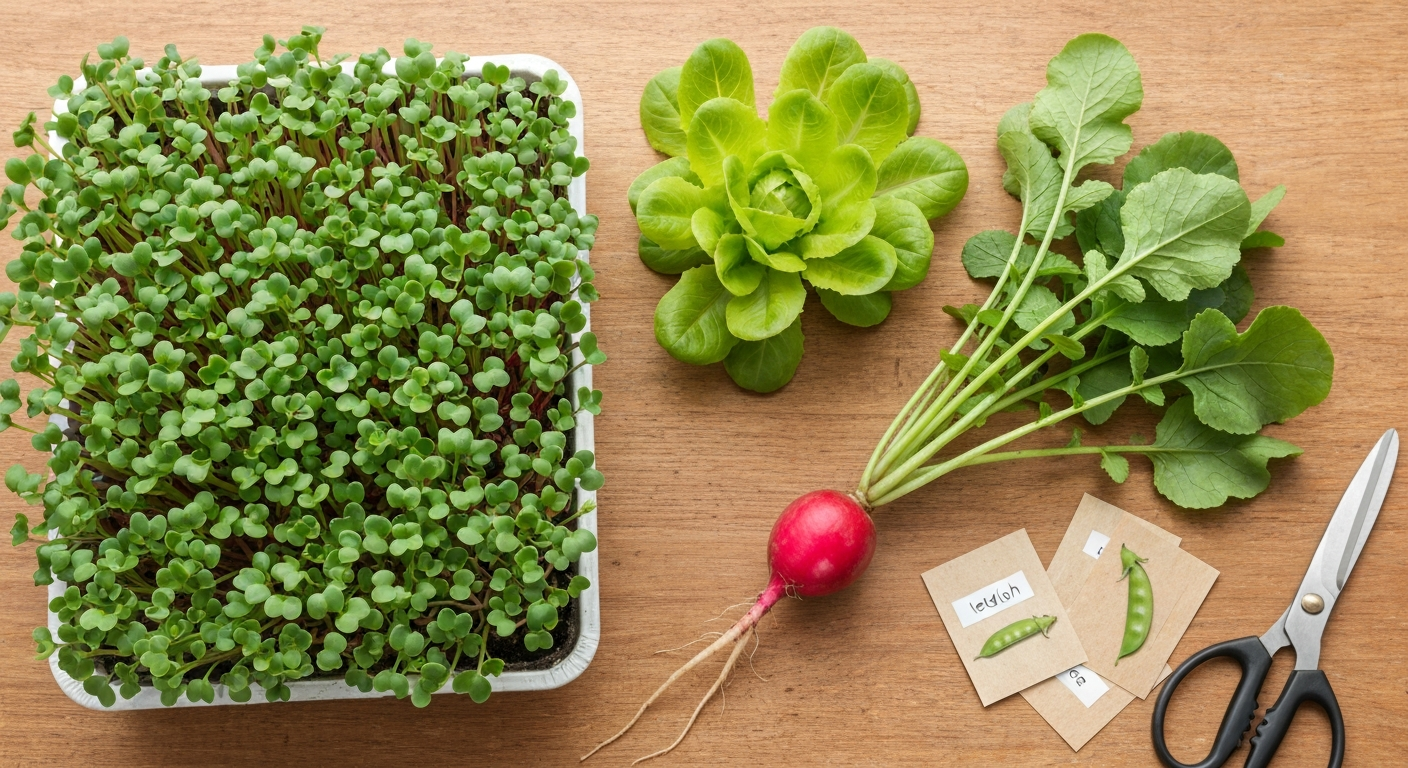
Microgreens take the shortest time to grow of any crop, with radish microgreens ready to harvest in as little as 7 days from sowing. If you step up to full-sized crops, salad radishes like 'Cherry Belle' mature in roughly 22 days, and baby-leaf lettuce or spinach can be cut in 20–35 days. The real answer depends on what you count as a harvest, but if speed is your primary goal, microgreens win by a wide margin. For a quick reference list of which crops grow the fastest, consult the companion guide.
Which Crop Takes the Shortest Time to Grow: Fastest Options

Samuel Rourke
26 Jul 2026
What does 'shortest time to grow' actually mean?
This sounds like a simple question, but the answer shifts depending on how you measure it. Seed companies like Johnny's Selected Seeds define 'days to maturity' as the average number of calendar days from sowing (or from transplant, where specified) to a harvestable crop under the vendor's production conditions. That number is useful, but it is not the only number that matters.
For cut-and-come-again crops such as leaf lettuce, kale, and baby spinach, good seed catalogs list two separate values: days to first harvest (the earliest you can cut baby leaves) and the full-size maturity date. A lettuce like 'Red Sails', for instance, is listed at 30 days to baby harvest but 55 days to a full head. For succession planting and market timing, the first-harvest number is the more useful figure.
Microgreens sit in their own measurement category. University extensions at Maryland, Mississippi State, and Virginia Tech, along with production manuals from major seed suppliers, define microgreen harvest as the cotyledon or first-true-leaf stage and consistently report a range of 7–21 days, depending on species. A peer‑reviewed review (Microgreens: Functional Food for Nutrition and Dietary Diversification (review, PMC)) summarizes harvest windows for microgreens as roughly 7–21 days depending on species and target stage. That is not the same as growing a full crop, but it is genuinely edible, nutritionally dense, and commercially sold, so it counts.
Why does the metric matter? Because your goal changes which number is relevant. A gardener who wants fresh greens on the table chooses by days-to-first-harvest. A market farmer planning cash flow wants the full harvest window plus repeat-cut potential. A classroom teacher running a plant-science experiment may want the fastest possible germination-to-visible-harvest window, which points straight to microgreens. Keeping these distinctions clear prevents a lot of confusion when comparing crops.
The fastest crops ranked by days to harvest
The table below uses standard seed-company and university extension ranges. Where a crop has both a microgreen/baby-leaf stage and a full-size stage, both are shown. Winter radishes, storage turnips, and daikon types are excluded here because those are a different category entirely from the fast spring salad types.
| Crop | Harvest Stage | Typical Days to Harvest | Notes |
|---|---|---|---|
| Radish microgreens | Microgreen (cotyledon) | 7–10 days | Among the fastest microgreens; widely cited by MSU Extension and suppliers |
| Sunflower microgreens | Microgreen (cotyledon) | 8–12 days | Popular for size and flavor; slightly slower than radish |
| Pea shoots | Shoot/micro harvest | 10–14 days | High biomass; harvested as young shoot, not pod |
| Brassica microgreens (broccoli, cabbage, mustard) | Microgreen (cotyledon) | 7–14 days | Varies by species; mustard on the fast end |
| Salad/spring radish (e.g., Cherry Belle) | Full root | 22–30 days | Cherry Belle listed ~22 days by Burpee; full range 22–35 days |
| Baby-leaf lettuce | Baby leaf (first cut) | 20–35 days | Johnny's lists many varieties at ~30 days to baby harvest |
| Baby-leaf spinach | Baby leaf (first cut) | 21–35 days | 3–5 weeks per Johnny's; full maturity later |
| Arugula | Baby leaf (first cut) | 21–40 days | Faster in warm conditions; bolt-prone in heat |
| Turnip greens | Greens (not root) | 20–25 days | Tokyo Cross roots ready ~30–35 days; storage types 50–55 days |
| Buckwheat | Flowering (cover/nectar crop) | 25–30 days | Seed maturity ~45–50 days per UC Davis SARE |
| Bush beans (fast varieties) | First pod | 50–60 days | Selected fast bush types; not in the ultra-fast category |
| Garden peas (edible pod) | First pod | 50–70 days | Much slower than pea shoots; shoot harvest at 10–14 days instead |
A few patterns stand out here. Anything harvested at the seedling or young-leaf stage is dramatically faster than anything grown to full size. Pea shoots at 10–14 days and full garden peas at 50–70 days are the same plant, just harvested at radically different points. The same logic applies to turnips: the greens are edible at 20–25 days, but waiting for a storage root takes twice as long. Knowing this lets you squeeze multiple uses out of a single sowing.
Where the fastest crops grow: regions, climates, and history
Speed is partly a trait of the crop and partly a function of where and when you grow it. The fastest crops are overwhelmingly cool-season or climate-tolerant, which is one reason they appear across a remarkable range of regions.
U.S. state examples
California's Central Valley and coastal valleys allow year-round baby-leaf production because temperatures rarely dip below freezing at lower elevations. Commercial salad greens and radishes are grown continuously in Salinas Valley, where the mild maritime climate compresses days-to-maturity by keeping soil temperatures in the ideal 55–65°F range for cool-season crops. Florida growers face the opposite problem: summer heat forces fast-maturing cool-season crops into a narrow window from October through March, but that window fully supports salad radishes, arugula, and baby spinach. Iowa and the Upper Midwest use fast crops like radishes and buckwheat heavily as cover crops between cash-crop rotations, capitalizing on the 6–8 week windows between corn and soybean plantings. Washington State's Puget Sound region, with its cool summers and relatively mild winters, is well-suited to extended baby-leaf production and has a thriving market-garden culture built partly around succession-planted fast greens.
Global climate zones
Temperate and continental climates (much of Europe, northern China, the northern U.S.) rely on fast crops to fill the shoulder seasons in spring and fall, when slower crops have not yet produced. Mediterranean climates (southern France, coastal California, parts of Chile and South Africa) allow near-year-round salad production and are global centers of leafy-green seed production. Tropical climates support fast-maturing tropical vegetables like amaranth greens and water spinach (kangkong), which can be harvest-ready in 3–4 weeks but are rarely discussed in temperate gardening guides. Arid regions, where water availability limits crop cycles, often favor the fastest crops simply because a short growing window reduces total water demand.
Ancient and historical agricultural context
Fast crops were not a modern invention. Egyptian agricultural records and archaeobotanical evidence show radishes, lettuces, and leafy greens being cultivated along the Nile floodplain, where the annual inundation cycle created fertile, moist seedbeds that allowed rapid germination and growth. Roman agricultural writers including Columella and Pliny the Elder described lettuce as a quick kitchen-garden crop grown close to the house for daily use. In ancient China, leafy greens and fast-maturing brassicas were staple crops in kitchen gardens well before modern breeding refined their maturity times. The consistent thread across ancient civilizations is that fast crops served as insurance crops and famine buffers: when long-cycle crops failed or were destroyed, a gardener could have radishes or greens on the table within a month. For anyone researching ancient agricultural patterns, these fast crops appear repeatedly in the historical record precisely because they were universally practical.
What actually changes how fast a crop grows
Days-to-maturity on a seed packet is a baseline measured under specific conditions. In real gardens and farms, several variables push that number up or down significantly.
- Temperature: Most fast cool-season crops germinate and grow quickest in soil temperatures of 50–65°F. Below 45°F, growth slows noticeably. Above 80°F, crops like spinach and arugula may bolt rather than produce usable leaves.
- Photoperiod: Long days accelerate bolting in lettuce and spinach, shortening the harvest window rather than speeding it up productively. Short-day or day-neutral varieties are worth selecting for summer production.
- Soil fertility and moisture: Consistent moisture and nitrogen availability directly shorten the time to first harvestable leaf. Dry or nutrient-poor soil adds days to the calendar, sometimes by a week or more for baby greens.
- Variety and seed selection: This is often underestimated. 'Cherry Belle' radish matures in ~22 days; some heritage radish varieties take 35 days or more. Choosing the right cultivar for speed can shave 30–40% off the growing time compared to a slow variety of the same crop.
- Pests and disease: Aphid pressure on lettuce, flea beetle damage on arugula, or downy mildew on spinach can effectively delay or eliminate a harvest window. Fast crops are vulnerable precisely because they have little time to recover.
- Planting date: Sowing radishes in cold, wet soil in early March versus waiting until soil warms to 50°F can mean the difference between 22 days and 40 days to harvest. The calendar date matters less than soil temperature at sowing.
Techniques that make fast crops even faster
If you want to push crops toward the short end of their days-to-harvest range, a handful of techniques are well-supported by commercial production practice and extension research.
Microgreen and baby-leaf production
Growing crops to the microgreen or baby-leaf stage is the most direct way to reduce time to harvest. Microgreens are sown densely in shallow trays (typically 1–2 inches of growing medium), kept under consistent light for 12–16 hours, and harvested with scissors at the cotyledon or first-true-leaf stage. This is equally valid in a home kitchen windowsill, a school classroom, or a commercial tray farm. The setup cost is minimal, and the 7–14 day turnaround for radish and brassica microgreens is genuinely reliable.
Protected culture: greenhouses and polytunnels
Even a simple low tunnel or cold frame extends the shoulder seasons and maintains soil temperatures above the minimum needed for active growth. Commercial growers in cool climates use unheated high tunnels to start salad crops 3–4 weeks earlier in spring and extend into late fall, effectively adding growing cycles that would not otherwise exist. Heated greenhouses allow year-round production of baby greens in climates that would otherwise freeze out.
Hydroponics and aeroponics
Nutrient-film technique (NFT) and raft hydroponic systems remove soil variability from the equation entirely. Lettuce grown in a properly managed NFT system can reach baby-leaf stage in 18–22 days, slightly faster than soil-grown equivalents, because roots have constant access to oxygen, water, and nutrients with no soil compaction or dry patches. Aeroponics can be faster still for some crops. These systems are particularly relevant in urban farming, vertical farms, and any situation where outdoor conditions are unfavorable.
Heat mats, row covers, and intensive bed preparation
Heat mats under germination trays maintain soil temperatures at 65–75°F regardless of ambient temperature, which can cut germination time from 7–10 days down to 2–4 days for radishes and lettuce. Row covers (floating fabric mulch) hold warmth around seedlings after transplanting or direct sowing, keeping soil temperatures 4–8°F warmer than uncovered beds. Deep, well-amended raised beds with good drainage allow earlier spring sowing than cold, waterlogged in-ground plots. None of these is exotic technology; they are standard practice for any market gardener trying to beat the season.
Choosing the fastest crop for your specific goal
The right fast crop depends heavily on what you are trying to accomplish. Here is how I think through the decision for four common goals.
| Goal | Best crop choice | Key priority | Notes |
|---|---|---|---|
| Quick food from the garden | Salad radishes, baby lettuce, spinach | Days-to-first-harvest, flavor, nutritional value | Radishes give the fastest full-crop harvest; baby greens extend the window with repeat cuts |
| Market or cash crop (fast turnover) | Microgreens (radish, sunflower, pea shoots), baby-leaf mixes | Consistent days-to-harvest, shelf life, market price per square foot | Microgreens return the highest value per square foot in the shortest time |
| Classroom or science experiment | Radish microgreens, mustard microgreens | Speed, reliability, visibility of germination and growth stages | 7–10 day cycle is ideal for a single school week or unit |
| Historical recreation or education | Radishes, lettuce, turnip greens, buckwheat | Historical accuracy, regional period-appropriate varieties | All four appear in ancient Mediterranean, Roman, and East Asian agricultural records |
For food production, radishes win on simplicity: direct-sow, thin lightly, harvest in under a month. If you’re wondering what is the easiest crop to grow, radishes are often the simplest starting point for direct-sowing and quick harvests. Baby greens require a bit more management but give you multiple cuts from a single sowing, which stretches the value. For cash, microgreens are hard to beat on a dollars-per-square-foot basis, though they require consistent light and more daily attention than an outdoor bed. For classroom use, radish or mustard microgreens are almost foolproof: germination is visible in 1–2 days, the cotyledons appear in 3–5 days, and the full harvestable microgreen is ready within a school week or two. For historical recreation, sticking with crops documented in ancient sources (radishes in Egypt, lettuces in Rome, brassica greens in ancient China) adds authenticity that a modern hybrid variety would undermine.
It is also worth noting what fast crops are not. Crops that take close to a year or more, such as sugarcane (10–18 months), most orchard fruits (3–7 years to first significant harvest), garlic (8–9 months from planting to harvest), and winter squash or storage onions (90–120 days), represent an entirely different category. For more on long-term crops and their challenges, see what is the hardest crop to grow. For more on long-season examples, see what crop takes the longest to grow, which surveys multi-year and extended-maturity crops. If those timelines interest you, the contrast with microgreens is striking and illustrates why fast crops have historically served as gap-fillers in agricultural systems dominated by slower, higher-yielding staples. If you're wondering which crop takes almost a year to grow, sugarcane is a common example, typically requiring 10–18 months from planting to harvest.
A note on video game crop timers
Games like Farmer's Dynasty and Medieval Dynasty use simplified crop timers that compress or abstract real growing times into in-game day cycles. These timers are designed for gameplay pacing, not agronomic accuracy. Wheat in Medieval Dynasty, for example, may grow in a handful of in-game days during a particular season regardless of historical reality. Real medieval European wheat took 9–10 months from autumn sowing to summer harvest. If you landed here from a search related to those games, the in-game growth rates are entirely fictional mechanics and cannot be mapped onto real crop biology.
Succession planting, seed selection, and a sample planting calendar
The best way to use fast crops is not to grow one batch and wait, but to stagger sowings so you always have something ready to cut. Succession planting is the single most practical technique for both home gardeners and small market farmers, and fast crops are perfectly suited to it because the turnaround is short enough to make multiple rounds of planting in a season genuinely worthwhile.
Step-by-step 10-week succession plan for salad greens and radishes (temperate spring)
- Week 1: Sow Planting A — radishes (Cherry Belle or similar, ~22–28 days to harvest) at 1 inch spacing in a 4-foot bed row, and a small tray of radish microgreens (7–10 days to harvest).
- Week 2: Harvest microgreens from tray sown in Week 1. Sow a second microgreen tray to maintain continuous supply.
- Week 3: Sow Planting B — baby-leaf lettuce mix at 1/2 inch spacing (first cut expected around Week 7). Check Planting A radishes for size.
- Week 4: Harvest Planting A radishes (if 22–28 days from sowing have elapsed and roots are 3/4–1 inch diameter). Immediately re-sow that bed row with Planting C radishes or baby spinach.
- Week 5: Sow Planting D — arugula at 1/2 inch spacing (first cut expected around Week 8–9). Continue bi-weekly microgreen tray sowings.
- Week 6: First cut of Planting B baby-leaf lettuce (cut leaves to 1 inch above crown; allow regrowth for second cut in 10–14 days).
- Week 7: Harvest Planting C radishes (if on 22–28 day schedule). Re-sow bed with Planting E — turnip or a faster baby-leaf brassica.
- Week 8: First cut of Planting D arugula. Second cut of Planting B lettuce if regrowth is 3–4 inches.
- Week 9: Assess soil moisture and fertility; side-dress with balanced fertilizer if growth is slowing. Continue microgreen rotation on 7–10 day cycles.
- Week 10: Full harvest or final cut of remaining greens before summer heat drives bolting. Plan fall succession using the same template starting 8–10 weeks before first frost.
Seed spacing and timing reference
| Crop | Sowing depth | In-row spacing | Row spacing | Sow-to-first-harvest | Succession interval |
|---|---|---|---|---|---|
| Radish (salad) | 1/2 inch | 1 inch | 6 inches | 22–30 days | Every 2 weeks |
| Baby-leaf lettuce mix | 1/8 inch (surface press) | 1/2 inch (broadcast) | Broadcast or 6 inches | 25–35 days | Every 2–3 weeks |
| Baby spinach | 1/2 inch | 1–2 inches | 6 inches | 21–35 days | Every 2–3 weeks |
| Arugula | Surface/1/8 inch | 1/2 inch (broadcast) | Broadcast or 6 inches | 21–40 days | Every 2–3 weeks |
| Turnip greens | 1/4 inch | 1–2 inches | 6–8 inches | 20–25 days (greens) | Every 3 weeks |
| Microgreens (radish, brassica) | Dense surface sow in tray | Dense/broadcast in tray | N/A | 7–14 days | Every 1 week |
Monthly planting template for a temperate zone (spring through fall)
This template assumes a last spring frost around April 15 and a first fall frost around October 15, which covers a broad swath of USDA hardiness zones 5–7 across the eastern and central U.S. Adjust by 2–4 weeks earlier or later for warmer or cooler regions.
| Month | Outdoor sowings | Indoor/tray crops | Notes |
|---|---|---|---|
| March (pre-frost under cover) | Radishes under row cover, baby spinach in cold frame | Microgreen trays (any species) | Soil temps may still be marginal; use row cover to warm beds |
| April | Radishes (direct sow), lettuce mix, arugula, turnip greens | Microgreen trays; pea shoots in trays | First reliable outdoor sowings for most zones; succession every 2 weeks |
| May | Radishes, lettuce, spinach, arugula; buckwheat as cover crop | Microgreen trays | Most productive spring month; watch for bolting risk as days lengthen |
| June | Early June: radishes, arugula (bolt-resistant types); late June pause cool-season crops | Microgreen trays (indoor/shaded) | Heat builds; switch to heat-tolerant lettuce varieties or pause until late summer |
| July–August | Minimal cool-season; buckwheat as summer cover crop | Microgreen trays (indoor AC environment) | Too hot for most fast cool-season crops outdoors in most zones |
| September | Radishes, lettuce, spinach, arugula, turnip greens — full restart | Microgreen trays | Fall succession begins; same schedule as April |
| October | Early October: radishes, baby spinach, arugula under row cover | Microgreen trays | Frost risk rises; extend season with floating row cover or low tunnels |
| November onward | Protected cold frame or low tunnel only | Microgreen trays (indoor) | Outdoor production ends except with protection in milder climates |
Seed selection is worth one final mention. Within any fast crop category, cultivar choice makes a measurable difference. For radishes, 'Cherry Belle' (~22 days) consistently outpaces slower heritage types. For baby lettuce, choosing a blend labeled specifically for baby-leaf harvest (rather than a heading type) gives you leaves optimized for the 25–30 day window. For microgreens, seed sold specifically as microgreen seed is typically untreated and higher-germination-rate than standard packet seed, which matters when you are sowing densely in trays. Spending a little time with seed catalogs before ordering pays back in predictable harvest timing.
FAQ
How do we define “shortest time to grow” for a crop?
Use precise, documented measurements: (A) Days‑to‑first‑harvest — calendar days from sowing (or transplant if specified) to the first commercially or kitchen‑useable harvest; (B) Microgreen/microharvest window — days from sowing to cotyledon/first‑true‑leaf harvest (typically 7–21 days); (C) Baby‑leaf vs full‑size — report both days‑to‑baby‑leaf (first cut) and days‑to‑full maturity when applicable. Seed companies (e.g., Johnny’s) and land‑grant extensions explicitly use these categories and list separate baby and full values.
Which crops are the fastest by days‑to‑harvest (ranked, evidence‑based)?
Ranked fastest candidates with typical days‑to‑first‑harvest (ranges reflect common seed‑catalog and extension listings): 1) Microgreens (many brassicas, radish microgreens): 7–14 days; 2) Pea shoots (micro/young shoots): 10–14 days; 3) Radish (salad types, e.g., Cherry Belle): 22–30 days; 4) Baby‑leaf lettuce / spinach / arugula (baby cut): 20–35 days; 5) Turnip greens (harvest as greens): 20–30 days; 6) Buckwheat (flowering/nectar for cover): flowers ≈25–30 days (seed ≈45–50 days); 7) Baby carrots (small/early varieties): ~30–50 days depending on cultivar; 8) Fast beans/peas (first pods): many green bean/pea types ≈45–70 days (note pea shoots are much faster). Sources: university extensions, seed catalogs (Johnny’s, Burpee), USDA/UC SARE production guides, and peer‑reviewed microgreens reviews.
Can I have a simple table of crops with days‑to‑harvest?
Suggested quick table (use for planning): - Microgreens (radish, broccoli, mustard): 7–14 d - Pea shoots: 10–14 d - Salad radish (Cherry Belle): 22–30 d - Baby lettuce / baby spinach / arugula: 20–35 d (baby cut) - Turnip greens (Tokyo Cross for baby leaves): 20–30 d; turnip roots 30–55 d - Buckwheat (flowering): 25–30 d; seed 45–50 d - Baby carrots (small varieties): 30–50 d - Fast bush beans (first pods): 45–60 d - Garden peas (pods): 50–70 d Note: ranges vary by variety, season, and technique; catalogs and extension pages list cultivar‑specific days‑to‑maturity (Johnny’s, Burpee, land‑grant extensions).
How do fastest crops map to regions and climates (U.S. states, global zones, and ancient examples)?
Regional mapping guidance: - Temperate U.S. (e.g., Pacific Northwest, Northeast, Upper Midwest): microgreens, baby greens, radishes, turnips, buckwheat for summer cover; spring/fall succession common. - Warmer U.S. (e.g., Southeast, California): microgreens year‑round indoors; fast warm‑season crops (buckwheat as quick summer cover, some tropical leafy vegetables may mature quickly). - Arid/short‑season zones (High Plains, parts of Canada): favor indoor microgreens, quick spring radishes, and early cold‑tolerant baby greens; use hoop houses for season extension. - Tropical/subtropical zones: some tropical leaf vegetables and fast tropical legumes can reach edible stages rapidly; microgreens and pea shoots also perform quickly indoors/under shade. Historical/contextual examples: - Ancient Near East / Fertile Crescent: fast leafy greens and young cereals (sprouted grains and baby shoots) were exploited for quick nutrition between cereal cycles. - Ancient China and South Asia: mustard/leafy brassicas and leafy vegetables were used as quick crops in paddy/off‑season plots. For local cultivar and timing guidance, consult your state or country Crops By Region pages (internal link cues: Crops By Region — [Your U.S. State] and Crops By Region — [Country/Ancient‑agriculture pages]).
What factors change growth time and how large is their effect?
Primary factors (and their effects): - Temperature/season: warmer but not extreme temperatures speed development (can reduce days by 10–30% vs cool conditions); heat stress can delay or bolt. - Daylength/photoperiod: some crops respond (bolting or slower leaf growth under long/short days). - Variety/cultivar: ‘early’ cultivars reduce maturity by days to weeks; seed‑packet days are cultivar‑specific. - Soil fertility and moisture: good fertility and steady moisture shorten growth times; drought or poor soil slows or reduces size. - Growing technique: greenhouse, hoop house, or controlled‑environment production (hydroponics, trays) can cut calendar days and allow year‑round microgreen production; GDD (growing degree days) tracking is used in extensions to refine timing. - Planting density & harvest target: baby‑leaf and microgreen systems harvest sooner when sown densely; thinning/transplanting changes timing compared with direct sow. Use extension GDD tables or seed‑vendor days‑to‑maturity plus local adjustments to predict timing.
How should students, gardeners, and farmers pick the fastest crop for a goal (food, cash, teaching, experiments)?
Actionable selection steps: 1) Define your objective: quickest edible biomass (microgreens/pea shoots), fastest marketable root (radish), quickest cash cover (buckwheat flowering for bee markets), or teaching demonstration (radish growth charts or microgreens in a week). 2) Choose right scale & system: microgreens (indoor trays/hydroponics) for very fast turnover; direct sow baby greens or radishes for field/small garden. 3) Select cultivar using seed‑catalog days‑to‑maturity and local extension recommendations (pick ‘early’ classes if available). 4) Use succession planting: stagger sowings every 7–14 days for continuous harvests (baby greens/radishes), and plan harvest windows using days‑to‑first‑harvest. 5) Optimize technique: use high‑quality seed, prepared soil or sterile mix (microgreens), steady moisture, and season extension (row cover or greenhouse) to shorten and stabilize days‑to‑harvest. 6) Record & adjust: log first harvest dates vs predicted days to refine timing for your microclimate.
Next Articles
Which Crop Takes Almost a Year to Grow
Discover which crops take about 11 to 12 months, how climate and planting windows affect harvest time, and how to choose
Medieval Dynasty: How Long for Crops to Grow
Get crop grow times in Medieval Dynasty: days to first harvest, harvest windows, and how seasons affect yields and repla
Farmer’s Dynasty: How Long Crops Take to Grow
Crop grow-time guide with planting to harvest timelines, plus what changes durations by climate, season, and conditions.