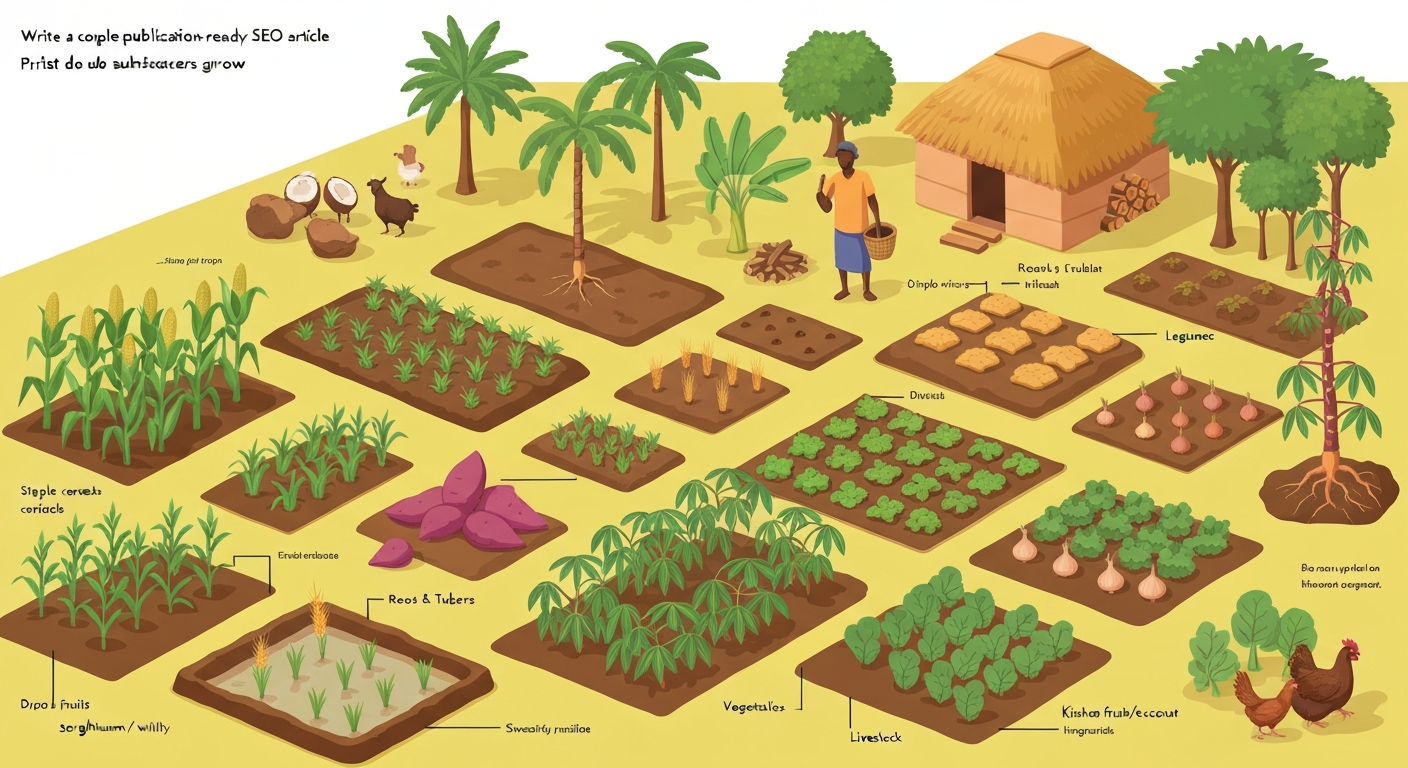
Subsistence farmers worldwide grow primarily staple cereals (maize, rice, wheat, sorghum, millet), roots and tubers (cassava, yam, sweet potato, potato), legumes (beans, cowpeas, groundnuts, lentils, chickpeas), and a supporting cast of fruits, vegetables, and tree crops. The exact mix depends heavily on climate, altitude, soil type, and local food tradition, but the goal is always the same: enough calories and nutrition to feed the household, with minimal purchased inputs and maximum crop reliability. For a region-by-region breakdown of what farmers grow, see the site page on what farmers grow (internal reference 3a76753a-92b7-44eb-9ea5-89af474fc77e).
What Do Subsistence Farmers Grow: Global Crops & Systems

Samuel Rourke
10 Aug 2026
Who this guide is for and what it covers
Whether you are a student researching agricultural geography, a farmer comparing cropping systems, a historian tracing food culture, or a gardener curious about traditional growing practices, this article maps out what subsistence farmers actually grow, region by region and crop category by crop category. It covers why particular crops dominate in specific climates, how cropping systems are structured across a year, and what practical indicators help identify what a given household is likely growing. For readers interested in commercial-scale patterns, the broader question of what farmers grow in different field systems is covered in related guides on this site.
What subsistence farming actually means
Subsistence farming means growing food primarily to feed the household rather than to sell. The family eats what it produces, and any surplus is traded locally or stored as a buffer against bad seasons. Plot sizes are typically small, from under one hectare to a few hectares, and the farmer relies on family labor, saved seed, and locally available inputs rather than commercial supply chains. Mechanization is limited or absent. This does not mean the farming is simple: subsistence farmers often manage extraordinary crop diversity, multiple growing seasons, and sophisticated knowledge of soil, weather, and variety selection built up over generations.
The core goals of a subsistence household are caloric sufficiency first, then nutritional balance, then risk management. Crop choices flow directly from those priorities. A drought-tolerant grain goes in because it is reliable, not because it commands the best price. A legume goes alongside it because it fixes nitrogen in the soil and adds protein to the diet. A root crop gets planted in a corner because it can sit in the ground for months as an emergency food store. Understanding those motivations is the fastest way to understand what you will find growing on a subsistence plot anywhere in the world.
A map of the main crop categories
Before going region by region, it helps to see the broad categories that appear on subsistence farms almost everywhere. These are not rigid boxes; on any real smallholding the categories overlap and support each other.
- Staple cereals: maize, rice, wheat, sorghum, millet — the caloric backbone of most diets
- Roots and tubers: cassava, yam, sweet potato, potato, taro — high-calorie, storable, and often drought or flood resilient
- Legumes and pulses: common bean, cowpea, pigeon pea, groundnut, lentil, chickpea, faba bean — protein, nitrogen fixation, and income
- Tree and perennial fruits: banana/plantain, breadfruit, coconut, mango, citrus, fig, avocado — long-term calorie and vitamin sources
- Vegetables and kitchen garden crops: leafy greens, tomatoes, onions, peppers, gourds — micronutrient diversity near the homestead
- Small livestock: poultry, goats, sheep, pigs, and in some systems cattle — protein, manure, and emergency cash
- Non-food and dual-use plants: fiber crops, medicinal herbs, cover crops, fodder grasses — soil maintenance, animal feed, and household use
Staple cereals: the grains that feed the most people
Cereals are the starting point on almost every subsistence farm because they deliver dense calories per unit of land and labor, store well after drying, and can be processed with simple equipment. Which cereal dominates depends almost entirely on rainfall pattern, temperature, and soil type.
Maize (corn)
Maize is the single most widely grown subsistence cereal across Sub-Saharan Africa and Latin America. In southern Africa the main planting season runs from October through December (the start of the rains), with harvest in April through June. In East and West Africa, planting timing shifts with the local rainy season. Maize yields well on modest soils, can be intercropped with legumes, and the cobs, leaves, and stalks all have uses, which is why it dominates household plots from Zimbabwe to Guatemala.
Rice
Rice is the dominant staple of South and Southeast Asia, grown in both rainfed lowland and irrigated paddy systems. Smallholders across Bangladesh, India, Indonesia, the Philippines, Vietnam, and Myanmar build their entire cropping year around rice. Double-cropping (two rice crops per year) and even triple-cropping are common where water is available. Where rice ends, another crop takes over: a legume, a vegetable, or a second cereal rotation follows the rice harvest in classic rice-based cropping systems documented by IRRI and FAO.
Wheat
Wheat is the winter-season staple across South Asia (grown as the Rabi crop, planted October through December, harvested March through May), the Mediterranean, and West Asia. In the Indo-Gangetic Plains of northern India and Pakistan, the classic smallholder rotation is rice in the monsoon (Kharif) season followed by wheat in the dry cool season. In the Mediterranean and West Asia, wheat and barley are planted after autumn rains and harvested before summer drought sets in.
Sorghum and millet
Where rainfall is too unreliable or soils too poor for maize or rice, sorghum and millet take over. These crops are the foundation of subsistence diets across the semi-arid Sahel of West Africa, the dryland areas of East Africa, and parts of South Asia. They tolerate heat, low rainfall, and sandy or shallow soils that would fail maize. Sorghum is also grown on larger Great Plains farms in the United States, but for subsistence households in Africa it is a critical drought buffer. Millet (pearl millet especially) handles the harshest, driest conditions of any major grain.
| Cereal | Primary subsistence regions | Why it dominates there |
|---|---|---|
| Maize | Sub-Saharan Africa, Latin America, parts of SE Asia | High yield, adaptable, intercropping friendly, multiples uses |
| Rice | South and Southeast Asia, West Africa lowlands | Paddy and rainfed systems, double-cropping potential, cultural centrality |
| Wheat | South Asia (Rabi), Mediterranean, West Asia, North America | Cool-season grain, stores well, flat fertile land suits mechanization |
| Sorghum | Sahel, East Africa, dryland South Asia, U.S. Great Plains | Drought and heat tolerance, grows on poor soils |
| Pearl millet | Sahel, semi-arid South Asia | Most drought-tolerant major grain, suited to sandy soils |
| Barley | Mediterranean, West Asia, highland Ethiopia, Tibetan Plateau | Cold and drought tolerance, important for beer, bread, and fodder |
Roots and tubers: the underground safety net
If cereals are the daily staple, roots and tubers are the insurance policy. They can stay in the ground for months after maturity, functioning as a living storage system. When rains fail, prices spike, or the cereal harvest comes up short, the household digs into its tubers. This is why cassava is sometimes called the 'famine reserve' crop across tropical Africa, and why Andean farmers maintained dozens of potato varieties across different altitude bands as a hedge against localized frost or drought.
Cassava
Cassava is arguably the most important subsistence root crop on the planet by total calories produced on marginal land. It tolerates poor, sandy, acidic soils where few other crops survive, requires minimal fertilizer, and the roots can be left in the ground for up to two years after maturity. FAO: cassava – FAO family farming / cassava resources documents cassava’s role as a resilient, low-input staple and its large harvested area and production across Sub-Saharan Africa, where it functions as a flexible 'famine reserve'. Across Sub-Saharan Africa, cassava accounts for enormous areas of harvested cropland and is a primary staple in Democratic Republic of Congo, Nigeria, Tanzania, Mozambique, and much of the humid tropics. It also anchors subsistence systems in lowland Amazonia and parts of Southeast Asia.
Yam
Yam (Dioscorea species) is a prestige and staple crop in West Africa, particularly in the 'yam belt' running through Ghana, Benin, Nigeria, and Côte d'Ivoire. It demands more fertile soil and labor than cassava, but yields high-quality carbohydrates and plays a central cultural role. Pacific island systems also include yam prominently, and it features in traditional Caribbean smallholder plots.
Sweet potato
Sweet potato is critically important in Sub-Saharan Africa, East Africa especially, and is the caloric backbone of smallholder diets in Papua New Guinea and much of Melanesia, where it replaced taro as the dominant crop after its introduction from the Americas. It is fast-growing (often harvested within 3 to 5 months), requires little fertilizer, and provides both carbohydrates and, in orange-fleshed varieties, significant beta-carotene (vitamin A).
Potato
In the Andean highlands of Peru, Bolivia, and Ecuador, potato is not just a staple crop but a cultural institution. International Potato Center (CIP) research documents Andean households maintaining dozens of named potato varieties, each suited to a different altitude, soil type, frost exposure, or end use. This varietal diversity is itself a risk-management strategy: different varieties mature at different times and tolerate different conditions, smoothing out the household's food supply across the year. Potato is also central to smallholder systems in Nepal, Ethiopia's highlands, and parts of East Africa.
Taro and other aroids
Taro (Colocasia esculenta) is the foundational root crop of Pacific island subsistence systems alongside yam and sweet potato. It thrives in wet conditions, including flooded paddies (wet taro) and upland gardens (dry taro). Taro features strongly in the homegardens of Fiji, Samoa, Tonga, Vanuatu, and across Melanesia and Polynesia, often grown in mixed multi-story gardens alongside fruit trees and vegetables.
Legumes and pulses: doing double duty for diet and soil
Legumes occupy a unique position on subsistence farms: they are both a food crop and a soil improvement tool. Through root nodule bacteria, legumes fix atmospheric nitrogen into forms plants can use. This matters enormously to smallholders who cannot afford commercial fertilizer. Plant cowpeas after sorghum and you are feeding the family and rebuilding soil nitrogen at the same time. This dual function explains why legumes appear in intercropping and rotation systems across every major subsistence region.
Common bean
Common bean (Phaseolus vulgaris) is the primary grain legume across Latin America and East and Central Africa. The classic 'maize and bean' intercrop, where climbing beans grow up the maize stalks, is probably the most widespread small-farm cropping system in the Americas and is replicated in parts of Africa. Beans supply the protein and amino acids that maize alone cannot provide, making the combination nutritionally complete and agronomically efficient.
Cowpea
Cowpea is the principal grain legume of West and East Africa and much of semi-arid South Asia. It tolerates heat and drought far better than common bean, which makes it ideal for the Sahel and similar dryland environments. Cowpea is intercropped with sorghum or millet across the Sahel in a system that has fed people in that region for thousands of years. The leaves are eaten as a vegetable before the pods mature, adding yet another dimension to its value.
Groundnut (peanut)
Groundnut is the dominant legume on smallholder farms across West Africa and South Asia. It provides dietary fat, which is often scarce in starch-heavy subsistence diets, along with protein and micronutrients. It fixes nitrogen efficiently and is often grown in rotation with cereal crops. Groundnut also functions as a modest cash crop, giving households a way to convert surplus into income.
Lentil and chickpea
In South Asia and the Mediterranean/West Asia region, lentil and chickpea are the cool-season legumes that complete the cereal rotation. In northern India and Bangladesh, lentils (masur dal) are a household staple grown in the post-monsoon dry season. Chickpea fills a similar role across India, Pakistan, Ethiopia, and the drier Mediterranean fringes. Both crops tolerate dry, cool growing conditions and store extremely well, making them reliable off-season protein sources.
Pigeon pea and faba bean
Pigeon pea is a perennial or semi-perennial legume central to smallholder systems in East Africa, India, and parts of the Caribbean. Its deep roots break hardpan soils, its stems provide fuel wood, and it produces protein-rich seeds across multiple years from a single planting. Faba bean dominates the cool-season legume niche in Ethiopia, Egypt, and Mediterranean Europe, where it has been grown for thousands of years as both food and field enricher.
Fruits that subsistence households rely on
Fruit on a subsistence farm is rarely an orchard operation; it is more often a collection of trees, palms, and perennial plants scattered around the homestead or mixed into a multi-story homegarden. These plants provide vitamins, sweetness, and additional calories without requiring annual planting labor once established. They are also a long-term investment in the land.
Banana and plantain
Banana and plantain are among the most important fruit crops on subsistence farms worldwide. In Sub-Saharan Africa, East African highland systems (Uganda, Rwanda, Burundi) depend on cooking banana (matoke) as a primary starch. In West and Central Africa, plantain is fried, boiled, and dried as a staple. In the humid tropics of Latin America and the Pacific, plantain and banana appear on virtually every smallholding. They are perennial, productive, and the plant provides leaves for wrapping food, stems for water storage, and shoots for vegetative replanting.
Breadfruit and coconut in the Pacific
In Pacific island subsistence systems, breadfruit and coconut are as foundational as rice is in Asia. Breadfruit trees produce enormous yields of starchy fruit with minimal management, and the fruit can be fermented and stored as a preserved food. Coconut supplies cooking oil, drinking water (young coconut), dried flesh (copra), and fiber from the husk. Both crops feature prominently in the mixed homegardens and agroforestry systems of Fiji, Vanuatu, Samoa, Tonga, and surrounding island groups.
Mango, citrus, and other widely grown fruits
Mango trees are a standard feature of smallholder compounds across South Asia, West Africa, and East Africa. They produce abundantly in the dry season, bridging a period when other fresh food is scarce. Citrus (orange, lemon, lime, mandarin) is common on smallholder plots across the Mediterranean, South Asia, and Latin America, often grown as a few trees near the house rather than in organized groves. Avocado is an important household fruit across Latin America and East Africa. Papaya is remarkably common across all humid tropical smallholding systems because it grows quickly (fruiting within a year), requires little space, and produces continuously.
Olives, figs, and grapes in the Mediterranean
Mediterranean and West Asian subsistence and smallholder systems are built around tree crops in ways that differ fundamentally from tropical systems. Olive trees are a multi-generational investment that provide oil (the primary cooking and caloric fat in traditional diets), table fruit, and branches for fuel. Figs and grapes (eaten fresh, dried as raisins, or fermented) have been grown in household plots in this region for thousands of years. Olive-cereal intercropping, where annual grains are planted between widely spaced olive rows, is a characteristic pattern across southern Spain, Tunisia, Greece, and the Levant.
Vegetables on smallholdings and kitchen gardens
The kitchen garden, often located just steps from the house, is where subsistence farms concentrate their vegetable production. This placement is intentional: vegetables need more frequent attention, watering, and harvesting than field crops, so proximity to the house reduces the labor burden. Kitchen gardens also benefit from household organic waste and cooking water, making them more fertile than the main fields.
Leafy greens
Leafy vegetables are universally present on subsistence plots because they supply iron, calcium, vitamins A and C, and variety in what would otherwise be a starchy monotonous diet. Which leaves depend on the region: amaranth (African spinach) is ubiquitous across Sub-Saharan Africa; moringa is grown across South Asia and the Sahel for its nutrient-dense leaves; sweet potato leaves are eaten as a vegetable in Africa and the Pacific long before the tubers are dug; cowpea leaves are harvested in West Africa; and a range of indigenous leafy vegetables (African nightshade, spider plant, pumpkin leaves) appear on East and Central African plots. In South Asia, mustard greens, fenugreek, and drumstick (moringa) leaves are common kitchen garden crops.
Tomatoes, onions, and peppers
Tomatoes and onions are perhaps the most cross-regionally universal kitchen garden vegetables. They appear on smallholder plots in Africa, South and Southeast Asia, Latin America, and the Mediterranean because they add flavor, can be dried or preserved for the off-season, and serve both home consumption and petty trade at local markets. Chili peppers are grown in virtually every tropical and subtropical smallholder system worldwide, providing flavor and some micronutrients with very little space required. Bell peppers, hot peppers, and capsicums of various kinds are present from West Africa to Mexico to Bangladesh.
Cucurbits: pumpkins, squash, gourds, and cucumbers
Cucurbits (the gourd family) are common on smallholder plots worldwide because they are prolific, use vertical space, and have multiple edible parts. Pumpkins and squash are grown across Africa, Latin America, and South Asia; their seeds, flesh, and leaves are all edible, which maximizes value from a single plant. Gourds are grown for both food and utensils (dried gourds become water containers, bowls, and musical instruments). Cucumbers and bitter melon appear across South and Southeast Asian kitchen gardens.
Root vegetables in the kitchen garden
Beyond the main field tubers, kitchen gardens in temperate and highland subsistence systems often include carrots, radishes, turnips, and beets. In South Asia and the Mediterranean, garlic and onion are kitchen garden staples that also serve as natural pest deterrents when planted in borders. In Andean systems, a range of Andean root crops including oca, ulluco, and mashua appear alongside potato, each occupying a slightly different altitude or soil niche.
How crops map to major regions
The following table summarizes the most documented typical crop portfolios for subsistence households across six major regions. These are generalizations drawn from FAO, CGIAR, and academic field research; actual plots vary with altitude, rainfall, and household resources.
| Region | Primary cereals | Primary roots/tubers | Key legumes | Common fruits | Typical vegetables |
|---|---|---|---|---|---|
| Sub-Saharan Africa (humid tropics) | Maize, plantain as starch | Cassava, yam, sweet potato | Cowpea, groundnut, common bean | Banana/plantain, mango, papaya | Amaranth, tomato, pepper, pumpkin leaves |
| Sub-Saharan Africa (semi-arid) | Sorghum, pearl millet, maize | Cassava (drought zone border) | Cowpea, groundnut | Mango, baobab fruit | Tomato, onion, moringa leaves |
| South Asia | Rice (Kharif), wheat (Rabi) | Potato, sweet potato | Lentil, chickpea, pigeon pea, groundnut | Mango, banana, citrus | Mustard greens, tomato, onion, eggplant |
| Southeast Asia | Rice (rainfed/irrigated) | Cassava, sweet potato, taro | Mung bean, cowpea, groundnut | Banana, coconut, papaya, durian | Water spinach, bitter melon, long bean |
| Latin America and Andes | Maize, rice (lowlands) | Potato (highlands), cassava (lowlands) | Common bean, peanut | Banana/plantain, avocado, papaya, citrus | Tomato, pepper, squash, amaranth |
| Pacific Islands | Rice (limited), breadfruit as starch | Taro, yam, sweet potato, cassava | Pigeon pea (limited) | Breadfruit, coconut, banana, papaya | Sweet potato leaves, taro leaves, pumpkin |
| Mediterranean and West Asia | Wheat, barley | Potato (limited kitchen garden) | Chickpea, lentil, faba bean | Olive, fig, grape, citrus | Tomato, onion, pepper, cucumber, eggplant |
Cropping systems: how it all fits into a year
Knowing what crops subsistence farmers grow is only half the picture; understanding how they arrange those crops in time and space reveals the full logic of the system. See the guide on what do farmers grow in fields for a concise regional overview of typical crop portfolios and field-level choices. Most subsistence farmers use more than one of the following strategies simultaneously.
Intercropping
Intercropping means growing two or more crops simultaneously in the same field. The most documented example is maize intercropped with common bean across Sub-Saharan Africa and Latin America. The maize provides structure for climbing beans, the beans fix nitrogen for the maize, and the household gets two harvests from one plot. Sorghum with cowpea across the Sahel, and rice relay-cropped with mung bean or vegetables in Southeast Asia, follow the same logic. The FAO regional synthesis Rice‑based cropping systems (FAO regional synthesis) documents relay and double-cropping practices, including rice–mung bean and rice–vegetable sequences, used by smallholders in Asia and Africa. Intercropping also reduces total crop failure risk: if one crop fails, the other may survive.
Double and multiple cropping
Where growing seasons and water allow, subsistence farmers plant two or even three crops in the same field within a year. In South Asia, the rice-wheat double crop across the Indo-Gangetic Plains is among the most intensively farmed systems on earth. In Southeast Asia, irrigated paddies allow two or three rice crops per year. In southern Africa, many households plant a single main rain-season maize crop (sowing October through December, harvesting April through June) but plant fast-maturing vegetables in the kitchen garden during the cool dry season.
Shifting cultivation (swidden)
In humid tropical forests, including the Amazon basin, the Congo Basin, and parts of mainland Southeast Asia, many smallholders use shifting cultivation (swidden or slash-and-burn). A plot of forest is cleared and burned, the ash fertilizes the soil, and a mixed garden of upland rice, maize, cassava, yam, sweet potato, banana, and legumes is planted for one to three seasons. When fertility declines, the farmer moves to a new plot and the original one is left fallow for years to regenerate. These systems are characterized by high species diversity within a single plot, which is itself a form of risk management.
Agroforestry and homegardens
Multi-story homegardens, where tree crops (coconut, breadfruit, mango, banana), mid-height plants (cassava, taro, legumes), and ground-level vegetables and herbs are layered in the same space, are especially characteristic of Pacific island and Southeast Asian systems. This vertical stacking is an intensely productive use of small areas, and many Pacific island families produce the majority of their food from a homegarden of under half a hectare. Similar systems exist in parts of West Africa, the Caribbean, and Central America.
Crops grown under plastic (plasticulture)
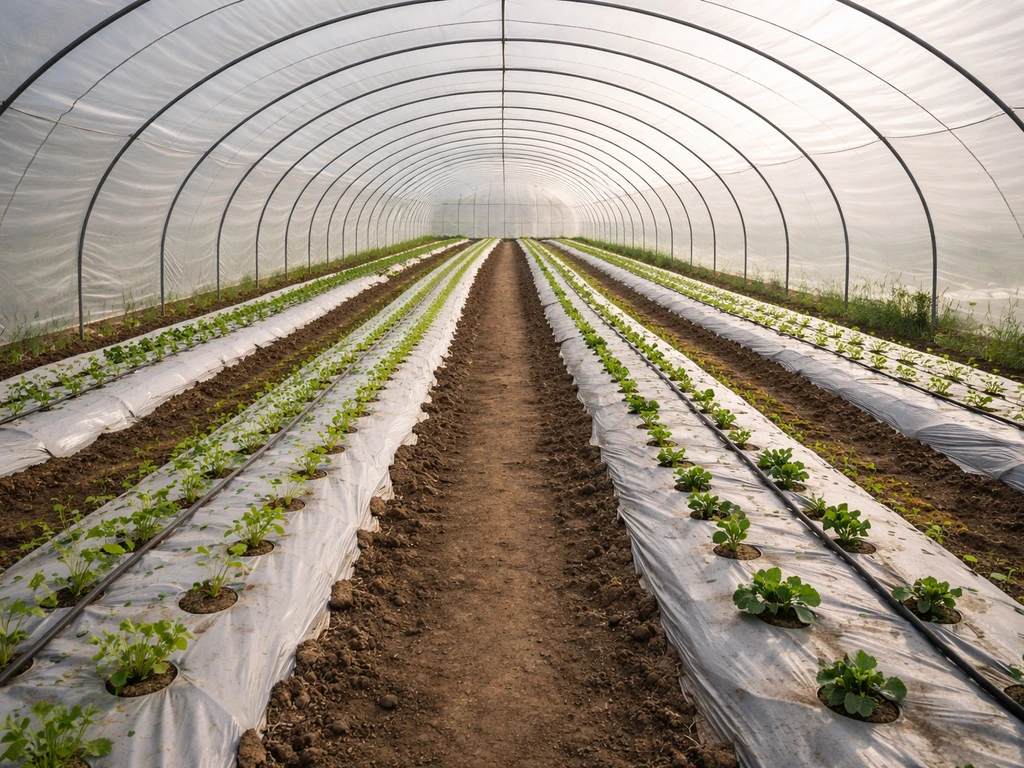
Plasticulture, growing crops under plastic mulch film or low polytunnels, has moved well beyond commercial horticulture into small-scale and peri-urban subsistence systems, particularly in South and East Asia, parts of the Mediterranean, and increasingly in Sub-Saharan Africa. Smallholders use plastic mulch primarily for vegetable crops such as tomatoes, peppers, strawberries, cucumbers, and leafy greens. The plastic retains soil moisture, reduces weed pressure, and extends the growing season into cooler months, which is exactly what time-constrained, resource-limited households need from a simple technology. This intersects with the broader topic of what farmers grow under plastic, which follows different economics at commercial scale but similar crop choices.
Cover crops and soil-building plants
Subsistence farmers in more knowledge-intensive or aid-supported systems sometimes incorporate cover crops between main-crop seasons to protect and enrich soil. Leguminous cover crops like mucuna (velvet bean), lablab, and sunn hemp are used in parts of Africa and Latin America to suppress weeds and fix nitrogen before the planting season. Phacelia, a flowering cover crop well known in European and North American small-farm systems, attracts beneficial insects and suppresses weeds, though it is less common in tropical subsistence systems. Understanding why farmers choose specific cover crops, including phacelia, connects to a different set of soil management goals covered in related site guides.
How many crops does a subsistence household grow in a year?
A typical subsistence household in a tropical or subtropical environment grows anywhere from 5 to 15 distinct crop species across a year when you count all field crops, kitchen garden vegetables, and perennial fruits and trees together. In shifting cultivation systems with diverse intercropped plots, the number can be considerably higher; swidden plots in the Amazon and Southeast Asia may contain 20 to 40 plant species in a single garden at peak diversity. The idea that subsistence farming means monoculture is wrong: the opposite is usually true. Diversity is the risk management tool, and smallholders are deliberately cultivating multiple crops for exactly that reason. For a more detailed look at seasonal cycles and how many crops fit into a single year, a dedicated guide on this site explores annual cropping patterns and crop rotation logic in depth.
Why these specific crops and not others
Every crop on a subsistence plot is there for a reason. The selection criteria are practical and overlap with each other in ways that make the final crop mix feel almost inevitable once you understand the local conditions.
- Caloric density: staple cereals and tubers are chosen because they deliver the most energy per unit of land and labor
- Climate fit: drought-tolerant crops (cassava, sorghum, cowpea) dominate dryland areas; water-demanding crops (rice, taro) dominate wet systems
- Storage quality: grains and dried legumes store for months without refrigeration; this is critical where markets are distant and harvests seasonal
- Labor timing: crops are chosen partly to spread labor demands across the year and avoid competing with the main cereal harvest
- Seed access: farmers grow crops they can save seed from year to year, reducing dependence on markets
- Soil tolerance: cassava on poor sandy soil, taro in wet low-lying areas, potato in frost-prone highlands — each crop fills a niche others cannot
- Nitrogen cycling: legumes are included specifically to maintain soil fertility without purchased fertilizer
- Nutritional balance: the combination of cereal plus legume plus fruit or vegetable is replicated across every region because it delivers a more nutritionally complete diet than any single crop
A simple checklist for identifying what a subsistence farm grows
If you are trying to understand or predict what a subsistence household in a specific location grows, work through these questions. The answers will narrow the crop list quickly.
- What is the dominant climate type? (humid tropical, semi-arid, temperate, highland) This sets the list of viable cereals and tubers immediately.
- What is the rainfall pattern? (single rainy season, double rainy season, year-round rain, winter rainfall) This determines whether double cropping is possible and which crops fit each season.
- What is the altitude? Andean and East African highlands favor potato, barley, and root diversity. Lowland tropics favor cassava, rice, banana, and yam.
- What is the staple cereal of the broader region? Maize in eastern and southern Africa, rice in Asia, wheat-rice in South Asia, sorghum-millet in the Sahel. The household staple almost always matches the regional staple.
- Is there a legume intercropped with the cereal? In Africa, cowpea or groundnut. In Latin America, common bean. In South Asia, lentil or pigeon pea. Almost always yes.
- Is there a root or tuber as a backup? Cassava in the humid tropics, potato in the highlands, sweet potato across tropical Africa and the Pacific.
- What tree crops or perennials are on the homestead? Banana, mango, papaya, coconut, breadfruit, olives, or figs depending on region — these are often multi-generational assets.
- What vegetables are grown near the house? Tomato, onion, pepper, and locally common leafy greens will almost always be present in some form.
Historical patterns behind modern subsistence crops
Many of today's subsistence crop distributions reflect historical movements rather than purely environmental logic. Maize and cassava are both originally from the Americas but now dominate African subsistence farming because Portuguese and other traders introduced them from the 16th century onward. They spread because they fit African tropical conditions and, in cassava's case, outperformed existing crops on poor soils. Sweet potato spread from South America across the Pacific to Papua New Guinea centuries before European contact, following Polynesian trade routes. Wheat spread westward from its origins in the Fertile Crescent with the expansion of early farming civilizations. Understanding these historical pathways helps explain why certain crops appear in regions far from their origins, which is a theme this site explores across its regional crop pages.
FAQ
What are the main categories of crops and livestock subsistence farmers grow worldwide?
Subsistence households typically grow: staples — cereals (maize, rice, wheat, sorghum, millet), roots/tubers (cassava, potato, sweet potato, yam, taro), and starchy fruits (plantain/banana); legumes — common bean, cowpea, pigeon pea, groundnut, chickpea, lentil; vegetables — leafy greens, onions, tomatoes, peppers, cucurbits; fruits and tree crops — banana, mango, citrus, breadfruit, coconut, olive; non‑food plants — fiber (cotton), fuel/wood, medicinal and herbal species; and small livestock — poultry, goats, sheep, pigs, and sometimes cattle for draft/milk. These categories appear in documented smallholder portfolios across regions and climates.
How do staple crops map to major regions and climates?
Typical regional patterns (widely documented): Sub‑Saharan Africa — maize, cassava, sorghum, millet, yam, plantain/banana, cowpea and groundnut; South & Southeast Asia — rice (rainfed and irrigated), maize, pulses, vegetables, tubers in uplands; South Asia (Indo‑Gangetic) — rice (Kharif), wheat (Rabi), potato, legumes, fruit trees; Latin America & Andes — maize and common bean, potato (highlands), cassava (lowlands/Amazon), plantain/banana; Pacific islands — taro, yam, sweet potato, breadfruit, coconut, mixed homegardens; North American Plains — maize, wheat, sorghum and soybean on larger farms; smaller family plots grow vegetables, forage, and keep beef/poultry; Mediterranean / West Asia — winter cereals (wheat, barley), pulses (chickpea, faba bean), olives, grapes, figs, small ruminants. These patterns reflect climate, soil and long‑term cultural practices.
Why do subsistence farmers choose particular crops?
Common, widely documented reasons: climate and agroecology (temperature, rainfall, season length); calorie yield and dietary importance (high‑energy staples like maize, rice, cassava); storage and shelf life (dried cereals, cassava roots or processed forms); soil and input needs (tolerant crops for poor soils or low fertilizer availability); labor requirements and timing (fit household labor calendar and gender roles); seed and planting material access (local varieties, vegetatively propagated crops like cassava/potato); risk management and flexibility (staggered harvests, famine‑reserve crops such as cassava); and market and cultural preferences (taste, ritual crops, saleability).
What cropping systems do subsistence farmers use?
Typical systems: monoculture single cropping (one crop per season on a plot); double/multiple cropping (sequential crops per year, e.g., rice–rice, rice–legume, wheat–vegetable); intercropping/polyculture (maize+bean, sorghum+cowpea, mixed root crops) to diversify diet and reduce risk; relay cropping (sowing a second crop before the first is harvested); shifting cultivation/swidden in humid tropics with polycropping and fallow cycles; agroforestry and homegarden multi‑storey systems combining trees, root crops, vegetables and livestock; and protected/season‑extension systems (plasticulture, low tunnels) in some regions.
What are special practices mentioned in related searches (plasticulture, cover crops like phacelia)?
Plasticulture — use of plastic mulch, polytunnels, low tunnels and row covers to warm soils, conserve moisture, suppress weeds and extend seasons; used by smallholders for vegetables, strawberries and seedlings where plastic is affordable. Cover crops — use of species (e.g., legumes, grasses, or species like phacelia) planted between cash or staple crops to protect soil, fix nitrogen, break pest cycles and provide mulch/green manure; adoption varies but legumes are especially common in smallholder rotations for soil fertility benefits.
How many different crops does a subsistence household commonly grow per year?
Varies by region and system but documented patterns: in many humid‑tropical smallholder and homegarden systems households grow a dozen or more species (staples + vegetables + fruit trees + medicinal plants); in cereal‑based mixed smallholdings 4–8 crop species per year is typical (one or two staples plus legumes, vegetables, and maybe a root crop and trees); Andean houseplots can contain dozens of potato landraces on a single farm. The count depends on land area, labor, diversity goals and agroecological niche.
Next Articles
How Many Crops Do Farmers Grow in a Year by Region
Learn how region, climate, and farm type affect how many crops farmers grow per year, with examples and estimates.
What Do Farmers Grow in Fields? Crops by Region and Climate
What farmers grow in fields varies by climate and soil. See common grain, row, oilseed and forage crops by region and ho
What Do Farmers Grow Under Plastic? Crops by System and Season
Crops grown under plastic by mulch, row covers, tunnels and greenhouses, with season and climate examples plus starter g