Ancient Egyptian farmers grew a surprisingly diverse range of crops, but the core list is manageable and well-documented. The staple cereals were emmer wheat and barley. Beyond those, Egyptians cultivated flax for linen, papyrus as a material crop, broad beans, onions, garlic, lettuce, and a range of herbs including coriander and cumin. Fruits like figs and grapes rounded out the diet. Everything about what they grew, where they grew it, and when they planted it came back to one thing: the Nile.
What Crops Did Ancient Egypt Grow Along the Nile

Samuel Rourke
2 Apr 2026
Why the Nile decided what farmers could grow
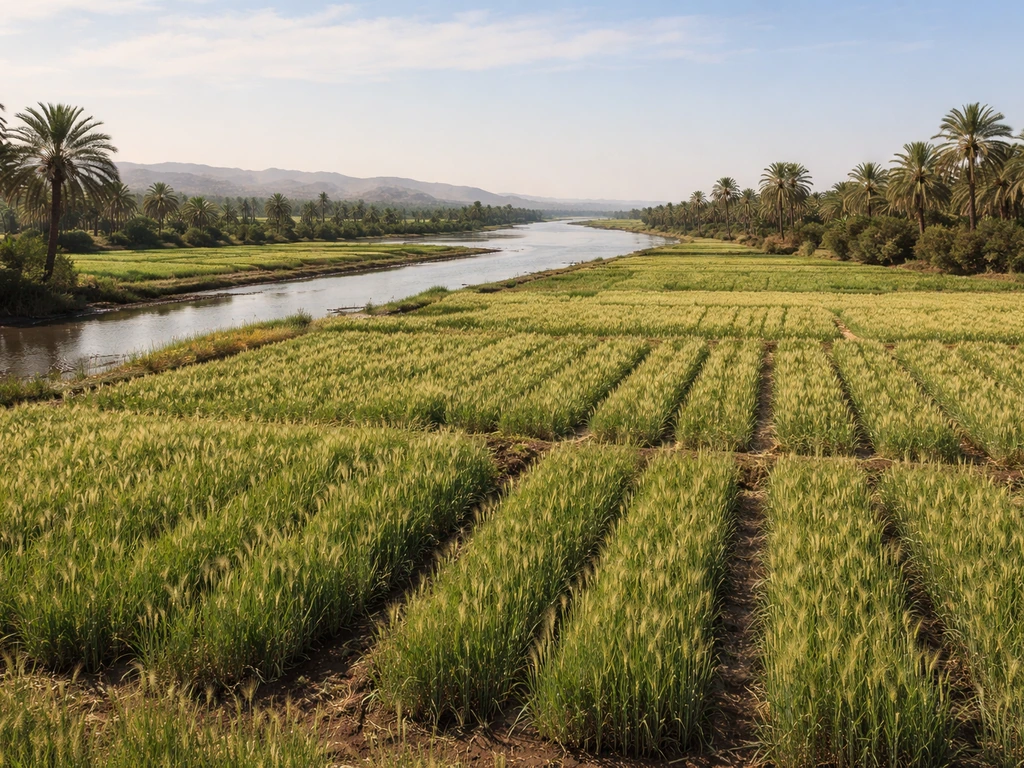
Egypt has almost no rainfall to speak of, especially outside the Delta. Agriculture was possible only because the Nile flooded every year, depositing rich black silt across the floodplain before receding. That annual flood, called the inundation, reset the growing calendar and determined what soil farmers had to work with. This is not a secondary detail. It is the entire foundation of Egyptian crop choices.
Once the floodwaters pulled back (roughly October to November), farmers planted into moist, nutrient-rich soil. Crops were harvested before the next flood arrived. This single-season-dominant cycle pushed farmers toward fast-maturing, flood-tolerant, or flood-cycle-compatible crops. Cereals like emmer wheat and barley fit perfectly. So did flax, legumes, and many vegetables. Irrigation via basin systems and, later, the shaduf (a counterweighted water-lifting tool that appears in Upper Egypt records from around 1500 BC) extended cultivation beyond the immediate floodplain, but the hydrology always set the ceiling on what was feasible.
It is worth noting that this logic still shapes Egyptian agriculture today. The underlying principle, that irrigation replaces rainfall, has not changed. The Aswan High Dam replaced the natural flood with a managed release, but cereals and field crops still dominate because the soil and water conditions that made Egypt's ancient farmland so productive are structurally the same.
Emmer wheat and barley: the crops everything else depended on
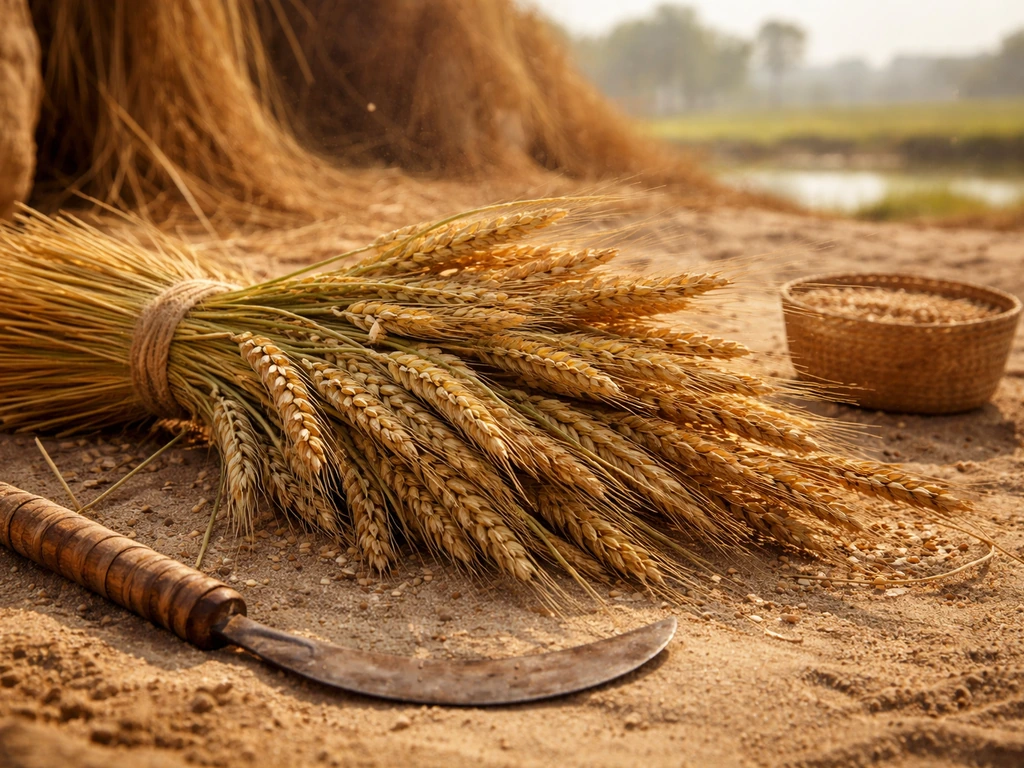
Emmer wheat (Triticum dicoccum) and barley (Hordeum vulgare) were the two crops that held ancient Egyptian civilization together. Bread was the daily staple food, and emmer wheat was the primary grain used to make it. Barley contributed to bread as well but was especially important for beer, which was a daily caloric and social staple, not an occasional drink. Ration records from the workers' village at Deir el-Medina explicitly document grain distributions in emmer and barley, showing how central both crops were even to state-managed labor economies.
Archaeobotanical research has confirmed that barley's role grew over time. In the Nile Delta, barley became increasingly dominant into the early dynastic period, likely because it handles cultivation stress better than emmer under certain soil and water conditions. Genetic analysis of 3,000-year-old emmer wheat samples from museum collections has also confirmed continuous cultivation lineages, reinforcing that these were not occasional crops but deeply entrenched agricultural staples across millennia. Genetic analysis in a blank" rel="noopener noreferrer">3,000-year-old Egyptian emmer wheat genome study found evidence for genetic continuity and gene flow patterns linked to Egyptian cultivation history. If you want to understand what the ancient Egyptians grew at its most fundamental level, start with these two cereals.
Legumes, vegetables, and everyday garden crops
Beyond the cereal fields, Egyptian farmers grew a solid roster of vegetables and legumes. Broad beans were a major protein source. Onions, garlic, lettuce, radishes, and parsley all appear in the archaeobotanical and documentary record. These plants show up in medical papyri, tomb art, and preserved plant remains, which is a useful reminder that when multiple evidence types point to the same crop, the identification is on solid footing.
Vegetables were typically grown in garden plots rather than open fields, often irrigated more deliberately than the flood-dependent cereal fields. This distinction matters for understanding land use: Egyptian agriculture was not one uniform system but a layered one, with large cereal fields dominating the floodplain and smaller, intensively managed kitchen and market gardens sitting closer to settlements and water sources. Comparing this approach to what crops Mesopotamia grew is instructive, since both river-valley civilizations developed similarly tiered agricultural systems around their respective flood regimes.
Flax, papyrus, and the crops that kept Egypt running economically
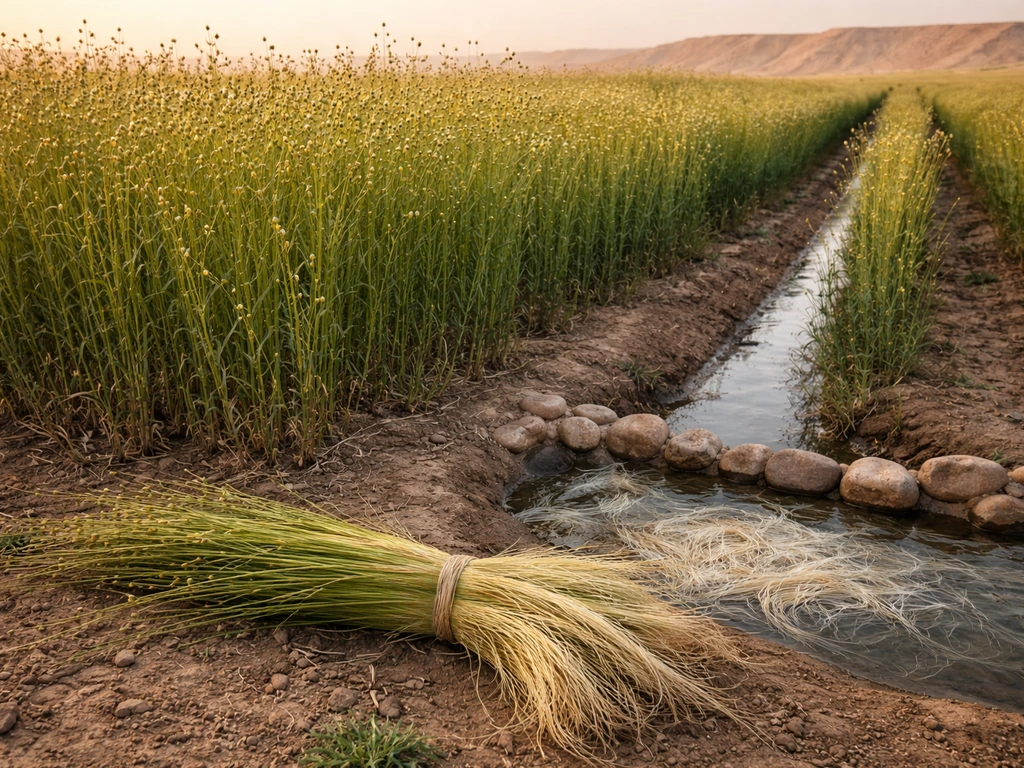
Two non-food crops were as economically critical as the cereals: flax and papyrus. Flax (Linum usitatissimum) was Egypt's primary fiber crop. It was harvested to produce linen, which was used for clothing, wrappings, and trade. Flax needs water, rich soil, and frequent weeding, so it was well-suited to the irrigated Nile floodplain. Egyptian farmers typically harvested flax while still green, before full seed maturity, to maximize fiber quality. This is well-documented in tomb depictions and later confirmed by textile analysis, including studies of 4,000-year-old Egyptian flax yarn.
Flax cultivation was so specialized and regionally embedded that later administrative papyri, like the Aphrodito papyri from late antique Egypt, show specific towns in northern Egypt closely associated with flax and linen production. This kind of regional specialization almost certainly has older roots. If you are trying to trace fiber agriculture across the ancient Mediterranean world, you will find what crops ancient Greece grew draws on some of the same fiber crop traditions.
Papyrus (Cyperus papyrus) was the other major non-food crop, though it was more harvested from natural stands along the Nile margins than cultivated in tilled fields. Its inner pith was processed into sheets that became the ancient world's primary writing surface. Papyrus was both a domestic product and an export commodity, making it one of the most economically significant plants in the ancient world despite not being a food crop. Understanding it as a managed resource rather than a purely wild plant is important for accurately mapping ancient Egyptian land use.
Fruits, herbs, and the specialty side of Egyptian farming
The sycamore fig (Ficus sycomorus) was the most culturally and agriculturally significant fruit tree in ancient Egypt. It appears repeatedly in tomb-garden scenes, often associated with the afterlife and divine provision. Beyond its ritual role, it was a real food source. Figs also appear in archaeobotanical assemblages from Upper Egyptian sites, particularly in Predynastic and early dynastic contexts.
Grapes were grown for wine, especially in the Delta and in oasis regions. Date palms were cultivated throughout the Nile Valley. Pomegranates and watermelons also appear in the record from the New Kingdom period onward. Herbs were another important category: coriander, cumin, and fennel appear frequently in Egyptian medical and culinary contexts, most famously through the Ebers Papyrus tradition, which links named plants to specific medicinal uses.
These herbal crops occupied a space between the kitchen garden and the medicine chest, and their cultivation was probably more widespread than the limited documentary record suggests. The way Egyptians used these plants shares interesting parallels with what crops ancient India grew, where herbs were similarly embedded in both food and medical traditions.
A quick inventory of the major crop categories
| Crop Category | Key Examples | Primary Use |
|---|---|---|
| Staple Cereals | Emmer wheat, barley | Bread, beer, rations |
| Legumes | Broad beans | Protein, food |
| Vegetables | Onion, garlic, lettuce, radish, parsley | Food, medicine |
| Fiber Crops | Flax | Linen textiles, trade |
| Material/Cash Crops | Papyrus | Writing surface, export |
| Fruit Trees | Sycamore fig, date palm, grapevine | Food, wine, ritual |
| Herbs/Spices | Coriander, cumin, fennel | Culinary, medicinal |
Upper vs. Lower Egypt: not every crop grew everywhere
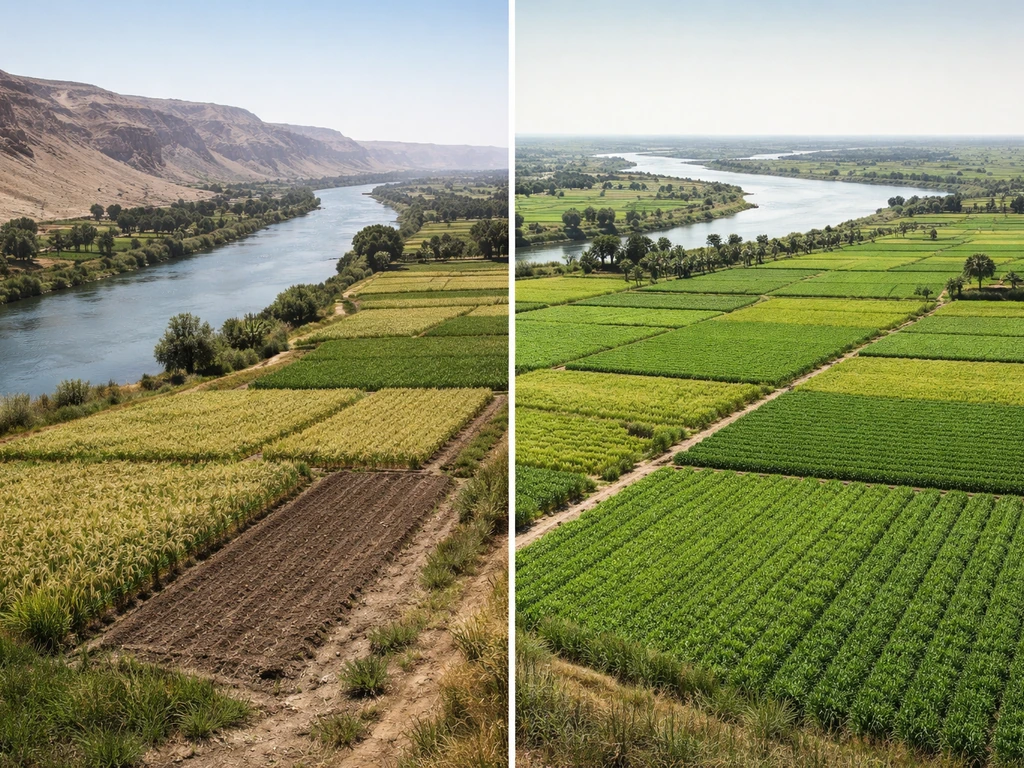
Egypt is not geographically uniform, and crop patterns reflected that. Upper Egypt is the narrow Nile Valley stretching from Aswan northward, with a thin floodplain bordered by desert. Lower Egypt is the broad Nile Delta, where the river fans out into multiple channels before reaching the Mediterranean. These two zones had meaningfully different soil types, water availability, and salinity profiles, which influenced what grew best where.
Barley in particular seems to have had regional varieties. Philological scholarship has identified distinct Egyptian terms for Upper Egyptian barley (šmꜣw) and Lower Egyptian barley (m/:lj), suggesting that regional crop differentiation was recognized administratively and agriculturally. The Delta's heavier, wetter soils and proximity to the sea introduced salinity challenges that barley, being more salt-tolerant than emmer, could handle better. This is one reason archaeobotanical evidence shows barley becoming increasingly dominant in Delta assemblages over time.
Upper Egypt's narrower, better-drained floodplain was more suited to emmer wheat and flax, especially in areas where irrigation could be carefully managed. Specialty crops like grapes and certain fruits tended to cluster in protected garden spaces, walled enclosures near temples or elite estates, or in the western oases where conditions were distinct from the main Nile Valley. This regional differentiation is something you see in other ancient river-valley civilizations too. For comparison, what crops the Mesopotamians grew shows similar north-south and upland-lowland splits driven by water availability and soil salinity.
The irrigation infrastructure also differed between regions. Basin irrigation, where floodwaters were trapped behind earthen embankments and allowed to soak into fields, was the dominant system across the Nile Valley. Canal networks became increasingly sophisticated over time. The shaduf, used to lift water manually for small garden plots and orchards, was more practical in locations where the flood did not reach directly. Understanding these water-delivery systems is key to understanding which crops were feasible in which zones, because without water, Egypt grows almost nothing.
How to verify a crop list and go deeper on the research
Ancient Egyptian crop identification is actually better-documented than most ancient civilizations because Egypt's dry climate preserves evidence that would rot away almost anywhere else. Papyri, botanical remains, and tomb paintings all survive, and together they form a triangulated evidence base that researchers use to confirm crop identifications. A claim that Egyptians grew a specific crop is most reliable when it is supported by at least two of these three evidence types: administrative texts, archaeobotanical plant remains, and tomb art or visual depictions.
For cereals, look for studies that link Egyptian crop terms to modern botanical identifications and combine them with archaeobotanical site data from places like Giza, Tell el-Iswid in the Delta, or Deir el-Medina. Searches pairing terms like 'emmer' or 'barley' with site names and period labels will get you into real scholarship quickly.
For administrative crop-land patterns by region and time period, two key primary documents to know are the Wilbour Papyrus (a land and plot ledger from the Ramesside period used to reconstruct regional crop assignments) and the Heqanakht Papyri (Middle Kingdom household accounts that reveal land use and crop obligations at a granular level).
Scholars also treat the blank" rel="noopener noreferrer">Wilbour Papyrus as a major Ramesside-period land and plot record, useful for reconstructing how Egyptian landholding and administration related to crop and obligation patterns Wilbour Papyrus (a land and plot ledger from the Ramesside period used to reconstruct regional crop assignments). Cross-checking those texts against archaeobotanical assemblages from the same region and period gives you the most defensible picture.
For vegetable and herb identifications, the Ebers Papyrus tradition is a useful starting point, but verify that scholarly sources explicitly connect a plant name in the papyrus to a confirmed botanical identification rather than later folk attribution. For fiber and specialty crops, peer-reviewed textile and archaeobotany journals are more reliable than general references. Searching for 'flax capsules Egypt,' 'linen ancient Egypt archaeobotany,' or 'Aphrodito papyri flax' will get you into specialist literature fast.
One practical note: crop lists that appear on general history websites often compress or oversimplify. If a source lists crops without specifying time period (Predynastic vs. Old Kingdom vs. New Kingdom) or region (Delta vs.
Upper Nile Valley), treat it as a rough guide only. Crop patterns shifted over time. Barley's dominance in the Delta grew during the early dynastic period. New fruits like pomegranate arrived during the New Kingdom.
The story is not static, and the best sources will reflect that. For a broader comparative perspective on how ancient farming evolved across regions in the same era, it is useful to look at what crops were grown in the Neolithic age, since several of Egypt's core crops have deep prehistoric roots in the same broad agricultural transition.
If you are comparing Egypt to its neighbors and want to understand whether crop choices were regionally unique or part of a broader ancient Near Eastern agricultural complex, examining what crops the Sumerians grew is a natural next step. Emmer wheat and barley, for instance, were staple cereals across the entire ancient Near East, not just Egypt, which tells you something important about both the shared origins of these crops and the independent agricultural logic that made them the right choice in different river-valley environments.
FAQ
Were the crops the same in all periods of Ancient Egypt (Old Kingdom, Middle Kingdom, New Kingdom)?
Not exactly. Staples like emmer wheat and barley stayed core, but some crops shifted in importance by region and time. For example, barley becomes more dominant in the Delta into the early dynastic period, and New Kingdom records show additional fruits such as pomegranate appearing later rather than from the start.
Did Ancient Egyptians grow rice or maize (corn)?
No. Those crops are not part of the long-established Nile farming set described in the archaeological and textual record for Pharaonic Egypt. The main field-crop system centered on cereals like emmer wheat and barley, with legumes, flax, and garden vegetables.
How much of Egyptian farming was actually in open fields versus gardens?
A lot of the productive floodplain was organized into large cereal-growing areas, but many vegetables and herbs were managed in smaller garden plots closer to settlements and water sources. If you are comparing yields or land use, treat cereals and “kitchen garden” crops as different production systems.
Why did Egypt mostly grow “fast” crops after the Nile flood?
Because the growing window closed when floodwaters returned. Planting into receding inundation moisture meant farmers had to harvest before the next flood cycle, favoring crop choices that could mature quickly and tolerate flood-cycle conditions rather than relying on long, rainfall-style seasons.
Was barley always a major crop, or did it change over time and place?
It changed. Barley’s role increased over time, especially in the Delta where it handled stressors such as salinity better than emmer under some conditions. That regional advantage helps explain why Delta assemblages trend toward barley dominance.
Were flax and papyrus grown as normal field crops?
Flax was cultivated as a planned fiber crop, but papyrus was more often harvested from natural stands along Nile margins than from tilled fields. That difference affects how you picture land use, labor, and water management for the two non-food plants.
What crop did most Egyptians eat daily, bread aside?
Emmer wheat was the primary grain for daily bread, barley also contributed to bread, and barley was especially important for beer. Even when people think of “bread,” the diet was tied to a mixed cereal system that supported everyday calories and work routines.
Did Egyptians have fruit orchards, or was fruit mostly wild-gathered?
Many fruits were grown, but the record also includes wild or managed resources. The sycamore fig is a standout because it appears in tomb-garden scenes and also shows up in archaeobotanical remains in early contexts, indicating both cultural importance and real agricultural presence.
How can I verify a claim about a specific crop in Ancient Egypt?
Look for at least two independent evidence types matching the same crop and period, such as administrative texts plus archaeobotanical remains, or tomb imagery plus botanical remains. Egypt’s dry preservation helps, but the strongest identifications still triangulate across sources.
If I find a simple crop list online, how should I treat it?
Use it only as a rough starting point. Crop choices shifted by time period and by region (Delta versus Upper Egypt), so a list that ignores chronology and geography will likely blur important changes like later introductions or regional crop dominance.
Next Articles
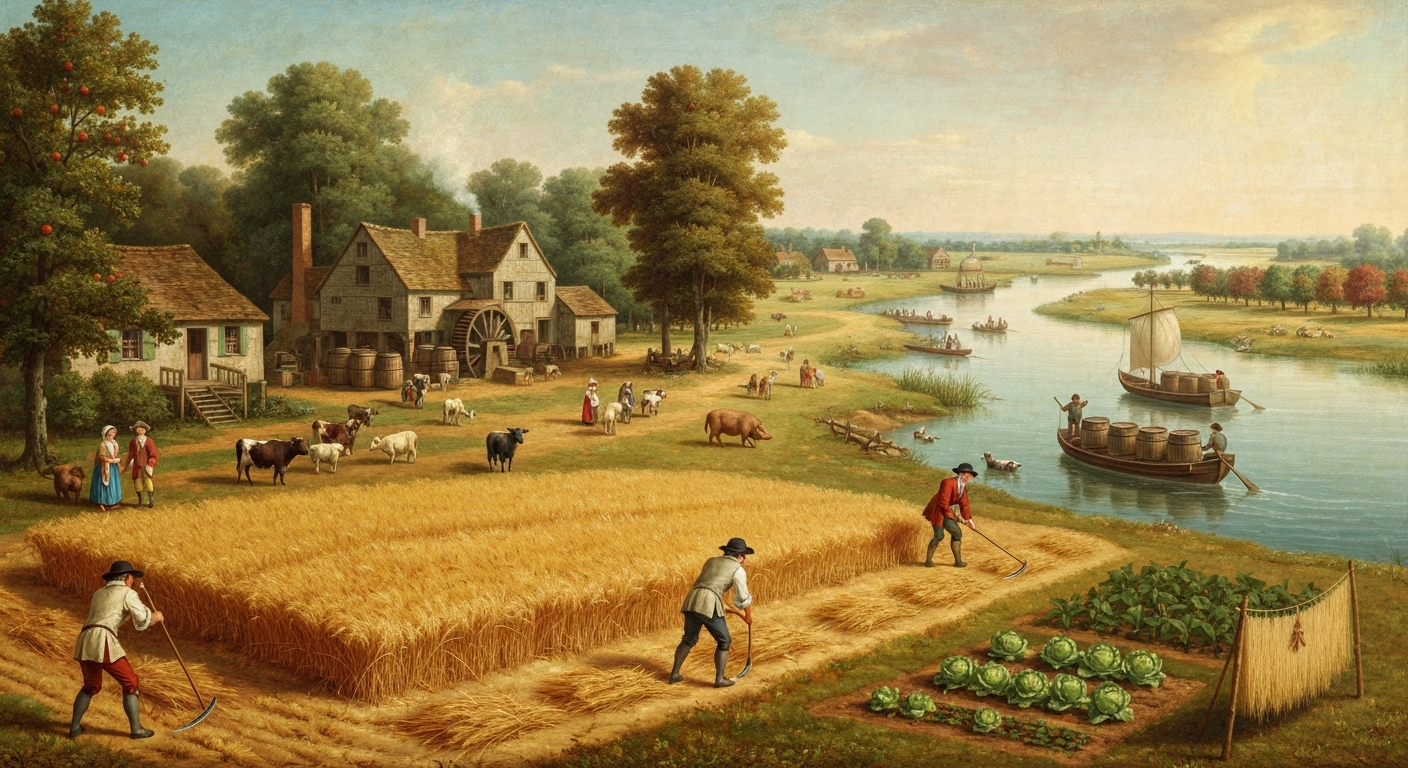
What Did the Delaware Colony Grow: Crops, Uses & Legacy
Colonial Delaware’s main crops, grains, hay, flax, fruits, vegetables, livestock, why they thrived and how they were sold.
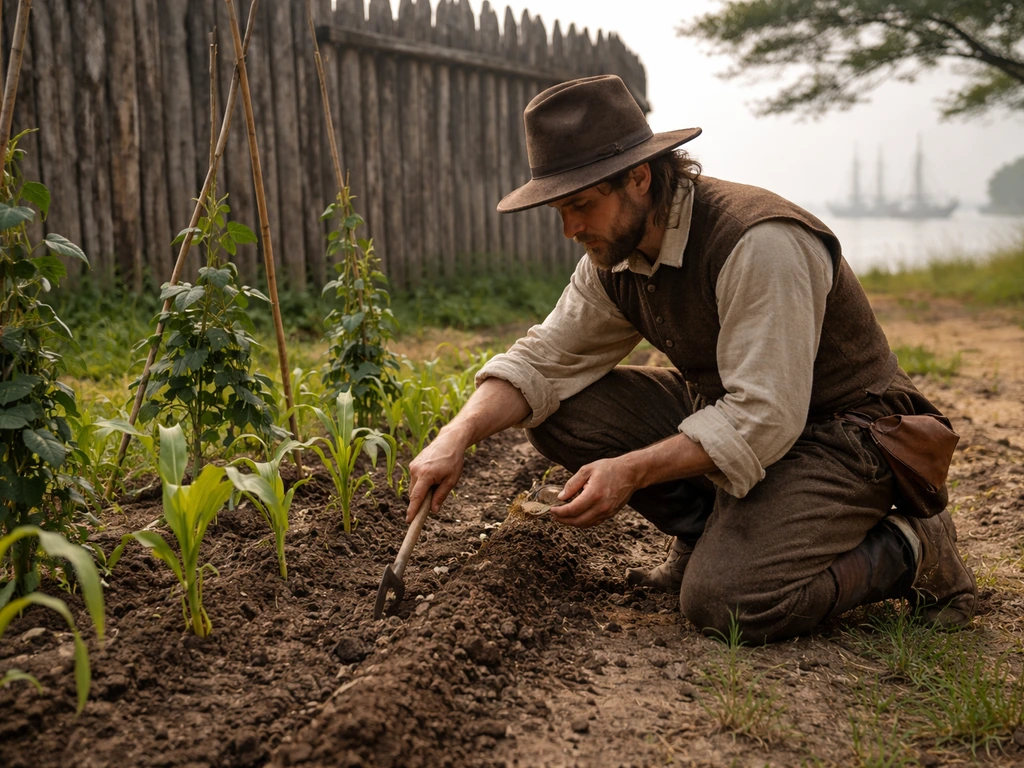
What Did Jamestown Grow and How They Farmed It
Learn what Jamestown colonists grew and the methods they used to plant, harvest, and adapt crops to Virginia conditions.
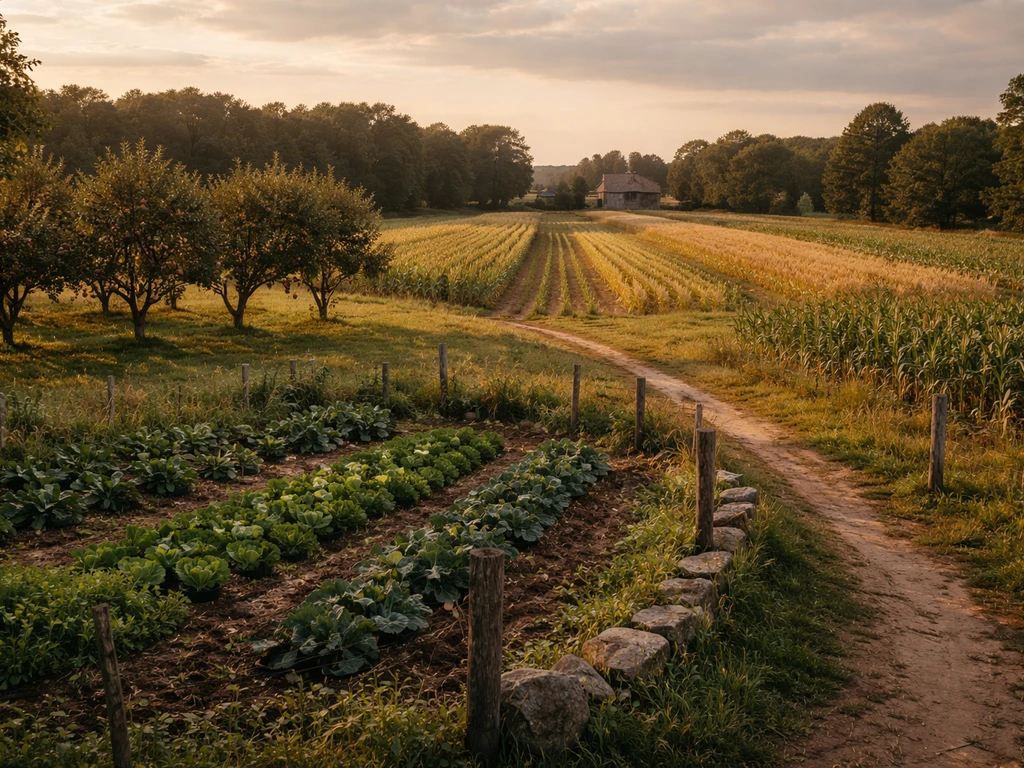
What Did the New England Colonies Grow? Major Crops
Major New England colonial crops explained by climate and soil, from corn and wheat to beans and hay, plus today’s paral